Novelhalla
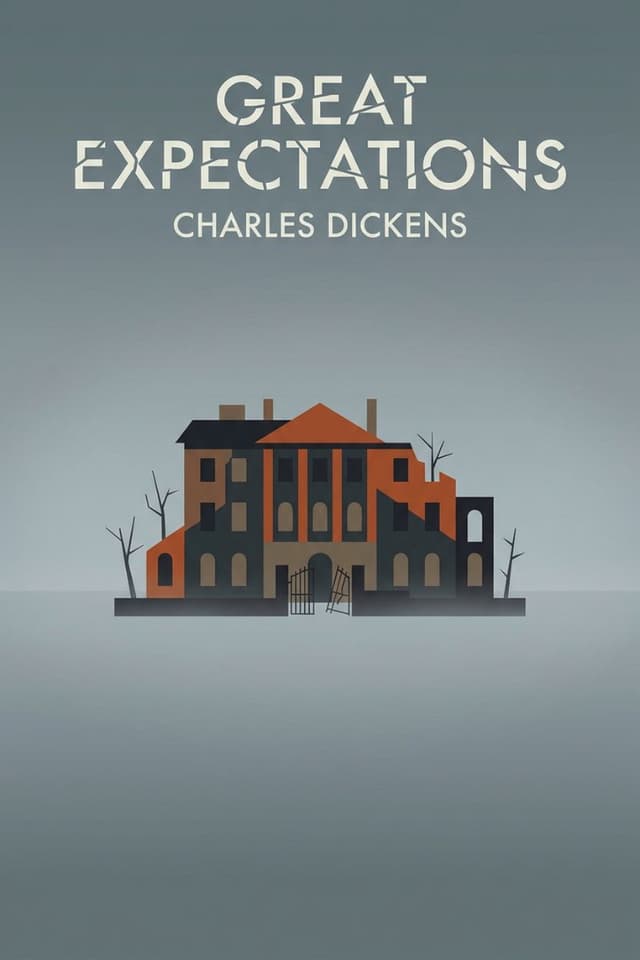
Great Expectations
Read Great Expectations by Charles Dickens for free on Novelhalla, and try out our easy-to-read modern edition of this classic book. You can also download the EPUB and read it on any device if you prefer!
The Plot
Great Expectations is a coming-of-age novel following Philip Pirrip, known as Pip, from his childhood in the marshlands of Kent through his attempts to become a gentleman in London.
The Boy on the Marshes
The story opens in a graveyard on the bleak Kent marshes, where the young orphan Pip is visiting his parents' graves. An escaped convict bursts from among the tombstones, grabs Pip by the throat, and demands food and a file to remove his leg iron. Terrified, Pip steals provisions from his sister's pantry and a file from his brother-in-law Joe Gargery's forge. The convict is soon recaptured along with another escapee with whom he had been fighting, but Pip's brief encounter with the criminal will shape his entire life in ways he cannot imagine.
Pip lives with his much older sister, Mrs. Joe, a harsh woman who reminds him constantly that she raised him "by hand." Her husband Joe Gargery, the village blacksmith, is Pip's true friend and protector, a gentle man of simple kindness who shields Pip from his sister's temper as best he can.
Satis House
Pip's life changes when he is summoned to Satis House to play for Miss Havisham, a wealthy recluse who has not left her decaying mansion in years. She wears a faded wedding dress and sits among the rotting remains of her wedding breakfast, all the clocks stopped at twenty minutes to nine, the exact moment she learned her fiance had abandoned her on their wedding day.
There Pip meets Estella, Miss Havisham's beautiful young ward, who has been raised to break men's hearts as revenge for Miss Havisham's own suffering. Estella treats Pip with contempt, mocking his coarse hands and common boots. Pip falls hopelessly in love with her and becomes ashamed of his humble origins for the first time.
Great Expectations
Years later, after Pip has been apprenticed to Joe as a blacksmith, a London lawyer named Mr. Jaggers arrives with astonishing news: an anonymous benefactor has provided for Pip to become a gentleman. He will move to London, receive an education, and inherit a fortune when he comes of age. The only conditions are that he keep the name Pip and never seek to learn his benefactor's identity.
Pip assumes Miss Havisham is behind his good fortune and that she intends him to marry Estella. In London, he studies with Matthew Pocket and becomes close friends with Matthew's son Herbert, a cheerful young man Pip once fought at Satis House as a boy. Pip also encounters Jaggers's clerk Wemmick, who lives a double life: all business at the office but warm and whimsical at home in his tiny castle complete with moat and drawbridge.
As Pip rises in society, he grows ashamed of Joe and his humble origins. He avoids the forge and treats his old friends with embarrassed condescension, becoming the very snob Estella accused him of not being.
About the Author: Charles Dickens
Early Life
Charles John Huffam Dickens was born on February 7, 1812, in Portsmouth, England, the second of eight children. His father John was a clerk in the Navy Pay Office, charming but financially reckless. The family moved frequently during Charles's childhood, settling for a happy period in Chatham, Kent, where he received some schooling and developed a love of reading.
The Blacking Factory
When Dickens was twelve, his father was arrested for debt and sent to Marshalsea Prison, where the rest of the family soon joined him. Charles was sent to work at Warren's Blacking Warehouse, pasting labels on pots of shoe polish for six shillings a week. The work was degrading, the conditions miserable, and the sensitive boy who had dreamed of becoming a gentleman found himself laboring alongside common children in a rat-infested factory.
Though the experience lasted less than a year, it scarred Dickens for life. He never forgot the humiliation and abandonment he felt, and these memories fueled his later campaigns for social reform and his sympathy for the poor. He kept the episode secret even from his wife and children; it only became public after his death when his biographer John Forster revealed it.
What wounded Dickens most was his mother's response when his father, freed from prison after receiving a small inheritance, wanted to remove Charles from the factory. Elizabeth Dickens argued that her son should continue working. Dickens later wrote: "I never afterwards forgot, I never shall forget, I never can forget, that my mother was warm for my being sent back."
Rise to Fame
After a brief return to school, Dickens worked as a law clerk and taught himself shorthand, becoming a court reporter and then a parliamentary journalist. In 1833 he began publishing sketches and stories under the pen name "Boz." His first novel, The Pickwick Papers, began appearing in monthly installments in 1836 and became a sensation, transforming the unknown journalist into the most popular author in England almost overnight.
Literary Career
Dickens went on to write fifteen novels, including Oliver Twist, David Copperfield, Bleak House, A Tale of Two Cities, and Great Expectations. Most were published in serial form, either monthly or weekly, a format that allowed him to adjust his stories based on reader response and kept the public eagerly awaiting each new installment.
In 1859 Dickens founded his own weekly magazine, All the Year Round, which he edited until his death. He was also famous for his dramatic public readings, theatrical productions, and tireless charitable work. His personal life was less successful: his marriage to Catherine Hogarth produced ten children but ended in separation in 1858 amid rumors of his attachment to a young actress named Ellen Ternan.
Death
Dickens died of a stroke on June 9, 1870, at age 58, leaving his final novel, The Mystery of Edwin Drood, unfinished. Despite his wish for a modest funeral, he was buried in Poets' Corner at Westminster Abbey. The epitaph on his tomb reads: "He was a sympathiser with the poor, the suffering, and the oppressed; and by his death, one of England's greatest writers is lost to the world."
Fun Facts About the Book
Written to Save a Magazine
Dickens originally planned Great Expectations as a longer work in monthly parts. But when sales of his magazine All the Year Round began falling due to an unpopular serial by Charles Lever, Dickens adapted his new novel to weekly installments to rescue the publication. The constraint produced one of his tightest, most focused novels.
The Changed Ending
Dickens originally wrote a bleaker ending in which Pip briefly encounters a remarried Estella on a London street and they part forever. After showing the proofs to his friend Edward Bulwer-Lytton, author of The Last Days of Pompeii, Dickens rewrote the conclusion to leave open the possibility that Pip and Estella might finally be together. The original ending appears in most modern editions as an appendix, and critics have debated ever since which version better suits the novel.
Hired a Steamer for Research
To ensure accuracy in describing Magwitch's attempted escape down the Thames, Dickens hired a steamer and took a party of friends from Blackwall to Southend. Though he appeared to be hosting a pleasure cruise, his mind was working on every detail of the river journey that would appear in the novel.
No Illustrations
Great Expectations and Hard Times are the only two Dickens novels that were not illustrated in their first book editions. The weekly format of All the Year Round did not include illustrations, and when the novel appeared in three volumes, Dickens chose not to add any.
Autobiographical Echoes
Like Pip, the young Dickens dreamed of becoming a gentleman and felt ashamed of his humble circumstances. The novel's exploration of class shame and social ambition drew directly from Dickens's own childhood trauma, though readers at the time had no idea of the connection.
Miss Havisham's Inspirations
Several real jilted brides have been proposed as inspirations for Miss Havisham, including an Australian recluse named Eliza Emily Donnithorne and an English woman named Elizabeth Parker. However, scholars have found no definitive evidence linking any specific person to the character. Dickens may have drawn on multiple sources, including a minor novelist named James Payn who claimed to have given Dickens the idea from "a living original of his acquaintance."
Satis House
The name of Miss Havisham's mansion comes from the Latin word for "enough." The irony is deliberate: nothing is ever enough for Miss Havisham, who can never be satisfied by any amount of revenge.
George Bernard Shaw's Praise
Shaw called Great Expectations Dickens's "most compactly perfect book" and praised it as "all of one piece and consistently truthful." George Orwell wrote that "psychologically the latter part of Great Expectations is about the best thing Dickens ever did."
The Clocks Stopped at Twenty to Nine
Miss Havisham stopped all the clocks in Satis House at the moment she received the letter telling her she had been jilted. The time, twenty minutes to nine, becomes a symbol of her frozen existence, her refusal to move beyond the moment of her heartbreak.
Themes
Class and Social Ambition
Great Expectations is fundamentally about the desire to rise in society and the moral cost of that ambition. Pip's "expectations" lead him to become ashamed of Joe and his origins, to treat his truest friends with condescension, and to pursue a cold woman who can never love him. Only when he loses everything does he understand what really matters.
Crime and Guilt
The novel is shadowed by crime from its opening scene. Pip's small act of theft to help the convict haunts him with guilt, while larger crimes, including fraud, attempted murder, and child abuse, connect the characters in unexpected ways. The criminal underworld and respectable society prove far more intertwined than they appear.
The Nature of a Gentleman
What makes a true gentleman? Pip believes it means wealth, education, and social position. But Joe Gargery, the humble blacksmith who never loses his kindness or integrity, proves more of a gentleman than the educated snobs Pip encounters in London. The novel suggests that character matters more than class.
Identity and Self-Knowledge
Pip spends the novel discovering who he really is and where he came from. The mystery of his benefactor's identity parallels his own journey toward self-understanding. Only when he learns the truth about his "expectations" can he begin to become the person he was meant to be.
Love and Manipulation
Miss Havisham raises Estella to be incapable of love as an instrument of revenge, not realizing that she destroys Estella in the process. Pip's obsessive love for Estella blinds him to her warnings and to the genuine affection offered by Biddy. The novel shows how love can be twisted into a weapon and how self-deception fuels romantic obsession.
Redemption and Forgiveness
Despite its dark elements, Great Expectations ultimately offers hope. Characters who have done wrong can recognize their mistakes and seek forgiveness. Miss Havisham repents her cruelty. Pip learns humility. Even the convict Magwitch shows himself capable of loyalty and generosity. The novel suggests that it is never too late to change.
The Book's Legacy
Great Expectations is considered one of Dickens's finest achievements, praised for its tight construction, psychological depth, and unforgettable characters. Miss Havisham in her rotting wedding dress has become one of the most iconic images in English literature, referenced and parodied countless times.
The novel has been adapted for film, television, and stage more than a dozen times. David Lean's 1946 film version is considered a classic, and its atmospheric portrayal of Miss Havisham influenced later works including Sunset Boulevard and What Ever Happened to Baby Jane?
Great Expectations continues to resonate because its themes remain relevant: the desire to improve oneself, the shame of one's origins, the blindness of romantic obsession, and the ultimate importance of loyalty and love over wealth and status. Pip's journey from snobbery to humility speaks to anyone who has ever been tempted to forget where they came from.