Novelhalla
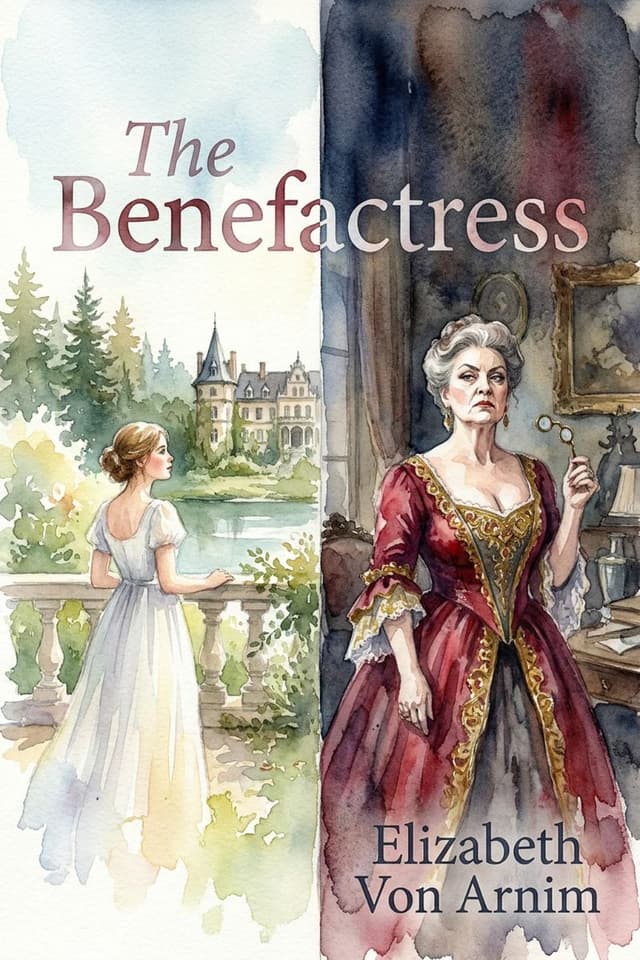
The Benefactress
Read The Benefactress by Elizabeth Von Arnim for free on Novelhalla, and try out our easy-to-read modern edition of this classic book. You can also download the EPUB and read it on any device if you prefer!
The Plot
A Wonderful Thing Happens
When Anna Estcourt was twenty-five, and had begun to wonder whether the pleasure extractable from life at all counterbalanced the bother of it, a wonderful thing happened. Before we get to the wonderful thing, though, you need to know what her life looks like. Anna is beautiful, well bred, and completely broke. Her parents are dead, and she lives with her brother, Sir Peter, and his wife Susie, a rich, pushy woman from new money who has spent years dragging Anna through London society and lining up suitable husbands for her. Anna turns down every proposal and scoffs at the idea of relying on a man for support and comfort. What she wants is independence, which she assumes she'll never get.
Then, out of nowhere, Uncle Joachim, her mother's brother, leaves her a handsome property in Germany. He had sons of his own, but he left the estate to Anna anyway. She now has land, a house, and an income, and she's free for the first time in her life.
A House Among the Pines
The estate sits in a remote corner of Pomerania near the Baltic coast. It isn't a fairy-tale castle. It's a low, white, two-storied house, separated from the forest only by a circular grass plot and a ditch, alone among the creaking pines. Anna loves it immediately. The locals are another matter. Her German isn't great, the farmworkers and the estate overseer don't know what to make of an English lady who has suddenly become their boss, and she has no idea how to run a farm.
She does make a couple of allies. The parson, Herr Manske, is kind, and her neighbour, Axel von Lohm, was a friend of Uncle Joachim and feels protective towards his niece. Axel is the only other gentleman for miles, and he's quiet, sensible, and lonely in a way Anna doesn't notice at first.
The Grand Plan
Anna doesn't want to keep her good luck to herself. She remembers how it felt to be dependent and powerless, and she decides to share her freedom. She wants to help other women who need independence and to invite twelve of them to share her home. Well-born ladies who've fallen on hard times will live with her as sisters, free from worry and free from the men and relatives who've let them down. Axel warns her it's a bad idea. Anna, full of enthusiasm, doesn't want to hear it.
The ad goes out, and the replies pour in. She starts with three. Frau von Treumann and Baroness Elmreich are snobbish women who look down on the third member of their company, Fräulein Kuhräuber. All three are ill at ease, suspicious of Anna's motives, and disapproving of her manners, her clothes, and everything else about her. Two of them seem to be hiding something about their pasts, too.
Everyone Has a Plan for Anna
Meanwhile, plenty of people have decided that a pretty young heiress living alone in the country really needs a husband. Frau von Treumann thinks her son Karlchen would be a perfect match. Anna's teenage niece Letty shows up and starts meddling, and before long a young curate imagines himself in love with Anna and believes she returns his feelings. And then there's Axel, who keeps giving advice nobody asked for and keeps being right.
Anna came to Germany to be independent and to make other women happy. Running a house full of resentful guests, a farm full of suspicious workers, and a neighbourhood full of would-be matchmakers is turning out to be a project which takes a far greater physical and emotional toll than she could have imagined. Trouble is building under the surface at the estate, and before long Anna will have to decide whether her dream of independence is worth what it's costing her, and what she really feels about the man next door.
About the Author: Elizabeth von Arnim
Early Life
Elizabeth von Arnim was born Mary Annette Beauchamp on August 31, 1866, in Sydney, Australia. She was the youngest of six children and went by the nickname May. Her family moved to London when she was very young, and she grew up there, going to private schools and later the Royal College of Music. She mainly studied the organ. She was a cousin of the New Zealand-born writer Katherine Mansfield.
Countess in Pomerania
In 1891 she married Count Henning August von Arnim-Schlagenthin, a German aristocrat. At first they lived in Berlin, and in 1896 they moved to the family estate at Nassenheide in Pomerania (now Rzędziny in Poland). Country life there gave her the material for her first book. She published the semi-autobiographical Elizabeth and Her German Garden (1898) under just the name "Elizabeth." Over time, that literary persona took over, and even her friends and family started calling her Elizabeth. The book was a huge success, and she followed it quickly with more, including this one.
Upheaval and Reinvention
In 1907 Count von Arnim was jailed for fraud, and in 1908 Elizabeth moved to London with the children. In 1910 money problems forced the sale of Nassenheide, and the Count died later that year. Their five children had tutors who included the writers E. M. Forster and Hugh Walpole. As a widow, she built a chalet in Switzerland and had a three-year affair with H. G. Wells, then married Frank Russell, elder brother of the Nobel Prize-winning philosopher Bertrand Russell. The marriage was a failure, and they separated for good in 1919.
Later Years
She turned that unhappy marriage into fiction. Many people consider Vera (1921), a condemnation of Russell, to be her masterpiece. A month in a castle in Portofino gave her the idea for her next and most enduring novel, The Enchanted April. In the 1930s she lived in London, Switzerland, and at her villa, Le Mas des Roses, in Mougins near Cannes, where she entertained friends and kept writing. She moved to the United States in 1939, when the Second World War began. She died of complications from influenza on February 9, 1941, in Charleston, South Carolina. Her gravestone in England says "Parva sed apta," meaning "Small but appropriate."
Fun Facts About the Book
No Name on the Cover
Elizabeth never signed her early books with her real name. First editions of this novel were published by Macmillan in 1901 and credited only to the author of "Elizabeth and Her German Garden".
An Early Novel
It came out early in her career. Before it, she'd published Elizabeth and Her German Garden, The Solitary Summer (1899), and The April Baby's Book of Tunes (1900). It was one of her first attempts at a full novel with a large cast and a proper plot.
Written From Experience
Anna's new home is close to where Elizabeth actually lived. The house is near Stralsund in northern Germany, the same isolated Baltic region as Nassenheide. Anna's struggles with the language, the farmworkers, and the long northern winters came from Elizabeth's own life as an English-speaking woman on a Pomeranian estate.
A Trial Run for a Classic
Fans of The Enchanted April will spot the family resemblance right away. One book blogger called it "essentially a trial run for The Enchanted April and eerily similar." Both books bring together a group of very different women under one roof, but this one goes somewhere quite different.
A Rare Male Hero
Elizabeth's books usually focus on women, and the men are often comic tyrants. Here, though, one reviewer noted that "this book actually has a male hero – not something typical in her works."
Her Most Serious Early Work
It still has her trademark wit, but it has more drama than readers might expect from her. One reviewer called it the least comic of her books that she had yet read, and said its final act was surprisingly dramatic.
Reviews in 1901
Critics at the time liked it. The New York Mail and Express called it "bright, humorous, full of life and action, and with many a shrewd observation on life and man".
Themes
The Trouble With Doing Good
The novel asks a hard question: can you make someone happy just by giving them things? Anna's generosity is real, but her guests don't see it as a gift. One reviewer put it this way: they see it as little less than their due, and certainly don't show much gratitude. Elizabeth looks at charity, pride, and resentment with a sharp but sympathetic eye.
Independence and Its Price
Anna has dreamed of freedom for years, and now she has it. But the book also shows how lonely and heavy freedom can be. Anna dreamed for years of the kind of independence Axel has, but in him we see the weighty reality of that independence and how lonely it can be.
Marriage as a Trap or a Choice
Anna turns down marriage because, for women of her time, it so often meant giving up control of their own lives. The novel takes her fears seriously while also asking whether a partnership between equals could ever be something different.
Pride and Snobbery
Frau von Treumann and the Baroness have lost their money but still have their titles, and they hold on to them hard. Their good name, good families, and good past are more or less the only things they have to cling to. Old-world snobbery runs into new-world wealth back in London, too, where Susie's money is never quite good enough for the people who eat her dinners.
The Outsider
Anna is a foreigner in her own home. She doesn't fully understand the language, the customs, or the people who work her land. Her good intentions keep getting lost in translation, which is sometimes funny and sometimes much more serious.
The Book's Legacy
This novel has always been overshadowed by Elizabeth and Her German Garden and The Enchanted April, but readers who discover it often end up loving it. It shows Elizabeth trying out ideas she'd come back to throughout her career: women escaping the limits placed on them, a house full of strangers learning to live together, and the gap between how freedom looks in daydreams and how it feels in real life.
Interest in von Arnim has grown steadily, helped by the much more successful 1992 film of The Enchanted April, and this book has found new readers along the way. It's been translated into other languages, including Italian and French, and there's a free LibriVox audiobook read by Helen Taylor.
Many readers say it's the book where Elizabeth cares most about her characters. As one reviewer put it, "Never before have I finished one of her books caring so much about the characters, as I did for the genuinely sympathetic Anna and Axel."