Novelhalla
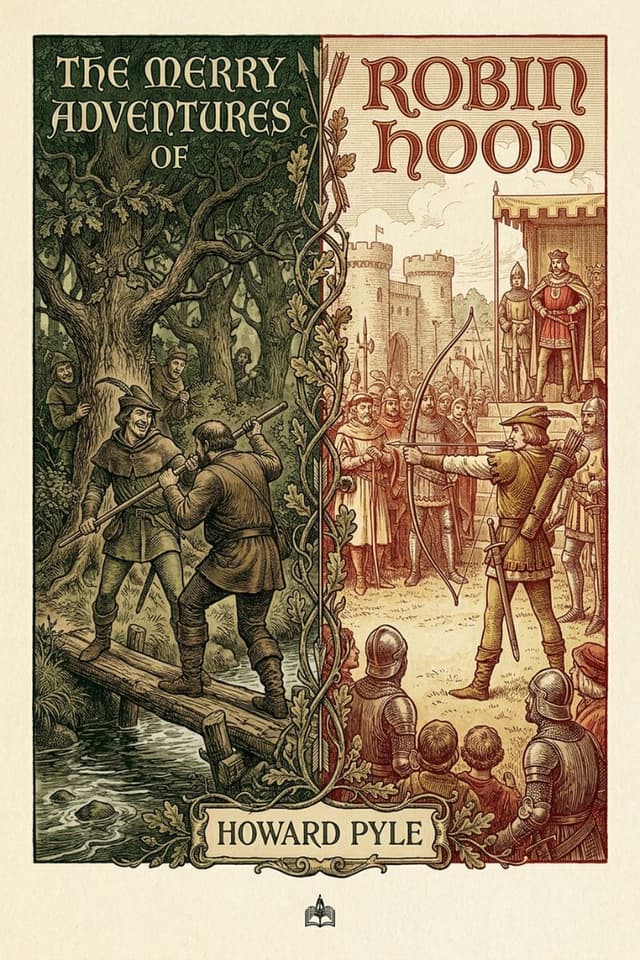
The Merry Adventures of Robin Hood
Read The Merry Adventures of Robin Hood by Howard Pyle for free on Novelhalla, and try out our easy-to-read modern edition of this classic book. You can also download the EPUB and read it on any device if you prefer!
The Plot
A Boy, a Bet, and a Body
Robin Hood is eighteen years old and walking through Sherwood Forest on a fine morning, headed to an archery contest in Nottingham. He's nobody special yet. Just a young man with a bow and more confidence than sense.
He runs into a group of the King's foresters. Words are exchanged. A bet is made. Things go sideways fast. One of the foresters tries to kill him, and Robin, defending himself, kills the man with a single arrow.
Just like that, Robin Hood is an outlaw. No trial, no appeal, no going home. The price on his head goes up, and Sherwood Forest becomes the only place in England where he can draw breath without a noose tightening around his neck.
But here's the thing about Sherwood Forest: Robin isn't alone there.
Building the Band
Outlaws, misfits, and men who've been chewed up by a corrupt system start finding their way to Robin's side. First there's Little John, a giant of a man Robin meets on a narrow bridge. Neither will yield. They fight with quarterstaffs, and Robin ends up in the creek. It's the beginning of a beautiful friendship.
Then comes Will Scarlet, Robin's own cousin, fleeing trouble of his own. And Allan a Dale, a lovesick minstrel whose sweetheart is about to be forced into marriage with a wealthy old knight she despises. Robin and his men crash the wedding in spectacular fashion, recruiting the roguish Friar Tuck to perform a proper ceremony on the spot.
One by one, the Merry Men grow to sevenscore strong. Dispossessed tradesmen, ruined farmers, men who've fallen afoul of unjust laws. They wear Lincoln green, live under the canopy of ancient oaks, and operate by a simple code: rob the rich, help the poor, and never harm a woman or an honest working man.
The Sheriff Problem
The Sheriff of Nottingham is furious. Robin and his band are making a fool of him on a regular basis. They ambush wealthy travelers on the forest roads, feast on the King's deer, and redistribute wealth with a cheerfulness that borders on insulting.
The Sheriff tries everything. He sets traps. He sends men into Sherwood. He posts enormous bounties. Robin slips through every net, usually while laughing.
And it's not just the Sheriff. The Bishop of Hereford gets humiliated. Wealthy merchants find themselves dining with outlaws and paying handsomely for the privilege. Robin has a gift for turning his enemies' schemes inside out, and his men have a talent for disguise that borders on the supernatural. One chapter finds Robin dressed as a butcher. Another as a beggar. Little John infiltrates the Sheriff's own household and robs him from the inside.
The adventures pile up, each one funnier and more daring than the last.
The Stakes Rise
But this can't go on forever, and Robin knows it. His fame spreads far beyond Nottingham, all the way to the royal court. Queen Eleanor herself hears of the famous outlaw archer and arranges for Robin to compete at the King's own match in London under her protection.
Robin goes. Robin wins. And then Robin nearly doesn't make it out of London alive.
The deeper into the story you go, the more the danger tightens. The sanctuary of Sherwood Forest is no longer impregnable. The Sheriff hires Guy of Gisbourne, a man who is less a person and more a weapon, to hunt Robin down in his own woods. The game of cat and mouse that seemed so playful in the early chapters starts to feel like something with real teeth.
And hovering over everything is the question of the King himself. King Richard is away on Crusade, and the laws Robin breaks belong to a kingdom whose ruler doesn't even know what's happening in his own forests. When Richard finally returns, he comes to Sherwood in disguise, and what happens next changes Robin's life completely.
Whether that change is for the better, and whether the greenwood will ever let Robin go, is something you'll have to read for yourself.
About the Author: Howard Pyle
Early Life
Howard Pyle was born in 1853 in Wilmington, Delaware, into a Quaker family with deep roots in the Brandywine Valley. His mother Margaret was a painter who read adventure stories to him constantly. Robinson Crusoe, Grimm's Fairy Tales, Arabian Nights. The kid was soaked in storytelling before he could hold a pencil.
He was a daydreamer who drifted through school without much enthusiasm. His parents, recognizing where his real talents lay, sent him to study art in Philadelphia rather than pushing him toward college. He trained for three years under the Belgian artist F.A. Van der Wielen, then returned home to work in the family leather business when money got tight.
The Breakthrough
In 1876, Pyle's mother sent some of his sketches and an essay to Scribner's Magazine without telling him. The editor loved it and invited Pyle to New York. He spent three years there, contributing illustrations and stories to magazines like Harper's Weekly and St. Nicholas, building a reputation as both a writer and an artist.
He returned to Wilmington in 1879, married Anne Poole in 1881 (they would have seven children), and threw himself into the project that would make his name: a retelling of the Robin Hood legends for young readers.
The Father of American Illustration
The Merry Adventures of Robin Hood, published in 1883, was Pyle's first novel and an immediate sensation. The British poet and designer William Morris was reportedly astonished that such a beautifully made book could come from American presses.
Pyle went on to write and illustrate over two dozen books, including a four-volume King Arthur series, Otto of the Silver Hand, and collections of original fairy tales. His pirate illustrations became so iconic that they essentially invented the modern image of how pirates look and dress, right down to Johnny Depp in Pirates of the Caribbean.
The Teacher
In 1894, Pyle began teaching illustration at the Drexel Institute in Philadelphia, and he never charged a penny for it. After 1900, he founded his own school in Wilmington. His students read like a who's who of American illustration: N.C. Wyeth, Maxfield Parrish, Jessie Willcox Smith, Frank Schoonover, Harvey Dunn. He trained roughly two hundred students, more than eighty of whom became successful professionals.
Even Vincent van Gogh was a fan. In a letter to his brother Theo, van Gogh wrote that Pyle's illustrations left him speechless with admiration.
Final Years
In 1910, dissatisfied with his painting technique and eager to study the old masters, Pyle traveled to Italy. He never came home. He died in Florence on November 9, 1911, at age fifty-eight. Over his career, he had produced some 3,300 published illustrations, roughly half of which accompanied stories and articles he had written himself.
Fun Facts About the Book
Pyle's First Novel
The Merry Adventures of Robin Hood was Pyle's debut as a novelist. He'd been publishing illustrations and short pieces in magazines for years, but this was his first attempt at a full-length book. He didn't just write and illustrate it. He designed the entire volume, including the calligraphy for headings and captions, making it a complete artistic object.
Cleaning Up Robin Hood
The Robin Hood of the original medieval ballads is, frankly, kind of a jerk. He robs people blind, kills freely, and isn't particularly motivated by helping the poor. Pyle deliberately softened the character for young readers. In the old ballads, Robin kills fourteen foresters over a bet. In Pyle's version, he kills one man in self-defense. Pyle also changed stories where Robin steals everything a traveler carries, instead having Robin leave his victims a third of their money and give another third to the poor.
The Missing Maid Marian
Here's a surprise: Maid Marian barely appears in this book. She gets a brief mention near the beginning and then essentially vanishes. For a character who became central to almost every later Robin Hood adaptation, her near-total absence from Pyle's version is startling. The story is almost entirely about male friendship, loyalty, and the bond between outlaws.
Presidential Fan Favorite
The book was a personal favorite of two U.S. Presidents: Theodore Roosevelt and John F. Kennedy. Not bad company for a children's adventure story.
William Morris Was Impressed
British poet, artist, and designer William Morris, one of the most influential figures in Victorian art and design, was so struck by the quality of the book's production that he could barely believe it had been manufactured in America. The volume set a new standard for American book design.
The Ye Olde English Thing
Pyle created a unique pseudo-archaic dialect for his characters' dialogue, adapting the Middle English of the original ballads into something that sounds old-fashioned and charming without being impossible to read. It's not historically accurate to any real period of English, but it gives the book a distinctive voice that generations of readers have loved (and some have found mildly exasperating).
He Illustrated It Himself
Pyle created all the illustrations for the book, over forty of them, plus page decorations throughout. The pictures have become nearly as iconic as the text, combining detailed linework with a warmth and energy that perfectly match the storytelling.
Themes
Justice Outside the Law
Robin and his men are criminals. They rob, they poach the King's deer, they assault representatives of the crown. But in a world where the law itself is corrupt, where the Sheriff perverts justice for personal gain and churchmen preach charity while hoarding wealth, the outlaws become more lawful than the authorities. The book asks a question that still resonates: what do you do when the system is broken and following the rules means accepting injustice?
The Power of Laughter
Robin Hood's greatest weapon isn't his bow. It's his ability to laugh, at his enemies, at his misfortunes, and especially at himself. When he gets beaten in a fight (which happens more often than you'd expect), he laughs and offers his opponent a place in the band. The Merry Men's joy is what makes them dangerous. The powerful can handle defiance. What they can't handle is being made ridiculous.
Loyalty and Brotherhood
The heart of the book is the bond between Robin and his men. They fight for each other, trick for each other, and risk their necks for each other without hesitation. In a society that has failed them, they've built something better in the greenwood: a community based on mutual loyalty rather than rank or wealth.
The Rich vs. The Poor
Pyle doesn't bother with subtlety here. The wealthy are vain, greedy, and ridiculous. The poor are honest and hardworking. The book's moral economy is simple and satisfying: those who have too much are relieved of their excess, and those who have too little receive help. It's a child's vision of fairness, and it still hits a nerve.
Freedom and Its Cost
Life in Sherwood Forest is presented as an idyll. No taxes, no masters, endless feasting and games under the trees. But the book doesn't pretend this freedom comes without a price. Robin is an outlaw. He can never go home. The world outside the forest is full of people who want him dead. The merry life is also a precarious one, and the further the story goes, the more that tension shows.
The Book's Legacy
Pyle's Robin Hood is the Robin Hood. Before this book, the legend existed as a scattered collection of ballads and stories with no consistent characterization or plot. Pyle wove them into a single coherent narrative and, in doing so, created the version that has shaped virtually every adaptation since.
The heroic outlaw who robs from the rich and gives to the poor, the jolly band in Lincoln green, the quarterstaff fight on the bridge, the archery contest with the split arrow: these images all crystallized in Pyle's telling. The 1922 Douglas Fairbanks film, the legendary 1938 Errol Flynn version, Disney's 1973 animated film with the fox, Mel Brooks' Men in Tights, Kevin Costner's Prince of Thieves, the BBC series, Ridley Scott's 2010 film: they all trace their DNA back to this book.
The novel also helped transform children's literature in America. It proved that a book for young readers could be a serious artistic achievement, beautifully written, gorgeously illustrated, and designed as a complete object. After Pyle, Robin Hood became one of the most popular subjects in children's publishing, and the standard he set influenced generations of writers and illustrators.
The book has never been out of print since 1883. Over 140 years later, it remains the definitive telling of the Robin Hood legend, the version against which all others are measured.