Novelhalla
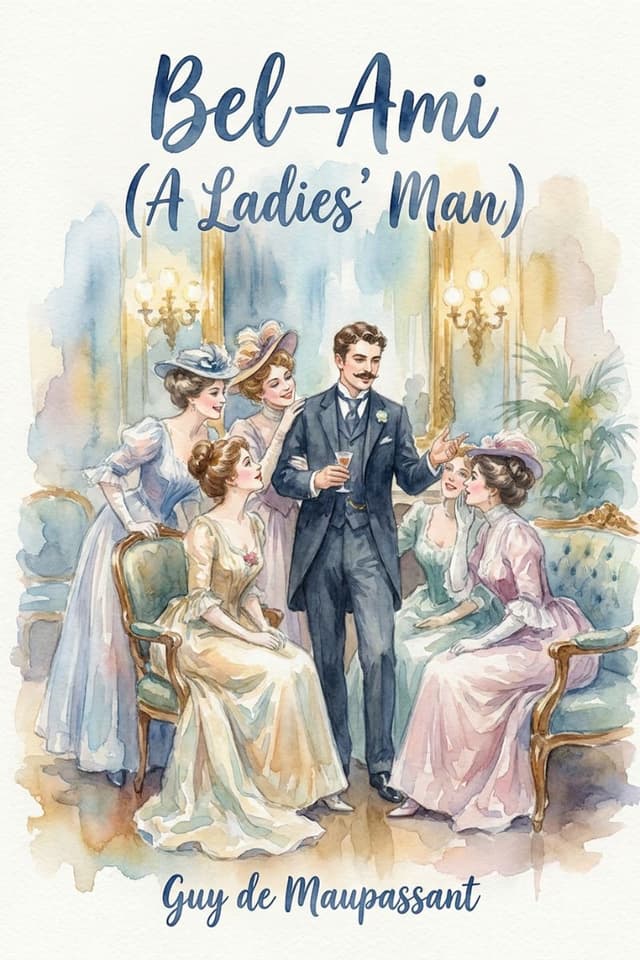
Bel-Ami (A Ladies' Man)
Read Bel-Ami (A Ladies' Man) by Guy de Maupassant for free on Novelhalla, and try out our easy-to-read modern edition of this classic book. You can also download the EPUB and read it on any device if you prefer!
Plot Summary
Georges Duroy is a penniless ex-soldier wandering the streets of Paris in the 1880s with barely three francs to his name. His luck changes when he bumps into Charles Forestier, an old army comrade from Algeria who now works as an editor at the newspaper La Vie Française. Forestier introduces Georges to the world of Parisian journalism and, more importantly, to the influential women orbiting its powerful men.
Georges can barely string together a sentence on paper, but Charles's wife Madeleine ghostwrites his first article for him, and suddenly he's a published journalist. From there, he discovers that the real power in Paris belongs not to the men but to their wives, and he sets about seducing them one by one. First there's Clotilde de Marelle, a married socialite who genuinely falls for him and whose young daughter gives him his nickname: Bel-Ami, the beautiful friend. Then there's Madeleine herself, whom he marries after Charles dies of tuberculosis. Later, he pursues Virginie Walter, the devoutly religious wife of his newspaper's owner.
Georges rises through the ranks at La Vie Française, trading on insider information about France's colonial schemes in Morocco, turning his well-connected women into stepping stones. He changes his name to the more aristocratic "Du Roy de Cantel" and grows increasingly ruthless. When Madeleine proves too independent, he orchestrates a trap to catch her in adultery and divorces her. His final target is Suzanne Walter, the newspaper owner's young daughter, whose fortune and connections will complete his transformation from penniless veteran to one of the most powerful men in Paris.
The novel ends with Georges's lavish wedding at the Madeleine church, all of Paris society in attendance, his victims watching from the pews as he strides triumphantly down the aisle already planning his next conquest.
Characters
Georges Duroy (Bel-Ami): A handsome, ambitious ex-soldier with no education, no talent, and no scruples. He possesses an almost magnetic effect on women and zero capacity for genuine affection. His signature moustache becomes a symbol of his seductive power.
Madeleine Forestier: The intelligent, politically savvy woman who essentially creates Georges's career by writing his articles and opening doors to influential circles. She marries him after Charles dies, treating him as a replacement for her first husband, which he deeply resents.
Clotilde de Marelle: A married socialite whose husband is conveniently always away. She's the only woman who genuinely loves Georges, and she keeps returning to him despite his repeated betrayals.
Charles Forestier: Georges's old army friend whose chance encounter in the street sets the whole story in motion. His declining health and eventual death clear the way for Georges to take his job and his wife.
Virginie Walter: The deeply religious wife of the newspaper's owner. Her affair with Georges drives her nearly mad when he discards her for her own daughter.
M. Walter: The wealthy Jewish owner of La Vie Française who profits from manipulating stock prices through his newspaper's political coverage. Georges eventually becomes his son-in-law.
Suzanne Walter: The young heiress whose marriage to Georges represents his ultimate social triumph.
Norbert de Varenne: An aging poet at the newspaper who serves as a kind of philosophical counterweight, obsessed with death and the futility of ambition.
About the Author
Guy de Maupassant was born in 1850 in Normandy to a family of minor aristocrats. His parents separated when he was eleven, and his mother, a cultured woman and childhood friend of Gustave Flaubert, became the dominant influence in his life. She arranged for the young Maupassant to meet Flaubert, and the famous novelist essentially adopted him as a literary apprentice.
For seven years, Flaubert drilled Maupassant on prose style, correcting his exercises and introducing him to major writers of the day including Émile Zola, Ivan Turgenev, and Henry James. Meanwhile, Maupassant worked as a clerk in the Navy Department, a job he despised, spending his weekends rowing on the Seine and chasing women with equal enthusiasm.
His breakthrough came in 1880 with the short story "Boule de Suif," published in a collection of Franco-Prussian War stories. Flaubert called it a masterpiece that would endure, but tragically died just weeks later. Maupassant, devastated, threw himself into work with almost manic intensity. Over the next decade, he produced roughly 300 short stories, six novels, and three travel books, becoming wealthy and famous.
But Maupassant had contracted syphilis in his early twenties, and the disease slowly destroyed him. His brother Hervé died in an asylum in 1889, likely from the same illness. Maupassant grew increasingly paranoid and obsessive, haunted by thoughts of death. On January 2, 1892, he slit his throat in a suicide attempt. His servant saved him, but he was committed to an asylum in Paris, where he died eighteen months later at age forty-two. His self-written epitaph reads: "I have coveted everything and taken pleasure in nothing."
Fun Facts
The yacht connection. Maupassant loved sailing so much that he named his private yacht Bel-Ami after his novel. He spent weeks cruising the Mediterranean, and the experience inspired his travel book Afloat (1888), supposedly written aboard the boat (though scholars have found he recycled material from old newspaper articles).
Predicting colonial conquest. The novel's subplot about French schemes to take over Morocco proved remarkably prophetic. France established its protectorate over Morocco in 1912, twenty-seven years after the book was published, and historians note that Maupassant accurately anticipated how public debt and newspaper manipulation would be used as instruments of colonial expansion.
Thirty-seven printings in four months. Bel-Ami was a sensation when it appeared in 1885, going through nearly forty printings in just four months. The novel's frank depiction of sexuality and its savage critique of journalism and politics made it scandalous but irresistible.
The anti-Eiffel Tower club. Maupassant was among forty-six prominent Parisian artists and writers who signed a letter protesting the construction of the Eiffel Tower, calling it a disgrace to the city. He reportedly claimed that he frequently ate lunch at the tower's restaurant because it was the only place in Paris where he didn't have to look at the thing.
Room at the Top's secret source. English novelist John Braine admitted that his 1957 bestseller Room at the Top was directly inspired by Bel-Ami, though he noted with some amusement that the critics never picked up on it.
Themes
The corruption of journalism and politics. The newspaper La Vie Française represents everything rotten about the intersection of media and power: it publishes propaganda dressed as news, manipulates stock prices, and serves political interests rather than truth. Maupassant based it on real Parisian papers of the 1880s.
Women as currency. In Georges's world, women function as social capital, their bodies and connections traded for advancement. Yet Maupassant's female characters are far more intelligent and capable than his protagonist, making his success all the more absurd and damning.
The hollow man. Georges has no interior life, no genuine passions, no moral compass. His success is Maupassant's darkest joke: in a corrupt society, emptiness is an advantage.
Ambition and its discontents. Through the nihilistic poet Norbert de Varenne, Maupassant poses the question of whether any achievement matters in the face of death, a theme that clearly haunted the author himself.
Legacy
Bel-Ami has been adapted for film and television over a dozen times, starting with an Italian silent version in 1919. George Sanders played Georges in the 1947 Hollywood adaptation The Private Affairs of Bel-Ami. The most recent film version (2012) starred Robert Pattinson alongside Uma Thurman, Kristin Scott Thomas, and Christina Ricci, though critics found Pattinson's brooding style unsuited to Maupassant's charming scoundrel.