Novelhalla
The Incredible Honeymoon
Read The Incredible Honeymoon by E. Nesbit for free on Novelhalla, and try out our easy-to-read modern edition of this classic book. You can also download the EPUB and read it on any device if you prefer!
The Plot
The Man Nothing Ever Happened To
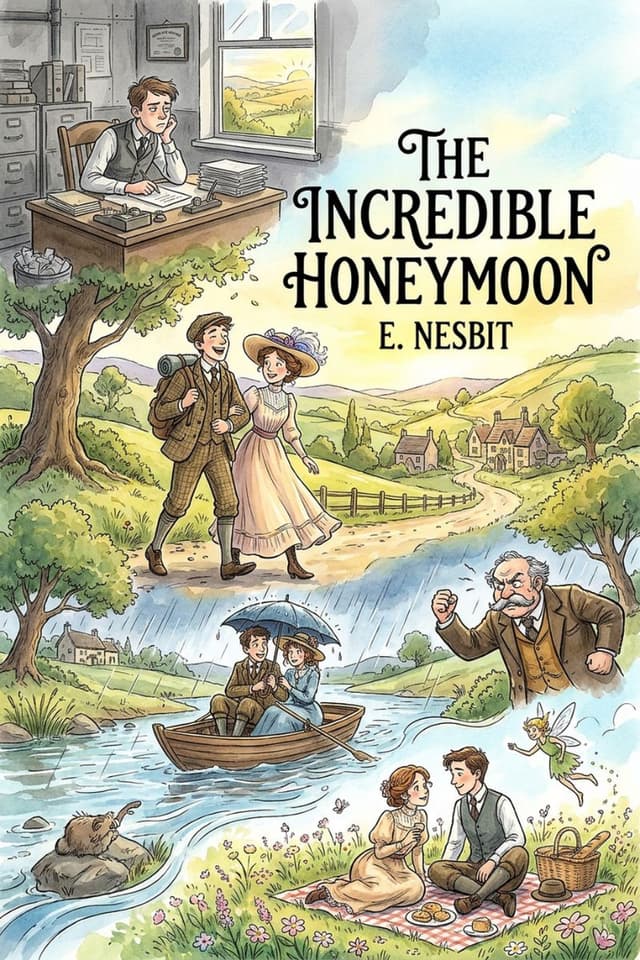
The book opens by talking directly to you, and specifically to the version of you that catches the nine-seven to town, comes home on the five-fifteen, and eats at eight, one, and half past six. There are people, the narrator says, who take neither trains nor meals regularly. While nothing whatsoever happens to you, there really are people on this earth to whom things happen. Adventures, it turns out, are to the adventurous.
Edward Basingstoke is an engineer at the works at Crewe, dreaming pastoral dreams in the din of ten thousand hammers, slowly acquiring the kind of dust on his hopes that thickens into clay you could grow cabbages in. Then an uncle dies and leaves him money.
He works the rest of that afternoon and the following morning. At noon the next day he puts his tools down and never picks them up again. He takes a train to Oxford, wakes his friend Vernon Martingale, announces that he's chucked the shop and intends to see life, and clarifies that by seeing life he does not mean the gas and wine and things one doesn't mention in front of ladies, but a stick, a knapsack, a different sort of hat, some very large boots with nails in them, and a dog.
They go out and buy the dog. His name is Charles, he is a large white bull terrier, and he is one of the great menaces of English literature. He upsets the canoe the same afternoon.
An Aeroplane Over a Wall
Edward's method of spending money is worth understanding, because it explains everything he does later. Told that his old nurse, a poor widow with five children, could use two pounds a week, he does not write her a letter. He sends her the most expensive hot-house flowers he can find, anonymously, on her birthday. Then a hamper. Then toys and clothes for the children. Then, finally and through his solicitors, an annuity from an unnamed former employer. It isn't enough for him to give people enough. He likes to give a feast.
So when he puts up at an inn on the South Downs and finds a small boy called Tommy who has been sent to bed in disgrace for tearing his trousers, Edward does not make him a kite. He makes him an aeroplane, over four days, with the village carpenter and the village blacksmith both roped in, and takes him to Eastbourne in a trap on the way, and buys him peppermint creams, and it is the greatest week of Tommy's life.
And then, very early one morning, alone in a meadow, Edward launches the finished machine on a string, and the wind takes it over a high red brick wall and into a chestnut tree in the park beyond.
He climbs the wall. He climbs the tree. He gets the aeroplane down. He turns round, and there is a girl standing there in a poppy-red Burmese coat with a green and gold Japanese parasol making a halo behind her head, and she wants to know what on earth he means by it.
Twelve O'Clock, or Possibly Thirteen
The conversation that follows lasts about ten minutes and changes both their lives, and Edward, who has spent years trying and failing to fall in love and has been quite certain that love at first sight is a thing that happens only in books, walks back to his inn knowing perfectly well that it has just happened to him.
She doesn't come the next morning. Instead there's a catastrophe on the road, an aunt in a dog cart, two people blushing scarlet at each other in front of exactly the wrong witness, and, a mile further on in the white dust, a dropped handkerchief. Edward carries it home and only later, holding it stretched against the window light, sees that there are words on it, pencilled an inch high and very rough, as though written under a driving rug without being able to look.
Ce soir 12 heures.
Or possibly thirteen. She isn't Italian, so he's fairly sure. He waits in the dark park anyway, from a quarter to twelve, for what feels like most of the night.
The Piano Tuner
When she finally comes, she has a story to tell him, and it's the reason she's in that house with a woman guarding the front hall at dawn.
Her father accepted a marriage proposal on her behalf, over lunch, from a sensible, middle-aged, very well-off man she had met once. She refused. There were scenes. He demanded to know whether there was somebody else, and wouldn't take no for an answer, and went on and on, and eventually, to make him stop, she said yes, there was.
Then he wanted a name.
The name she gave him, because it was the first one in her head and because she was past caring, was the piano tuner. The man was sacked on the spot, poor devil. She was sent down to the country to come to her senses, forbidden to write letters, forbidden to see anyone. And her aunt, who has never laid eyes on the actual piano tuner, has now concluded that the young man who was climbing trees in the park at five in the morning and whose dog ran under the horse is him, pursuing her.
They are taking her away tomorrow. Ireland or Scotland. They won't say which.
She has come out at midnight only to explain, because she couldn't bear him to think she'd made an appointment and broken it, and because, as she points out, breaking appointments is unbusiness-like.
The Offer
What Edward says next takes her half a minute to answer, and the answer is not the one he wanted.
He proposes that she run away with him. He isn't joking and he isn't leering, and when she says with real dignity that she couldn't marry anyone she wasn't very fond of, and that you can't be fond of a person you've seen twice, he doesn't argue. He offers her the other thing instead. Come as a sister. Come on any terms you like. We'll take a map and you'll put your finger anywhere on it and we'll go, by rail or motor or cart or caravan, and stop when you want and move on when you want, and cook supper over a fire of sticks under the stars.
He has, in fact, thought better of it and is halfway through withdrawing the offer when she stops him, because across the park, near the house, lights have started moving.
They're looking for her.
The Incredible Honeymoon
What follows is a chase across the south of England in which almost nothing goes to plan.
There is a ladder lowered on a string. There is an empty farmhouse in a fold of the downs where she waits alone in the dark on a nest of straw while Edward goes back to his inn to be roused at two in the morning by an aunt in brown gloves and a hat with an aggressive quill, who offers him twenty pounds to leave the village and never molest this defenceless girl again, and who is not remotely prepared for a man who talks like a book. There is a motor car at dawn and an empty kitchen and a second handkerchief weighted down with a match box. There is a stranger with a red neck and a foreign name who has been perfectly kind and who Edward would very much like to strangle. There is a waste-paper basket that Charles knocks over at exactly the right moment, in a coffee room a hundred miles from anywhere, with Edward's own name lying face up on a torn envelope at the top of it.
And underneath all of it there's a problem that no amount of running solves. She is twenty-one and legally her own mistress, which means nobody can force her back. But she is travelling alone with a man she has known for three days, and the world of 1916 has extremely firm views about what that means, and the two of them have agreed to call each other brother and sister, and neither of them has thought through what happens the first time somebody asks a straight question in a hotel lobby.
There is also Mr. Schultz. She declares brightly, at the end of one of the early chapters, that they have seen the last of poor Mr. Schultz.
Nesbit notes, in her own voice, that this proves to be completely inaccurate.
About the Author: E. Nesbit
A Childhood on the Move
Edith Nesbit was born in Kennington in August 1858, the youngest of six. Her father, who ran an agricultural college, died before she was four. Her sister Mary was consumptive, and the family spent years moving around France, Germany, and Belgium looking for air that would help, which meant Edith's education was scattered across the Continent and several schools she loathed. They came back to England when she was fourteen.
Fabian Bland
At twenty-one, seven months pregnant, she married Hubert Bland, a bank clerk turned journalist. The marriage was turbulent from the very start, and stayed that way for thirty-four years. Bland was a serial philanderer. Their friend Alice Hoatson bore him two children while living in the household as housekeeper and secretary, and Nesbit raised both of them as her own alongside her three.
In 1884 the two of them helped found the Fabian Society, with Bland as its first chairman, and edited its journal between them. Nesbit lectured on socialism around the country, wrote furiously to keep the family afloat, cut her hair short and smoked in public at a time when women did neither, and named her third child Fabian. Some of the early novels she wrote jointly with Bland came out under the name Fabian Bland. They did not sell.
In 1900 Fabian died at fifteen, from an operation performed at home to remove his tonsils.
The Books That Worked
In 1899 she published The Story of the Treasure Seekers, and everything changed.
What followed over the next decade is one of the great runs in English literature: the Bastable books, Five Children and It, The Phoenix and the Carpet, The Story of the Amulet, The Railway Children, The Enchanted Castle. She invented a thing that had not existed before, which was magic arriving in the middle of an ordinary suburban life, in a gravel pit, on a Tuesday, with rules and consequences and squabbling siblings. Nearly every children's fantasy written since runs on the engine she built.
She also wrote some genuinely frightening ghost stories, and eleven novels for adults, of which this is one.
The Long Boat
Bland died in 1914. Two years later, at fifty-eight, Nesbit met Thomas Tucker, a widowed marine engineer who worked the Woolwich ferry, shared her politics, spoke with a broad accent, and never wore a collar. Her family were appalled. She told her sister it felt as though somebody had come and put a fur cloak round her. They married in February 1917 and were happy.
Money was short and her health failed. She died of lung cancer in May 1924, at a house called The Long Boat on Romney Marsh, and was buried in the churchyard at St Mary in the Marsh under a wooden marker her husband carved himself.
Fun Facts About the Book
Published During the Somme
This came out in October 1916. There is not one word of the war in it anywhere. No khaki, no casualty lists, no recruiting posters, no shortages. It is an English summer with nothing in it but downs and dust and larks and a very badly behaved dog, written by a widow of two years standing in the middle of the worst year the country had ever had.
She Gave Him the Job She Gave Her Own Husband
The hero is an engineer who walks out of engineering. The year after this was published, Nesbit married a marine engineer. She had spent her whole adult life among Fabian intellectuals and she ended up, cheerfully and to the horror of her friends, with a man who worked with his hands.
Charles Is Based on a Real Kind of Problem
Over the first hundred pages Charles the bull terrier upsets a canoe, steals a small boy's cakes, kills a hen, gets butted by a goat, steals a leg of mutton, bites a policeman to the tune of ten shillings, is run over by a bicycle, causes a horse to bolt, plays dead convincingly enough to fool everybody including his own master, bites a groom's trousers off from knee to ankle, and wrecks a hotel coffee room. He is also the reason the plot works, twice.
The Geography Is Exact
Jevington, Eastbourne, the cliff above Cuckmere, Alfriston, Pevensey, Hurstmonceaux, Seaford, Polegate, Crowborough, Tunbridge Wells. You can follow the whole first half on a map of East Sussex. Nesbit knew this country intimately and eventually died a few miles east of it.
She Drove Past the National Trust's First Property
In one throwaway paragraph the motor whirls through Alfriston past the old church and the half-timbered Clergy House, where three little girls in green pinafores are trying to coerce a reluctant goat. Nesbit calls the building thirteenth century. It's actually a Wealden hall house built around 1400, and it was the very first property the National Trust ever bought, acquired in a state of near ruin in 1896 for ten pounds, twenty years before this novel appeared. It's still there, and so is the view over the Cuckmere.
She Was Berta Ruck's Mentor
The young Berta Ruck, then scraping a living illustrating and writing for magazines like Home Chat, was encouraged early on by her friend Edith Nesbit. Ruck went on to become one of the most prolific romantic novelists in Britain, publishing up to three books a year for half a century, with her final novel appearing when she was nearly ninety. She wrote about Nesbit in her own memoirs decades later. She also married the novelist Oliver Onions who as of writing this summary has had one book modernized on Novelhalla, "Mushroom Town."
The Children's Author Doing Grown-Ups
Nesbit published eleven novels for adults across her career and none of them made anything like the impression of her children's books. What's odd about this one is how thoroughly her children's book instincts survive the transfer. The delight in food and weather and small purchases, the pitch-perfect small boy, the refusal to be sentimental, the absolute conviction that the ordinary world is crammed with possibility if you're willing to climb a wall for it.
The Shop Girl
There's a scene where Edward, waiting outside a department store, buys stockings for his old nurse's children from a young shop assistant, remembers her name, and two weeks later has a beribboned box of sweets sent to her anonymously from a place she's never been, signed only "From Mary," on the theory that everybody has at least one relative or friend called Mary. Nesbit follows the box all the way to its effect: a day of surprise and a week of speculation in a life she describes as drab and subordinated. It has nothing to do with the plot. It's the best single page in the book.
Themes
Adventures Are to the Adventurous
The line is repeated, by the narrator and by a small boy in a nightshirt who worked it out for himself: if he'd stayed in bed like a good boy, nothing would have happened. The novel's whole argument is that the difference between a life where things happen and a life where they don't is not money and not luck but temperament, and that the price of admission is being willing to look like an idiot.
Money as a Tool for Delight
Edward's inheritance is never a plot solution. It's a moral test, and what makes him likeable is how he passes it: not by grand philanthropy but by working out precisely what would give a particular person the most pleasure and then arranging it so they never find out who did it. Nesbit the Fabian is clearly aware that this is charity rather than justice. Nesbit the novelist can't resist how nice it is.
The Trap
The girl's situation is drawn with real anger under the light comedy. She has no money that she's allowed to touch, no friends she's allowed to write to, no occupation, no way out, and a father who accepts marriage proposals on her behalf over lunch. She says, early on, that she thinks it's dull being a woman because men can do whatever they want. Edward points out that this is only true if you don't have a living to earn. Neither of them is wrong.
Honour, and the Nuisance of It
The engine of the second half is a man who has fallen completely in love and has given his word, and who therefore has to keep proving, in situation after situation, that his word was the real thing and not a strategy. Nesbit is very funny about how inconvenient this is for him and how much she admires it anyway.
Truth and Convenient Lies
Almost every crisis in the book is caused by a lie told to get out of a corner: an invented fiancé, an invented profession, an invented brother, an invented dying dog. Nesbit doesn't moralise about it. She just lets the lies compound, one on another, until the characters are managing a structure they can barely remember the shape of.
Being Known
Twice in the novel somebody observes that they feel they know the other person far better after a quarrel than before it. That's the actual subject of the book, buried under the chase: not falling in love at first sight, which happens on page thirty, but the much slower business of finding out whether the person you fell for exists.
The Book's Legacy
This is not one of the books E. Nesbit is famous for, and it's fair to say it was never going to be. Her adult fiction was already out of fashion by the time she died, and the twentieth century decided, correctly enough, that her monument was the children's work.
But it has kept finding readers, largely because of what it is rather than what it's about: a thoroughly enjoyable English road novel written by one of the most naturally charming prose stylists of her generation, at the height of her powers, having an obviously wonderful time. Readers who come to it from the children's books almost always say the same thing, which is that the voice is exactly the same. The same delight in weather and food and dogs. The same complete lack of condescension. The same trick of making a hedge, a farmhouse, and a packet of biscuits feel like the furniture of an epic.
It also has a strange double life as biography. The woman who wrote this fantasy of two people walking out of their assigned lives and into the open air had spent thirty-four years in a marriage she couldn't leave, supporting a household that included her husband's mistress and their children. She published it at fifty-eight, in the second year of her widowhood. Within a year she had run off, in the mildest and most respectable way available to her, with a ship's engineer who never wore a collar, and been happier than she had been in decades.
Adventures, as the book says, are to the adventurous.