Novelhalla
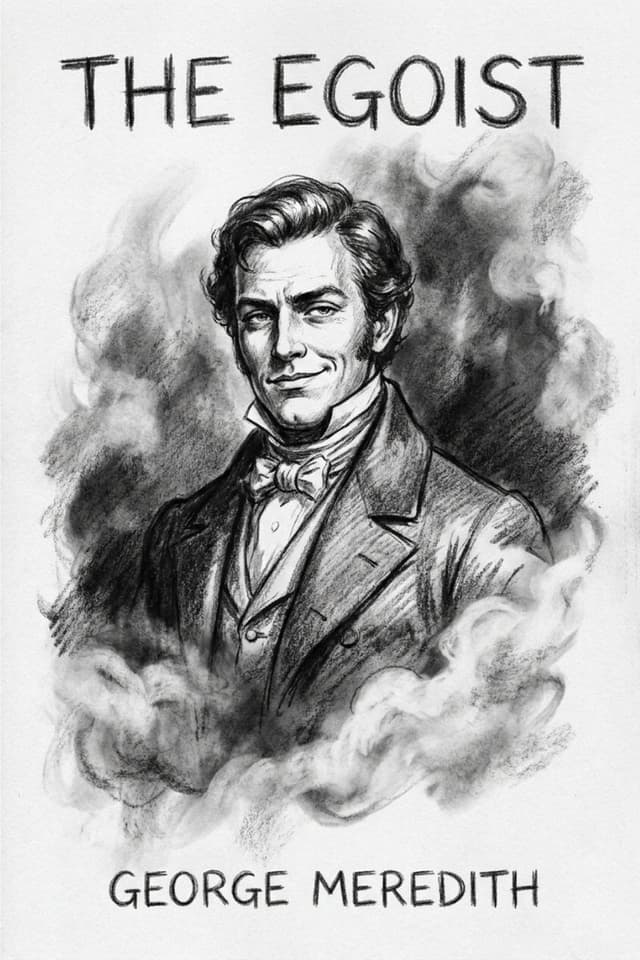
The Egoist
Read The Egoist by George Meredith for free on Novelhalla, and try out our easy-to-read modern edition of this classic book. You can also download the EPUB and read it on any device if you prefer!
The Plot
The Catch of the County
Sir Willoughby Patterne has everything. Wealth, a grand estate called Patterne Hall, excellent legs (the Victorians cared about these things), and absolute confidence that the world revolves around him. On the night of his coming-of-age celebration, the whole county turns out to admire him. Laetitia Dale, a quiet, devoted young woman who lives in a cottage on his estate, even writes poetry in his honor. He barely notices her. Why would he? She'll always be there.
Willoughby becomes engaged to Constantia Durham, a beautiful woman perfectly suited to ornament his life. Everything is going according to plan.
Then Constantia runs away with another man. Just bolts. Right before the wedding. The humiliation is catastrophic, and Willoughby handles it the way only a true egoist can: he pretends it doesn't matter, flirts briefly with Laetitia to save face, and then disappears on a three-year world tour, leaving her behind without explanation.
When he returns, he has a new target.
Clara's Trap
Clara Middleton is young, clever, and full of life. She accepts Willoughby's proposal in a rush of flattery and social pressure, swept along by his intensity and the excitement of her debut into society. She asks for a year-long engagement. He insists on six months. She begins to feel the walls closing in before the ring is even settled.
At Patterne Hall, Clara starts to see what Constantia must have seen. Willoughby doesn't want a wife. He wants a mirror. Every conversation circles back to him. Every plan serves his comfort. He speaks of love in language that sounds more like ownership, wrapping possessiveness in poetry until Clara can barely breathe. He talks through other people's responses, only pausing to acknowledge their words when his own train of thought has run out of steam.
Clara wants out. But wanting out of a Victorian engagement is not the same as getting out.
The Cage
Here is Clara's problem, and it's a brutal one. She has no money of her own. Her father, Dr. Middleton, a brilliant classical scholar with a weakness for fine wine and well-stocked libraries, is thoroughly charmed by Willoughby's hospitality. Breaking an engagement would mean scandal, social ruin, and disappointing the one parent she adores. Every path to freedom is blocked by propriety, by obligation, by the simple fact that a woman in her position is not supposed to change her mind.
So Clara tries everything short of an outright break. She hints. She pleads. She appeals to Willoughby directly, asking to be released. He cannot hear her. Literally cannot process the idea that anyone would not want him. He interprets her distress as feminine nerves. Her resistance as charming spirit. Her desperation as something that will pass once she settles down and accepts her good fortune.
Meanwhile, she begins noticing Vernon Whitford, Willoughby's poor cousin who lives at the estate and works as a scholar. Vernon is everything Willoughby is not: modest, principled, genuinely interested in other people. He's also fiercely protective of young Crossjay Patterne, a wild, good-hearted boy whom Willoughby treats as a prop when useful and an inconvenience when not.
The Players
The household fills with people who all see different pieces of the truth. Colonel De Craye, Willoughby's charming Irish friend, arrives to serve as best man and almost immediately suspects that something is very wrong between the engaged couple. Laetitia Dale is still nearby, still patient, still watching. But years of devotion to a man who only values her as a backup plan have quietly changed something inside her.
And then there is Willoughby himself, growing more desperate as he senses Clara slipping away. His solution? If Clara won't stay willingly, he'll tighten his grip. If she threatens to leave, he'll maneuver her father into blocking the exit. And if the worst should happen, well, there's always Laetitia. Faithful, grateful, uncomplaining Laetitia. She'll say yes whenever he asks.
Won't she?
The Unraveling
Clara's attempts to escape grow bolder and more reckless. Willoughby's attempts to maintain control grow more elaborate and more transparently self-serving. The gap between who he believes himself to be and who everyone around him can see he actually is widens with every passing day. Secrets multiply. Alliances shift. Young Crossjay stumbles into knowledge he shouldn't have. And the people Willoughby has spent years taking for granted begin, one by one, to stop playing their parts.
The whole system Willoughby has built, the estate, the social world, the web of obligations and flattery and dependence, starts to buckle. Not from any outside force, but from the sheer weight of his refusal to see anyone but himself.
Something has to give. The question is what it will cost, and who will be left standing when the great egoist finally has to look in a mirror that isn't angled in his favor.
About the Author: George Meredith
Origins and Secrets
George Meredith was born in 1828 in Portsmouth, the son and grandson of naval tailors. This was a fact he spent his entire life concealing. The Merediths ran a successful outfitting business, but George was raised with pretensions far above the shop floor, and he learned early to let people assume he came from the gentry. His mother died when he was five, and a small inheritance she left for his education allowed him to attend good schools, including two formative years at a Moravian school in Germany. His father went bankrupt, remarried his housekeeper, and largely disappeared from George's life.
The shame Meredith felt about his origins never fully left him. It also gave him a razor-sharp eye for social pretension, the kind of insight that runs through every page of his fiction.
A Disastrous First Marriage
In 1849, at twenty-one, Meredith married Mary Ellen Nicolls, a widow seven years his senior and the daughter of the satirist Thomas Love Peacock. She was brilliant, witty, and independent. They were a terrible match. Financial strain and clashing temperaments tore the marriage apart. In 1858, Mary Ellen left Meredith for the painter Henry Wallis, the same artist for whom Meredith had recently modeled in a famous painting of the dying poet Chatterton. She died in 1861, alone and ill. Meredith, still bitter, only grudgingly allowed their son Arthur to visit her near the end.
Meredith believed his own egoism had driven her away. He channeled that painful self-knowledge into his poetry sequence Modern Love, and years later, into the devastating psychological portrait at the heart of his most famous novel.
The Working Writer
Meredith remarried in 1864, this time to Marie Vulliamy, a practical and devoted woman. They settled at Box Hill in Surrey, which became his home for the rest of his life. He wrote steadily but struggled for popular success, supplementing his income by working as a publisher's reader for Chapman and Hall. In that role he became an influential gatekeeper of Victorian literature. He was the first to recognize Thomas Hardy's talent, advising the young novelist to revise his debut. He encouraged George Gissing. He shaped careers from behind a desk.
His own novels sold modestly. They were too intellectual, too stylistically demanding, too interested in psychology over plot for the average Victorian reader. Oscar Wilde called his prose style "chaos illumined by flashes of lightning."
Late Recognition
Fame arrived late. Diana of the Crossways became his first commercial hit in 1885, when he was already fifty-seven. By the 1890s, he was widely regarded as one of the greatest living English novelists. He succeeded Tennyson as president of the Society of Authors. He received an honorary doctorate from St Andrews. In 1905, King Edward VII awarded him the Order of Merit.
But his body was failing. Locomotor ataxia gradually robbed him of his beloved long walks and eventually left him immobile. His second wife died in 1885 of throat cancer. His son Arthur, with whom he'd had a difficult relationship, died of tuberculosis in 1890. Despite all this, visitors continued making pilgrimages to Box Hill to hear the old man talk. Even deaf and confined to a chair, Meredith remained a legendary conversationalist. He died in 1909 at eighty-one, and was buried in Dorking Cemetery, not in Westminster Abbey, as he had refused the honor.
Fun Facts About the Book
"He Is All of Us"
After the novel was published, a young friend of Meredith's reportedly came to him in distress, declaring that Sir Willoughby was obviously based on him. Meredith's reply has become one of the most quoted anecdotes in Victorian literary history. He told the young man not to worry, that the character wasn't based on any one person. The egoist, he said, is all of us. Robert Louis Stevenson recorded the story, and it captures something essential about the novel's project: it's not a portrait of a villain. It's a mirror held up to something uncomfortably universal.
The Name Is No Accident
Sir Willoughby Patterne's surname is a deliberate pun. It echoes the "willow pattern," the famous blue-and-white design found on Victorian chinaware, which depicted an idealized, artificial scene from a legend that never really existed. The connection is woven throughout the novel. A local society hostess describes Clara as "a dainty rogue in porcelain." A porcelain vase, one of Clara's wedding gifts, gets broken. Willoughby himself is essentially a decorative surface with nothing real underneath, a pattern that looks beautiful from a distance but cracks under pressure.
Born from a Theory of Comedy
Two years before writing the novel, Meredith delivered a lecture called "An Essay on Comedy" at the London Institution. In it, he argued that true comedy isn't farce or slapstick. It's an intellectual tool, a way of exposing human foolishness through laughter that makes you think. He called comedy "the ultimate civiliser." Then he sat down and wrote the novel that put the theory into practice. The book even opens with a philosophical prelude about the "Comic Spirit," which has been known to scare off readers before the story begins. Those who push through are rewarded.
A Different Title
During its serialization in the Glasgow Weekly Herald from June 1879 to January 1880, the novel ran under the title "Sir Willoughby Patterne, The Egoist." Meredith shortened it for the three-volume book publication later that year. The subtitle, "A Comedy in Narrative," was his signal that he was doing something deliberate, applying the structure and spirit of stage comedy to the form of the novel.
His Best Seller (Sort Of)
The Egoist sold better than any of Meredith's other novels during his lifetime. That said, the bar was not especially high. Meredith never achieved the kind of mass readership that Dickens or Trollope enjoyed. His audience was small, devoted, and intellectually serious. The novel's real ascent to classic status happened in the decades after his death, boosted significantly by E.M. Forster's praise in Aspects of the Novel.
The Model for the Painting
In 1856, Meredith posed as the model for Henry Wallis's painting "The Death of Chatterton," one of the most famous Pre-Raphaelite works. The painting shows a beautiful young poet lying dead in a garret. Two years later, Wallis ran off with Meredith's wife. It's the kind of biographical detail that almost seems too novelistic to be true, and it fed directly into the themes of betrayal, vanity, and wounded ego that would define Meredith's greatest fiction.
Sherlock Holmes Was a Fan
Arthur Conan Doyle was an admirer of Meredith, and he slipped a tribute into the Sherlock Holmes story "The Boscombe Valley Mystery." At the end of the case, Holmes turns to Watson and says he'd rather discuss George Meredith than dwell on minor matters. Coming from Holmes, that's about the highest literary compliment available.
Themes
The Anatomy of Egoism
The novel is a clinical study of what happens when a person is fundamentally incapable of seeing other people as real. Willoughby isn't a monster. He's charming, generous in certain ways, and genuinely baffled when things go wrong. But he relates to everyone in his life as an extension of himself. Other people exist to reflect, admire, and serve him. When they fail to do so, he doesn't get angry so much as confused, the way you might be confused if your own hand refused to obey you. Meredith's genius is making this funny and terrifying at the same time.
The Comedy as Weapon
Meredith believed that comedy was the most effective tool for correcting human folly. Not satire, which is too angry. Not farce, which is too silly. Comedy, the kind that makes you laugh while also making you squirm because you recognize yourself. The novel is structured as a sustained comic exposure. Every scene peels back another layer of Willoughby's self-delusion, and the laughter it produces is the kind that stings.
Women as Property
Clara's predicament is not just personal. It's systemic. She is passed between her father and her fiance like a valuable object. Her consent is technically required but practically meaningless, because the social machinery makes refusal nearly impossible. The novel lays this out with cold precision: a woman in Clara's position has no money, no profession, no legal standing outside her relationships to men. Her only power is the power to say no, and even that comes at a price most people around her consider too high to pay.
The Performance of Respectability
Willoughby's greatest fear isn't losing Clara. It's being seen to have lost her. Everything he does is calculated to maintain his public image. He would rather trap a woman in a miserable marriage than suffer the embarrassment of a second broken engagement. The novel is merciless about how much of upper-class Victorian life was pure performance, a willow pattern painted over emptiness.
The Cost of Devotion
Laetitia Dale has spent years adoring Willoughby from a distance, writing about him, believing in the version of him she created in her own mind. The novel asks what happens to that kind of devotion when it finally confronts reality. What does it cost a person to spend their youth waiting for someone who only values them as a fallback? Laetitia's arc is quieter than Clara's, but in some ways it's the most devastating thing in the book.
Self-Knowledge and Freedom
Clara's journey isn't about finding a better man. It's about learning to trust her own perceptions. She senses something wrong with Willoughby long before she can name it. The novel tracks her slow, painful process of believing what she sees over what she's been told she should feel. In a world designed to make women doubt themselves, Clara's insistence on her own reality is a quiet act of revolution.
The Book's Legacy
For decades after Meredith's death, The Egoist was considered one of the towering achievements of Victorian fiction. E.M. Forster held it up as a masterclass in plot construction. Virginia Woolf wrote admiringly about Meredith's intelligence and his respect for his readers. The novel was a bridge between the Victorian novel and modernism, with its psychological depth, its interest in interiority over action, and its willingness to let dialogue do the work of plot.
Meredith's reputation has faded considerably since its peak in the early twentieth century. His dense, allusive prose style, which dazzled some readers and infuriated others even in his own time, has kept him from the wide readership enjoyed by contemporaries like Hardy or Eliot. He is one of those writers more praised than read, a phrase that has followed him for over a century.
But The Egoist endures. Its portrait of narcissism feels startlingly modern. Readers who encounter Sir Willoughby Patterne today often remark that they've met him, dated him, worked for him, or been raised by him. The novel's central insight, that egoism isn't dramatic villainy but a quiet, smiling inability to acknowledge that other people exist as fully as you do, hasn't aged a day.
The book has been adapted for BBC Radio and remains in print in multiple editions. It continues to be studied in university courses on Victorian literature, feminist criticism, and the history of comedy. And Meredith's answer to his anxious young friend remains its best summary and its sharpest warning: the egoist is all of us.