Novelhalla
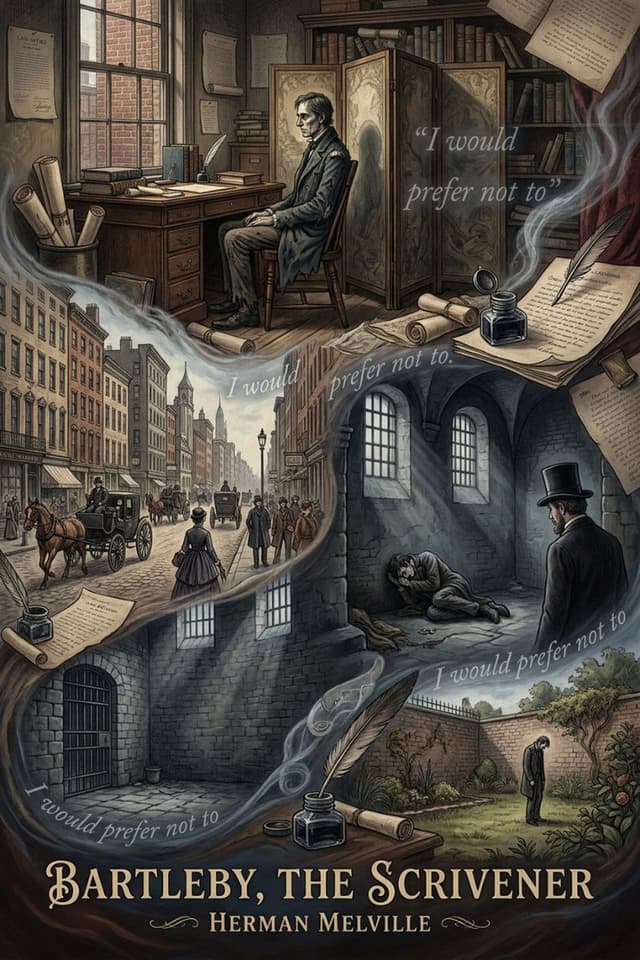
Bartleby, the Scrivener
Read Bartleby, the Scrivener by Herman Melville for free on Novelhalla, and try out our easy-to-read modern edition of this classic book. You can also download the EPUB and read it on any device if you prefer!
The Plot
The Office on Wall Street
An elderly lawyer runs a comfortable practice on Wall Street. He deals in mortgages, title deeds, and bonds. He is not a man of drama. He describes himself as one who, from his youth upward, has been filled with the conviction that the easiest way of life is the best. He is, in short, a man who does not like trouble.
His office is staffed by a small cast of characters who are trouble anyway. Turkey, his senior scrivener, is a decent worker in the mornings but turns red-faced and reckless after his noon meal, blotting documents and snapping at everyone. Nippers, the younger scrivener, is the reverse: useless before lunch due to chronic indigestion but perfectly productive in the afternoons. And Ginger Nut, the twelve-year-old errand boy, spends most of his time fetching little cakes for the other two.
The system works. Barely. But the lawyer needs more help, so he puts out an advertisement.
The New Hire
A young man appears at the office door. He is pale, neat, quiet, and pitiably respectable. His name is Bartleby. The lawyer hires him on the spot, setting him up at a small desk facing a window that looks out on nothing but a brick wall, three feet away.
At first, Bartleby is extraordinary. He copies documents ceaselessly, silently, as though starving for something to do. He produces enormous quantities of work. The lawyer is delighted.
Then one day, the lawyer asks Bartleby to help examine a copied document for errors. It's a routine request, something every scrivener does as a matter of course.
Bartleby, without looking up, replies: "I would prefer not to."
The Preference
The lawyer is so stunned that he can't even respond. He must have misheard. He asks again. Bartleby repeats himself, calmly and without hostility. He would prefer not to.
This is where the story becomes something no one expects. Because Bartleby doesn't stop there. Over the following days and weeks, he prefers not to examine documents. He prefers not to run errands. He prefers not to answer questions about himself. Each time, the refusal is delivered in the same mild, immovable tone. There's no anger, no explanation, no negotiation.
The lawyer cycles through frustration, bewilderment, pity, rationalization, and something close to awe. He keeps trying to reason with Bartleby. He keeps failing. The other employees are baffled and outraged. And somehow, impossibly, Bartleby stays.
The Discovery
One Sunday morning, the lawyer stops by the office and finds the door locked from inside. Bartleby is there. Bartleby is living in the office. He has been sleeping at his desk, eating nothing but ginger nut cakes, and spending his Sundays staring at dead walls.
The lawyer is flooded with a complex, uncomfortable emotion. Something about this pale, solitary figure triggers a recognition he can't quite name. Pity. Guilt. Fear. Bartleby has no friends, no family, nowhere to go, nothing. And something about his stillness makes the lawyer feel implicated in it.
The Escalation
Then Bartleby stops writing altogether. He simply stands at his window, gazing at the wall. He prefers not to copy. He prefers not to do anything at all. But he also prefers not to leave.
The lawyer tries everything. Reason. Bribery. Stern commands. Gentle appeals. Nothing works. Bartleby is polite. Bartleby is immovable. And Bartleby's presence begins to unravel the lawyer's carefully ordered life in ways he never anticipated.
Business associates start asking questions. The lawyer's professional reputation is at stake. He needs Bartleby gone, but Bartleby will not go. And the lawyer, for reasons he cannot fully explain even to himself, cannot bring himself to have the man forcibly removed.
What follows is a slow, strange escalation that becomes almost absurd, almost heartbreaking, and finally something much darker. The five quiet words that Bartleby keeps repeating turn out to be the most unsettling sentence in American literature. And the question the story ultimately asks has no comfortable answer: what do we owe someone who has simply stopped participating in the world?
About the Author: Herman Melville
A Boy Made by Disaster
Herman Melville was born in New York City on August 1, 1819, the third of eight children. His father, Allan Melvill, was an importer of French dry goods who lived beyond his means and borrowed constantly from relatives to maintain the appearance of prosperity. When the business collapsed, the family relocated to Albany. Allan Melvill died in 1832, bankrupt and apparently mentally unraveling. Herman was twelve.
The family added an "e" to their surname after Allan's death. The children were pulled from school and sent to work. Herman clerked at a bank, worked in his brother's fur and cap store, and taught at local schools. His formal education was fractured and incomplete, but he read voraciously on his own.
The Sea Years
In 1839, at nineteen, Melville shipped out as a cabin boy on a merchant vessel bound for Liverpool. It was the beginning of a period of seafaring that would define his literary career. In 1841, he signed on to a whaling ship called the Acushnet. Eighteen months later, unable to bear the conditions on board, he and a friend deserted in the Marquesas Islands and spent weeks living among the Typee people, a group rumored (with some exaggeration) to be cannibals.
He escaped on an Australian whaler, participated in a minor mutiny in Tahiti, worked odd jobs in Hawaii, and finally enlisted in the U.S. Navy, arriving back in Boston in 1844 with enough stories to fill a shelf of books.
The Rise
Melville turned his adventures into fiction almost immediately. Typee (1846) and Omoo (1847) were exotic, accessible tales of South Seas adventure, and both were popular successes. He married Elizabeth Shaw in 1847 and seemed set for a comfortable literary career.
But Melville's ambitions were growing. He wanted to write something bigger, stranger, more philosophically daring. He met Nathaniel Hawthorne in 1850, and the friendship electrified him intellectually. He threw himself into what would become Moby-Dick, a novel that combined whaling adventure with metaphysical obsession on a Shakespearean scale.
The Fall
Moby-Dick was published in 1851 to mixed reviews and dismal sales. It sold about 3,000 copies in Melville's lifetime. The book that would eventually be called the Great American Novel was out of print when he died.
His next novel, Pierre (1852), was savaged by critics. Some thought Melville had lost his mind. His publisher refused him further advances. Desperate for income, Melville turned to short stories for magazines, producing some of his finest work during 1853 to 1856, including this story. But the money was never enough. He tried lecturing, failed at that too, and eventually took a job as a customs inspector on the New York docks, a position he held for nineteen years.
The Quiet End
Melville's later life was marked by depression, family tragedy, and near-total literary obscurity. His eldest son Malcolm died of a self-inflicted gunshot wound in 1867 at the age of eighteen. His younger son Stanwix drifted and died in 1886. Melville kept writing, mostly poetry, but published little and was read by almost no one.
He died on September 28, 1891. A brief obituary in the New York Times misspelled his name. He left behind an unfinished manuscript in a tin breadbox. It was called Billy Budd.
The Resurrection
In 1919, the centennial of Melville's birth triggered a scholarly rediscovery. By the 1920s, Moby-Dick was being hailed as a masterpiece. Billy Budd was published in 1924 to acclaim. The Melville revival had begun in earnest, and it never stopped. He is now considered one of the greatest American writers who ever lived, a man who spent his career speaking to an audience that hadn't been born yet.
Fun Facts About the Book
Published Anonymously in Two Parts
The story first appeared in Putnam's Monthly Magazine in November and December of 1853, without Melville's name attached. It was later collected in The Piazza Tales in 1856. At the time, Melville was publishing magazine fiction to keep the lights on, and this story was just another piece of work for hire.
Written in the Wreckage of Moby-Dick
By 1853, Melville was in serious financial trouble. Moby-Dick had flopped. Pierre had been destroyed by critics. He owed money to his publisher, Harper and Brothers. Some scholars believe the story is partly autobiographical, a portrait of a writer who, like his protagonist, has decided he would prefer not to keep producing work for an audience that doesn't want it.
A Scrivener Is a Human Photocopier
The job title in the subtitle might be unfamiliar to modern readers. A scrivener was a law-copyist, someone whose entire job was to copy legal documents by hand, word for word, all day long. It was repetitive, soul-crushing work that required precision but no thought. The profession was about to be made obsolete by new copying technologies. Bartleby's job is, in a real sense, already dead before the story begins.
The Dead Letter Office
Near the end of the story, the lawyer mentions a rumor that Bartleby previously worked in the Dead Letter Office, the branch of the post office where undeliverable mail was destroyed. Letters that never reached their recipients. Messages from the living that arrived after the intended reader had died. It's a detail Melville drops almost casually, but it reframes everything.
"I Would Prefer Not To"
Five words. Possibly the most famous refusal in literary history. The phrase has been analyzed by philosophers, linguists, legal scholars, and political theorists. Gilles Deleuze wrote an entire philosophical essay about it. Giorgio Agamben wrote another. The sentence is perfectly grammatical and perfectly maddening. It's not a refusal exactly. It's not insubordination. It's something stranger, something the lawyer (and the reader) can never quite pin down.
Melville Couldn't Get a Job as a Scrivener Either
Before he went to sea, the young Melville tried and failed to find work as a legal copyist in New York. His biographers note that his handwriting was essentially illegible. There's a dark irony in the fact that he went on to write one of literature's most haunting stories about a man who copies for a living and then stops.
Walls Everywhere
The story is obsessed with walls. The office looks out on walls. Bartleby stares at a wall. The subtitle references Wall Street. Even the characters' emotional states are described in terms of barriers and enclosures. Melville never explains the symbolism directly, but it's impossible to miss once you start looking.
Side Characters
Turkey
The senior scrivener, about sixty years old. Sober and excellent in the mornings, he becomes flushed, erratic, and ink-splattered after lunch. The lawyer suspects drinking but never confirms it. Turkey is loyal and hardworking in his way but represents the kind of compromise people make with degrading work: you give it half your day and lose yourself for the other half.
Nippers
The younger scrivener, twenty-five, ambitious, and perpetually dissatisfied. His mornings are consumed by indigestion and fidgeting, but he settles into competence by afternoon. He's the perfect comic mirror to Turkey, and together they form a single functioning employee split across two bodies.
Ginger Nut
The twelve-year-old errand boy, son of a carman, sent to the office by his father to learn the law. In practice, he mostly fetches snacks. His nickname comes from the ginger nut cakes he supplies to the office. He's a small detail that quietly reinforces the story's interest in the gap between what work is supposed to be and what it actually is.
Themes
Passive Resistance
Bartleby doesn't fight. He doesn't argue. He doesn't explain himself. He simply declines. And this turns out to be more powerful than any confrontation. His quiet refusal paralyzes the lawyer and eventually disrupts an entire building. The story anticipates, by nearly a century, the philosophy of nonviolent resistance that would be articulated by Gandhi and Martin Luther King Jr.
The Alienation of Modern Work
Every character in this story is diminished by their labor. Turkey drinks. Nippers fidgets. Ginger Nut runs errands instead of learning. The scriveners' work is mechanical, uncreative, and slowly dehumanizing. Bartleby's refusal can be read as the logical endpoint: if the work strips you of everything, eventually there's nothing left to give.
Charity and Its Limits
The lawyer wants to be a good person. He genuinely pities Bartleby. But his charity is always complicated by self-interest, social pressure, and the basic limits of what one person is willing to sacrifice for another. The story asks hard questions about compassion: Is the lawyer generous or cowardly? Kind or self-serving? And does it matter, if the result is the same?
Walls and Isolation
The story is enclosed. The office looks out on walls. Bartleby faces a wall. Wall Street itself is named for a wall. Everywhere you look, there are barriers between people, between the self and the world, between intention and action. Whether these walls are imposed by society or by something inside Bartleby himself is a question the story refuses to answer.
The Unknowable Other
We never learn who Bartleby really is. The lawyer tries to understand him and fails. The reader tries and fails too. Melville gives us just enough to make us care and not enough to let us explain. Bartleby remains opaque, a figure who resists interpretation the same way he resists work. The story suggests that some people, and some forms of suffering, are simply beyond our capacity to comprehend.
The Book's Legacy
For decades, the story was largely overlooked, a minor piece by a forgotten author. The Melville revival of the 1920s changed everything. As critics rediscovered Moby-Dick, they also found the shorter works, and this story quickly became recognized as one of the greatest short stories in the English language.
It has been read as a parable about capitalism, depression, free will, civil disobedience, existentialism, and the writing life. Philosophers Gilles Deleuze and Giorgio Agamben each wrote major essays devoted to interpreting Bartleby's phrase. The story has been adapted into multiple films, referenced in novels from Stephen King to Enrique Vila-Matas, and invoked in political movements as a symbol of refusal.
The character has become a cultural shorthand. To "pull a Bartleby" is to quietly, politely, and devastatingly opt out. In an age of burnout, quiet quitting, and questions about what we owe our employers and what they owe us, the story feels more relevant than ever. Melville wrote it in 1853, broke and failing, about a man who stops working in an office on Wall Street. It reads like it was written yesterday.