Novelhalla
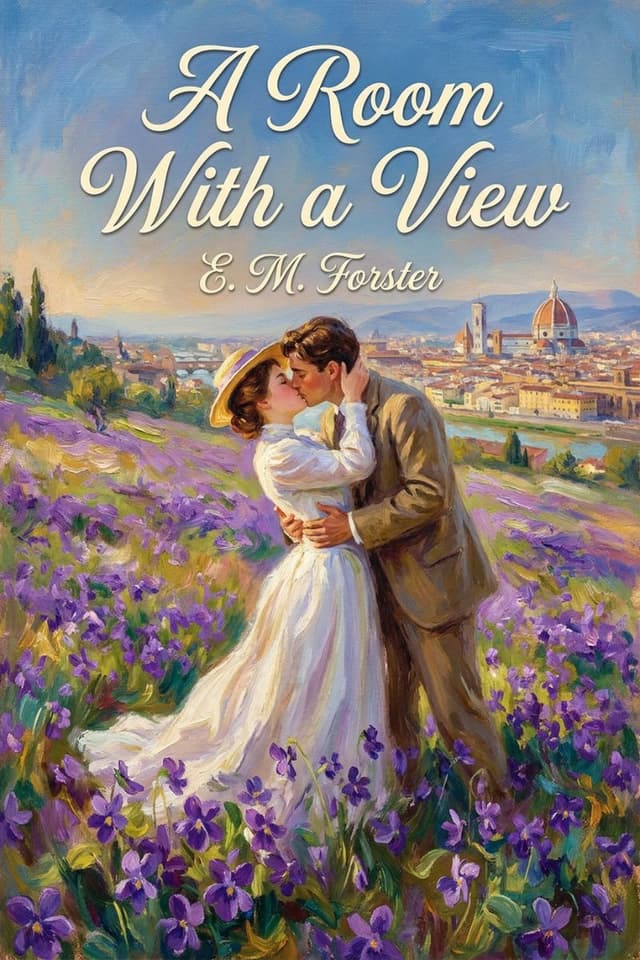
A Room With a View
Read A Room With a View by E. M. Forster for free on Novelhalla, and try out our easy-to-read modern edition of this classic book. You can also download the EPUB and read it on any device if you prefer!
The Plot
A Disappointing Arrival
Lucy Honeychurch is a young Englishwoman on her first trip to Italy, and so far it isn't going well. She and her older cousin Charlotte Bartlett, who's come along as her chaperone, have just arrived at the Pension Bertolini in Florence. They were promised rooms facing the River Arno. Instead they've got rooms looking out on a courtyard, the landlady is a Cockney, and the whole place feels like a little piece of London that somebody accidentally dropped in Tuscany.
At dinner, Charlotte grumbles about it. And then an old man at the next table does something shocking. Mr. Emerson, a blunt, kindly, decidedly unfashionable fellow, simply offers to trade. He and his son George have river views, and they don't care about them. Why not swap?
To Charlotte, this is an outrage. Accepting a favor from strange men just isn't done. The other English guests agree that the Emersons are not quite the right sort of people. But the kindly clergyman Mr. Beebe smooths things over, and Lucy gets her view, along with the uneasy feeling that she's now somehow in debt to the odd, quiet son.
Florence Wakes Her Up
Lucy has been raised to be pleasant, proper, and agreeable, and to keep her real feelings for the piano, where she plays Beethoven with a passion that surprises everyone. But Florence has a way of shaking people loose. There's Miss Lavish, a bohemian novelist who drags Lucy through the back streets and then abandons her in a church without her guidebook. There's the Reverend Mr. Eager, who knows everything about art and nothing about kindness. And there's George, who seems to brood about the meaning of life every time she sees him.
Then one afternoon in the Piazza della Signoria, Lucy witnesses something violent and sudden, and her legs give way. When she comes to, George Emerson is the one holding her. On the walk home, something passes between them that neither of them knows how to talk about. He throws her parcel into the river, and she can't figure out why.
A Field of Violets
A carriage outing to the hills above Fiesole was supposed to be a pleasant day of scenery. But the Italian driver has his own ideas about romance, Lucy goes wandering alone, and the ground suddenly falls away into a terrace covered in violets. George is standing there, looking out over the view.
What happens in that moment sends Charlotte into a panic and the two cousins out of Florence on the first train they can catch, with a promise to keep the whole thing secret.
Home to Surrey
Back home at Windy Corner, her family's comfortable house in the English countryside, Lucy has made a sensible decision. She's engaged to Cecil Vyse, a cultured, sophisticated Londoner who knows all about art and books and has very firm ideas about how Lucy ought to improve herself. Her mother is pleased. Her rowdy younger brother Freddy can't stand him. Lucy insists she's very happy.
Then Cecil, thinking it a clever joke on the local gentry, arranges for a pair of eccentric strangers he met in a museum to rent a villa in the village. Their name is Emerson. Lucy's carefully arranged life is about to get very crowded, and the secret she promised to bury in Italy has just moved in down the road.
About the Author: E. M. Forster
Early Life
Edward Morgan Forster was born in London on New Year's Day, 1879. His father, an architect, died of tuberculosis before Morgan was two, and he was raised by his devoted mother, Lily, along with a household of aunts and a grandmother. He spent his happiest childhood years at Rooksnest, a rented house in Hertfordshire that he'd later turn into the setting of Howards End.
A great-aunt, Marianne Thornton, left him a legacy that gave him financial independence, which meant he could become a writer without having to scramble for a living. School was another story. He was miserable at Tonbridge, where he felt like an outsider among boys obsessed with sports and status, and he later poured that distaste for stuffy English institutions into his fiction.
Cambridge and Italy
At King's College, Cambridge, everything changed. Forster found friends, ideas, and the freedom to think for himself. He was elected to the Apostles, a famous secret discussion society, and he came away with a lifelong belief in personal relationships, honesty, and the life of the mind.
After graduating, he traveled through Italy with his mother in 1901 and 1902. They stayed in pensions full of English tourists, and Forster watched them carefully. That trip gave him the raw material for his first two Italian novels.
The Novelist
Forster published four novels in just six years: Where Angels Fear to Tread (1905), The Longest Journey (1907), this novel (1908), and Howards End (1910), which made him famous and gave the world his motto, "Only connect." During World War I he volunteered with the Red Cross in Alexandria, Egypt. Trips to India led to A Passage to India (1924), widely considered his masterpiece.
And then, at the height of his reputation, he stopped writing novels. He lived another forty-six years without publishing a new one. He said he'd simply run out of things he wanted to say in that form.
Later Life
Forster stayed busy as an essayist, critic, broadcaster, and defender of free speech. His lectures on fiction, Aspects of the Novel, are still read by writers today. He turned down a knighthood but accepted the Order of Merit in 1969. He spent his later years living in rooms at King's College, Cambridge, where students would drop by to chat with the famous old man. He died in 1970 at ninety-one. One more novel, Maurice, which he'd written decades earlier and chose not to publish, appeared the year after his death.
Fun Facts About the Book
His First Novel, Published Third
Forster started this novel before any of his others, during his 1901 to 1902 trip to Italy when he was just twenty-two. He kept setting it aside, wrote and published two other novels in the meantime, and kept coming back to it. It finally came out in 1908, about seven years after he began.
The Lucy Novels
The early versions of the story went through several very different drafts that scholars call "the Lucy novels." They were eventually published in 1977, so curious readers can see how Forster's ideas about these characters shifted over the years.
A Real Pension on the Arno
The Pension Bertolini was inspired by the real Florentine lodgings where Forster and his mother stayed, with their crowd of gossiping English guests. Forster studied his fellow tourists closely, and many of them clearly ended up in the book.
The Real Miss Lavish
The flamboyant novelist Miss Lavish was based on a writer named Emily Spender, whom Forster and his mother met on their travels. She apparently swept around in a military cape and smoked thin cigars in the pension's smoking room.
Making Fun of the Guidebook
English tourists of the period carried Baedeker guidebooks everywhere and treated them almost like scripture. Forster pokes fun at this constantly, including a chapter title that announces Lucy is in the church of Santa Croce without her Baedeker, as if that were a scandal in itself.
Playful Chapter Titles
The chapters have wonderfully odd titles, like "Fourth Chapter," "Lying to George," and "Twelfth Chapter," which hides one of the funniest and most famous scenes in the book. The titles give the whole novel a lighthearted, slightly mischievous feel.
His Sunniest Book
Forster's other novels tend toward the serious and even the tragic. This one is a comedy at heart, bright and warm, and it's often called the most cheerful and optimistic thing he ever wrote.
Beethoven Tells the Truth
Lucy's piano playing is a running clue throughout the book. Mr. Beebe notices early on that when she plays, she seems like an entirely different, much braver person, and he wonders what would happen if she ever started living the way she plays.
Themes
Convention Versus Passion
The big question of the book is whether Lucy will live by the rules she's been taught or by what she actually feels. Forster has a lot of fun showing how silly, fussy, and suffocating "proper" behavior can be, and how much courage it takes to stop pretending.
Seeing Clearly
Views are everywhere in the novel: rooms with views, rooms without them, hillside panoramas, and people who look at the world only through a guidebook or a picture frame. The real question is whether Lucy can learn to see her own life clearly and honestly.
The Muddle
Old Mr. Emerson warns Lucy about getting into a "muddle," his word for the confusion that happens when people don't admit what they really feel or want. A lot of the comedy, and a lot of the heartache, comes from characters lying to others and, worse, to themselves.
Snobbery and Class
Almost everyone in the book is judging somebody else. The guests at the pension look down on the Emersons, Cecil looks down on Lucy's family, and nearly everyone looks down on somebody. Forster skewers all of it, and the characters who care least about status often turn out to be the most decent.
Italy and England
Italy stands for warmth, spontaneity, beauty, and life lived out loud. England stands for tea, tennis, and keeping a stiff upper lip. Forster loves both, but he clearly thinks the English could stand to learn a thing or two from the Italians.
Growing Up
At its core, this is a coming-of-age story about a young woman figuring out who she is. Lucy starts the book doing what everyone expects of her. The question is whether she'll ever find the nerve to make her own choices.
The Book's Legacy
Forster's lightest novel has become one of his most beloved. Readers keep coming back to it for its sharp, funny portraits of English tourists, its gorgeous Florentine setting, and its warm, hopeful heart. It's often listed among the greatest English novels of the twentieth century and appeared on the Modern Library's list of the hundred best English-language novels.
The 1985 Merchant Ivory film, starring Helena Bonham Carter as Lucy, Maggie Smith as Charlotte, Daniel Day-Lewis as Cecil, and Julian Sands as George, was a huge success. It won three Academy Awards, including Best Adapted Screenplay for Ruth Prawer Jhabvala, and helped launch a whole wave of lush period films. It's also credited with sending countless tourists to Florence looking for their own rooms overlooking the Arno.
The story has since been adapted for television in 2007, as well as for the stage, including a musical version. Its influence shows up all over romantic comedy, where the formula of a heroine choosing between the "suitable" partner and the one who makes her feel truly alive owes a lot to Lucy Honeychurch.
More than a century later, the novel still speaks to anyone who's ever felt stuck living the life other people expected of them and wondered what it would take to throw open the window.