Novelhalla
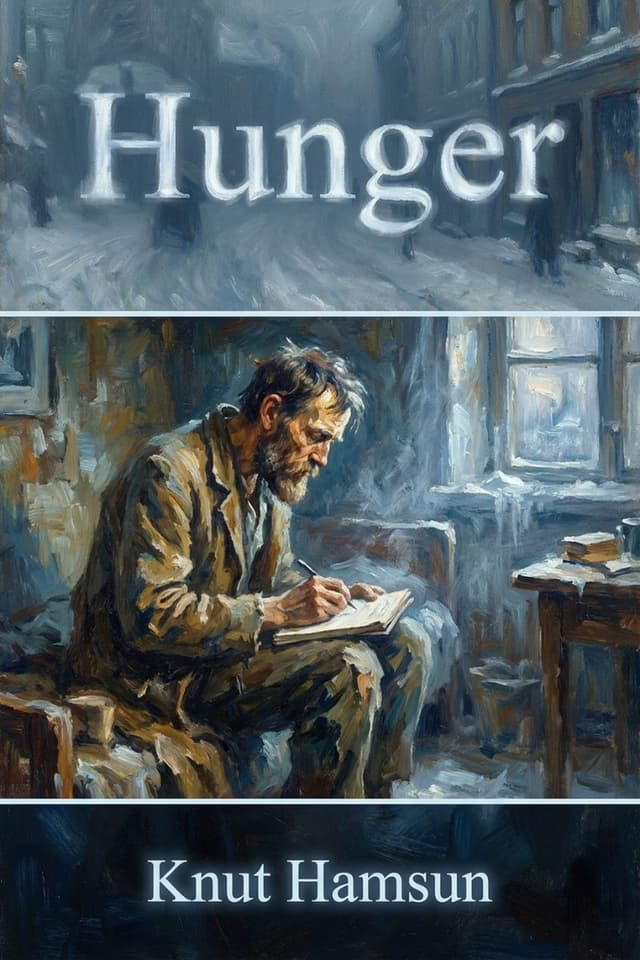
Hunger
Read Hunger by Knut Hamsun for free on Novelhalla, and try out our easy-to-read modern edition of this classic book. You can also download the EPUB and read it on any device if you prefer!
The Plot
The City That Marks You
The book opens with a man lying awake in a rented attic room in Kristiania, the city that would later be renamed Oslo, and it tells you straight away that nobody leaves this place without being marked by it. He's young, he's a writer, and he hasn't eaten in a while.
That's the whole setup. There's no inheritance plot, no murder, no mystery. A man is hungry in a city, and he walks around in it, and you're inside his head the entire time. It shouldn't work. It's one of the most gripping books ever written.
A Man With a Pencil and No Bread
He has talent, or believes he does, and he has a plan: sell an article to a newspaper, get paid, eat, rent the room another week, write something greater. Sometimes it even works. He sells a piece, gets some coins, and for one glorious afternoon he's a man of means.
Then he gives the money away. To a beggar, or a child, or a woman selling cakes who he decides has been cheated. He does this over and over. He turns down food. He confesses to crimes he hasn't committed. He lies elaborately to strangers for no reason he can explain afterward, inventing whole identities on the spot, then walks away burning with shame and does it again the next day.
The awful comedy of the book is that he keeps rescuing himself and then quietly, deliberately dismantling the rescue. He has a private code of honor that only he can see, and he'd rather starve than break it, and starving is exactly what breaks his mind.
Because that's the other thing happening here, in real time, page by page. As his body fails, his thinking goes strange. He invents words and becomes convinced they mean something. He rages at God for singling him out. He gets giddy, then euphoric, then vicious, then tender. He gnaws on a wood shaving. He considers his own finger. And through all of it he's still, doggedly, trying to write something brilliant, because he refuses to be a man who takes an ordinary job.
The Woman He Names Ylajali
Then, on the street one evening, he falls into step with a woman.
He doesn't know her. He tells her something ridiculous and untrue as an opener, and instead of walking away she's intrigued, and something starts. He gives her a name he makes up on the spot, a name with a soft gliding sound: Ylajali. She has no idea he's starving. She sees a strange, intense, well-spoken young man with an unusual mind.
He now has one thing in the city that could still go right for him. He is also, by this point, a man in a coat he's had to sell pieces off of, who hasn't eaten properly in days, whose grip on what's real is loosening by the hour.
You will spend the rest of the book waiting to find out what he does with her, and dreading it.
The Spiral
There's a night when he has nowhere to sleep and talks his way into a police cell by pretending to be a respectable journalist who has misplaced his keys, giving a false name that stands as the only name anyone in the novel attaches to him. In the morning there's free breakfast for the homeless, and he can't bring himself to take it, because taking it would mean admitting what he is.
That's the engine of the whole book. Every door out requires him to say one true sentence about himself, and he cannot make himself say it.
Winter is coming into the city. The room is running out. The pencil is nearly all he owns. And he is still, somehow, sure that he's about to write something that will change everything.
About the Author: Knut Hamsun
The Boy From the Post Office
He was born Knud Pedersen in 1859 in Gudbrandsdal, in central Norway, the fourth of seven children in a poor family that moved north to Hamarøy when he was small. At nine he was sent to live with an uncle and work in his post office, an arrangement he later described as brutal. He got almost no formal schooling.
By fourteen he was working. Shoemaker's apprentice, peddler, itinerant schoolteacher, sheriff's assistant, road laborer. He wrote in whatever hours he had and published his first attempts in his early twenties without making any impression at all.
The American Years
Twice he went to the United States, first from 1882 to 1884 and again from 1886 to 1888, chasing a living. He worked as a farmhand in North Dakota, as a streetcar conductor in Chicago, as a journalist in Minneapolis. He did not enjoy it. He came home with a fierce dislike of American materialism and wrote a book attacking it.
His name comes from this period, and from a mistake. He published an article signing himself with a version of his family farm's name, Hamsund, and the printer dropped the final letter. He kept it.
The Breakthrough
In late 1888, back in Copenhagen and genuinely destitute, he pawned his coat to pay for an attic room and brought a thirty page manuscript to an editor. It ran anonymously in a Danish journal that November and caused an immediate sensation across Scandinavia. It sold out in three days. He was told to go away and finish the thing, moved to a poor district of Kristiania, and did.
When the complete novel appeared in 1890 it made him famous at thirty-one, and he spent the next few years touring Norway giving lectures attacking Ibsen and the entire older generation of Norwegian literature for writing characters who were too consistent, too explicable, too much like types. What he wanted instead, he said, was to write the whisper of the blood and the pleading of the bone marrow.
He got his wish. Mysteries followed in 1892, Pan in 1894, Victoria in 1898, and a long, prolific career after that. In 1920 he won the Nobel Prize in Literature, largely on the strength of Growth of the Soil, a very different book about farming and rootedness.
The Fall
And then there's the rest of it, which can't be skipped.
Hamsun spent decades as an outspoken opponent of England, of cities, of industry, and of democracy, and an admirer of Germany. When Germany occupied Norway in 1940 he supported the occupation publicly and repeatedly, urging his countrymen not to resist. He backed Vidkun Quisling's collaborationist government. In 1943, after meeting Joseph Goebbels, he mailed him his Nobel medal as a gift, and its whereabouts are still unknown. He met Hitler in person, an audience that reportedly consisted largely of Hamsun complaining about how Germany was treating Norwegians. When Hitler died in 1945, Hamsun wrote him a glowing obituary.
He was arrested after the war, held partly in a psychiatric institution, and eventually tried not for treason but in a civil action, in December 1947, at eighty-eight and nearly deaf. He was ordered to pay an enormous sum in damages. He died in 1952, having wrecked his standing in his own country so thoroughly that Norway still hasn't finished arguing about him.
None of that is in this book, which was written half a century earlier by a starving young man in a rented room. Both things are true at once, and readers have been sitting uncomfortably with that for a hundred years.
Fun Facts About the Book
It Was a Hit Before It Was Finished
The thirty page fragment that ran anonymously in Ny Jord in November 1888 sold out the issue within days and got Scandinavia's literary world asking who'd written it. Hamsun then told his publisher he had three more pieces planned on the same theme and, with beautiful irony, that he was too poor to finish them.
He Was Living It
The pawned coat, the attic room, the walking, the pencil: this came out of Hamsun's own destitution in Kristiania and Copenhagen in the late 1880s. It isn't a memoir and the events aren't literally his, but the physiology of it is reported from inside.
The Narrator Has No Name
Across the whole novel nobody names him. The only name that appears is one he invents on the spot to lie to a policeman. For a book that lives entirely inside one person's head, that's a remarkable piece of nerve.
He Called It a Series of Analyses
Hamsun didn't think of it as having a plot and said so. What he wanted was the shifting mental states of a starving man, rendered one after another. That's why the book feels less like a story and more like weather passing through a person.
He Kept Rewriting It for Twenty-Six Years
The 1890 text wasn't final. Hamsun revised it for new editions in 1899, 1907, and 1916, tinkering with the language of the book that had made his name long after he'd stopped needing it to.
The English Version Has a Censorship Problem
The first English translation, in 1899, was by the Irish writer Mary Chavelita Dunne, who published under the name George Egerton. Her version is widely and wrongly said to have been prudishly cleaned up. It's actually the later commercial reprintings from 1921 onward that were quietly censored, cutting the narrator's sexual material and shedding a few pages in the process. Scholars who've compared them rate Egerton's original very highly and consider it in some ways bolder than the modern translations. If you're reading the free public domain text, it's worth making sure you have the uncut one.
The Title Character Is a Physical Process
Hamsun tracks starvation with unnerving accuracy: the euphoria, the irritability, the sudden vertiginous joy, the inability to eat when food finally arrives, the way the body wrecks the judgment and then the wrecked judgment wrecks the body. Physicians have remarked on how right he gets it. He got it right by being there.
It Has Been Filmed More Than Once
There's a Danish-Norwegian-Swedish adaptation from 1966, an American version from 2001, a 2012 Greek film that borrows its premise loosely, and a Norwegian graphic novel adaptation published in 2019.
Themes
Pride Is the Antagonist
Nothing in this book is trying to kill the narrator except the narrator. Help is available. Work is available. Charity is available. What he cannot do is be seen accepting any of it, and so the story becomes a study of a man whose self-image is more important to him than food. It is the most sympathetic and least flattering portrait of the artistic ego ever written.
Hunger as an Altered State
Starvation here isn't just suffering, it's an intoxicant. He gets highs off it. He has visions, invents language, feels enormous and chosen. Some of the best writing in the book is the narrator convinced that his sharpened, buzzing, malfunctioning mind is genius arriving at last.
The City as a Machine
Kristiania is full of food he can't buy, rooms he can't rent, and people who look right through him. It's an early and merciless picture of what a modern city does to someone with no money in it: not cruelty exactly, just total indifference, which turns out to be worse.
Arguing With God
He doesn't blame society and he doesn't blame the rich. He blames God, personally and by name, for having picked him out for special punishment. It gives the book an odd theological fury that sits strangely alongside its grubby realism.
The Unreliable Self
Hamsun's whole literary program was that people aren't consistent, and his narrator changes his mind, his mood, and his personality from paragraph to paragraph without explanation. That was the innovation. Almost every interior novel of the last century runs on the engine he built here.
The Book's Legacy
This is frequently called the first modern novel, or the literary opening of the twentieth century, and the claim is easier to defend than most such claims. It appeared in 1890, before Joyce, before Kafka, before Proust, and it already does the thing they're famous for: it abandons plot and social commentary and puts you inside one unstable consciousness for the duration.
Isaac Bashevis Singer called Hamsun the father of modern literature and named Thomas Mann, Schnitzler, Fitzgerald, and Hemingway as writers working in his wake. The line of descent runs on through Kafka, Henry Miller, Bukowski, Paul Auster, and basically every novel since about a broke young person walking around a city being brilliant and useless.
Its afterlife is complicated by the man who wrote it, and that complication is permanent. Norway kept reading him and kept flinching. The rest of the world has mostly settled into reading this book as the work of a twenty-nine year old who had genuinely been hungry and who could not yet have imagined the old man he'd become.
What keeps it alive isn't its historical importance, though. It's that the voice is still electric. It's funny, which nobody expects. It moves fast. And the narrator's mixture of arrogance, tenderness, self-sabotage, and sheer manic energy feels less like a nineteenth century artifact than like someone talking directly at you, right now, in a city where nobody knows his name.