Novelhalla
The Rosary
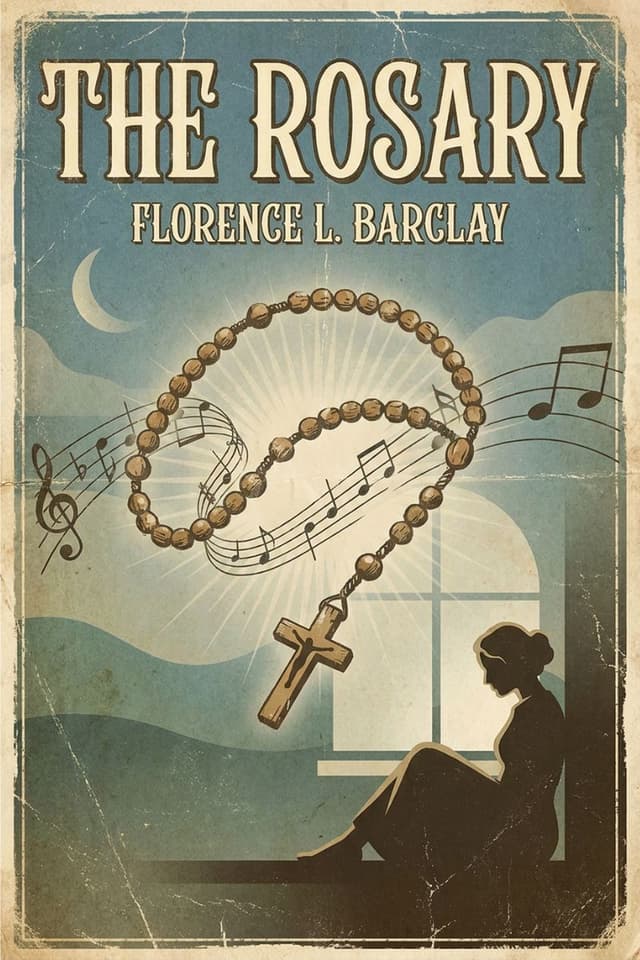
Read The Rosary by Florence L. Barclay for free on Novelhalla, and try out our easy-to-read modern edition of this classic book. You can also download the EPUB and read it on any device if you prefer!
The Plot
The House Party
The Duchess of Meldrum is hosting one of her legendary gatherings at Overdene, and the guest list glitters. Artists, socialites, minor aristocracy. Among them is Garth Dalmain, a young painter with a reputation for worshipping beauty in all its forms. He is charming, wealthy, talented, and so impossibly handsome that half the women in Edwardian England have set their sights on him.
And then there is Jane Champion. The Duchess's niece. Thirty years old. Tall, broad-shouldered, plainly dressed, and entirely at ease with the fact that she is not, by any conventional measure, beautiful. Jane is smart, funny, fiercely capable, and treated by most of the men in her circle the way you'd treat a good chum. She's the one they confide in about the women they actually want to marry. She knows exactly where she stands.
Jane and Garth are friends. Easy, comfortable friends. He tells her things he wouldn't tell anyone else, and she listens with the quiet steadiness that defines her. There is nothing romantic about it. Not as far as Jane can tell.
Then the evening's entertainment falls apart.
The Song
The professional singer cancels at the last minute, and in a pinch, Jane is persuaded to step in. She takes her place at the front of the room and sings a song called "The Rosary." It is a simple, devastating piece about love and memory and loss, and Jane sings it with a voice so rich, so achingly beautiful, that the room goes still.
Garth Dalmain, the man who has spent his entire life in love with beautiful things, hears that voice and something inside him shifts. He doesn't fall in love with Jane in spite of her plainness. He falls in love with her because of what he hears in that song: the depth, the tenderness, the soul that no one else has bothered to see. The veil, as he later puts it, is lifted.
He proposes. And Jane, who loves him desperately, says no.
The Refusal
Here is Jane's logic, and it is merciless: Garth is an artist. His whole life revolves around beauty. He sees beauty in everything, and he needs it the way other people need air. She believes, with the certainty of a woman who has spent thirty years being overlooked, that his love cannot survive what she looks like. He thinks he loves her now, but one day he will wake up beside her and see only what everyone else sees. And that will destroy them both.
So she lies. She tells him the age difference matters, that he is too young for her. She watches the light go out of his face. And then she leaves the country.
Jane travels the world. Egypt. The pyramids. The long, punishing emptiness of distance. She tells herself she did the right thing. She almost believes it. Months pass, and the ache does not lessen. It grows.
And then, just as she begins to reconsider, just as she allows herself to think that maybe she was wrong, a letter arrives with news that changes everything.
The Accident
Garth Dalmain has been blinded. A shooting accident. The man who built his entire world around what he could see will never see again.
Jane wants to go to him immediately. She wants to take back every word, cross every mile between them, and tell him what she should have said the night he proposed.
But Garth will not see her. That is, he will not allow her to come. He has sent word through their mutual friend, Dr. Deryck Brand, that he wants Jane's love or nothing. He will not accept her pity. He will not let her come to him out of guilt or obligation. If she didn't love him enough to marry him when he could see, he doesn't want her now that he can't.
It is the most painful kind of pride, and Jane has no idea how to break through it.
Nurse Rosemary
What Jane does next is either the bravest or the most reckless thing she has ever done. With the help of Dr. Brand, she takes on a false identity. She becomes Nurse Rosemary Gray and arrives at Garth's estate in the Scottish Highlands to care for him.
He doesn't know it's her.
What follows is a slow, agonizing, impossibly tender deception. Jane tends to Garth every day, speaks to him in a voice she tries to disguise but that keeps slipping toward familiarity. Garth is drawn to his nurse in ways he can't explain. Something about her presence calms him. Something about her voice tugs at a memory he can't quite reach. He begins to trust her, to open up to her, to show her the man he is becoming now that the world he knew has gone dark.
Jane watches the man she loves learn to live without the one thing that defined him. She watches him grieve, and rage, and slowly, painfully begin to rebuild. She is right there beside him, close enough to touch, and he has no idea.
The question that hangs over every scene, every conversation, every accidental brush of a hand is this: what happens when he finds out? Will the deception feel like betrayal or like proof that she loved him all along? Can a love built partly on a lie survive the truth?
And underneath that, the deeper question: was Jane right the first time? Did Garth need to lose his sight before he could truly see her?
About the Author: Florence L. Barclay
A Rector's Daughter
Florence Louisa Charlesworth was born on the island of Jersey in 1862, the daughter of an Anglican rector. She grew up in a world of churches and parish life, first in Surrey and then in Limehouse, in London's East End, where her family moved when she was seven. One of three sisters, Florence showed early musical talent but ultimately set aside thoughts of a musical career. Her sister Maud would go on to co-found the Volunteers of America and become a Salvation Army leader, a fact that suggests the Charlesworth sisters were not given to small ambitions.
Marriage and Motherhood
In 1881, Florence married the Reverend Charles W. Barclay, her father's curate. The couple honeymooned in the Holy Land, where they reportedly discovered the site of Jacob's Well at Shechem. They settled in Hertford Heath, Hertfordshire, where Florence spent decades as a rector's wife, managing the household, tending to parish duties, and raising eight children.
It was a full life and a quiet one. Florence did not begin her writing career until illness forced her into stillness.
A Late Bloom
In her early forties, health problems left Florence bedridden for an extended period. To pass the time, she began writing fiction, producing her first novel, The Wheels of Time. Her second novel, The Rosary, was published in 1909 and became an immediate sensation. By 1910 it was the bestselling novel in the United States, according to the New York Times.
Florence wrote eleven books in total. The Mistress of Shenstone was adapted into a silent film in 1921. But it was The Rosary that defined her career, translated into eight languages and adapted into five motion pictures. She died in 1921 at the age of fifty-eight. That same year, one of her daughters published an anonymous biography titled The Life of Florence Barclay: A Study in Personality.
Fun Facts About the Book
Named After a Hit Song
The novel takes its title from "The Rosary," a hugely popular song composed by Ethelbert Nevin with words by Robert Cameron Rogers, first performed in 1898. The song was one of the biggest sheet music sellers of the early twentieth century, moving over 2.6 million copies by 1928. In the novel, it is the song Jane sings at the fateful house party, and its themes of love, memory, and loss thread through the entire story. The novel's success, in turn, boosted the song's already enormous sales even further.
The Bestseller of 1910
The Rosary was the number one bestselling novel in the United States in 1910, and it stayed on bestseller lists for years afterward. More than twenty-five years after its initial publication, Sunday Circle magazine serialized the story for a new generation of readers, and in 1926 the French playwright Alexandre Bisson adapted it as a three-act play for the Parisian stage. For a novel by a rector's wife from Hertfordshire, the reach was extraordinary.
Five Film Adaptations
The novel inspired five separate film adaptations across multiple countries and languages, including the 1934 French film Le Rosaire and the 1944 Mexican production El Rosario. Few novels of the era generated that kind of international cinematic interest, and fewer still from authors who came to writing as late in life as Barclay did.
The Jane Eyre Connection
Readers have drawn comparisons to Charlotte Bronte's Jane Eyre since The Rosary first appeared. Both novels feature a plain heroine of fierce inner strength, a proud and passionate hero who is blinded, and a love story that can only reach fulfillment after both characters are stripped of the defenses they hide behind. Barclay's spin on the formula puts the heroine's insecurity, rather than external obstacles, at the center of the conflict.
An Older Heroine
At thirty, Jane Champion was an unusually mature heroine for Edwardian romance fiction. She is also taller, broader, and more physically imposing than the hero, which Barclay treats not as a flaw to be overcome but as a fact of life that Jane navigates with humor and dignity. For readers in 1909, Jane's body was as unconventional as her independence.
The Disguise Plot
The second half of the novel hinges on a bold deception that divided readers then and continues to divide them now. Some find Jane's decision to pose as Nurse Rosemary Gray deeply romantic, a woman willing to do anything to be near the man she loves. Others find it troubling, a violation of trust built on the assumption that she knows what's best for someone else. Barclay was clearly aware of the tension, and she leans into it rather than resolving it neatly.
Themes
Beauty and Worth
The novel's central question is whether a man who worships beauty can truly love a plain woman. Jane believes the answer is no, and she builds an entire fortress of self-protection around that belief. But Barclay complicates the question at every turn. Garth's love for beauty is real, but so is his capacity to see beyond it. The novel asks whether beauty is something you look at or something you recognize.
Pride as Self-Destruction
Both Jane and Garth are crippled by pride long before Garth loses his sight. Jane's pride tells her she isn't worth loving. Garth's pride tells him he won't accept love he hasn't earned on his own terms. They are both wrong, and they both pay for it in years of loneliness. Barclay is gentle but unsparing about the damage people do to themselves in the name of dignity.
Faith and Surrender
The Rosary is, quietly, a deeply religious novel. Barclay was a rector's wife, and her characters navigate their suffering through faith. The idea that runs beneath the surface of the story is that love, real love, requires a kind of surrender that looks a lot like prayer. You have to stop trying to control the outcome. You have to trust something beyond yourself.
Seeing and Knowing
Garth's blindness is not just a plot device. It is the novel's great metaphor. When he could see, he was dazzled by surfaces. When he can't, he is forced to know people by their voices, their hands, their presence. The novel suggests that true intimacy requires a kind of darkness, a willingness to stop looking and start listening.
The Cost of Self-Sacrifice
Jane's refusal of Garth is framed as selfless, but the novel slowly reveals it as something more complicated. By deciding for Garth what he can and cannot love, she takes away his choice. The Rosary is surprisingly modern in its recognition that self-sacrifice can be its own form of control, and that sometimes the bravest thing you can do is let someone love you.
The Book's Legacy
The Rosary was a publishing phenomenon in its time, outselling nearly every novel of the decade and generating a cultural footprint that stretched across continents and languages. It made Florence Barclay one of the most widely read English novelists of the early twentieth century, though her fame faded relatively quickly after her death.
The novel's influence can be traced in the DNA of twentieth-century romance fiction, particularly in stories that pair unconventionally attractive heroines with heroes who must learn to see beyond the surface. Its themes of disguise, pride, and second chances have echoed through countless romance novels since.
For modern readers, The Rosary offers something rare: a love story that takes seriously the question of whether two people who are obviously meant for each other can still get it catastrophically wrong. Jane and Garth are not kept apart by villains or circumstance. They are kept apart by their own fear. And the novel's power comes from the slow, excruciating possibility that fear might win.