Novelhalla
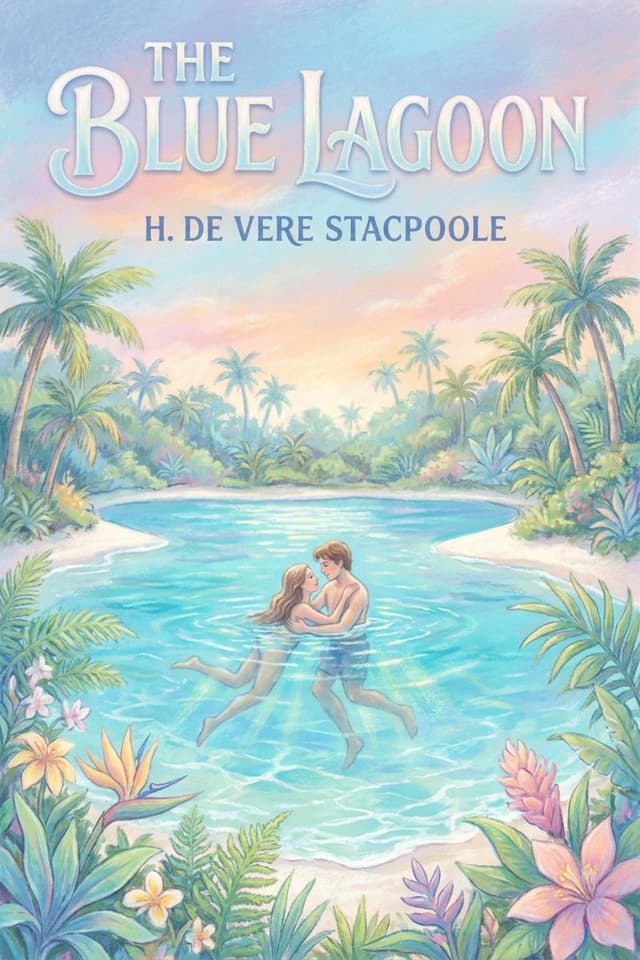
The Blue Lagoon
Read The Blue Lagoon by H. De Vere Stacpoole for free on Novelhalla, and try out our easy-to-read modern edition of this classic book. You can also download the EPUB and read it on any device if you prefer!
The Plot
The Burning Ship
Arthur Lestrange is dying. He knows it, his doctor knows it, and somewhere in the back of his mind, he knows this voyage from New Orleans to San Francisco is less a cure than a last act of hope. But Arthur isn't traveling alone. With him are the two people he loves most in the world: his young son Dick, about eight years old, and his orphaned niece Emmeline, roughly the same age. They're children. They play on deck, they chase each other through the corridors, they have no idea how sick their father and uncle truly is.
The other person who matters is Paddy Button, a big-hearted Irish galley cook with a fiddle, a gift for tall tales, and a deep, instinctive kindness toward children. Dick and Emmeline adore him. He is, in many ways, more present to them than any adult on the ship.
Then the cargo catches fire.
The evacuation is swift and chaotic. In the confusion, Arthur is separated from the children. Paddy is shoved into the dinghy with Dick and Emmeline, ordered to row them clear of the ship. By the time the smoke clears and the lifeboats scatter across the Pacific, the children are gone. Arthur has no idea where they are. They have no idea where he is.
The Island
Paddy, Dick, and Emmeline drift until they find it: a small island in the South Pacific, ringed by coral reef and centered around a lagoon so impossibly blue it barely looks real. There are coconut palms and breadfruit trees, fresh water, fish in abundance, and a warm, steady climate that makes survival almost easy.
Almost.
Paddy does his best. He builds a shelter, teaches the children to fish, shows them which fruits are safe. He issues one absolute rule: never eat the scarlet berries that grow on a certain tree. He calls them "the never-wake-up berries," and the name alone is enough to make the children remember. There's also the other side of the island, a place Paddy has explored alone and come back from looking shaken. He forbids the children to go there. He doesn't explain why.
For two and a half years, the three of them live together in something close to paradise. Paddy plays his fiddle. He tells the children stories about Ireland. He keeps them fed and safe and mostly happy.
Then one night Paddy finds a barrel of rum that washed ashore, and the fragile scaffolding of their little world collapses.
Alone
Dick and Emmeline are now truly on their own. They're children still, but growing fast, and the island doesn't care whether they're ready. They move to a new part of the island, as far from the memory of what happened to Paddy as they can get. They build a new home. They fish and swim and dive for pearls and learn the rhythms of the tides and seasons with no one to explain any of it.
Years pass. The children stop being children.
Dick grows tall and strong, tanned dark by the sun, capable of things he never could have imagined back on the ship. Emmeline grows too, but differently. She becomes quiet in ways she wasn't before, withdrawn at odd moments, startled by changes in herself that she has no words for and no one to ask about. They barely talk anymore. Not because they're angry, but because they've been alone so long that language itself has started to feel unnecessary.
And then something shifts between them. Something neither of them understands.
The Other Side of the Island
The island has secrets Dick and Emmeline haven't uncovered yet. There's a stone idol hidden in the trees on the forbidden side, stained with things they don't want to examine too closely. There are drums that echo across the water some nights, carried from other islands. And occasionally, canoes appear on the horizon, carrying people who use that idol for purposes that have nothing to do with paradise.
Dick and Emmeline aren't just growing up. They're growing up in a place that is beautiful and dangerous in equal measure, with no one to tell them what any of it means. Not the changes in their bodies, not the feelings pulling them toward each other, not the drums in the night, and not the terrible, thrilling realization that they might be the only two people in the world.
Their story doesn't stop at survival. It goes somewhere far stranger, far more intimate, and far more uncertain than a simple castaway tale. And somewhere out on the ocean, Arthur Lestrange is still searching.
About the Author: H. De Vere Stacpoole
Early Life
Henry de Vere Stacpoole was born in 1863 in Kingstown (now Dun Laoghaire), near Dublin, the youngest child and only son of a Church of Ireland clergyman. His father died when Henry was seven, and his mother raised four children alone, eventually taking the family to the south of France to treat Henry's chronic bronchitis. He credited his mother, who had spent her own childhood in the Canadian wilderness, with instilling in him a lifelong love of nature.
He attended boarding school at Portarlington, which he hated, and later Malvern College, which he liked considerably more. He went on to study medicine at St. George's and St. Mary's hospitals in London, qualifying as a doctor in 1891. But medicine was never really the point. Even as a student, he was more interested in literature than anatomy.
The Ship's Doctor
After qualifying, Stacpoole spent years working as a doctor aboard ships, traveling extensively through the South Pacific. These voyages gave him the detailed knowledge of tropical islands, ocean life, and Pacific cultures that would fill his fiction for decades. He also practiced briefly as a country doctor in Somerset, an experience he drew on for one of his early novels. He published several books through the 1890s, none of which found much of an audience.
By the early 1900s he had committed fully to writing, claiming he wrote two thousand words a day and citing Edgar Allan Poe, Victor Hugo, and Robert Louis Stevenson as his primary inspirations.
Success and Later Life
In 1907, two things changed Stacpoole's life: he wrote The Blue Lagoon and he married Margaret Robson. The novel, published in January 1908, was an immediate and enormous success, reprinted more than twenty times in twelve years. He never had to worry about money again.
Stacpoole continued writing prolifically, producing more than fifty novels, poetry, translations of Sappho and Francois Villon, a biography of Villon, children's stories, and two volumes of autobiography. He and Margaret settled on the Isle of Wight in the 1920s, where he became a justice of the peace and a passionate conservationist. He founded the Penguin Club, dedicated to protecting seabirds from oil pollution, a cause he championed for the rest of his life.
Margaret died in 1934. Stacpoole dedicated a pond and bird sanctuary to her memory in the village of Bonchurch. In 1938, he married Margaret's sister, Florence. He had no children from either marriage. He died in April 1951 at the age of eighty-eight and is buried at Bonchurch on the Isle of Wight.
Fun Facts About the Book
A Sleepless Night's Inspiration
Stacpoole came up with the idea for The Blue Lagoon during a bout of insomnia in early 1907. Lying awake, he found himself thinking about cavemen and how they must have experienced the world before language gave names to things like sunsets, storms, birth, and death. He imagined two children alone on a desert island, facing all of these "nameless wonders" without any adult to explain them. The next day, he started writing.
Adam and Eve in the Pacific
Stacpoole deliberately structured the novel as a retelling of the Garden of Eden story. Dick and Emmeline live in a state of innocence, naked and unashamed, in a paradise complete with forbidden fruit (the never-wake-up berries), a mysterious danger on the other side of the island, and a slow awakening to knowledge that changes everything. The parallels are intentional and woven throughout the book.
The Alice in Wonderland Connection
Less obviously, the novel is also full of references to Lewis Carroll's Alice's Adventures in Wonderland. Emmeline's former pet resembles the Cheshire Cat. Her attempt to eat the poisonous berries echoes Alice's encounter with the "Drink Me" bottle. Paddy's pipe-smoking wisdom recalls the Caterpillar. The children lose all track of time, like the Mad Hatter's tea party. Scholars have traced these allusions throughout the text as a deliberate literary game on Stacpoole's part.
The Doctor Who'd Rather Write
Stacpoole qualified as a doctor in 1891 but practiced medicine only sporadically and reluctantly. By his own account, he was always more drawn to literature than to anatomy. His medical training did, however, put him on ships as a doctor, and those voyages through the South Pacific gave him the firsthand knowledge of tropical life that makes the novel's island setting so vivid and specific.
A Bestseller That Kept Selling
The Blue Lagoon was reprinted more than twenty times in its first twelve years alone. It was adapted into a stage play in London in 1920 that ran for 263 performances. Film versions followed in 1923 (now lost), 1949 (starring a young Jean Simmons), and 1980 (starring Brooke Shields and Christopher Atkins). The 1980 film was panned by critics but became a massive commercial hit, introducing the story to an entirely new generation.
It's a Trilogy
Stacpoole wrote two sequels: The Garden of God (1923) and The Gates of Morning (1925). The three novels were eventually combined into The Blue Lagoon Omnibus in 1933. The Garden of God was adapted into the 1991 film Return to the Blue Lagoon starring Milla Jovovich.
The Congo Connection
Just a year after publishing his tropical romance, Stacpoole wrote The Pools of Silence (1909), a harrowing novel about Belgian atrocities in the Congo Free State under King Leopold II. It was part of the same literary movement that included Joseph Conrad's Heart of Darkness and Mark Twain's anti-imperialist writings. The man who wrote one of literature's most innocent love stories also wrote one of its most unflinching accounts of colonial brutality.
Themes
Innocence and the Loss of It
This is the novel's beating heart. Dick and Emmeline grow up without any framework for understanding the world. Birth, death, love, sex, danger: all of it arrives without explanation, without context, without even names. The book asks what happens to human beings when they encounter the fundamental experiences of life with no cultural filter at all.
Nature as Paradise and Threat
The island is gorgeous. It is also full of sharks, poisonous berries, mysterious human visitors, and the slow, indifferent passage of time. Stacpoole refuses to let his paradise stay simple. The same lagoon that feeds the children could kill them. The same isolation that protects their innocence also leaves them utterly unprepared for what's coming.
Civilization vs. the Natural World
The novel sets up an implicit comparison between the society Dick and Emmeline left behind and the world they've built on their own. In civilization, children are lied to about death and told babies come from cabbage patches. On the island, death and birth arrive without euphemism. Whether Stacpoole thinks the island is better or worse than Victorian society is a question he very carefully leaves open.
The Limits of Language
One of the novel's most striking features is the way Dick and Emmeline gradually stop talking. They've been alone so long that words feel unnecessary. They communicate through gesture, through proximity, through silence. It's a quiet but radical idea: that human connection might go deeper than language, and that language itself might be a kind of limitation.
The Fragility of Safety
Every source of security in the novel is temporary. The ship burns. Paddy dies. The island has hidden dangers. Even the children's love for each other introduces new vulnerabilities they can't foresee. Nothing in this story stays safe for long, and Stacpoole never lets the reader forget it.
The Book's Legacy
The Blue Lagoon was a phenomenon when it was published and has never really gone away. It was one of the most reprinted novels of the early twentieth century, adapted for stage and screen four times over, and translated into dozens of languages.
Its cultural impact is complicated. The 1980 Brooke Shields film turned the story into something more sexually explicit than Stacpoole ever intended, and for many people, that film is the only version of the story they know. The novel itself is quieter, stranger, and more interested in psychology than in spectacle. It's less about bodies and more about minds encountering the world without any preparation at all.
Stacpoole's influence can be traced through decades of castaway fiction, survival romance, and stories about people stripped of civilization and forced to discover what's left. The novel anticipated questions about nature, nurture, and human instinct that would preoccupy writers and thinkers for the next century.
For readers willing to look past the famous film adaptations, the original novel remains a genuinely unusual book: a romance about two people who don't know what romance is, a survival story about people who don't know they're in danger, and an Eden story where the serpent might already be inside the garden.