Novelhalla
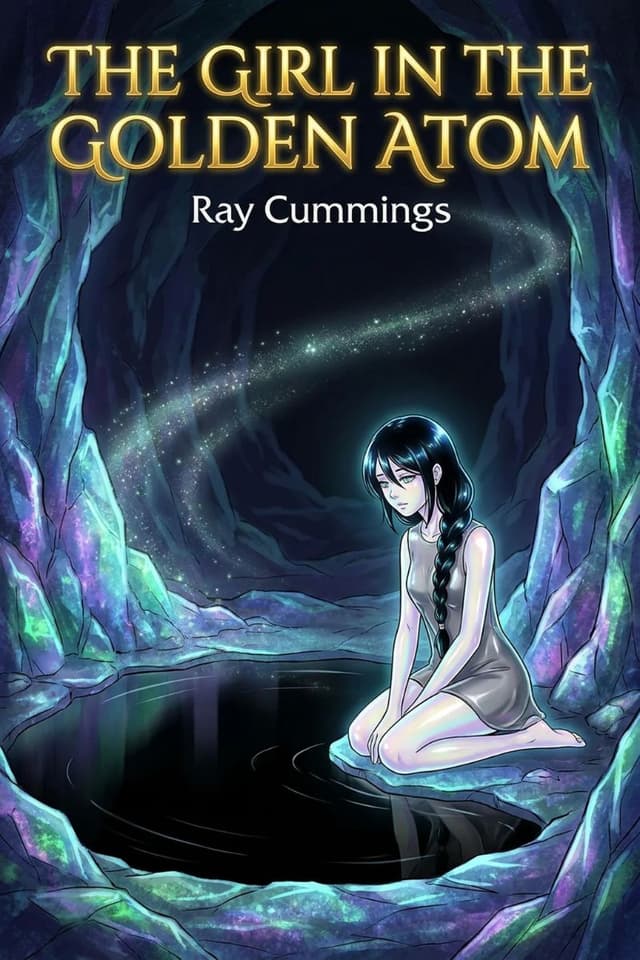
The Girl in the Golden Atom
Read The Girl in the Golden Atom by Ray Cummings for free on Novelhalla, and try out our easy-to-read modern edition of this classic book. You can also download the EPUB and read it on any device if you prefer!
The Plot
A Wedding Ring Under the Microscope
For the most part, the novel takes place inside a single room in New York City: one of the rooms in the Scientific Club, the setting for several dozen other Cummings stories. There, a Chemist tells four friends (a Doctor, a Banker, a Big Business Man, and a Very Young Man) about his latest theories. The Chemist has spent his career wondering what might exist at the smallest scales of matter, and he's done more than wonder. He's built a microscope more powerful than anything the world has seen and pointed it at the most ordinary object he could find, his mother's gold wedding ring.
Under that microscope, he saw a beautiful young woman sitting in front of a cave inside the ring. Night after night he came back to watch her, a girl in a world too small to measure, living her life with no idea that a man in New York was falling in love with her. Then something went wrong with the microscope, and his only window into her world was gone.
The Impossible Solution
A sane man would have given up. The Chemist didn't. If he couldn't see her anymore, he'd go to her. He invents pills to make him smaller and pills to make him larger. His friends sit around the club room listening to all this with the skepticism you'd expect from a banker and a businessman, and the doubts get very practical very fast. What does it feel like to shrink? How do you find one tiny spot on a ring when you're smaller than a grain of dust? And what if you get there and can't come back?
The Chemist puts the ring on the table, takes his dose, and goes. When he comes back, he has a story to tell. He found her. Her name is Lylda, and her people live in a world that looks almost like paradise. But Lylda's people are threatened by their neighbors' aggression, and the Chemist has brought something into that world that it's never seen before: a man who can change his size whenever he likes.
The Ones Left Behind
Of course, he decides to go back. His friends agree to watch over the ring while he's gone, and then they wait. And wait. That otherworldly place, at first a seeming Utopia, is full of strife and civil war, and the Chemist does not return. His friends are left guarding a ring with a whole universe inside it, along with a supply of very dangerous chemicals, and they're starting to understand just how easily those chemicals could get loose.
So they make a decision that's either very loyal or very foolish. The Doctor, the Big Business Man, and the Very Young Man make the hazardous journey, while the elderly Banker is left to watch over the ring in the club room.
Into the Golden Atom
What comes next is one of the strangest trips in early science fiction. The three men start shrinking on the surface of the ring, and what looked like a smooth band of gold turns into a landscape of enormous canyons and cliffs that keep getting bigger the longer they climb. Getting the dose right turns out to be harder than it sounds, and three grown men trying to stay the same size as each other is about as chaotic as you'd guess.
Somewhere at the bottom of all that gold is the world of Lylda's people, and somewhere in that world is their missing friend. But the paradise the Chemist described may not be the one they find. The people of the atom are restless, the old enemies haven't gone away, and a size-changing drug in the wrong hands could turn a small war into something much worse. Can three outsiders who barely know how to use the pills find the Chemist in time, and what will they have to become to get him home?
About the Author: Ray Cummings
Early Life
Raymond King Cummings was born on August 30, 1887, on Times Square in New York City. He was educated at Princeton University and on his family's orange plantation in Puerto Rico. It's a pretty unusual upbringing, splitting time between one of the busiest corners of Manhattan and a tropical farm, and his fiction would always be full of strange landscapes and the thrill of travel.
Working for Edison
Before he wrote a single story, Cummings got an education most science fiction writers could only dream of. He worked with Thomas Edison as a personal assistant from 1914 to 1919, arranging phonograph record albums and writing labels for Edison Records. Facsimiles of his signature appear on many of the labels. His time around Edison's laboratories gave him an appreciation for the possibilities of science and technology, which he later channeled into his fiction.
A Pulp Powerhouse
His first story came out in 1919, the same year his Edison job ended, and he never looked back. He wrote over 600 identified stories under various names in various genres, about 350 of them between 1935 and 1942, and it's estimated he wrote at least 750 tales in all. Besides his own name, he used the pen names Ray King, Ray P. Shotwell, Robert Wallace, and Gabriel Wilson (the last a joint pseudonym used by Cummings and his second wife). Writing was a family business: their daughter Elizabeth (Betty Cummings) sold a short story to Liberty magazine at the age of 13, and during the 1930s Cummings himself contributed a series of "World of Tomorrow" sketches to Liberty, at the time one of the most popular magazines in America. He also attended the first Worldcon, Nycon, in 1939.
Later Years
When the pulp market faded, Cummings adapted. During the 1940s, with his literary career in eclipse, he anonymously scripted comic book stories for Timely Comics, the predecessor to Marvel Comics. He recycled the plot of The Princess of the Atom for a two-part Captain America tale. He died in January 1957 at Mount Vernon, New York, of a cerebral hemorrhage. He was 69.
Fun Facts About the Book
Two Stories Stitched Together
The novel started out as two separate magazine stories. In 1919 Cummings published the short story "The Girl in the Golden Atom" in All-Story Weekly, which got a sequel in the same magazine the following year, "People of the Golden Atom." In 1922 the two stories were combined into the novel. The first book edition came out in London from Methuen & Co in 1922.
Before There Were Science Fiction Magazines
When the story first appeared, the genre didn't even have its own home yet. All-Story was a general-interest pulp fiction magazine; there was no pulp magazine devoted solely to science fiction until 1926. Cummings was one of the few writers active during the heyday of US pulp science fiction to have begun his career before Hugo Gernsback launched Amazing in 1926.
Borrowing From Two Classics
Cummings knew his literary ancestors. He combined the idea of Fitz James O'Brien's The Diamond Lens with H. G. Wells's The Time Machine. O'Brien's 1858 story is about a scientist who develops a super-powerful microscope and learns that each atom of matter is a microcosmic world. Cummings took that idea and asked the next obvious question: what if you could actually go there?
The Famous Line About Time
One line from this book has had a much bigger life than the book itself. Cummings wrote in "The Girl in the Golden Atom": "Time . . . is what keeps everything from happening at once," a sentence repeated by scientists such as C. J. Overbeck and John Archibald Wheeler, and often misattributed to the likes of Einstein or Feynman. Cummings repeated the sentence in several of his novellas, and his earlier work The Time Professor, published in 1921, is usually cited as its earliest documented use.
Heroes Without Names
Cummings gives his main characters job titles instead of names. The names of a couple of them come up a few times in dialogue, but the author always refers to them as the Chemist, the Doctor, the Very Young Man, the Banker and the Big Business Man. It gives the book a fun, almost fable-like feel, like a tall tale told among friends at a gentlemen's club.
A Poem Gets Mangled
Cummings had a soft spot for a particular bit of verse. He misquotes lines from Irish writer Justin Huntly MacCarthy's poem "If I Were King" no fewer than three times!
Shrinking Done Right
Plenty of later writers have shrunk their heroes, but Cummings thought hard about how it would actually feel. Reviewers often point to the highly convincing growth and shrinking scenes, in which the subject feels no change other than some mild dizzying nausea, but notices his surroundings growing smaller or larger.
Themes
The Wonder of Scale
The whole book rests on one dizzying idea: that every speck of matter might hold a universe, and our universe might be a speck in something bigger. Cummings keeps coming back to that feeling of vertigo, and the journey across a single wedding ring turns into an expedition as epic as crossing a continent.
The Danger of Discovery
The Chemist isn't a reckless mad scientist. He worries about what he's made. Cummings wrote the two stories in the years right after World War I, and you can feel it in the plot. The Chemist realizes the danger that the drugs he invented could be used in harmful ways in our world. The size-changing pills are a miracle and a weapon at the same time, and the book never lets you forget it.
Paradise and Its Fragility
The world inside the atom looks like a perfect society at first, peaceful and well ordered. Cummings very swiftly moves from showing this world as near utopia to dystopia as the revolution takes place, and the existence of the size-changing drugs becomes the key. It's an old question in a new setting: can any paradise survive contact with power?
Love Across Worlds
At its heart, this is a love story with the longest of long-distance relationships. The Chemist falls for a woman he's only seen through a lens, then risks his life and his sanity to cross an unimaginable gap to reach her. It's a pulp adventure, but it's also pure romance.
Friendship and Loyalty
The friends in the club room could easily have shrugged and gone back to their lives. Instead, ordinary middle-aged professionals and a kid with more nerve than sense put everything on the line for a friend who might already be lost. That loyalty gives the second half of the book its heart.
The Book's Legacy
Cummings was one of the founding fathers of science fiction, and his 1919 "The Girl in the Golden Atom" was one of three keystone novellas in All-Story Magazine that are credited with planting the seed of the genre. His work inspired many of the writers who created science fiction's Golden Age in the United States.
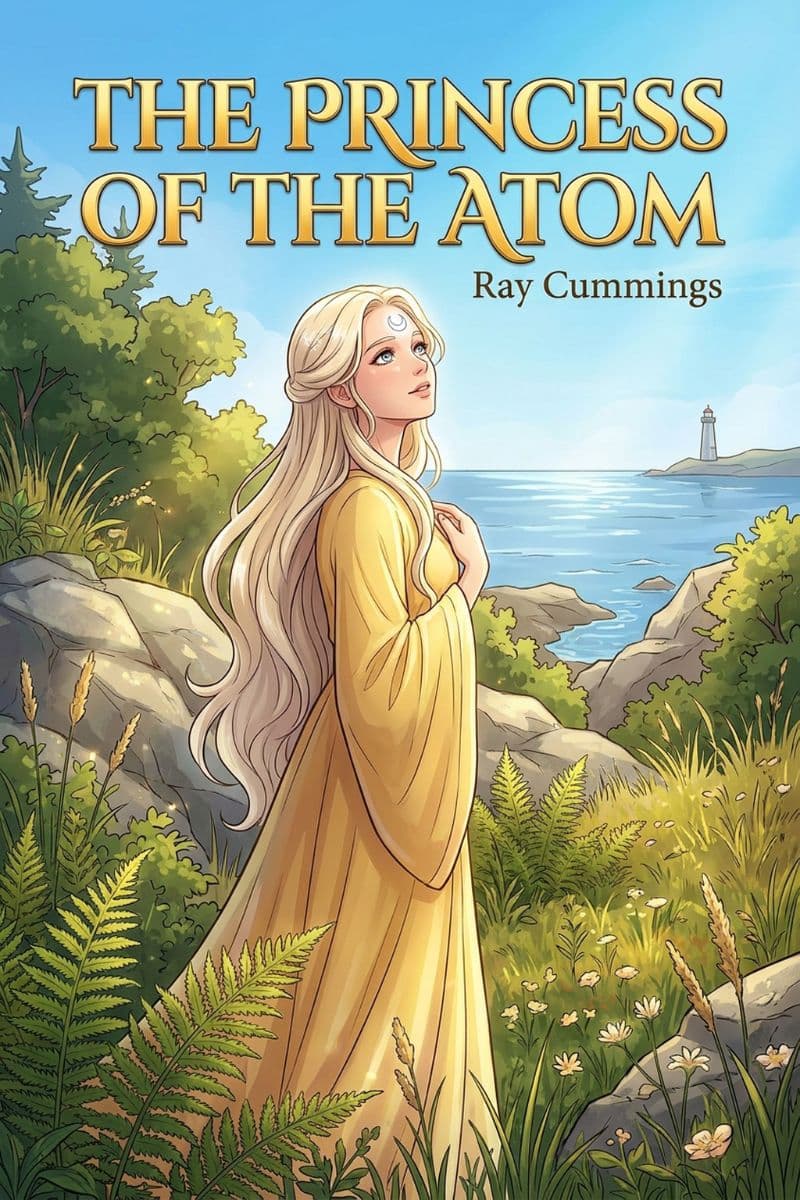
The shrinking-hero idea he made popular has never gone away. This is generally considered the first story about shrinking and enlarging people, and reviewers have suggested it possibly influenced Richard Matheson's "The Shrinking Man" (1956). Anyone who's read about a hero swallowing a pill to shrink down to bug size, in comics or on screen, is reading in the tradition Cummings helped start. He kept going back to the idea himself, too, with later atom stories like The Princess of the Atom.
The book has also proved remarkably durable. As late as 1966, when Famous Science Fiction Tales of Wonder was published, Cummings' first story was still being read by fans of the genre, and it's been reprinted many times since. Today it's a fascinating time capsule from the moment science fiction was being invented, full of the same sense of wonder that hooked its first readers in the pages of a pulp magazine more than a century ago.