Novelhalla
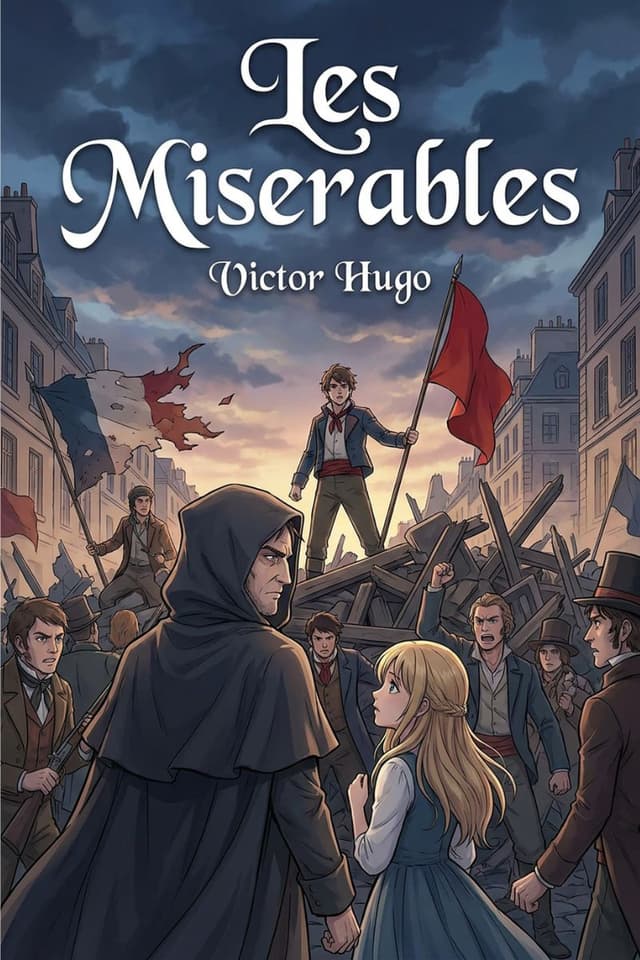
Les Misérables
Read Les Misérables by Victor Hugo for free on Novelhalla, and try out our easy-to-read modern edition of this classic book. You can also download the EPUB and read it on any device if you prefer!
The Plot
The Convict
In 1815, a man walks into a small French town after nineteen years in prison. His name is Jean Valjean. His crime: stealing a loaf of bread to feed his sister's starving children. The sentence was five years. Escape attempts added the rest. Now he's free, but freedom means nothing when every inn turns you away and every face looks at you like you're still a criminal. His yellow passport, the document all ex-convicts are required to carry, marks him as untouchable.
Desperate and exhausted, Valjean is taken in by the Bishop of Digne, a gentle, almost absurdly kind old man who offers him a meal, a bed, and the dignity of being treated like a human being. Valjean repays this kindness by stealing the bishop's silver in the middle of the night and running.
He's caught immediately. The police drag him back to the bishop's house, and what happens next changes the entire trajectory of the novel. The bishop tells the police that the silver was a gift. Then he hands Valjean two silver candlesticks he'd left behind, and with them, delivers a quiet, devastating charge: use this to become an honest man.
The Mayor
Years pass. Valjean, under a new name, has remade himself completely. He's become Monsieur Madeleine, a wealthy factory owner and the mayor of a small town called Montreuil-sur-Mer. He's generous, respected, beloved. He has done exactly what the bishop asked. But his past is a loaded weapon, and it's pointed at his head.
In his factory works a woman named Fantine. She's young, she's poor, and she has a secret: a daughter named Cosette, hidden away with an innkeeper and his wife, the Thenardiers, who were supposed to care for her. Instead, the Thenardiers have turned Cosette into a slave and turned Fantine's desperate love into a cash machine, demanding more and more money that Fantine doesn't have.
When Fantine's secret is discovered, she's fired from the factory. What follows is one of the most harrowing descents in literature. Fantine sells her hair. She sells her teeth. She sells herself. And the system that crushed her doesn't notice, doesn't care, and certainly doesn't help.
Meanwhile, Inspector Javert has arrived in town. Javert is a man who believes in the law the way other men believe in God. Absolutely. Without nuance. Without mercy. And Javert has a suspicion that the beloved Mayor Madeleine is not who he claims to be.
The Choice
Valjean faces a crisis that would break most people. Another man has been arrested and is about to be convicted as Jean Valjean, the escaped convict. All Valjean has to do is stay silent, and he's free forever. His new life, his good works, his reputation: all of it is safe. All it costs is an innocent man's life.
This is the kind of moral question Hugo returns to again and again. Not whether a person can change, but what that change costs, and whether they'll keep paying when the bill comes due.
And then there is Fantine, dying in a hospital bed, begging Valjean to save her daughter from the Thenardiers. He promised he would.
The Child
Cosette is eight years old, and she has known nothing but cruelty. The Thenardiers are magnificently awful: petty tyrants who spoil their own daughters and treat Cosette like vermin, sending her out in the cold to fetch water, dressing her in rags, feeding her scraps. Hugo writes the Thenardiers with the kind of fury that makes you feel the temperature in the room drop.
Valjean finds Cosette on a dark road, carrying a bucket of water that's almost as big as she is. He takes her hand. It's one of the simplest and most devastating moments in the novel, and it's the beginning of everything that follows.
From this point on, Valjean's life has a single purpose: protect this child. He takes Cosette to Paris, where they live in hiding, moving from address to address, always one step ahead of Javert, who has not forgotten and will not stop.
The Students
The story widens. Paris in the early 1830s is a pressure cooker. The monarchy has been restored, the poor are getting poorer, and a generation of young idealists is ready to burn the whole thing down.
Enter Marius Pontmercy, a young law student with a dead hero for a father and a tyrannical royalist grandfather who raised him on lies. Marius is sheltered, passionate, and completely unprepared for the world he's about to stumble into. He falls in with a group of revolutionary students called the Friends of the ABC, led by the charismatic Enjolras, who is ready to die for the republic and fully expects to.
And then Marius sees Cosette in a park, and everything changes. He doesn't know her name. She doesn't know his. But the charge between them is immediate, obsessive, the kind of love that only a French Romantic novelist would dare write at full volume, and Hugo writes it at full volume.
The problem is that Valjean sees it too. And Valjean, who has built his entire life around Cosette, who has made her his reason for breathing, now faces a new threat: the possibility that she might love someone else more.
The Barricade
In June 1832, a popular general dies and the streets of Paris erupt. The students build barricades. Marius, heartbroken and believing Cosette has been taken from him forever, joins them. He's not there for the revolution. He's there to die.
And Valjean, who has every reason to want Marius gone, follows him to the barricade. Because Cosette loves this boy, and Valjean loves Cosette, and love, in Hugo's world, means choosing someone else's happiness over your own, even when it destroys you.
What happens at the barricade is chaos, courage, sacrifice, and the kind of violence that strips away every pretense about who people really are. The National Guard closes in. The ammunition runs low. And somewhere in the smoke and the shouting, Javert appears again, because Javert always appears again.
Hugo has been building to this for a thousand pages. Every thread, every character, every moral question the novel has asked converges on a few city blocks in Paris where young men are dying for an idea that most of the city has already decided to ignore.
Whether anyone survives, whether Valjean can keep his promise, whether Javert's iron certainty can withstand the one thing it was never designed for: those answers are in the book. And they are earned.
About the Author: Victor Hugo
Early Life and Ambition
Victor Hugo was born in 1802 in Besancon, France, the son of a general in Napoleon's army and a royalist mother. The contradictions in his family ran deep. His parents separated, and young Victor was pulled between their opposing political worlds, a tension that would echo through his work for the rest of his life.
Hugo was a prodigy. At fourteen he wrote in his diary that he wanted to be "Chateaubriand or nothing." At twenty he published his first collection of poetry and received a pension from the king. By thirty he was the leading figure of the French Romantic movement, having kicked down the door of classical theater with his controversial play Hernani, which literally caused riots at the Comedie-Francaise.
Love, Loss, and Reinvention
Hugo married Adele Foucher in 1822, and they had five children. The marriage was passionate at first but fractured over time. In 1831, Hugo's close friend, the critic Sainte-Beuve, fell in love with Adele, and she appears to have returned the feeling. Two years later, Hugo met the actress Juliette Drouet, who became his mistress, his secretary, and his constant companion for the next fifty years. She wrote him over 20,000 letters.
In 1843, Hugo's eldest daughter Leopoldine drowned on her honeymoon. She was nineteen. The grief was annihilating. Hugo stopped writing for nearly a decade and threw himself into politics, serving in the French parliament and becoming an increasingly vocal champion of the poor, the condemned, and the forgotten.
Exile
When Louis Napoleon seized power in 1851 and dismantled the republic, Hugo stood against him publicly, calling him a traitor. He fled France disguised as a workman. He would not return for nineteen years.
Hugo settled on the island of Guernsey in the English Channel, where he bought a house called Hauteville House and turned it into one of the strangest and most beautiful homes in Europe, decorating it himself with carved wood, mirrors, and tapestries. It was here, in exile, looking out at the sea, that he wrote Les Miserables.
Napoleon III offered amnesty to all political exiles in 1859. Hugo refused. He would not go home until France was free.
Return and Legacy
The Second Empire fell in 1870, and Hugo returned to Paris as a hero. Crowds met him at the train station. He was elected to the Senate. He continued writing, advocating for universal suffrage, the abolition of the death penalty, and amnesty for political prisoners.
Hugo's final years were shadowed by the deaths of his sons Charles and Francois-Victor, and by the declining health of Juliette Drouet, who died in 1883. Hugo himself died on May 22, 1885, at eighty-three. Despite his request for a pauper's funeral, an estimated two million people attended the procession. It was the largest public gathering in French history up to that point. His body lay in state beneath the Arc de Triomphe before burial in the Pantheon.
Fun Facts About the Book
Thirty-Three Years in the Making
Hugo first conceived of the novel in 1829, originally titled "Les Miseres." He worked on it intermittently for over three decades, with a major interruption after his daughter's death and his plunge into politics. The bulk of the writing happened during his exile on Guernsey, and the book was finally published in 1862.
The Shortest Correspondence in History
When the novel was published, Hugo was vacationing away from his publisher. Anxious to know how sales were going, he sent a telegram containing a single character: "?" His publisher replied: "!" The exchange is often cited as the shortest correspondence in history, though some scholars believe it may be apocryphal.
The Critics Hated It
Fellow writers were savage. Flaubert said the novel lacked both truth and greatness. The Goncourt brothers called it artificial. Baudelaire praised its social impact but said propaganda was the opposite of art. The Catholic press attacked it so relentlessly that Hugo counted 740 hostile reviews from religious outlets alone. The Vatican banned it. The public, meanwhile, bought it by the hundreds of thousands.
Lee's Miserables
The novel was translated into English almost immediately and became a sensation in America, where the Civil War was raging. The themes of suffering, injustice, and impossible moral choices resonated so deeply with Confederate soldiers that they nicknamed themselves "Lee's Miserables" after their general, Robert E. Lee.
A Real Person Behind Valjean
Hugo based Jean Valjean partly on a real man named Eugene Francois Vidocq, an ex-convict who reinvented himself as a successful businessman and eventually founded the French national police's detective bureau. Hugo once witnessed Vidocq lift a heavy cart off a trapped worker using brute strength, a scene that made it directly into the novel.
Fantine Was Born on a Street Corner
Hugo witnessed a wealthy young man shove a handful of snow down a prostitute's dress in the streets of Paris. When she struck back, the man called the police to arrest her. Hugo intervened, using his celebrity to have her released. The injustice of the scene haunted him. He imagined what would happen if she had children depending on her, and Fantine was born.
The Battle of Waterloo Detour
The novel contains a famous sixty-page digression on the Battle of Waterloo that has almost nothing to do with the main plot. Hugo visited the actual battlefield in 1861 to research it. Readers have been arguing about whether to skip this section since 1862. Hugo would want you to read every word.
One of the Longest Novels Ever Written
The original French text runs to 655,478 words, making it one of the longest novels in Western literature. Over a quarter of the book consists of essays and digressions that don't advance the plot. Hugo wrote about the Paris sewer system, the history of convents, Parisian slang, and the nature of progress. He considered all of it essential.
Themes
Redemption
The novel's central question is whether a person destroyed by injustice can be remade through love and moral courage. Valjean's transformation from a hardened criminal to a man willing to sacrifice everything for others is the spine of the book, and Hugo never lets the reader forget how difficult and costly that transformation is. Redemption isn't a moment. It's a lifetime of choices.
Law vs. Justice
Javert embodies the law. Valjean embodies justice. They are not the same thing, and the collision between them is the novel's most powerful engine. Hugo argues that a legal system that punishes a man for nineteen years for stealing bread is not just, no matter how orderly it is. The question of what happens when a righteous man confronts an unjust law runs through every page.
Poverty as Violence
Hugo does not treat poverty as a backdrop. He treats it as a crime committed by society against its weakest members. Fantine's destruction is not caused by bad luck or bad choices. It's caused by a system that offers her nothing and punishes her for having nothing. The novel insists that poverty is not inevitable but manufactured, and that its consequences are as brutal as any act of war.
The Power of Mercy
The bishop's decision to give Valjean the silver and lie to the police is the novel's founding act. Everything that follows grows from that moment of radical mercy. Hugo argues that mercy is not weakness but the most transformative force available to human beings, more powerful than punishment, more durable than law.
Revolution and Sacrifice
The barricade scenes are not just set pieces. They are Hugo's meditation on what happens when young people decide the world must change now, and the world decides to crush them for it. The novel does not romanticize revolution. It mourns the cost while honoring the courage, and it asks whether a cause can be right even when it fails.
Love as Salvation
Every kind of love appears in this novel. The bishop's love for a stranger. Valjean's love for Cosette. Fantine's love for her daughter. Marius and Cosette's romantic love. Even Javert's love of order. Hugo treats love not as a feeling but as an action, something you prove by what you're willing to give up.
Historical Context
The June Rebellion of 1832
The barricade scenes are based on a real event. On June 5, 1832, the funeral of General Lamarque, a popular champion of the poor, sparked an armed uprising in Paris against the monarchy of King Louis-Philippe. A group of republicans built barricades in the narrow streets and fought the National Guard for two days. The rebellion was quickly and brutally suppressed. It was not the French Revolution and it was not the later revolution of 1848. It was a smaller, more desperate, more doomed affair, which is precisely why Hugo chose it.
Post-Napoleonic France
The novel spans roughly 1815 to 1833, a period of extraordinary political instability. France cycled through the fall of Napoleon, the Bourbon Restoration, the July Revolution of 1830, and the establishment of the July Monarchy. The poor bore the worst of every transition. Hugo saw this firsthand and built the novel to indict not one government but the entire system that allowed such suffering to persist regardless of who sat on the throne.
The Book's Legacy
Les Miserables has never been out of print since 1862 and has been translated into virtually every major language on earth. It remains one of the most widely read novels in history.
The stage musical, created by Alain Boublil and Claude-Michel Schonberg, premiered in Paris in 1980 and was adapted into English by Cameron Mackintosh in 1985. The London production became the West End's longest-running musical. The Broadway production ran for nearly 7,000 performances. The 2012 film adaptation, starring Hugh Jackman and Anne Hathaway, brought the story to a new generation and won three Academy Awards.
But the novel's deepest legacy is not in adaptations. It's in the way it permanently changed what fiction could do. Hugo proved that a novel could be simultaneously a love story, a thriller, a historical panorama, a political argument, and a work of moral philosophy. He proved that popular entertainment and serious art were not enemies. And he proved that a book could hold a mirror up to an entire civilization and say: this is what you are doing to the people you pretend not to see.
When Hugo died, two million people came to say goodbye. They were not there for the literary critic's darling. They were there for the man who saw them. Les Miserables is not just a novel. It is an act of witness, and it has never stopped speaking.