Novelhalla

Tess of the D'Urbervilles
Read Tess of the D'Urbervilles by Thomas Hardy for free on Novelhalla, and try out our easy-to-read modern edition of this classic book. You can also download the EPUB and read it on any device if you prefer!
The Plot
The Girl from Marlott
Tess Durbeyfield is sixteen, beautiful, and poor. She lives in the village of Marlott with her family: a father who drinks too much and works too little, a well-meaning but foolish mother, and a house full of younger siblings who need feeding. Tess is the responsible one. She's the one who holds things together.
Then her father finds out the family has noble blood.
A local parson casually informs John Durbeyfield that "Durbeyfield" is actually a corruption of "d'Urberville," one of the oldest Norman families in England. The family's ancient lineage stretches back to William the Conqueror. This is, in practical terms, completely useless information. The d'Urbervilles lost their money and their land generations ago. But John celebrates like he's won a fortune, and Tess's parents get an idea: there's a wealthy family called d'Urberville living nearby. Surely they must be relations. Surely they'll help.
They send Tess to claim kin.
The Trap
The wealthy d'Urbervilles aren't actually related to Tess at all. The family name was purchased by a rich merchant who wanted a pedigree to match his money. But Tess doesn't know this. What she does know is that Alec d'Urberville, the son of the household, is immediately and aggressively interested in her.
Alec is charming in the way that a fox is charming when it's watching a henhouse. He's persistent, generous with gifts, and absolutely relentless. He arranges a job for Tess tending his blind mother's chickens, and she feels she can't refuse because her family desperately needs the income. She blames herself for the death of the family horse, Prince, in an accident that was really just bad luck. The guilt drives her to accept what she otherwise wouldn't.
Tess resists Alec's advances. She resists for weeks. And then, one night in a dark wood, Alec takes what he wants.
Whether Hardy intended the scene as rape or seduction has been debated for over a century. What's not debatable is this: Tess did not choose what happened to her, and she will pay for it for the rest of her life.
Sorrow
Tess goes home. She's pregnant. She gives birth to a boy she names Sorrow, a name that tells you everything. The baby is sickly and dies in infancy. Tess baptizes the child herself when the local vicar won't come, pouring water over his tiny head in a desperate, improvised ceremony in the middle of the night while her frightened siblings watch.
The village treats her as fallen. Ruined. Used goods. Tess absorbs this judgment into her bones, even though Hardy, through his subtitle, is telling you from the very first page that she is pure. That she has done nothing wrong. That the world's verdict on this girl is a lie.
Talbothays
A year passes. Tess leaves home to start over, taking work as a dairymaid at Talbothays, a lush, green farm in a river valley that feels like another world entirely. The work is honest. The landscape is beautiful. And there is Angel Clare.
Angel is the son of a clergyman, a thoughtful, educated young man who has rejected the path his family set for him and is learning farming instead. He's idealistic, bookish, and drawn to what he sees as the natural, unspoiled world of the countryside. He sees Tess and sees everything he's been looking for: beauty, innocence, a living connection to an older, purer England.
Tess falls in love with him. Deeply, completely, terrifyingly. And Angel falls in love with her. Their courtship unfolds through misty mornings and long milking sessions and quiet conversations, and it is genuinely, achingly tender.
But Tess carries a secret. Several times she tries to tell Angel about her past. She writes him a letter the night before their wedding and slips it under his door. It slides under the carpet. He never sees it.
They marry.
The Wedding Night
On their wedding night, Angel confesses to Tess that he once had a brief affair with an older woman in London. He asks her to forgive him. She does, instantly, with relief. Now she can tell him her own story. Surely he'll understand. Surely the man who just confessed his own sin will extend the same grace to her.
She tells him about Alec. About Sorrow.
Angel does not extend the same grace.
The man who prided himself on being modern, who rejected his father's rigid religion, who claimed to value Tess for her natural goodness, cannot forgive her for something that was done to her. He sees a different woman now. The Tess he loved was an idea, and the real Tess doesn't match it.
He leaves. He goes to Brazil to try farming there, telling Tess they'll figure things out eventually. He doesn't send for her. He barely writes.
The Long Winter
What follows is one of the bleakest stretches in English literature. Tess, abandoned, runs out of money. She's too proud to ask Angel's family for help, and when she finally tries, she overhears his brothers mocking the marriage and can't bring herself to knock on the door. She takes work at Flintcomb-Ash, a brutally harsh farm where the land is starved and the labor is punishing.
And then Alec d'Urberville reappears.
He's become a traveling preacher now, converted to evangelical Christianity by, of all people, Angel's own father. But the conversion doesn't survive contact with Tess. The moment Alec sees her again, the religion falls away like a costume, and he's back to pursuing her with the same entitled hunger as before.
Tess's father dies. Her family is evicted from their home. Her mother and siblings have nowhere to go. Alec offers money, shelter, security for all of them. He can solve every material problem in Tess's life. All she has to do is come back to him.
She holds out for as long as she can. She writes to Angel, begging him to come home. The letter takes weeks to reach him in Brazil. He is already sick, already regretting what he did, already planning to return.
He is too late.
The Reckoning
When Angel finally comes back to England and tracks Tess down, he finds her living in a fashionable seaside boarding house. She is dressed in fine clothes. She is with Alec.
The look on her face when she sees Angel standing in the doorway is the kind of thing that breaks a reader in half. She tells him he's come too late. She sent him letter after letter. He didn't come.
Angel leaves. And something inside Tess, something that has been bending and bending under the weight of everything the world has done to her, finally snaps.
What happens next is sudden, violent, and inevitable. And it sends Tess and Angel running together across the countryside, stealing a few desperate days of the love they should have had all along, while something terrible closes in behind them.
They end up at Stonehenge. Tess lies down on an ancient stone altar and sleeps. Whether the dawn brings mercy or justice or something crueler than either is a question Hardy answers with the kind of ending that has haunted readers for over a century.
About the Author: Thomas Hardy
The Stonemason's Son
Thomas Hardy was born in 1840 in a thatched cottage on the edge of open heathland in Dorset, the rural English county that would become the center of his fictional universe. His father was a stonemason and builder who played the fiddle at local dances. His mother was sharp-minded and ambitious for her children. Hardy was a sickly boy, kept mostly at home, where he absorbed the rhythms of country life, folk songs, local superstitions, and the hard realities of rural poverty.
He was apprenticed to a local architect at sixteen and eventually moved to London to practice the trade. But what he really wanted was to write poetry. Nobody wanted to publish his poems. So he turned, reluctantly, to novels.
The Novelist
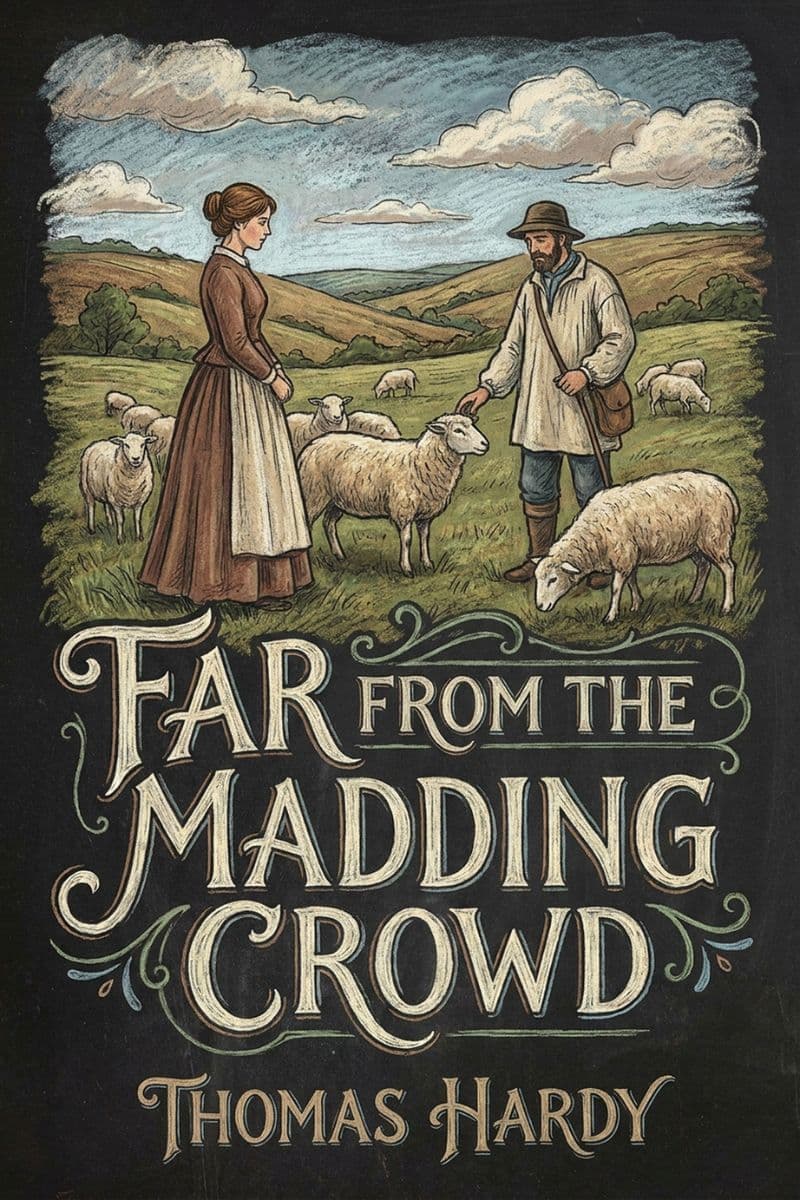
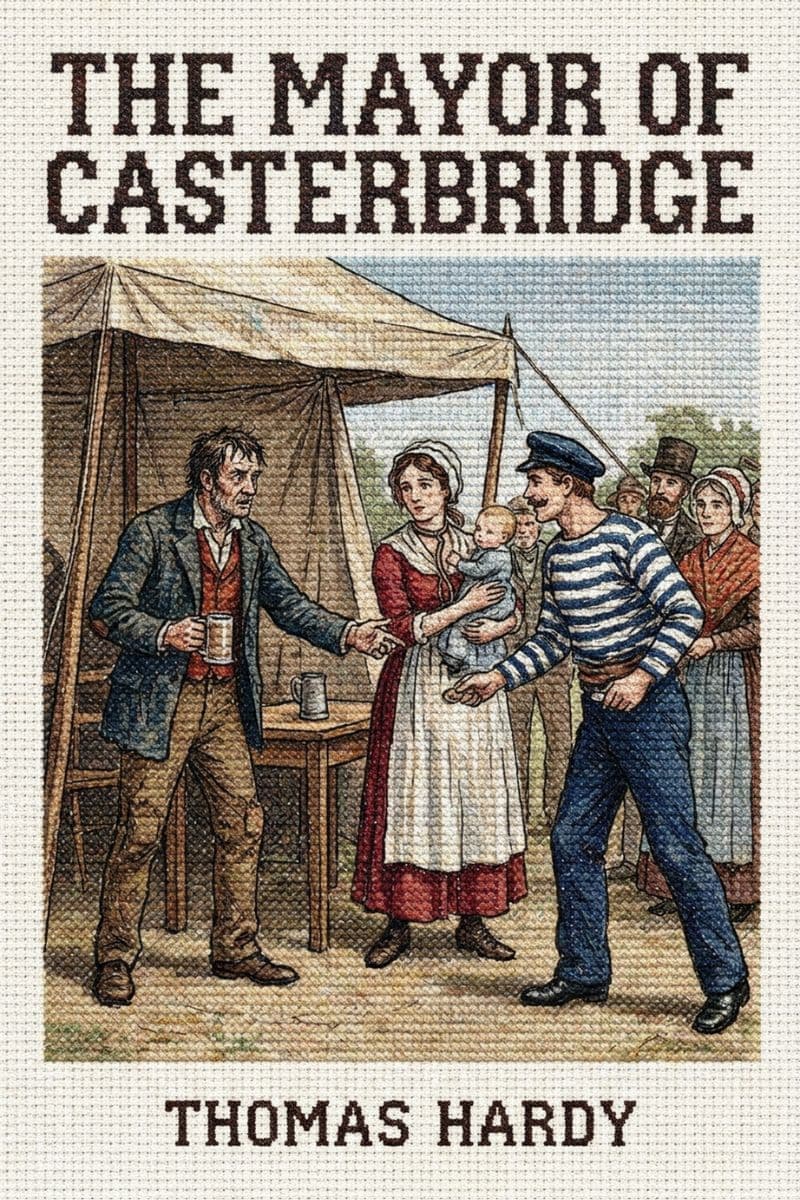
His breakthrough came with Far from the Madding Crowd in 1874, which introduced the fictional county of Wessex and made Hardy famous. He married Emma Gifford the same year and settled into a career writing novels that grew steadily darker and more confrontational. The Return of the Native, The Mayor of Casterbridge, The Woodlanders, and then his two devastating final novels: Tess of the d'Urbervilles and Jude the Obscure.
Both books caused uproars. Tess was called immoral for its sympathetic treatment of a "fallen woman." Jude the Obscure was even worse in the public's eyes. One bishop reportedly burned his copy. The backlash stung Hardy so deeply that he stopped writing novels entirely.
The Poet
He went back to what he'd always wanted to do: poetry. From 1898 until his death in 1928, Hardy published eight volumes of verse containing over nine hundred poems. They are strange, beautiful, melancholy things, full of ghosts and regret and the Dorset landscape. When his first wife Emma died in 1912, after years of estrangement, Hardy wrote some of the most devastating elegiac poems in the English language, mourning a love he'd neglected while it was alive.
He married Florence Dugdale, nearly forty years his junior, shortly after Emma's death. He kept writing. He died in 1928 at eighty-seven, and in a characteristically Hardy twist, his body was divided: his heart was buried in Dorset, in the churchyard near his birthplace, while his ashes were placed in Westminster Abbey's Poets' Corner.
Fun Facts About the Book
Two Publishers Rejected It
Hardy initially submitted the novel to Macmillan's Magazine, which rejected it for containing "immoral situations." One editor specifically complained that Hardy overused the word "succulent." A second magazine also turned it down. The Graphic finally agreed to serialize it, but only after Hardy removed scenes involving characters traveling on a Sunday and rewrote a famous passage where Angel carries Tess over a puddle so that he instead pushes her across in a wheelbarrow. Victorian censorship was nothing if not thorough.
"A Pure Woman"
The subtitle was Hardy's provocation. By calling Tess "A Pure Woman Faithfully Presented," he was directly challenging the Victorian assumption that a woman who had been sexually assaulted was permanently damaged and morally compromised. Critics went apoplectic. Hardy knew they would.
Inspired by a Hanging
When Hardy was sixteen years old, he witnessed the public execution of Martha Brown, a woman hanged for murdering her abusive husband. The image stayed with him for decades. Scholars have traced a direct line from that experience to the novel's tragic conclusion. Hardy reportedly stood close enough to see the rain running down the condemned woman's clothing.
The Rape/Seduction Debate
Hardy deliberately left the crucial scene in The Chase ambiguous, and scholars have argued about it ever since. Was Tess raped or seduced? The text can support both readings, and many believe Hardy made it deliberately vague to get it past the censors. In the serialized version, the scene was altered even further. Hardy spent twenty-two years revising the passage across different editions, which suggests he was never fully satisfied with how much he could say.
Hardy's Original Title
Hardy initially wanted to call the novel "Daughter of the d'Urbervilles" but was persuaded by his publisher to change it. Given the novel's themes of inheritance, fate, and the sins visited upon children by their parents, the original title might have worked just as well.
The Real Tess
The character of Tess was partly inspired by Hardy's cousin, Tryphena Sparks, who died young. Hardy was also inspired by the beauty of a young milkmaid named Augusta Way, whom he encountered visiting a farm near his birthplace. Years later, when Hardy saw Augusta's daughter Gertrude Bugler perform the role of Tess on stage, he declared she was the living image of the character he'd imagined.
Hardy's Wessex
Like all of Hardy's major fiction, the novel is set in Wessex, his fictional version of southwestern England. The locations map closely to real places: Marlott is Marnhull in Dorset, Talbothays is based on farms in the Frome Valley, and "Wintoncester" is Winchester. Hardy fans have been tracing these connections for over a century, and the Dorset tourism industry has benefited considerably.
Themes
The Purity Double Standard
The novel's subtitle is its thesis statement. Hardy insists that Tess is pure despite what has been done to her, and he uses every page to demonstrate how monstrous it is that society disagrees. Angel Clare, who has his own sexual past, abandons his wife for having one forced upon her. The novel asks, with barely contained fury, why a woman's worth is measured by something that was taken from her against her will.
Fate and Injustice
Hardy's universe is not kind. Bad things don't happen to Tess because she deserves them. They happen because the world is structured to crush people like her. Every time she tries to start over, something pulls her back. The horse dies. The letter slides under the carpet. The timing is always wrong. Hardy doesn't quite believe in God, but he seems to believe in something worse: a universe that pays attention just enough to twist the knife.
Class and Power
Alec's wealth gives him power over Tess. Angel's education gives him the luxury of moral judgment. Tess has neither money nor position, and the novel shows, with unflinching clarity, how poverty strips away choices. She can't refuse Alec's job offer. She can't leave Flintcomb-Ash. She can't say no to Alec's help when her family is starving. Every "choice" Tess makes is shaped by the fact that she has no real options.
The Vanishing Rural World
Behind the personal tragedy is a larger one. The agricultural England of Tess's world is dying. Farms are mechanizing. Families are being pushed off land they've worked for generations. The old rhythms of rural life are being ground down by economic forces nobody in Marlott can control. Tess is a victim of men, yes, but she's also a victim of history.
Nature and the Body
Hardy writes about the natural world with extraordinary sensuality. The lush valley of Talbothays, the brutal fields of Flintcomb-Ash, the ancient stones of Stonehenge. Tess is consistently associated with nature, with the physical world, with the body. The men who judge her do so from the safety of abstraction and ideology. Hardy suggests that Tess, rooted in the earth and its honest realities, is more moral than any of them.
The Book's Legacy
Tess of the d'Urbervilles is widely considered Hardy's masterpiece and one of the greatest novels in the English language. It was a bestseller in its own time despite the controversy, and it has never gone out of print.
The novel has been adapted for stage and screen numerous times. Roman Polanski directed a celebrated film version, simply titled Tess, in 1979, starring Nastassja Kinski. A well-regarded BBC television adaptation aired in 2008. Stage versions have appeared regularly since the first Broadway production in 1897, and the story has been reimagined as musicals, ballets, and even a rock opera.
Tess herself has become one of literature's great symbolic figures: the innocent destroyed by a system designed to benefit the powerful at the expense of the vulnerable. Modern readers, particularly those attuned to conversations about consent, class, and gender, often find the novel more relevant now than ever. Hardy was writing about things in 1891 that the culture is still arguing about.
The novel is regularly taught in schools and universities around the world, and it remains the book that most readers think of first when they hear Hardy's name. It's a gut punch of a story, gorgeous and merciless in equal measure, and it leaves you furious at a world that could do this to someone like Tess while calling itself civilized.