Novelhalla
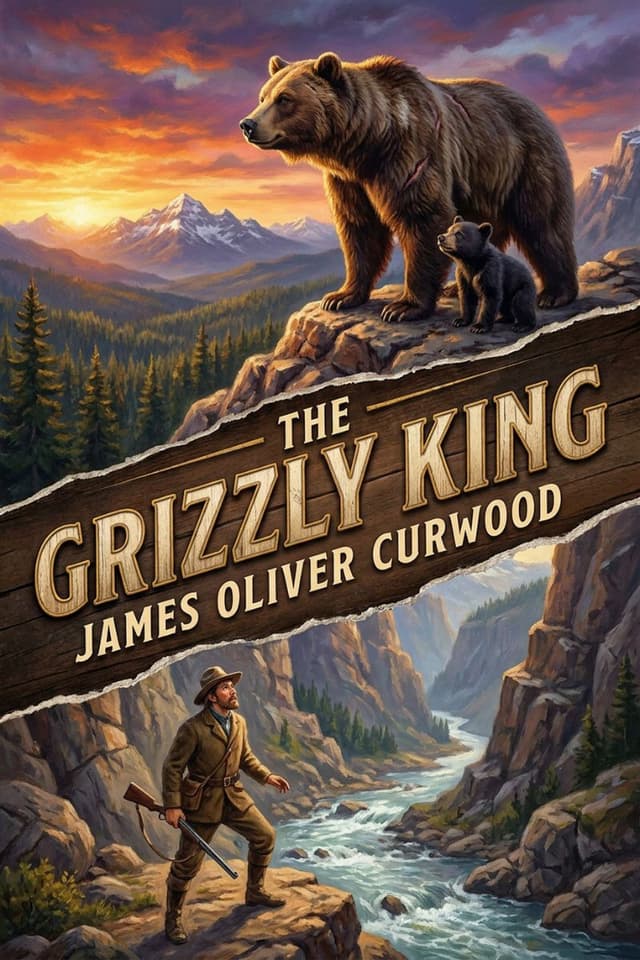
The Grizzly King
Read The Grizzly King by James Oliver Curwood for free on Novelhalla, and try out our easy-to-read modern edition of this classic book. You can also download the EPUB and read it on any device if you prefer!
The Plot
The King of the Valley
Somewhere deep in the Canadian Rockies, a grizzly bear named Thor sits on his haunches and surveys his kingdom. He is enormous. He is ancient. He is right-handed, which is almost unheard of in grizzlies, and it makes him faster and deadlier than any bear in the mountains. Thor has never encountered a human being. He has fought rivals of his own kind, sometimes to the death, but no creature has ever truly challenged his reign. His one law is simple: leave me alone.
Thor spends his days turning over rocks with that massive right paw, licking up ants and grubs, digging out gophers, grazing on berries in meadows thick with wildflowers. He sleeps hard from November to April and stays wide awake the rest of the year. He is, by bear standards, content.
Then a strange scent drifts into the valley. Something Thor has never smelled before.
The Hunters
Jim Langdon is a sportsman. He has hunted all over the Canadian wilderness, and he believes there is no greater thrill in life than stalking big game. His companion, Bruce, is a seasoned guide who knows these mountains like the back of his hand. Together, they've spotted Thor from across a wide meadow, and Langdon's blood is up. A grizzly this size would be the trophy of a lifetime.
They close the distance carefully, using a rocky gully for cover. Bruce stays low with a rifle while Langdon creeps upward through the boulders, heart hammering. Thor has no idea they're coming. He's busy eating ants.
The shot rings out across the valley. But a wounded grizzly is not a dead grizzly, and Thor is very much alive.
The Orphan
While Thor nurses his wound and his fury in the high country, a tiny black bear cub is having the worst day of his young life. Muskwa has lost his mother. He is small, helpless, starving, and utterly alone in a wilderness that has no patience for weakness.
When Muskwa stumbles across Thor, he does the only thing instinct tells him to do. He follows. The enormous grizzly wants nothing to do with this squeaking, stumbling little tagalong. He growls. He swats. He walks away. But Muskwa keeps coming back. And slowly, something shifts in Thor. Something no one would expect from a thousand-pound predator with a bullet wound and a grudge.
The two bears begin to travel together. Thor fishes. Muskwa watches and tries to copy him, badly. Thor sleeps in the sun. Muskwa curls up against his massive side. It's an unlikely pair, the king and the orphan, moving through a landscape so vivid you can smell the pine and feel the cold river spray.
The Hunt Continues
But Langdon and Bruce haven't given up. The wounded grizzly is still out there, and a hunter doesn't leave a job unfinished. They push deeper into the mountains, tracking blood and broken branches, closing the gap day by day.
The wilderness is vast and dangerous, full of cougars, rival bears, and terrain that can kill you with one wrong step. The closer the hunters get to Thor, the more the story tightens like a wire. Two men with rifles. One wounded grizzly with a cub he never asked for but can't seem to leave behind.
And then comes the moment everything changes. A narrow ledge. No rifle within reach. Just a man and a bear, face to face, with nowhere to run.
What Thor does next will rewrite everything Jim Langdon thought he knew about the wild.
About the Author: James Oliver Curwood
Small-Town Beginnings
James Oliver Curwood was born in 1878 in Owosso, Michigan, the son of a cobbler. When his father's business failed, the family moved to a farm in Ohio, where young Jimmie's job was picking up stones. He started writing stories at nine years old, dreaming up tales of castles and heroes while hauling rocks. The family returned to Owosso when he was thirteen, and he was expelled from high school at sixteen. Undeterred, he passed the entrance exam for the University of Michigan, studied journalism for two years, dropped out, sold his first story, and talked his way into a reporting job at the Detroit News-Tribune. He was paid eight dollars a week to cover funerals.
Into the Wild
By 1909, Curwood had saved enough money to travel to the Canadian northwest, and it changed his life. He fell in love with the vast, untamed wilderness of British Columbia, the Yukon, and Alaska. From then on, he spent the majority of each year in the backcountry, returning to civilization only long enough to write up his adventures. His novels drew comparisons to Jack London and became massive bestsellers. At the peak of his career in the 1920s, he was one of the highest-paid authors in the world, per word. He wrote over thirty books and more than two hundred articles and short stories.
He built himself a writing studio in Owosso modeled after a Norman chateau. It's still standing. Locals call it Curwood Castle.
The Transformation
In his early years, Curwood was an avid hunter. He killed bears, caribou, wolves, and anything else the north country put in his path. Then, around 1917, something happened on a mountain ledge in the Rockies. Curwood came face to face with a massive grizzly he had wounded. The bear could have killed him. It didn't. It turned and walked away.
That encounter broke something open in Curwood. He put down his rifle and never picked it up again. He became one of the most passionate conservationists of his era, eventually being appointed to the Michigan Conservation Commission. He poured his transformation into this novel, writing in the preface that it was "a confession of one who for years hunted and killed before he learned that the wild offered a more thrilling sport than slaughter."
A Short Life, Well Lived
Curwood died in 1927 at just forty-nine years old, from an infection caused by a spider bite he received on a fishing trip in Florida. He had spent his final years fighting for forest preservation and wildlife protection, testifying before the state legislature even as the infection spread through his body. He is buried in Owosso, in the shadow of the castle he built to write his stories.
Fun Facts About the Book
Based on a True Story
The encounter between Langdon and Thor is drawn directly from Curwood's own experience in British Columbia. Years after his death, his granddaughter shared a letter confirming that the pivotal scene on the mountain ledge actually happened. Curwood was hunting bear, lost his rifle down a cliff, and found himself face to face with a grizzly that, for reasons he could never explain, chose to spare him.
It Inspired One of the Most Unusual Films Ever Made
French director Jean-Jacques Annaud adapted the novel into the 1988 film "The Bear" (originally "L'Ours"), a movie told almost entirely from the animals' perspective with virtually no human dialogue. The adult grizzly was played by Bart the Bear, a trained nine-foot-tall Kodiak who became one of the most famous animal actors in Hollywood history. The film was endorsed by both the American Humane Association and the World Wildlife Fund.
Thor is Right-Handed
Curwood goes out of his way to note that Thor is one of the rarest of bears: a right-handed grizzly. He explains that ninety-nine out of a hundred bears are left-handed, and that a grizzly's right arm is actually longer than its left. Thor's right-handedness gives him an edge in fighting, fishing, and stalking prey, and Curwood treats it like a point of pride for his furry protagonist.
Curwood's Most Personal Quote
The tagline that would later be used for the film adaptation came straight from Curwood's preface to this novel: "The greatest thrill is not to kill but to let live." It became one of the most famous lines in conservation literature and essentially summarized the second half of Curwood's life.
Out of Print for Fifty Years
After Curwood's death, the novel gradually faded from public memory and went out of print in the United States. It wasn't until the 1988 film adaptation became a surprise international hit that the book was republished by Newmarket Press, introducing a new generation of readers to the story.
Themes
The Inner Lives of Animals
Curwood writes Thor and Muskwa not as symbols or abstractions but as thinking, feeling beings with preferences, moods, and something very close to emotional intelligence. Thor is grumpy when woken early, patient with Muskwa's clumsiness, and capable of decisions that look a lot like mercy. The novel asks you to consider what's happening behind a bear's eyes, and the answer it offers is richer than you'd expect.
The Ethics of Hunting
This is a book written by a reformed hunter, and it shows. Langdon begins the story convinced that tracking and killing a great bear is the pinnacle of sport. But Curwood doesn't preach at the reader. Instead, he slowly lets the reader see the grizzly as something more than a target, and then puts the hunter in a position where he has to see it too.
Found Family
Thor never asked to be a parent. Muskwa never chose Thor as a guardian. But the bond that develops between them is one of the most tender relationships in adventure fiction. It's a story about how connection can grow in the most unlikely circumstances, between creatures who have no logical reason to need each other but somehow do.
Wilderness as Cathedral
Curwood's descriptions of the Canadian Rockies aren't just scenery. The mountains, rivers, and meadows are alive in this novel, as much characters as Thor or Langdon. There's a reverence in the writing that borders on spiritual, a sense that the wild is not empty space waiting for human use but something sacred and complete on its own terms.
Power and Restraint
Thor could destroy nearly anything in his path. He doesn't. He fights when challenged, but his default is peace. The novel draws a quiet contrast between power used for domination and power held in reserve, and suggests that true strength shows itself most clearly in the choice not to use it.
The Book's Legacy
This novel essentially changed its author's life, and through the 1988 film adaptation, it reached millions of viewers who had never heard of Curwood. "The Bear" became an international sensation, earning critical acclaim for its nearly dialogue-free storytelling and its groundbreaking use of trained animal actors. The film brought Curwood's novel back into print after half a century of obscurity.
The story also sits at a pivotal moment in the history of conservation literature. Written in 1916, when the idea of wildlife having intrinsic value was still a radical notion, the novel made a quiet but powerful case for seeing animals as something other than resources or trophies. Curwood's quote about the thrill of letting live became a rallying cry for early conservationists.
For modern readers, the novel remains startlingly fresh. Its pacing, its emotional honesty, and its willingness to center animal consciousness feel ahead of their time. Thor and Muskwa's journey through the high country of British Columbia still has the power to make you hold your breath, laugh at a clumsy bear cub, and reconsider your place in the natural world.