Novelhalla
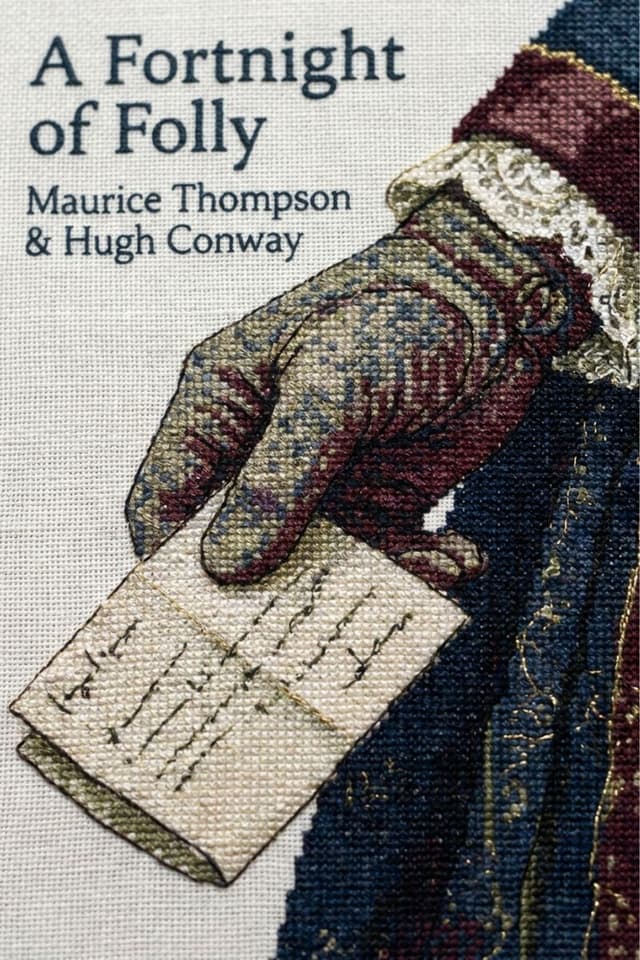
A Fortnight of Folly
Read A Fortnight of Folly by Maurice Thompson and Hugh Conway for free on Novelhalla, and try out our easy-to-read modern edition of this classic book. You can also download the EPUB and read it on any device if you prefer!
The Plot
A Free Hotel Full of Writers
Isaiah R. Gaslucky made his money in natural gas, and now he's built an enormous white hotel on a rock shelf near the top of a mountain in the southern Appalachians. Getting there takes a full day of switchbacks. There's no reason on earth for the place to exist.
So Gaslucky has an idea. He'll fill it for one season, free of charge, with the most distinguished authors in America, throw in a few newspaper people to do the interviewing, and let the publicity build itself. The invitations go out. Everybody accepts.
What arrives on Mount Boab is a hotel full of professional egos with nothing to do all summer but watch each other. A Kentucky poet who has personally met every famous person alive. A New England critic who despises everything, especially Tolstoy. A historian who knocks over the claret. A Boston clubwoman who runs eleven societies and has never finished anything. A romancer whose books get glowing reviews and sell in the hundreds. And Miss Alice Moyne of Virginia, young, beautiful, and the only one of them anybody actually likes.
The Man in Room 24
Room 24 is the good room, and it's been reserved from the start for a guest nobody can identify.
He turns up on the coach: short, round, cheerful, with a Napoleonic forehead and a look of enormous private amusement. He gives no name. He says nothing about his work. He simply takes the best room in the house and settles in.
The guessing starts before he reaches the top of the steps. Is he Mark Twain? Howells? The famous analytical novelist everyone's been arguing about? A mother eventually sends her seven-year-old to ask for his autograph, which he cheerfully provides, and which turns out to be illegible.
He fishes. He smokes fifty-cent cigars. He argues with Miss Moyne about whether Emerson ever discovered anything. And whenever the conversation turns to publishers, which at this hotel is roughly hourly, he has to get up and leave the veranda because he can't keep his face straight.
Every writer on that mountain has a grievance about royalties. Every one of them names the same firm. And the little man in room 24 keeps laughing at jokes nobody else can hear.
The Woman With the Note-Book
Miss Sarah Anna Crabb walks up the mountain from the depot carrying her own bag, which impresses everybody. She's the associate editor of the Ringville Star in Indiana, she talks at roughly twice the normal speed, and she is quietly filing syndicated letters to a Chicago paper about everything that happens on Mount Boab.
She has a little red note-book. She writes down dialect. She writes down insults. She writes down other people's private conversations. A rival newspaperman once called her a bag of gimlets because she bored him so.
She's also the funniest thing in the book, and Thompson clearly knows it. When a fistfight breaks out in the hotel parlor and a mountaineer draws a revolver and a bowie knife, Miss Crabb's chief takeaway is three new phrases for her collection.
A Duel at Midnight, and a Scream From the Cliff
The poet and the critic are both in love with Miss Moyne, and neither will admit it. What they will admit to is a mortal insult, which is how two grown literary men end up at a place called Eagle's Nest at midnight with a pair of Confederate dress swords, no seconds, and an agreement that the meeting ends in somebody's death.
Miss Crabb, naturally, follows them. She has no intention of stopping it. She has every intention of wiring the story down the mountain first thing in the morning.
The blades are ringing, the sparks are flying over a two-hundred-foot drop, and then there's a crash in the bushes behind the critic, a woman's scream, and the sound of a body going over the edge into the cedars.
Both men drop their swords and look down. What happens on Mount Boab that night, and what it does to two reputations by breakfast, is the point at which this book stops being a gentle satire and becomes something closer to a farce with teeth.
The Joke Everybody Is Standing In
Down in the ravine there's a moonshiner named Wesley Tolliver, six feet of gun, whiskers and courtesy, who has a still hidden in a mountain pocket and a very poor opinion of revenue officers. The hotel's authors take one look at him and start scribbling. He's exactly the sort of picturesque mountain character the magazines are paying for.
Tolliver, for his part, is a real person with a real life, and he's about to get tangled up with Miss Crabb in a way neither the magazines nor his mother saw coming.
Meanwhile the man in room 24 is still there, still nameless, still watching a hotel full of writers explain to each other how literature works. He knows exactly who they are. Not one of them knows who he is. And when they finally find out, several of the people on that veranda are going to want the mountain to open up and swallow them.
Also Bound Into This Volume
Two stories by Hugh Conway ride along with the novella. The longer is a strange, gripping piece about Charles Carriston, a young artist who sees things he has no way of knowing. His doctor, who narrates, wants very badly to find a rational explanation and can't. Then the woman Carriston loves vanishes without a trace, and his gift becomes the only thing that might find her.
The trouble is what a gift like that looks like from the outside. Carriston has a cousin with a great deal to gain if the family's odd young heir were quietly certified insane, and in 1880s England it took only two doctors' signatures to put a man away. Carriston knows this. He's read the law. He thinks he can stay ahead of it.
The other Conway piece is a short tale about a sculptor, first serialized in English newspapers in the late summer of 1885, a few months after its author's death.
About the Authors
Maurice Thompson: The Archer
James Maurice Thompson was born in 1844 in Fairfield, Indiana, the son of a Baptist minister, and grew up in the north Georgia mountains after the family moved south. He and his younger brother Will took up the bow as boys in those woods, which turned out to matter enormously later.
Both brothers fought for the Confederacy. Maurice was wounded at Cold Harbor. After the war a doctor sent him to Florida to recover, and there he went back to the bow as a practical tool, shooting for the pot.
The story usually told is that the brothers became archers because ex-Confederates weren't permitted firearms. It's a good story, and the underlying legal squeeze was real, though it skips the part where they'd been shooting since childhood. Either way, Maurice's 1878 book of archery essays became a classic, and in 1879 the two of them founded the National Archery Association in Crawfordsville, with Maurice as its first president. American target archery essentially descends from these two ex-rebels and their longbows.
The Hoosier Renaissance Man
Thompson moved to Crawfordsville, Indiana in 1868 and married Alice Lee, a local woman. Will married her sister. In 1871 the brothers opened a law office together, which was never especially successful but left Maurice time to write.
He piled up careers the way other people collect hobbies: railroad man, civil engineer, surveyor, lawyer, state legislator (elected in 1879), naturalist, poet, critic and, from 1885 to 1888, State Geologist of Indiana. He lived at a house called Sherwood Place on the edge of town, a few streets from Lew Wallace, who had written a modest little book called Ben-Hur.
Neighbors remembered him as shy and self-effacing and endlessly hospitable, which is worth holding in mind while reading a novel this comfortable with mockery.
Fame at the End
Thompson went full-time as a writer around 1889 and served as literary editor of the Independent, becoming one of the more widely read critics in the country. He wrote poetry, nature essays, criticism and fiction, roughly thirty books in all.
The big one came last. Alice of Old Vincennes, a historical romance about George Rogers Clark's campaign in the Northwest Territory, was a national bestseller in 1900. Thompson died in Crawfordsville in February 1901, just as it was making him famous.
Hugh Conway: The Auctioneer
Hugh Conway was really Frederick John Fargus, born in Bristol in December 1847, the son of an auctioneer. At thirteen he ran off to the training ship Conway on the Mersey, which is where the pen name came from. He came home, was articled to accountants, and took over his father's auction business when the old man died in 1868. He married a Bristol alderman's daughter in 1871 and had four children.
He wrote song lyrics and stories on the side. A local printer named Arrowsmith took an interest and published one of them.
Called Back
In 1883 Arrowsmith brought out Conway's short thriller Called Back as a cheap Christmas annual. It sold over 350,000 copies within four years. Critics compared him to Wilkie Collins. He quit auctioneering, adapted the book for the London stage in 1884, and became for about eighteen months one of the most read novelists in the English-speaking world. Bristol gave him a mayoral banquet. Emily Dickinson, of all people, was a fan, and borrowed the title for one of her last letters.
An Ending Nobody Wanted
His lungs were bad. In early 1885 his doctors sent him to the Riviera. He caught typhoid there and died at Monte Carlo on 15 May 1885, aged 37. He's buried in Nice under an epitaph written by Lord Houghton that speaks of great renown and greater promise, and there's a memorial tablet for him in Bristol Cathedral.
Books kept appearing for years afterward. The two stories in this volume are part of that posthumous flood.
Fun Facts About the Book
The Author Was the State Geologist During the Gas Boom
The comic engine of the plot is a Cincinnati man who struck it rich in natural gas and doesn't know what to do with the money. Thompson wasn't guessing. He was State Geologist of Indiana from 1885 to 1888, right through the Trenton Field frenzy, and personally wrote the official chapter on natural gas in the state's 1886 annual report. He had watched an entire region go briefly insane over gas money, and then he wrote this.
Two Authors Who Never Met
The book is credited to Maurice Thompson and Hugh Conway, which makes it sound like a collaboration. It isn't. Conway died in 1885, three years before Thompson's novella was published. When Street & Smith reissued the book in 1902 they padded out the volume with two Conway stories, and the double credit stuck. Two men on one title page who never exchanged a word.
It Name-Checks Half of American Letters
Mark Twain, Howells, Emerson, Lowell, Tolstoy, Zola, Dostoevsky, George Washington Cable and Uncle Remus all get dragged into the arguments on that veranda. The characters who don't appear are the funniest ones: a novelist called Arthur Selby who writes filthy criticism and prim fiction, and an aesthete named Edgar De Vere. Readers in 1888 knew exactly who was meant.
The Craddock Joke Was Extremely Fresh
Every author on the mountain wants to write a mountain dialect story like Craddock. Charles Egbert Craddock was the pen name of Mary Noailles Murfree, a wealthy Tennessee woman who wrote about Appalachian mountaineers she'd mostly observed from resort verandas, and whose identity had been a national literary scandal when it broke in 1885. Thompson is mocking the imitators of an imitation, and his readers would have caught it instantly.
The Copyright Fight Was Real
The characters keep sighing that America ought to have international copyright. In 1888 the United States still gave no protection to foreign authors, which meant British books could be pirated freely and American writers had to compete with stolen goods. Congress finally passed an international copyright act in 1891, three years after this book appeared.
It's a Short Book
The 1888 first edition ran to 140 small pages. This is a novella that moves, not a three-decker. Thompson's real gift was for essays and nature writing, and it shows in the descriptive passages, which are genuinely beautiful and never overstay.
The Author's Own Publisher Grievances
The novel devotes an entire chapter to a savage riff on the book business: publishers as bunco operators, royalty statements as fiction, every author's sales mysteriously reported at eleven hundred and forty copies. Thompson had by that point published a dozen books with a dozen houses. Draw your own conclusion about where the material came from.
The Bestseller Came Twelve Years Later
Anyone reading this in 1888 would have known Thompson as an archery writer and essayist. The novel that made his name, Alice of Old Vincennes, was still a decade away and appeared the year before he died.
Themes
Writers Are Ridiculous
The book's central proposition is that authors, gathered together with nothing to prove and nothing to do, will behave exactly like a bad hotel. They posture, they name-drop, they claim acquaintances they've never had, and they conduct duels over a woman who has expressed no preference at all. Thompson was one of them and wrote it anyway.
Realism Versus Romance
The great literary war of the 1880s runs straight through the dining room. Is fiction supposed to reproduce life or transform it? Is Tolstoy a genius or a fraud? Every character has a violently held position, and Thompson lets them all sound faintly absurd while quietly siding with nobody.
Local Color as an Industry
The most pointed satire is aimed at the dialect-story boom. A real mountaineer stands in front of these people and they see raw material. They mine his speech for phrases, they price him by the magazine word, and it never occurs to any of them that he has his own opinions about them. He does.
Money and the Manuscript
Underneath the comedy is a genuinely unhappy portrait of a profession. These are people who have given their lives to writing and who cannot get an honest accounting of what they've sold. The bitterness in those passages is real, and it's the closest the book comes to anger.
The Press Will Eat You
Miss Crabb's syndicated letter is scrupulously truthful and completely merciless, and it lands in ninety newspapers before anyone on the mountain can react. Thompson is very good on what it feels like to be accurately reported and still ruined by it, and on how a woman in particular gets caricatured in the process.
Who Do You Think You Are
Both halves of this volume hang on the same hook, which may be why Street & Smith bound them together. In one, a hotel full of experts cannot identify the man sitting among them. In the other, a man's most extraordinary quality is the very thing that could get him declared mad. Identity in both is a question of who gets believed.
The Book's Legacy
This one has always sat in the shadow of the two books everybody remembers. Thompson is known for the archery essays and for Alice of Old Vincennes; Conway is known for Called Back and for dying young. The volume that accidentally joined their names is a curiosity, and it's a much better curiosity than it has any right to be.
What it preserves is the American literary world of the 1880s from inside, at the exact moment when realism was fighting romance, when the dialect story was a gold rush, when the copyright question was live, and when a writer could reasonably expect a publisher to lie to him about the numbers. Very little fiction of the period records that world so specifically. Thompson knew all these people, and he was too well mannered to name them and too irritated not to draw them.
Conway's contribution is a reminder of a career that had barely started. The mystery-with-a-strange-gift story he does here belongs to the same current that produced Wilkie Collins before him and the psychic-detective boom after him, and he handles the queasy business of a sane man trying to prove he isn't mad with more skill than his reputation as a bestseller would suggest.
Read together, the pieces make an odd but satisfying pairing: an American comedy about people who can't stop performing, and an English thriller about a man nobody will take at his word.