Novelhalla
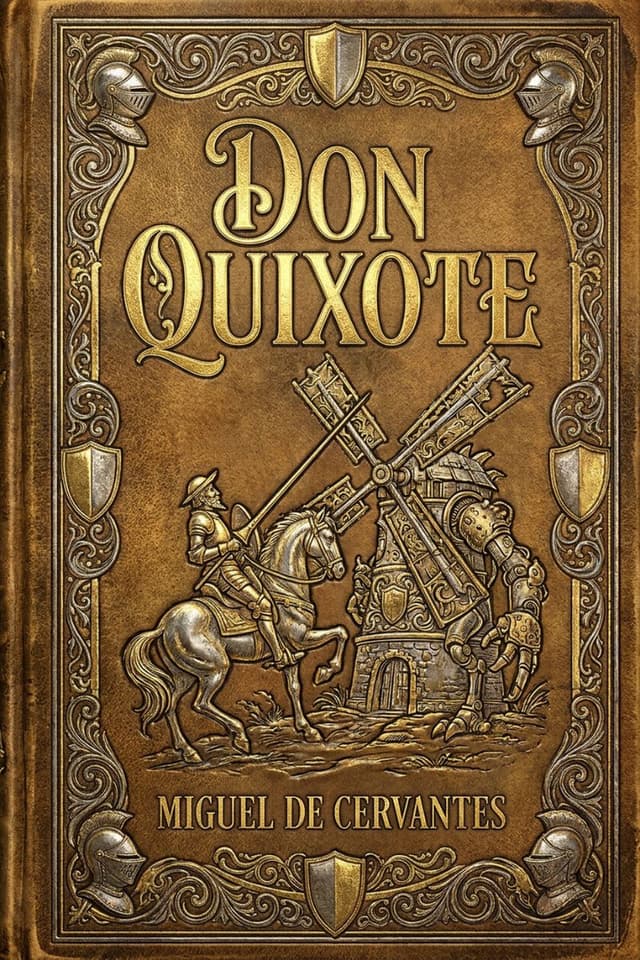
Don Quixote
Read Don Quixote by Miguel De Cervantes for free on Novelhalla, and try out our easy-to-read modern edition of this classic book. You can also download the EPUB and read it on any device if you prefer!
The Plot
The novel follows two intertwined storylines across two parts, though they share characters and themes throughout.
Part One
Alonso Quixano is a middle-aged gentleman from La Mancha who has spent so much time reading chivalric romances that he loses his grip on reality. He decides he must become a knight-errant himself, renames himself Don Quixote de la Mancha, dubs his skinny old horse Rocinante, and declares a peasant woman named Aldonza Lorenzo to be his lady love, renaming her Dulcinea del Toboso.
His first solo adventure goes poorly. He returns home battered, and his friends the barber and the priest burn most of his books, hoping to cure him. It doesn't work. Don Quixote convinces a simple farmer named Sancho Panza to become his squire by promising him an island to govern someday.
What follows is a series of increasingly absurd adventures as Don Quixote mistakes windmills for giants, flocks of sheep for armies, and country inns for castles. Sancho Panza, practical and illiterate, serves as a grounding counterweight to his master's delusions, though he's not immune to getting swept up in them himself.
Part Two
Published ten years after Part One, the second part finds Don Quixote and Sancho aware that a book has been written about their adventures. They've become celebrities. This creates a strange situation where characters they meet have already read about them and have expectations.
A duke and duchess who've read the book invite Don Quixote and Sancho to their castle, where they stage elaborate pranks to amuse themselves at the pair's expense. Sancho actually gets his promised island to govern, with surprising results.
The novel grows more reflective and melancholic as it progresses, raising questions about identity, reality, and what happens when dreams collide with the world.
About the Author: Miguel de Cervantes
Early Life
Miguel de Cervantes Saavedra was born in 1547 in Alcalá de Henares, Spain. His father was a barber-surgeon of modest means who moved the family frequently to escape debt. Little is known about Cervantes' formal education, though his writing shows wide reading.
Soldier and Captive
In 1571, Cervantes fought in the Battle of Lepanto, one of the largest naval battles in history, where the Holy League defeated the Ottoman fleet. He was shot three times, and the wounds permanently maimed his left hand. He called his injuries "stars that guide others to the heaven of honor."
Four years later, while sailing home to Spain, his ship was captured by Barbary pirates. Cervantes spent five years as a slave in Algiers, making four escape attempts. He was finally ransomed in 1580.
Struggling Writer
Back in Spain, Cervantes worked as a tax collector and purchasing agent for the Spanish Armada. He was imprisoned at least twice for financial irregularities in his accounts. Legend has it he began writing Don Quixote while in prison, though this isn't confirmed.
His early literary career was unremarkable. A pastoral novel and some plays brought little success. He was in his late fifties before Don Quixote changed everything.
Late Fame
Part One of Don Quixote was published in 1605, when Cervantes was 57. It was an immediate sensation, going through multiple editions in its first year. Despite its success, Cervantes remained poor. The publishing system of the time meant authors sold their manuscripts outright for modest sums.
He died on April 22, 1616, just one day before William Shakespeare. Both are commemorated on April 23, though due to calendar differences, they actually died ten days apart.
Fun Facts About the Book
The First Modern Novel
Literary scholars frequently call Don Quixote the first modern novel. While earlier long prose narratives existed, Cervantes pioneered techniques that became standard in fiction: complex psychology, multiple perspectives, meta-fictional awareness, and the mixing of high and low characters.
An Unauthorized Sequel Forced His Hand
In 1614, someone published a fake Part Two under the pseudonym Alonso Fernández de Avellaneda. Cervantes was furious. He rushed to complete his own Part Two, published in 1615, and even has characters in it encounter and criticize the fake sequel. The identity of Avellaneda remains a literary mystery.
Sancho's Evolving Speech
Throughout the novel, Sancho speaks in a stream of proverbs, often mangling them or stringing together so many that they become nonsense. Don Quixote frequently criticizes him for this. Scholars have counted over 200 proverbs in Sancho's dialogue, and his character becomes increasingly sophisticated as the novel progresses, a phenomenon sometimes called the "Sanchification" of Don Quixote and the "Quixotification" of Sancho.
The Windmills Are Only One Chapter
The famous windmill episode, which has become the novel's most iconic image, takes up only a few pages. Most people who reference "tilting at windmills" have never read the book.
It Killed the Chivalric Romance
Don Quixote was partly written as a parody of the chivalric romances that were wildly popular in Spain. These books featured knights performing impossible deeds for idealized ladies. Cervantes' satire was so effective that the genre essentially died out afterward. He killed a literary form with comedy.
Dulcinea Never Appears
Despite being the motivation for much of Don Quixote's behavior, Dulcinea del Toboso never appears directly as a character. She exists entirely through Don Quixote's descriptions and other characters' deceptions. This absence is central to the novel's exploration of idealism and imagination.
Lost in Translation
Cervantes' Spanish contains puns, wordplay, and period-specific jokes that are nearly impossible to translate. Different English translations take very different approaches, from archaic and formal to modern and colloquial. The "right" translation depends entirely on what kind of reading experience you want.
Part Two Is Different
Readers often note that Part Two feels distinctly different from Part One. It's more melancholic, more self-aware, and more interested in questions of identity and perception. Some scholars consider it the superior work.
The Title Character's Real Name
The novel opens with uncertainty about the protagonist's actual name. Cervantes suggests it might be Quixada, Quesada, or Quexana, and admits he can't be sure. This playful ambiguity sets the tone for a book constantly questioning what's real and what's invented.
Global Impact
Don Quixote has been translated into more languages than any book except the Bible. The word "quixotic" entered English to describe impractical idealism. Phrases like "tilting at windmills" became universal shorthand. The novel influenced everything from Laurence Sterne's Tristram Shandy to the development of magical realism in Latin America.
Themes
Idealism vs. Reality
The central tension of the novel: is Don Quixote a fool for seeing the world as he wishes it were, or is everyone else impoverished for accepting it as it is? The novel refuses to give a simple answer, constantly shifting between laughing at and admiring its hero.
The Power of Stories
Characters throughout the novel are shaped by the stories they've read or heard. Don Quixote has been transformed by chivalric romances. In Part Two, characters have been transformed by reading Part One. The novel asks what stories do to us and whether we can ever escape their influence.
Appearance vs. Reality
Nothing in Don Quixote is straightforwardly what it seems. Inns are castles. Peasants are princesses. A barber's basin is a legendary helmet. The novel delights in the gap between how things appear and what they might actually be, while questioning whether "actually" has any stable meaning.
Sanity and Madness
The novel complicates any simple distinction between sanity and madness. Don Quixote's delusions lead him to act with more courage, generosity, and honor than the "sane" people around him. His madness often exposes the madness of conventional society.
Class and Social Order
Don Quixote is a gentleman who makes himself a knight. Sancho is a peasant who becomes a governor. The novel constantly plays with questions of social standing, what gives people authority, and whether nobility is something you're born with or something you enact.
Friendship and Loyalty
At its heart, the novel is a story about the relationship between Don Quixote and Sancho Panza. They argue, disagree, and exasperate each other, but their bond deepens across hundreds of pages into something genuinely moving.
The Book's Legacy
Don Quixote is one of the most influential novels ever written. Dostoyevsky called it "the ultimate and most sublime word of human thinking." Faulkner said he reread it every year. It essentially invented the techniques of modern fiction and created a vocabulary for talking about idealism, delusion, and the relationship between stories and reality.
The image of a thin knight on a bony horse, lance aimed at a windmill, has become one of Western culture's most recognizable symbols. The novel has been adapted into countless films, ballets, operas, musicals, and paintings. Picasso, Dalí, and Doré all created famous illustrations.
Four centuries later, calling someone "quixotic" remains our best shorthand for a dreamer whose reach exceeds their grasp, and it's never entirely clear whether it's an insult or a compliment.