Novelhalla
Erewhon
Read Erewhon by Samuel Butler for free on Novelhalla, and try out our easy-to-read modern edition of this classic book. You can also download the EPUB and read it on any device if you prefer!
The Plot
Erewhon is a satirical novel following an unnamed narrator who discovers a hidden civilization while working as a sheep farmer in New Zealand.
The Journey
The narrator, a young man of about twenty-two, becomes obsessed with what lies beyond the imposing mountain range near his sheep station. With the help of a native guide named Chowbok, he sets out to explore the forbidden territory. After Chowbok abandons him partway through the treacherous mountain crossing, the narrator presses on alone until he descends into a valley marked by ten enormous stone statues of strange, semihuman figures.
The Land of Erewhon
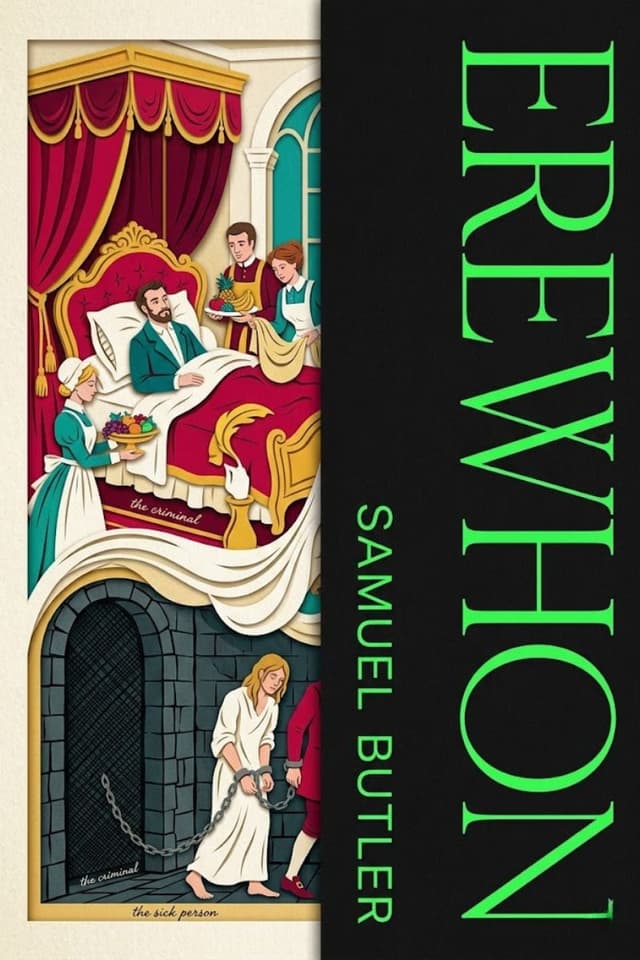
The narrator is captured by the Erewhonians, a handsome people who live in villages resembling northern Italy. When they discover his pocket watch, their curiosity turns to horror. He is imprisoned for the crime of possessing a machine.
During his captivity, the narrator learns the Erewhonian language and begins to understand their inverted society. Illness is treated as a crime punishable by imprisonment, while actual crimes like theft and embezzlement are treated sympathetically as ailments to be cured by specialists called Straighteners. All machines have been destroyed after philosophers warned they would evolve to dominate humanity.
After his release, the narrator lives with the Nosnibor family and falls in love with Arowhena, the younger daughter. He explores Erewhonian institutions including the Musical Banks, ornate but empty religious establishments, and the Colleges of Unreason, where students study impractical hypothetical subjects.
About the Author: Samuel Butler
Early Life
Samuel Butler was born on December 4, 1835, at the rectory in Langar, Nottinghamshire. His father was the Reverend Thomas Butler, and his grandfather was Dr. Samuel Butler, the famous headmaster of Shrewsbury School who later became Bishop of Lichfield. Butler attended Shrewsbury School and then St. John's College, Cambridge, where he studied classics.
Crisis of Faith
After university, Butler began preparing for ordination in the Church of England, as his family expected. But working with the poor in London caused him to question his faith deeply. He refused to take holy orders, causing a bitter conflict with his domineering father. When Butler expressed interest in becoming an artist instead, his father refused to fund it.
New Zealand Adventure
A compromise was reached: Butler's father would finance him to seek his fortune as a sheep farmer in New Zealand. Butler arrived at Lyttelton in January 1860, just after narrowly avoiding death by canceling his berth on a ship that was lost at sea with all hands.
Finding all the known sheep country already claimed, Butler explored the mountain headwaters of Canterbury's rivers. He discovered the land that would become his Mesopotamia Station, named for its position between rivers. After a famous race against a rival claimant to the Christchurch Land Office, he secured his claim and built the station into a 55,000-acre operation that doubled his initial capital in four years.
During this time, Butler explored the Southern Alps, discovering mountain passes that now bear his name. He also began writing, contributing articles to the Christchurch Press including "Darwin Among the Machines" (1863), which would become the seed of Erewhon.
Return to England
Butler returned to England in 1864, possibly due to a failed romance. He settled in rooms at Clifford's Inn in London, where he would live for the rest of his life. He tried to become a painter, exhibiting some works at the Royal Academy, but eventually turned to writing.
Literary Career and Controversies
Erewhon was published anonymously in 1872 and was Butler's only commercial success, earning him about 69 pounds. He spent much of his later life antagonizing both the religious establishment and the scientific community. He wrote several books attacking Darwin's theory of natural selection, championing instead Lamarckian evolution, which made him unpopular with both camps.
Butler also produced deliberately provocative scholarship: The Authoress of the Odyssey (1897) argued that Homer's epic was written by a young Sicilian woman, while Shakespeare's Sonnets Reconsidered (1899) contended that Shakespeare wrote his sonnets for a male lover.
Later Years and Death
Poor book sales and bad investments kept Butler financially dependent on his family until his father's death in 1886 finally gave him independence. He spent his summers traveling in Italy, which he loved, and maintained a small circle of close friends including Henry Festing Jones, who would later write his biography.
Butler died in London on June 18, 1902. His autobiographical novel The Way of All Flesh, a devastating attack on Victorian family life that he had worked on for years, was published posthumously in 1903 and cemented his reputation as a major literary figure.
Fun Facts About the Book
Published Anonymously
Erewhon appeared anonymously in late March 1872. Butler attributed its unexpected success to two favorable early reviews in the Pall Mall Gazette and the Spectator, but also to what a friend later identified as "the sound of a new voice, and of an unknown voice." When Butler revealed himself as the author, he became a well-known figure, though some accounts suggest the revelation actually dampened sales.
Confused with Another Book
Many readers assumed Erewhon was connected to The Coming Race, a similar utopian novel by Edward Bulwer-Lytton published the previous year. Butler insisted in his preface that Erewhon was essentially finished before he even heard of The Coming Race and that he never read it until long after his own book was published.
A Difficult Birth
Butler later admitted that Erewhon took nearly ten years to write and was composed with great difficulty. He assembled it from several previously written pieces, including "Darwin Among the Machines" (1863), "The World of the Unborn" (1865), and "The Musical Banks" (1869), stringing them together at a friend's suggestion.
Rejected by Major Publishers
Butler first submitted Erewhon to Chapman & Hall in May 1871, but they rejected it on the advice of one of their readers. Butler let the manuscript sit for months before finally placing it with the publisher Trubner in early 1872.
The Name Game
"Erewhon" is an anagram of "nowhere" with the h and w transposed. Butler was particular about pronunciation, noting in his preface that it should be spoken as three short syllables: "E-re-whon." Other names follow similar patterns: "Nosnibor" is "Robinson" backward, "Yram" is "Mary" reversed, and "Senoj Nosnibor" is "Jones Robinson."
The Goddess Ydgrun
The Erewhonians worship a goddess named Ydgrun, an anagram of "Grundy," referring to Mrs. Grundy, the symbol of conventional respectability from Thomas Morton's play Speed the Plough. This goddess represents social conformity and the tyranny of what the neighbors might think.
Best Satire Since Swift
In 1873, a reviewer in the Dunedin newspaper the Otago Witness declared Erewhon the best English satirical fiction since Gulliver's Travels. The comparison to Jonathan Swift's classic was intentional on Butler's part, as he modeled his imaginary voyage narrative on Swift's satirical method.
Prophetic About Machines
George Orwell praised the book in a 1945 broadcast, saying it required "imagination of a very high order to see that machinery could be dangerous as well as useful." Alan Turing referenced Erewhon in his paper "Intelligent Machinery, A Heretical Theory," writing that "at some stage we should have to expect the machines to take control, in the way that is mentioned in Samuel Butler's Erewhon."
Not Anti-Darwin
Some reviewers treated the chapters on machines as an attempt to mock Darwin's theory of evolution. Butler protested in his second edition preface that "nothing could be further from my intention, and few things would be more distasteful to me than any attempt to laugh at Mr. Darwin."
Themes
The Inversion of Morality
Erewhon's central satirical device is the reversal of how Victorian society treats illness and crime. By making sickness a punishable offense and crime a treatable condition, Butler forces readers to question their own assumptions about moral responsibility, free will, and social justice.
The Danger of Machines
The Book of the Machines, spanning three chapters, presents a philosophical argument that machines are evolving and may eventually develop consciousness and dominate humanity. Butler was the first writer to seriously explore the idea of machine consciousness through a Darwinian lens, predating modern concerns about artificial intelligence by over a century.
Religious Hypocrisy
The Musical Banks satirize the Church of England as an institution that everyone publicly respects but no one actually uses for anything practical. The Erewhonians maintain two currencies, one spiritual and one practical, just as the Victorians maintained one set of values for Sunday and another for the rest of the week.
Educational Absurdity
The Colleges of Unreason attack the Victorian educational system's emphasis on dead languages and impractical classical learning. Students study a "hypothetical language" that serves no purpose in daily life, just as English students spent years mastering Latin and Greek they would never use.
The Tyranny of Conformity
Through the goddess Ydgrun and the Erewhonians' obsessive concern with what others think, Butler critiques Victorian society's suffocating emphasis on respectability and proper appearances over genuine virtue or happiness.
Birth and Responsibility
The Erewhonian belief that children choose to be born and must accept responsibility for all their misfortunes satirizes religious doctrines of original sin and the Victorian tendency to blame the poor for their own poverty.
The Book's Legacy
Erewhon established Butler as a pioneer of speculative fiction and social satire. The novel influenced major dystopian writers of the twentieth century: Aldous Huxley acknowledged its influence on Brave New World and referenced Erewhon in both The Doors of Perception and Island. George Orwell praised it as a precursor to modern dystopian literature.
Frank Herbert named the "Butlerian Jihad" in his Dune novels after Butler's warnings about machine consciousness. The term has become shorthand for any rebellion against technology or artificial intelligence.
Philosophers have also engaged with the book. Karl Popper used an epigraph from Erewhon in The Open Society and Its Enemies, and Gilles Deleuze referenced Butler's ideas throughout his philosophical work, describing Erewhon as "not only a disguised no-where but a rearranged now-here."
The novel spawned a sequel, Erewhon Revisited (1901), in which the narrator returns twenty years later to find his balloon escape has been interpreted as a miraculous ascension into heaven and that he is now worshipped as a god called "the Sunchild."