Novelhalla
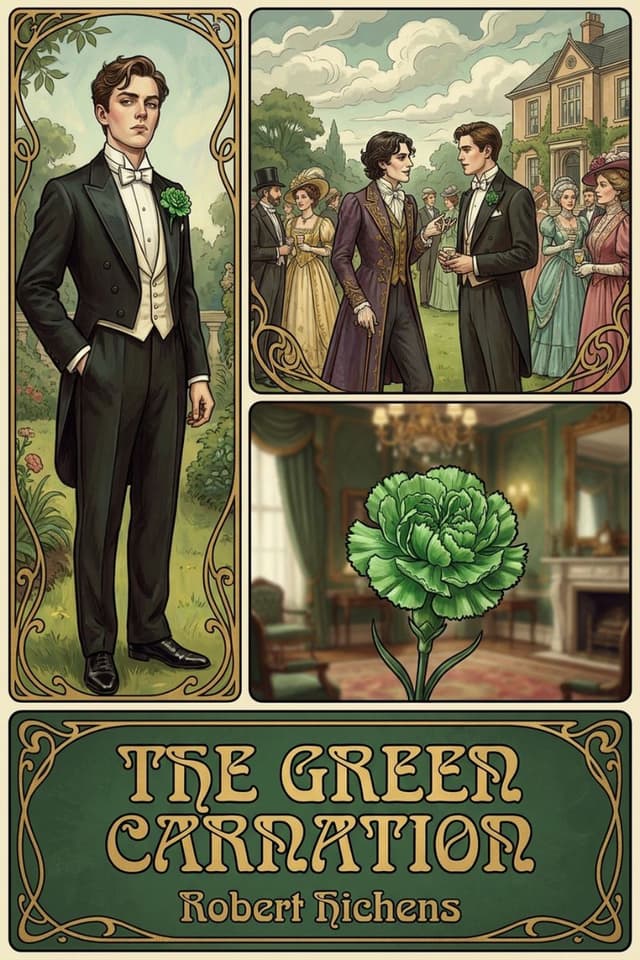
The Green Carnation
Read The Green Carnation by Robert Hichens for free on Novelhalla, and try out our easy-to-read modern edition of this classic book. You can also download the EPUB and read it on any device if you prefer!
The Plot
The Flower
A young lord stands before a mirror in his London bedroom, sliding a green carnation into the lapel of his evening coat. The flower is not natural. It's been dyed. That's the whole point.
Lord Reggie Hastings is on his way to a dinner party, and everything about him is carefully arranged: his posture, his expression, the tilt of his head. He is a disciple of Esme Amarinth, a famous playwright and professional wit who has taught him that artifice is superior to nature, that sinning beautifully is better than being good boringly, and that the green carnation is the badge of a new kind of man. Not a club, exactly. Not a society. Something more like a philosophy worn in the buttonhole.
At dinner, Reggie meets Lady Locke. She is a young widow, recently returned to England after ten years abroad, and she has no idea what she's walked into.
The Widow
Lady Locke is smart, warm, and utterly bewildered by the London she's come home to. Everything has changed. Men wear dyed flowers and talk in epigrams. A playwright named Amarinth holds court and everyone revolves around him like satellites around a very witty sun. His followers all seem to walk the same way, talk the same way, and wear the same unnatural flower.
Lady Locke's cousin, Mrs. Windsor, invites everyone to spend a week at her country cottage in Surrey: Reggie, Amarinth, Lady Locke, her young son Tommy, and the magnificently sharp-tongued Madame Valtesi, who claims her one good deed in life was marrying the only man who wasn't in love with her.
What follows is a week of croquet and conversation, country walks and philosophical fireworks. And underneath all the wit, a question Lady Locke can't stop turning over in her mind: who is Lord Reggie, really?
The Puzzle
This is the thing that keeps Lady Locke awake. Reggie seems talented but hollow. Good-hearted but performing. A gentleman, but somehow not quite a man at all. He says he commits every sin that attracts him, but he doesn't look wicked. Is he being himself, or is he being Amarinth? Is there a real person underneath the pose, or has the pose eaten the person alive?
She watches him compose a church anthem from the Song of Songs and charm a village curate into letting him conduct the choir. She watches him play ball with Tommy and laugh like a boy. She watches him deliver brilliant epigrams that sound like someone else's thoughts coming out of his mouth. She likes him. She might even be a little in love with him. And she is increasingly disturbed by everything he represents.
Then she overhears him promising Tommy a green carnation. And something in her snaps.
The Question
Because this isn't just about a flower. It's about what the flower means, and what kind of man wears it, and what kind of world he wants her son to grow up in. Lady Locke has to decide what she believes about artifice and sincerity, about charm and substance, about the beautiful young lord who may or may not be capable of loving anyone at all.
Reggie, meanwhile, has his own plans for Lady Locke. Plans that have less to do with love than with convenience. Plans that Amarinth has encouraged with the same elegant detachment he brings to everything.
The week in the country is almost over. The proposal is coming. And Lady Locke already knows more than Reggie thinks she does.
About the Author: Robert Hichens
Early Life
Robert Smythe Hichens was born in 1864 in Speldhurst, Kent, the eldest son of a clergyman. His father, a Canon of Canterbury, wanted him to study at Oxford, but Hichens had other ideas. He enrolled at the Royal College of Music, studied journalism at the London School of Journalism, and published his first novel, The Coastguard's Secret, at age twenty-one. He was a teenager who left school at fifteen without distinction and grew into a man who would write over fifty books.
The Egypt Trip and the Spark
In his late twenties, Hichens fell ill with a bout of poisoning and traveled to Cairo to recover. There, on the Nile, he met Lord Alfred Douglas and was introduced to Oscar Wilde. He spent time in their company, absorbing the wit, the philosophy, the atmosphere. He wrote down everything Wilde said. Back in London, he turned those notes into The Green Carnation, writing the manuscript in roughly four weeks. It was published anonymously in 1894, and it detonated.
The Long Career
Hichens went on to become a prolific and successful novelist for over half a century. He succeeded George Bernard Shaw as music critic at the London World. His novel The Garden of Allah (1904) was a bestseller that was filmed three times, including a 1936 Technicolor production starring Marlene Dietrich. His 1933 novel The Paradine Case was adapted by Alfred Hitchcock in 1947. He also wrote some genuinely unsettling supernatural fiction, including "How Love Came to Professor Guildea," which remains one of the most anthologized horror stories of its era.
Private Life and Death
Hichens never married. He was gay but extremely discreet, even by the standards of his time. His close friends included gay writers E.F. Benson and Reginald Turner. He spent much of his later life abroad, living in Sicily, Italy, North Africa, and Switzerland. He published his memoirs, Yesterday, in 1947. He died in Zurich in 1950 at the age of eighty-five, a largely forgotten figure whose most famous book was written when he was twenty-nine.
Fun Facts About the Book
Published Anonymously on Purpose
The English publisher advised Hichens to leave his name off the book to generate more intrigue. It worked spectacularly. Everyone wanted to know who wrote it, and speculation ran wild. Many people assumed Oscar Wilde himself was the author. Wilde initially found this amusing before publicly denying it.
Wilde's Verdict
When the book first appeared, Wilde wrote to his friend Ada Leverson that he hadn't thought Hichens capable of anything so clever. But when the Pall Mall Gazette suggested Wilde might have written it himself, he fired off a letter to the editor: "I invented that magnificent flower. But with the middle-class and mediocre book that usurps its strangely beautiful name I have, I need hardly say, nothing whatsoever to do. The flower is a work of art. The book is not." Even Wilde's insults were works of art.
A Roman a Clef With a Key
Everyone in the novel maps onto a real person. Esme Amarinth is Wilde. Lord Reggie Hastings is Lord Alfred Douglas. Wilde's novel The Picture of Dorian Gray appears as "The Soul of Bertie Brown." Other real literary figures of 1890s London are referenced throughout, from George Meredith to Henry James to Olive Schreiner. Contemporary readers would have recognized the cast immediately.
Used Against Wilde in Court
The Green Carnation was withdrawn from circulation in 1895, but it was too late. The book had made explicit what many people suspected about Wilde's private life, and it was used as evidence during his trials for gross indecency. Hichens, horrified by the consequences, refused to allow any reprints for over fifty years. The novel didn't appear in print again until 1948, two years before his death.
The Real Green Carnation
Wilde and his circle wore dyed green carnations to the opening night of his play Lady Windermere's Fan in 1892. The flower, deliberately unnatural, became associated with aestheticism and, eventually, with homosexuality, though the latter connection may have been a later invention. Dyed flowers had existed in England for years before Wilde adopted them. The green carnation was later worn by Irish Americans on St. Patrick's Day, entirely unrelated to its Wildean origins.
Written in Four Weeks
Hichens reportedly dashed the entire manuscript off in about a month. The speed shows in the best possible way: the book has a crackling energy and sharpness that come from writing in a single burst of inspiration. He'd spent nearly a year absorbing Wilde's world before he sat down to write, so the material was ready. He just had to let it out.
Themes
The Performance of Self
The novel's central question is deceptively simple: is anyone in this story being real? Reggie performs a version of himself that was designed by Amarinth. Amarinth performs brilliance so constantly that even he may have forgotten what's underneath. Lady Locke is the only person trying to figure out what's genuine and what's costume. The green carnation itself is the perfect symbol: a real flower made to look unreal.
Influence and Identity
Reggie worships Amarinth the way a student worships a charismatic professor. He has absorbed Amarinth's ideas so completely that his own personality has vanished into the imitation. The novel asks whether this kind of devotion is a form of self-creation or self-destruction. Can you become someone by copying a genius, or do you just become a copy?
Artifice vs. Nature
Amarinth's philosophy is that nature is vulgar and art is everything. The dyed carnation is better than the real one because it is deliberate, chosen, crafted. Lady Locke pushes back instinctively. She finds the countryside beautiful. She values sincerity. She suspects that people who despise nature are also incapable of natural feeling. The novel stages this argument without fully resolving it, which is part of its charm.
The Limits of Wit
The book is packed with brilliant one-liners, many of them lifted almost directly from Wilde's real conversation. But Hichens quietly suggests that a life built entirely on wit might be a life built on nothing. Amarinth has a moment where he listens to choirboys sing and feels a pang for his own lost youth, buried under decades of cleverness. It's the one instant where the performance cracks.
A Woman's Judgment
In a world full of posing men, Lady Locke is the one who sees clearly. She's attracted to Reggie, she's charmed by the wit, but she's also a mother with a son she's raising alone, and she will not sacrifice her judgment for a good line. The novel gives her the final word, and it's a devastating one.
Side Characters
Madame Valtesi
The true scene-stealer of the book. A cynical older woman who smokes cigarettes, says terrible things with perfect composure, and claims that marrying the only man not in love with her was her one good deed. She watches everything with the detachment of someone who figured out the game decades ago and is now merely entertained by it.
Tommy
Lady Locke's nine-year-old son, who adores Lord Reggie with the uncritical worship of a child. Tommy wants a green carnation of his own. He wants to be just like the beautiful young lord who plays him ball and lets him sit on the organ bench. Tommy is the reason Lady Locke can't afford to be wrong about Reggie.
The Book's Legacy
The Green Carnation was a sensation in 1894 and a ghost for the next fifty years. Its withdrawal after Wilde's trials turned it into one of the most infamous books of the decade, more talked about than read. When it finally returned to print in 1948, the world had changed enough to receive it differently: less as scandal, more as a vivid snapshot of a vanished world.
The novel is one of the earliest works of English literature to deal openly, if obliquely, with homosexuality. It didn't invent the code, but it broadcast it to a mass audience. Noel Coward nodded to it in 1929 with the song "We All Wear a Green Carnation" in his operetta Bitter Sweet.
For modern readers, the book works on two levels. It's a wickedly funny comedy of manners, full of epigrams sharp enough to cut glass. And it's a portrait of a moment just before catastrophe, a glimpse of Oscar Wilde at his peak, charming and careless and a year away from ruin, captured by a young writer who was close enough to see everything and smart enough to write it down.