Novelhalla
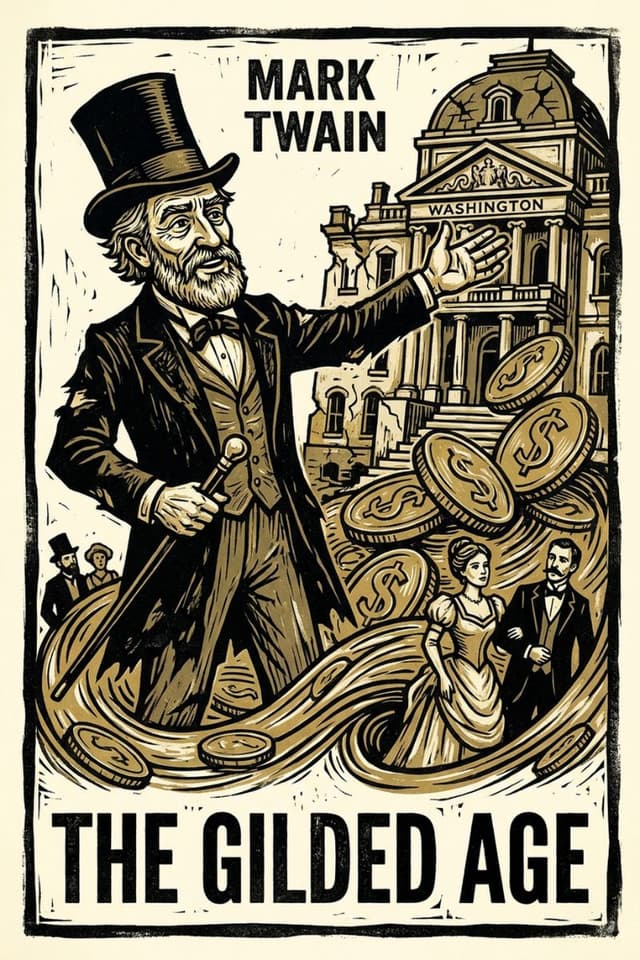
The Gilded Age
Read The Gilded Age by Mark Twain for free on Novelhalla, and try out our easy-to-read modern edition of this classic book. You can also download the EPUB and read it on any device if you prefer!
The Plot
The Hawkins Family Dream
In the backwoods of Obedstown, Tennessee, Silas Hawkins lives in quiet poverty with his wife Nancy and their children. He owns a small store that barely sustains the family, but Hawkins harbors a secret hope: seventy-five thousand acres of Tennessee land that he believes will one day make his children rich beyond measure. When his old friend Colonel Beriah Sellers writes from Missouri promising boundless opportunity in the new frontier, Hawkins decides to uproot his family and chase a better life.
The journey westward brings both tragedy and unexpected family. On the road, the Hawkinses take in an orphan boy named Henry Clay. Later, aboard a steamboat on the Mississippi, disaster strikes when a rival vessel explodes during a reckless race. From the wreckage, the Hawkinses rescue a young girl named Laura, whose parents have perished in the flames. They adopt her as their own.
Colonel Sellers and His Schemes
Missouri proves no kinder to the Hawkins family than Tennessee. Years pass, and Silas Hawkins dies still dreaming of the fortune his land will bring. The family remains poor, sustained by the tireless work of their son Clay and the unwavering optimism of Colonel Sellers.
Sellers is a man who sees millions in every mud puddle. He feeds his family turnips while describing feasts, sits by an empty stove while rhapsodizing about its revolutionary heating properties, and discusses his intimate dealings with New York bankers and the Rothschilds while lacking the money for postage. His schemes multiply endlessly: patent medicines, land speculation, railroad ventures, industrial projects. None of them succeed, yet Sellers never loses faith that prosperity is just around the corner.
Washington and Laura Go to the Capital
The story shifts to Washington, D.C., where the Hawkins family's dreams collide with the realities of American politics. Washington Hawkins, the eldest son, travels to the capital to work with Senator Abner Dilworthy, a pious fraud who speaks of Christian charity while trading votes for cash. Laura, now a beautiful and intelligent young woman, follows to serve as a lobbyist for a scheme to sell the family's Tennessee land to the federal government.
The plan is to convince Congress to purchase the land for a university to educate freed slaves, a noble goal that masks the corruption underlying it. Laura proves devastatingly effective in the drawing rooms of power, charming congressmen and navigating Washington society with cold skill.
A Parallel Story
Meanwhile, two young men from New York pursue their own fortunes out west. Philip Sterling is earnest and hardworking, an engineer who believes in honest labor. His friend Harry Brierly is charming but shallow, quick with a scheme and slow with effort. They join a surveying expedition, cross paths with Colonel Sellers, and become entangled in the land speculation fever that grips the nation.
Philip falls in love with Ruth Bolton, a young Quaker woman determined to become a doctor despite the prejudices of her era. Their courtship unfolds alongside the main plot, offering a contrast between genuine ambition and the hollow dreams that consume so many characters.
About the Authors
Mark Twain
Early Life
Samuel Langhorne Clemens was born on November 30, 1835, in Florida, Missouri, two weeks after Halley's Comet made its closest approach to Earth. His family moved to Hannibal, Missouri, when he was four years old, and the Mississippi River town would shape his imagination for the rest of his life. His father died when Sam was eleven, ending his formal schooling. He became a printer's apprentice, learning the trade that would lead him to writing.
River and Road
At twenty-one, Clemens fulfilled a boyhood dream by training as a steamboat pilot on the Mississippi. He earned his license in 1859 and spent two years navigating the great river, learning its moods and meeting the colorful characters who would populate his fiction. The pen name "Mark Twain" came from this period, a river pilot's call indicating water two fathoms deep and safe for passage.
The Civil War ended his piloting career. After a brief, inglorious stint in a Confederate militia unit, Clemens headed west with his brother Orion, seeking fortune in Nevada's silver mines. He found no silver but discovered his true calling as a writer, publishing humorous sketches that brought him national attention.
The Hartford Years
In 1870, Clemens married Olivia Langdon and eventually settled in Hartford, Connecticut, where he lived next door to Harriet Beecher Stowe in the literary enclave of Nook Farm. During his seventeen years there, he wrote most of his major works, including The Adventures of Tom Sawyer, Adventures of Huckleberry Finn, and A Connecticut Yankee in King Arthur's Court.
His neighbor and friend Charles Dudley Warner became his collaborator on The Gilded Age, Twain's first novel and his only collaborative work. Bad investments eventually bankrupted Twain, forcing him to leave Hartford and embark on a worldwide lecture tour to pay his debts.
Final Years
Twain's later life was marked by personal tragedy. His daughter Susy died of meningitis, his wife Olivia died in 1904, and his daughter Jean died on Christmas Eve 1909. He grew increasingly pessimistic about human nature, though his wit never fully abandoned him.
He had predicted that since he came into the world with Halley's Comet in 1835, he expected to go out with it when it returned. He died of a heart attack on April 21, 1910, one day after the comet reached its closest approach to the sun.
Charles Dudley Warner
Early Life
Charles Dudley Warner was born on September 12, 1829, in Plainfield, Massachusetts. His father died when he was five, and he was sent to live with relatives on a farm in Charlemont, a childhood he would later recall fondly in his memoir Being a Boy. He graduated from Hamilton College in 1851 and drifted through various occupations: surveying in Missouri, studying law at the University of Pennsylvania, practicing law in Chicago.
The Hartford Courant
In 1860, Warner found his true calling when he became assistant editor of The Hartford Press. The following year he became editor, and when the paper merged with The Hartford Courant, he became co-editor with Joseph R. Hawley. He would remain associated with the Courant for the rest of his life.
Warner's essays, beginning with My Summer in a Garden in 1870, made him one of the most popular writers in America. His gentle humor and reflective style won him a devoted readership, and he became known for witty observations that are still quoted today, including the famous remark often misattributed to Twain: "Everybody complains about the weather, but nobody does anything about it."
Later Career and Legacy
Warner wrote travel books, biographies, novels, and essays throughout his long career. He edited the massive Library of the World's Best Literature and was the first president of the National Institute of Arts and Letters. He was deeply interested in social reform, particularly prison reform.
Warner collapsed during an afternoon walk in Hartford on October 20, 1900, and died that day. Mark Twain served as a pallbearer at his funeral.
Fun Facts About the Book
A Dinner Table Dare
According to Twain's biographer Albert Bigelow Paine, The Gilded Age began as a challenge. At dinner one evening in early 1873, Olivia Clemens and Susan Warner complained about the poor quality of novels they were reading. Their husbands claimed they could do better. The wives dared them to prove it. The entire novel was written between February and April of that year.
The Title That Named an Era
The phrase "Gilded Age" comes from Shakespeare's King John: "To gild refined gold, to paint the lily... is wasteful and ridiculous excess." The title suggests a thin layer of gold covering baser metal, a perfect metaphor for an era of ostentatious wealth masking corruption and inequality. The name stuck so thoroughly that historians now routinely refer to the period from roughly 1870 to 1900 as the Gilded Age.
The Real Colonel Sellers
Colonel Sellers was based on James Lampton, Twain's maternal cousin, a lovable dreamer who spent his life chasing schemes that never materialized. The Tennessee land in the novel mirrors the actual experience of Twain's own father, John Clemens, who purchased a vast tract of Tennessee land expecting it to make his children wealthy. It never did. Twain later wrote that to begin life "poor and prospectively rich" was a curse that kept the family "hoping and hoping, during 40 years, and forsook us at last."
A Name Change Controversy
The character was originally named "Eschol Sellers" in the first edition. When a real George Escol Sellers of Philadelphia objected, the publishers changed the name to "Beriah Sellers." Then a real Beriah Sellers appeared. In subsequent works, Twain renamed the character "Mulberry Sellers" to avoid further trouble.
Critics Were Mixed
Contemporary reviews praised the novel's humor and satire but complained that the collaboration produced an uneven work. One 1874 review compared it to a badly mixed salad dressing: "the ingredients are capital, the use of them faulty." The two storylines, written largely independently by each author, never quite mesh into a unified narrative.
A Successful Play
Despite mixed reviews, the novel was remarkably popular, and a stage adaptation starring John T. Raymond as Colonel Sellers became one of the most successful plays of the decade. Audiences loved the character's irrepressible optimism and grandiose schemes.
The First Washington Novel
Literary scholars often identify The Gilded Age as the first American novel of consequence to satirize Washington, D.C., and the workings of federal government. It established a tradition of political satire that continues to this day.
Twain's First Novel
Though Twain had published two successful travel books before this, The Gilded Age was his first attempt at fiction in novel form. The experience taught him about the craft of longer narrative, skills he would perfect in Tom Sawyer and Huckleberry Finn.
Themes
The Curse of Easy Riches
The novel relentlessly mocks the dream of getting rich without working for it. Every character who chases quick wealth through speculation ends in disappointment or disaster. Only Philip Sterling, who puts in honest labor as an engineer and eventually discovers coal through persistent effort, achieves genuine success. The Hawkins family's Tennessee land represents the seductive promise of unearned fortune that keeps people passive and dreaming rather than building real lives.
Political Corruption
Washington, D.C. appears as a swamp of bribery, vote-buying, and moral compromise. Senator Dilworthy mouths pieties while trading votes for cash. Lobbyists like Laura manipulate congressmen through flattery and favors. The scheme to sell worthless land to the government for a supposedly charitable purpose reveals how easily noble rhetoric can mask corrupt intent. The novel suggests that American democracy, for all its ideals, operates largely through the exchange of money.
The Illusion of Opportunity
The Gilded Age presents America as a land of promise that rarely delivers. Missouri offers no more opportunity than Tennessee. Washington's power brokers care nothing for the people they claim to serve. The railroad that was supposed to bring prosperity to Stone's Landing never arrives. The novel questions whether the American Dream is anything more than a useful fiction that keeps people striving while others profit from their hope.
Women's Limited Options
Laura Hawkins is brilliant, ambitious, and utterly constrained by her society. Betrayed by Colonel Selby, she has no legal recourse and no path to respectability except through the manipulation of men. Ruth Bolton's determination to become a doctor meets constant resistance. The novel shows how women's intelligence and ambition, denied legitimate outlets, can turn destructive or be channeled into narrow acceptable roles.
The Power of Optimism (and Its Dangers)
Colonel Sellers embodies both the glory and the folly of American optimism. His refusal to accept defeat is admirable in its way, but it also keeps him from dealing with reality. He is a dreamer who cannot stop dreaming, even when his dreams harm those around him. The novel asks whether such optimism is a virtue or a vice, and whether America's faith in the future blinds it to the problems of the present.
The Book's Legacy
The Gilded Age gave a name to an entire era of American history. When historians speak of the Gilded Age, they invoke Twain and Warner's vision of a society obsessed with wealth, riddled with corruption, and blind to the suffering beneath its glittering surface. No other novel has so thoroughly branded a historical period.
The book established political satire as a major mode of American fiction. Its portrayal of Washington as a marketplace where votes are commodities and principles are for sale influenced generations of writers. The tradition runs through novels like Henry Adams's Democracy and Robert Penn Warren's All the King's Men down to contemporary political fiction.
Colonel Sellers became one of the most recognizable comic characters of the nineteenth century, inspiring stage adaptations and sequels. His combination of boundless optimism and complete impracticality struck a chord with audiences who recognized the type from their own lives. Twain returned to the character in The American Claimant, though never with the same success.
For Twain personally, the novel marked a turning point. It was his first attempt at sustained fiction, and despite its flaws, it taught him how to construct a narrative over hundreds of pages. The skills he developed here would serve him well in the masterpieces to come.
Modern readers often find The Gilded Age uncomfortably relevant. Its portrait of politicians serving wealthy interests, of speculators gambling with other people's futures, of a society that celebrates wealth while ignoring how it was obtained, feels remarkably contemporary. The title has been applied to other periods of American history when inequality soared and corruption flourished, suggesting that Twain and Warner identified something permanent in the national character.
The collaboration itself remains unique in Twain's career. He never wrote another novel with a partner, perhaps because the experience showed him how difficult it is to merge two voices into one. Yet the novel succeeds despite its seams, its energy and anger carrying readers past the inconsistencies. It remains in print after more than 150 years, still finding audiences who recognize the world it describes.