Novelhalla
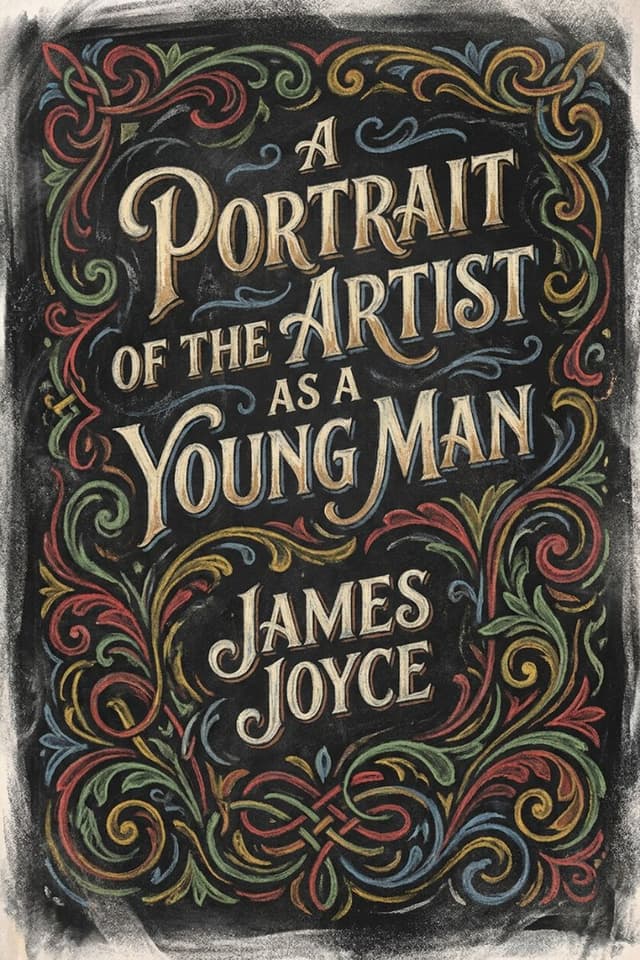
A Portrait of the Artist as a Young Man
Read A Portrait of the Artist as a Young Man by James Joyce for free on Novelhalla, and try out our easy-to-read modern edition of this classic book. You can also download the EPUB and read it on any device if you prefer!
The Plot
Once Upon a Time
The novel opens inside the mind of a very small boy. Stephen Dedalus is hearing a story his father tells him, feeling the warmth of wetting the bed, noticing how his mother smells different from his father. The world arrives in fragments: sounds, textures, colors, the feel of words in his mouth before he understands what they mean. It's a remarkable beginning because it doesn't just describe childhood. It recreates the way a child actually experiences reality, one sensation at a time.
Stephen is sent to Clongowes Wood College, a Jesuit boarding school, and he is immediately, viscerally out of place. He's small, his eyesight is poor, and the other boys are rougher and louder than anything he's prepared for. He gets shoved into a ditch of cold, filthy water. He gets sick. He lies in the infirmary wondering if he might die, and the thought arrives not with panic but with a strange, almost poetic curiosity. When a prefect punishes him unjustly, breaking his glasses with a blow across the palms, something shifts. Stephen, trembling and humiliated, walks to the rector's office and reports the injustice. It is one of the first choices he makes entirely on his own. It won't be the last.
A Family Coming Apart
At home, things are unraveling. Stephen's father, Simon Dedalus, is a charming, boastful man who is spectacularly bad with money. The family is sinking. They move from a comfortable house to cheaper lodgings, then cheaper still, the children multiplying as the resources shrink. A Christmas dinner erupts into a vicious argument about Charles Stewart Parnell, the fallen Irish political leader whose betrayal by the Catholic Church and his own allies has torn the country apart. Stephen sits at the adult table for the first time and watches the people he loves scream at each other over politics, religion, and loyalty. He doesn't fully understand what's happening, but he feels every bit of it.
The Dedalus family continues its slide. Stephen is pulled from Clongowes when his father can no longer afford the fees. He attends Belvedere College on a scholarship, where he proves brilliant but restless. He wins prizes, acts in school plays, and begins to realize that his mind works differently from those around him. He notices everything. Words fascinate him, not just their meanings but their sounds, their textures, the way they taste. He is becoming something, but he doesn't yet have a name for it.
The Fall
Adolescence hits Stephen like a fever. He is consumed by desire, guilt, and a loneliness so deep it feels physical. He wanders the streets of Dublin at night, drawn toward the poorer parts of the city, until he finds himself in the arms of a prostitute. It is his first sexual experience, and it opens a door he can't close. He begins visiting prostitutes regularly, and the Catholic guilt that has been threaded through his entire upbringing coils tighter and tighter inside him.
Then comes the school retreat. A Jesuit priest delivers a series of sermons about hell that are among the most terrifyingly vivid passages in all of literature. The fire, the stench, the eternal darkness, the worms, the despair without end. Stephen sits in the chapel and feels the full crushing weight of his sins. He is convinced he is damned. The terror drives him to confession, to penance, to a devotion so intense and rigid that his teachers begin to take notice.
The Temptation
Stephen's piety is so conspicuous that the Jesuits approach him with a question: has he ever considered joining the priesthood? It is presented as the highest calling available to him, the ultimate expression of the faith that has shaped his entire world. Stephen walks away from the meeting and feels the full gravity of the offer. A life of order, ritual, authority. A collar. A name that isn't quite his own.
He walks toward the sea. And on the shore, he sees a girl wading in the water, her skirts lifted, her face turned away. She is ordinary and extraordinary at the same time. Something in the image, the light, the water, the freedom of her bare legs, cracks open something inside him that the Church cannot contain. It is not just desire. It is a vision of a different kind of life.
The University
Stephen enters University College Dublin, and the final chapter of the novel tracks a young man pulling himself loose from every net that has been cast over him. Family. Church. Country. Friendship. He develops theories about beauty and art, arguing passionately with classmates who can't quite keep up. He admires a young woman from a distance and writes her a poem but cannot bring himself to speak honestly to her. He debates Irish nationalism with friends who want him to sign petitions and join movements, and he refuses. Not because he doesn't care, but because he has begun to understand that his path lies elsewhere.
His closest friend, Cranly, pushes him on what he actually believes. About God. About Ireland. About his mother, who begs him to take Easter communion and whom he loves but cannot obey. Stephen's answers are fierce, precise, and a little frightening. He is stripping away every allegiance that doesn't serve the one thing he's finally identified as his purpose.
He is going to be an artist. And to do that, he is going to have to leave.
About the Author: James Joyce
Dublin Childhood
James Joyce was born on February 2, 1882, in Rathgar, a suburb of Dublin, the eldest of ten surviving children. His father, John Stanislaus Joyce, was a civil servant with a gift for storytelling and a talent for losing money. His mother, Mary Jane Murray, was a devout Catholic and a gifted singer. The family's fortunes declined steadily throughout Joyce's childhood, forcing move after move into increasingly shabby neighborhoods. Joyce was sent to Clongowes Wood College, the same Jesuit boarding school Stephen Dedalus attends in the novel, but was pulled out when his father could no longer pay. He went on to Belvedere College on a scholarship and then to University College Dublin, where he studied modern languages and developed a fierce literary ambition.
Self-Exile
In 1902, Joyce left Ireland for Paris, ostensibly to study medicine, but really to write. He was recalled the following year by his mother's terminal illness. After her death, he stayed in Dublin just long enough to meet Nora Barnacle, a young woman from Galway working as a chambermaid. Their first date, on June 16, 1904, became the most famous day in literary history: the date on which Ulysses is set, now celebrated worldwide as Bloomsday. In October 1904, Joyce and Nora left Ireland together. He would return only a handful of times and never again after 1912.
The Wandering Writer
Joyce and Nora settled in Trieste, where he taught English at a Berlitz school and began building the body of work that would change literature. They had two children, Giorgio and Lucia. Money was perpetually scarce. Joyce's eyesight was deteriorating badly, and he would undergo more than twenty-five eye surgeries over his lifetime. His short story collection Dubliners took a decade to publish due to censorship concerns. A Portrait of the Artist as a Young Man was serialized in 1914 and published as a book in 1916. When World War I forced the family to Zurich, Joyce began the novel that would consume him for seven years: Ulysses.
Fame and Difficulty
Ulysses was published in Paris in 1922 by Sylvia Beach's bookshop Shakespeare and Company, and it was immediately banned in the United States and the United Kingdom for obscenity. Copies were smuggled across borders. The novel made Joyce the most talked-about writer in the world. He spent the next seventeen years in Paris working on Finnegans Wake, his most experimental and divisive work. His daughter Lucia suffered from severe mental illness and was eventually institutionalized. When World War II began, the family fled to Zurich. Joyce died there on January 13, 1941, at the age of fifty-eight, following surgery for a perforated ulcer. He was buried in Fluntern cemetery without Catholic rites.
Legacy
Joyce is widely considered one of the most important and influential writers of the twentieth century. His innovations in stream of consciousness, interior monologue, and the musicality of prose reshaped what the novel could be and do. His influence runs through Faulkner, Hemingway, Beckett, Ellison, and virtually every serious novelist who followed. Ulysses regularly tops lists of the greatest novels ever written. Despite never receiving the Nobel Prize, Joyce has never gone out of fashion, and his work continues to generate more scholarly attention than that of almost any other modern writer.
Fun Facts About the Book
It Started as a Different Novel Entirely
Joyce originally began writing the story as a sixty-three-chapter realistic novel called Stephen Hero. After completing about twenty-five chapters, he abandoned it in 1907 and completely reimagined the material as the tightly compressed, five-chapter work we have today. The shift was radical: out went the conventional narration, in came a revolutionary technique where the prose itself changes and matures as Stephen does, moving from the baby talk of the opening pages to the dense philosophical arguments of the final chapter.
The Prose Grows Up with the Character
This is one of the novel's most celebrated innovations. The very first lines are written in the halting, sensory language of a toddler. By the final chapter, the prose has become that of a university student wrestling with Aristotle and Aquinas. Joyce didn't just tell the story of a mind developing. He made the reader experience it in real time through the texture of the sentences themselves.
Printers Refused to Print It
When the novel was serialized in The Egoist magazine in London in 1914 and 1915, printers repeatedly balked at the text. They objected to certain words and feared prosecution for obscenity. Harriet Shaw Weaver, the magazine's editor, had to fire multiple printers over their refusal to set the type. The full book was eventually printed in New York by B. W. Huebsch in 1916, with a small number of copies shipped to London for British publication.
Ezra Pound Made It Happen
The novel might never have been published without the intervention of the American poet Ezra Pound. W. B. Yeats had shared one of Joyce's poems with Pound, who wrote to the unknown Irish writer and asked to see more work. Joyce sent back Dubliners and the first chapter of his novel. Pound called it "damn fine stuff" and within a month had arranged for its serialization. His early championing of Joyce was one of the most consequential acts of literary matchmaking in the twentieth century.
Stephen Dedalus Returns
Joyce wasn't finished with his protagonist. Stephen Dedalus reappears as a central character in Ulysses, set on a single day in Dublin in 1904. In that novel, the brilliant but directionless young artist encounters Leopold Bloom, an ordinary man navigating the mundane and the extraordinary in equal measure. Reading Portrait first gives Ulysses one of its deepest emotional layers.
The Name Means Everything
Stephen's surname alludes to Daedalus, the master craftsman of Greek mythology who built the labyrinth for King Minos and later fashioned wings of wax and feathers to escape imprisonment on Crete. His son Icarus flew too close to the sun and fell into the sea. Joyce chose the name with full awareness of both possibilities: the artist who escapes on wings of his own making, and the young man whose ambition might destroy him. The novel never tells you which one Stephen will become.
Joyce's Birthday Was the Publication Date
The serialization of the novel in The Egoist began on February 2, 1914, which was Joyce's thirty-second birthday. Whether this was coincidence or deliberate tribute by the magazine's editors, the date links the fictional self-portrait even more tightly to the man who painted it.
Themes
The Making of an Artist
At its core, this is a novel about how a creative mind comes into being. Stephen doesn't simply decide to become a writer. He is shaped into one by everything that happens to him: the beauty and cruelty of language, the pressure of religion, the disappointments of family, the shock of desire, the loneliness of seeing the world differently from everyone around him. Joyce tracks the process with extraordinary precision, showing how an artist's sensibility isn't born but forged.
Religion as Both Shelter and Cage
Catholicism saturates every corner of Stephen's world. It gives him language, structure, community, and terror. The retreat sermons are so powerful precisely because Stephen's faith is real, not performed. But the same institution that shaped his imagination also tries to own it. The novel traces the slow, painful process of a mind outgrowing the framework it was raised in, without ever dismissing the power of what's being left behind.
The Nets of Nationality
Ireland in the late nineteenth century is a country tangled in its own identity: colonized, Catholic, culturally defiant, politically fractured. Stephen's peers want him to commit to the nationalist cause, to write in service of Ireland, to be Irish before he is anything else. Stephen refuses, not out of indifference but out of a conviction that the artist's first loyalty must be to truth and freedom, even when that means leaving home.
Family and Its Costs
The Dedalus family is warm, chaotic, and slowly collapsing under the weight of poverty. Stephen loves his parents but increasingly sees them as people shaped and limited by the same forces he's trying to escape. His relationship with his mother, in particular, becomes the novel's most painful tension: she needs him to stay faithful, to the Church and to the family, and he cannot give her what she needs without betraying himself.
Silence, Exile, and Cunning
Stephen's famous declaration of his artistic weapons, "silence, exile, and cunning," is also a map of his strategy for survival. He will not argue. He will not stay. And he will not be straightforward about his intentions. It's a young man's manifesto, grandiose and a little self-dramatizing, but Joyce lets the reader decide whether it's heroic or foolish. That ambiguity is one of the novel's great gifts.
The Book's Legacy
A Portrait of the Artist as a Young Man arrived in 1916 and helped establish literary modernism as a force that could not be ignored. Along with Dubliners, it announced Joyce as one of the most original prose stylists in the English language and laid the groundwork for the even more radical experiments of Ulysses and Finnegans Wake.
The novel's technique of matching prose style to the consciousness of its protagonist was genuinely revolutionary. Writers had described childhood before, but Joyce was among the first to write childhood from the inside, using language that mimics the way a developing mind actually processes the world. That innovation echoed through decades of fiction, influencing writers from Virginia Woolf to Toni Morrison.
Stephen Dedalus became one of the defining characters of twentieth-century literature: the artist as outsider, the young person suffocating under the expectations of family, faith, and nation, determined to break free even at enormous personal cost. His struggle resonates with anyone who has ever felt that the life they were expected to lead wasn't the one they were meant for.
The novel was adapted into a well-regarded 1977 film with a largely Irish cast. Bloomsday celebrations on June 16 each year in Dublin and around the world keep Joyce's entire body of work alive in popular culture, and the James Joyce Centre in Dublin draws visitors from across the globe. But the book's truest legacy is in the countless readers who have recognized something of themselves in Stephen's restless, brilliant, infuriating determination to become the person he was meant to be, no matter what it cost.