Novelhalla
The Call of the Wild
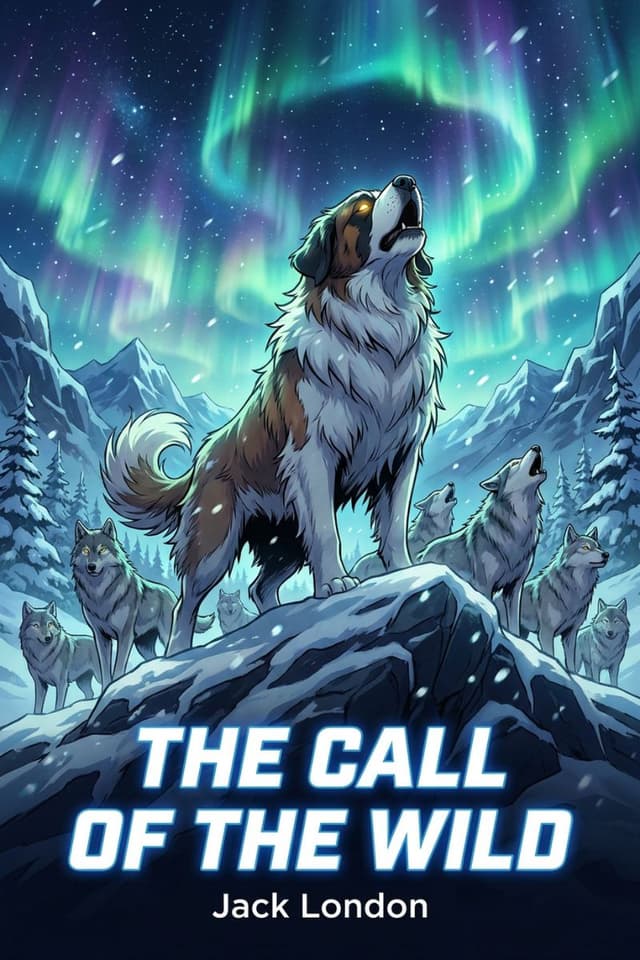
Read The Call of the Wild by Jack London for free on Novelhalla, and try out our easy-to-read modern edition of this classic book. You can also download the EPUB and read it on any device if you prefer!
The Plot
The Good Life
Buck is living the dream and doesn't even know it. He's a massive, 140-pound mix of St. Bernard and Scotch shepherd, and he rules Judge Miller's sprawling estate in sun-drenched Santa Clara Valley, California, like a benevolent king. He swims with the Judge's sons, escorts the daughters on walks, carries the grandchildren on his back. He lounges by the fire in winter and lolls in the grass in summer. He has never been hungry, never been cold, never been afraid.
It's 1897, and gold has been discovered in the Klondike. Thousands of men are flooding north into the Yukon, and they need dogs. Big, strong dogs with thick fur and hard muscle. Dogs exactly like Buck.
One night, a man Buck trusts leads him away from the estate and sells him to a stranger.
The Education
What follows is a crash course in a world Buck never knew existed. He is crated, shipped north by rail and boat, beaten when he fights back, and delivered into the frozen wilderness of Canada. Everything he understood about the relationship between dogs and people is wrong here. The rules are different. There is only one law now, and it is enforced with clubs and teeth.
Buck watches a friendly dog named Curly approach a husky in a spirit of play. The husky rips her face open. When Curly falls, the pack closes in. It is over in seconds. Buck never forgets it. In this world, once you go down, you don't get back up.
He is harnessed to a sled and put to work alongside dogs who have known nothing but this life. He learns fast. How to dig a sleeping hole in the snow. How to steal food without getting caught. How to break ice from between his toes. Instincts he didn't know he had begin to surface. Something ancient and buried is waking up inside him, something that knows this cold, this darkness, this competition for survival. It feels less like learning and more like remembering.
The Rival
The lead dog of Buck's team is a husky named Spitz, and he is cunning, experienced, and utterly ruthless. From the moment Buck arrives, Spitz watches him the way a predator watches a threat it hasn't decided how to handle yet. The tension between them builds through frozen trails and desperate camps, through starving nights and grueling runs, until it becomes the kind of thing that can only end one way.
Every dog on the team knows a fight is coming. They just don't know when.
The Descent
Buck passes through the hands of different masters. Some are competent. Some are kind. Some are neither. He is sold and resold, worked until his ribs show, pushed through conditions that break weaker dogs. The civilized creature from Judge Miller's estate begins to disappear. In its place, something older and harder is taking shape. Buck dreams by firelight of ancient, half-human figures crouching in darkness. He hears something calling from the forests beyond the trail, a sound that pulls at him like a current, though he can't yet name what it is.
Then three newcomers buy the team: a man named Hal, his sister Mercedes, and her husband Charles. They know nothing about dogs, nothing about the trail, nothing about the North. They overload the sled, overfeed when food is plentiful, starve the dogs when it runs out. They beat the animals when they falter and argue with each other while the team collapses around them.
Buck is dying on his feet when they reach the camp of a man named John Thornton.
The Bond
Thornton is different from anyone Buck has known. He talks to Buck like an equal, tends his wounds, lets him recover without rushing him back to work. What develops between them is something fierce and mutual, a bond so deep it borders on the spiritual. Buck loves this man the way only a creature who has known cruelty can love the person who showed him kindness.
But even as Buck's devotion to Thornton grows, so does the pull of that other thing. The call from the forest. The howl in the distance that makes his blood sing. Buck begins disappearing into the woods for hours, then days. He runs with wolves. He hunts alone. Each time, he comes back to Thornton. Each time, going back gets a little harder.
Something is building toward a choice Buck doesn't know how to make. The deepest love he has ever felt is pulling him in one direction. The deepest instinct he has ever known is pulling him in another.
The wilderness is patient. It can wait.
About the Author: Jack London
A Hard Start
Jack London was born John Griffith Chaney in San Francisco on January 12, 1876. His mother, Flora Wellman, was an unmarried spiritualist from an aristocratic family. His biological father, a traveling astrologer named William Chaney, abandoned Flora when he learned she was pregnant. She attempted suicide twice in two days. Eight months after the birth, she married John London, a Civil War veteran and grocer, who gave the boy his surname and what stability he could.
The family was poor. Jack grew up in Oakland and was expected to contribute to the household income from a young age. He left school after eighth grade and went to work. By his mid-teens he'd been a newspaper boy, a factory worker, an oyster pirate raiding the beds of San Francisco Bay, a seal hunter in the Pacific, and a hobo riding the rails across America. At eighteen, he was arrested for vagrancy in New York and spent thirty days in a penitentiary. The experience radicalized him. He became a committed socialist and resolved to educate himself out of poverty through writing.
The Klondike
London returned to Oakland, finished high school, and spent a semester at UC Berkeley before the Klondike Gold Rush pulled him north in 1897. He staked eight claims. None of them paid. He spent the brutal Arctic winter in a cabin on the Yukon, reading Darwin's On the Origin of Species and Milton's Paradise Lost by firelight while surviving on beans, bread, and bacon. He developed scurvy, his gums swelling until he could barely eat, and decided to head home. He rafted two thousand miles down the Yukon River and hired himself onto boats to get back to San Francisco.
He returned as broke as the day he left. But he had a head full of stories.
Fame
London threw himself into writing with ferocious discipline, sometimes working fifteen hours a day. He accumulated 664 rejection slips before the breakthrough came. His Klondike stories began appearing in magazines, and in 1903 he wrote The Call of the Wild in a single month. It made him famous overnight. Within a few years he was the highest-paid and most widely read author in America.
He published over fifty books in his career, including White Fang, The Sea-Wolf, and the dystopian political novel The Iron Heel. He covered the Russo-Japanese War and the Mexican Revolution as a journalist. He sailed the South Pacific on his boat, the Snark, and ran a large ranch in Northern California. He was a walking contradiction: a passionate socialist who lived in luxury, a champion of the brotherhood of man whose novels celebrated raw power and survival of the fittest.
The End
London's health deteriorated in his final years. He suffered from kidney disease and stomach problems, compounded by years of hard living and heavy drinking. He died on November 22, 1916, at his ranch in Glen Ellen, California. He was forty years old. Whether the overdose that killed him was accidental or intentional has been debated ever since.
Fun Facts About the Book
Written in Thirty Days
London wrote The Call of the Wild in a single explosive month in 1903. He originally conceived it as a short story of about four thousand words, a companion piece to a story he'd already published. The narrative took on a life of its own and grew to approximately thirty-two thousand words before he stopped. He later said the book simply wrote itself.
He Sold It Too Cheap
London sold all rights to The Call of the Wild to Macmillan for a flat fee of two thousand dollars instead of negotiating royalties. The first printing of ten thousand copies sold out immediately. The book has been in continuous print for over 120 years and has been translated into nearly fifty languages. London never received another cent from it. The decision haunted his finances for the rest of his career.
Buck Was Based on a Real Dog
The character of Buck was inspired by a dog named Jack, a large mixed-breed belonging to Marshall and Louis Bond, whom London had befriended during the Klondike Gold Rush. London also modeled Judge Miller's California estate on the Bond family's home. The Bonds reportedly recognized their dog in the novel when it was published.
664 Rejections
Before writing The Call of the Wild, London had been rejected 664 times by publishers. He kept every rejection slip impaled on a spindle in his writing room, creating a column of paper reportedly four feet tall. The Call of the Wild was initially met with similar indifference from publishers before the Saturday Evening Post agreed to serialize it for $750, and Macmillan picked it up as a book.
Banned and Burned
The novel was banned in Italy and Yugoslavia in 1929 for being "too radical," a consequence of London's well-known socialist politics. In 1933, the Nazis burned copies of it along with other London works during their mass book bonfires. The irony of fascist regimes feeling threatened by a novel about a dog speaks to how clearly readers saw the story's deeper themes of rebellion, self-determination, and resistance to domination.
The Nature Faker Controversy
President Theodore Roosevelt publicly criticized London as a "nature faker," accusing him of giving his animal characters human-like reasoning abilities. London fired back that his intention was the exact opposite. He had deliberately written lines like "He did not think these things; he merely did them" to stress that Buck was driven by instinct and emotion rather than abstract thought. London saw the book as a corrective to writers who sentimentalized animals, not an example of it.
The Plagiarism Accusation
London was accused of lifting material from Egerton R. Young's My Dogs in the Northland, published the year before. London acknowledged that he had read Young's book, thanked him in correspondence for the inspiration, and firmly denied plagiarism. Scholars have generally sided with London, noting that while both books involve sled dogs in the North, the works are fundamentally different in scope and intent.
Carl Sandburg's Verdict
The poet Carl Sandburg called The Call of the Wild "the greatest dog story ever written and at the same time a study of one of the most curious and profound motives that play hide-and-seek in the human soul." The description has stuck, in part because it captures the trick of the novel: it works perfectly as an adventure about a dog and simultaneously as something much deeper and stranger.
Themes
Civilization vs. Wildness
The entire novel is organized around a single question: what happens when the veneer of domestication is stripped away? Buck's journey from pampered pet to creature of the wilderness isn't portrayed as a fall or a tragedy. It's an awakening. London suggests that civilization is a thin layer painted over something much older and more powerful, and that under the right pressure, the paint comes off.
The Law of Club and Fang
The North operates by a simple, brutal code. The club represents human dominance: obey or be beaten. The fang represents the law among dogs: fight or die, and if you go down, the pack finishes you. There is no appeals process, no mercy, no fairness. London doesn't moralize about this. He presents it as fact. The reader is left to decide whether this rawness is horrifying, liberating, or both.
Ancestral Memory
One of the novel's most haunting elements is Buck's dreams. As he moves deeper into the wild, he begins dreaming of ancient fires and primitive, half-human figures. Something in his blood remembers a time before domestication. London suggests that instinct is not just a set of reflexes but a kind of deep memory, an inheritance from ancestors who knew how to survive in a world nothing like a California estate.
Love and Freedom
The emotional heart of the book is the tension between Buck's love for John Thornton and his pull toward the wild. London doesn't set these up as good versus bad. Both are real, both are powerful, and neither can be dismissed. The tragedy isn't that one wins. It's that they can't coexist. Buck's story asks whether a creature can truly belong to another being and still belong to itself.
Adaptability and Survival
Buck survives not because he is the strongest or the most vicious but because he learns. He adapts. He reads situations, assesses threats, and changes his behavior. London, steeped in Darwin, presents adaptability as the supreme virtue in a world that rewards fitness and punishes rigidity. The dogs who can't adapt don't make it. The humans who can't adapt fare even worse.
The Book's Legacy
The Call of the Wild was an instant sensation when it was published in 1903 and has never gone out of print. It has been translated into nearly fifty languages and adapted for film, television, and stage dozens of times, from a 1935 version starring Clark Gable to a 2020 CGI-heavy Harrison Ford vehicle. It regularly appears on lists of the greatest American novels, ranked 35th on the Guardian's list of the 100 best novels and 88th on the Modern Library's list of the 100 best English-language novels of the twentieth century.
The novel essentially created the modern adventure story as a serious literary form. Before London, tales of the wilderness were largely dismissed as boys' fiction. After The Call of the Wild, critics had to reckon with the possibility that a story about a dog could also be a profound meditation on freedom, power, instinct, and the nature of civilization. London proved that adventure fiction could carry philosophical weight without losing its ability to make your heart pound.
The book's influence extends well beyond literature. It helped cement the Klondike Gold Rush as one of America's defining mythic episodes and established the Yukon wilderness as a landscape of the imagination. It shaped how generations of readers thought about the relationship between humans and animals, nature and culture, the tame and the wild.
Perhaps most importantly, The Call of the Wild endures because it taps into something primal in its readers. The fantasy at the book's core, the idea that somewhere beneath the routine of domesticated life there is something fierce and free waiting to be remembered, turns out to be one of the most powerful stories you can tell a human being.