Novelhalla
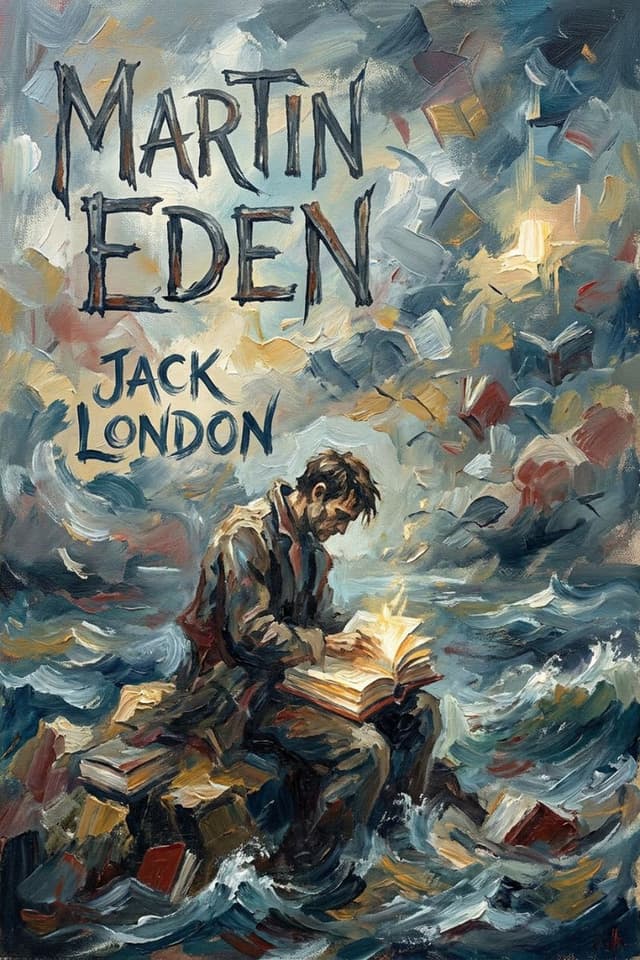
Martin Eden
Read Martin Eden by Jack London for free on Novelhalla, and try out our easy-to-read modern edition of this classic book. You can also download the EPUB and read it on any device if you prefer!
The Plot
Martin's Story
Martin Eden is a rough, uneducated sailor from Oakland's working-class waterfront who stumbles into the refined world of the bourgeoisie after a chance encounter. When he defends a young man named Arthur Morse from a street fight, Martin is invited to the Morse family home to be thanked, and there he meets Arthur's sister, Ruth.
Ruth Morse is everything Martin is not: educated, cultured, genteel. She plays piano, discusses literature, and moves through a world of books and ideas that Martin has never known existed. He falls instantly, completely in love, not just with Ruth, but with the entire world she represents.
What follows is Martin's relentless campaign of self-education and self-transformation. He devours books from the public library, teaches himself grammar and philosophy, and decides to become a writer. He believes that if he can master the world of letters, he can bridge the impossible gap between his rough origins and Ruth's refined sphere.
The Writing Life
Martin throws himself into writing with the same fierce energy he once brought to sailing and manual labor. He writes stories, poems, essays, anything and everything, and sends them out to magazines only to receive rejection after rejection. He lives in poverty, pawning his belongings, sometimes going hungry, all while Ruth and her family urge him to give up this foolishness and get a respectable job.
The novel offers a brutal portrait of the literary marketplace and the gap between artistic merit and commercial success. Martin becomes increasingly sophisticated in his craft even as the publishing world refuses to recognize him.
Two Worlds
Throughout the novel, Martin moves between two worlds that both ultimately reject him. The working-class world of his past sees his intellectual aspirations as pretentious betrayal. The bourgeois world he's trying to enter sees him as an uncouth climber who doesn't belong. The question becomes whether Martin can find a place where his transformed self can actually exist.
About the Author: Jack London
Early Life
Jack London was born in 1876 in San Francisco under uncertain circumstances. His biological father was likely an astrologer named William Chaney who abandoned his mother before Jack's birth. He was raised in Oakland by his mother Flora and stepfather John London in grinding poverty.
Self-Made Education
Like Martin Eden, London was largely self-educated through voracious reading at the Oakland Public Library. He worked brutal jobs from childhood: in a cannery, as an oyster pirate, on sealing ships, in a jute mill. He tramped across the country as a hobo and was briefly jailed for vagrancy. He joined the Klondike Gold Rush in 1897, which would provide material for his most famous works.
Literary Success
London became one of the first American authors to earn a fortune from writing. The Call of the Wild (1903) and White Fang (1906) made him internationally famous. He was the highest-paid writer in America at his peak, earning the equivalent of millions in today's money, though he spent it as fast as it came.
Politics and Philosophy
London was a committed socialist who lectured on class struggle and ran for mayor of Oakland on the Socialist Party ticket. He was also deeply influenced by Nietzsche, Darwin, and Spencer, creating a sometimes contradictory worldview mixing socialist collectivism with individualist philosophy. These tensions run throughout Martin Eden.
Personal Life and Death
London married twice and had two daughters. He built a grand ranch in Sonoma County called Beauty Ranch, where he experimented with scientific farming. He died in 1916 at age 40, officially of kidney failure, though the circumstances have prompted speculation about suicide given his declining health and the novel's ending.
Fun Facts About the Book
Autobiographical Core
Martin Eden is London's most autobiographical novel. Like Martin, London was a self-educated sailor who fell in love with a middle-class woman (Mabel Applegarth), wrote obsessively while facing constant rejection, and struggled between two social worlds. Many of Martin's specific experiences (the rejection slips, the pawnshop visits, the library binges) came directly from London's life.
A Warning Ignored
London intended the novel as a critique of Nietzschean individualism, showing how Martin's rejection of socialism and embrace of pure self-reliance leads to emptiness. Instead, generations of readers have taken Martin as a hero to emulate. London expressed frustration that his cautionary tale was being read as an inspirational one.
The Herbert Spencer Connection
Martin becomes obsessed with the philosopher Herbert Spencer, who popularized "Social Darwinism" and coined the phrase "survival of the fittest." London uses Martin's Spencer worship to explore how ideas meant to explain society can become justifications for isolation and despair.
Publication and Reception
The novel was serialized in The Pacific Monthly in 1908-1909 before book publication in 1909. It received mixed reviews. Some critics found it powerful, others thought it self-indulgent. It has grown in reputation over time and is now considered one of London's finest works.
The Burning Manuscripts
One of the novel's most vivid recurring images is Martin burning rejection slips and eventually his own manuscripts in his small stove. London drew this from his own experience of receiving hundreds of rejections during his early writing years.
Working-Class Authenticity
London was criticized by some socialists for abandoning the working class through his wealth and lifestyle. Martin Eden can be read as London wrestling with this accusation, examining what happens when someone from the working class succeeds in bourgeois terms.
Film Adaptations
The novel has been adapted for film multiple times, including an acclaimed 2019 Italian adaptation directed by Pietro Marcello that transposed the story to 20th-century Naples.
Themes
Class and Social Mobility
The novel ruthlessly examines the American myth of self-improvement. Martin transforms himself intellectually and artistically, but the class system proves far more rigid than meritocratic promises suggest. Success, when it comes, reveals the hollowness of what he was striving for.
Art vs. Commerce
Martin's struggle to get published exposes the gap between artistic quality and market success. The same stories rejected dozens of times suddenly become valuable once Martin's name carries cachet. The literary marketplace is shown as arbitrary and driven by fashion rather than merit.
Authenticity and Self-Transformation
Can you truly transform yourself, or do you simply become unmoored from who you were without ever belonging somewhere new? Martin's education alienates him from his origins without granting him genuine entry into the world he coveted.
Love and Illusion
Ruth loves Martin conditionally. She loves his potential to become respectable, not who he actually is. Martin loves an idealized version of Ruth that may never have existed. The novel asks hard questions about whether love can survive the destruction of illusion.
The Individual and Society
Through Brissenden's socialism and Martin's individualism, the novel stages a debate about human connection. Is self-reliance strength or isolation? Can meaning come from within, or must it come from solidarity with others?
Success and Emptiness
The novel's most devastating insight may be that achieving your dreams can reveal those dreams as hollow. What happens when you get everything you wanted and discover it was never what you needed?
The Book's Legacy
Martin Eden has influenced generations of writers and autodidacts, particularly those from working-class backgrounds. Its portrait of the struggling artist remains painfully relevant. The novel anticipated much of the 20th century's literature of alienation and has been cited as an influence by writers from Upton Sinclair to Jack Kerouac.
The book's examination of self-education's promises and limits speaks to ongoing debates about meritocracy and social mobility. Its depiction of the publishing industry feels eerily contemporary. And its central question, whether individual transformation is possible or illusory, continues to resonate with readers navigating their own class transitions.