Novelhalla
Anthem
Read Anthem by Ayn Rand for free on Novelhalla, and try out our easy-to-read modern edition of this classic book. You can also download the EPUB and read it on any device if you prefer!
The Plot
We
There is no "I" in this world. The word has been erased. Not just discouraged or stigmatized but completely eliminated from the language. Every person speaks of themselves as "we." Every thought, every action, every breath belongs to the collective. To be alone is a crime. To have a preference is a sin. To look at another person and feel something singular and specific is the deepest transgression there is.
This is the future. Not the gleaming, high-tech future of flying cars and space stations but something far worse. Civilization has collapsed backward into a new Dark Age. The tallest building stands three stories high. Time is kept by sundials. The newest technological achievement, celebrated after years of committee debate, is the candle. Somewhere in the distant past there were towers that touched the sky and wagons that moved without horses, but those things belong to the Unmentionable Times, and speaking of them is forbidden.
Everyone has a number for a name. Everyone is assigned their work, their schedule, their sleeping hours. Children are raised in collective homes, never knowing their parents. The old are sent to the Home of the Useless. Love does not exist. Choice does not exist. The self does not exist.
And in the middle of all of it, there is Equality 7-2521.
The Problem
He is tall. That's the first problem. Taller than his brothers, which makes him conspicuous when the point of existence is to be identical. He is also curious, which is worse. He asks questions. He learns too quickly. His teachers reprimand him for it. Being quicker than others means you think yourself better than others, and there is no greater evil than believing you are anything other than a fragment of the whole.
When the time comes for the Council of Vocations to assign each young person their life's work, Equality 7-2521 secretly hopes to be sent to the Home of the Scholars, where he could study and think and discover. The Council assigns him to be a street sweeper.
He accepts it. He has been taught to accept everything. But something in him has not been fully extinguished.
The Tunnel
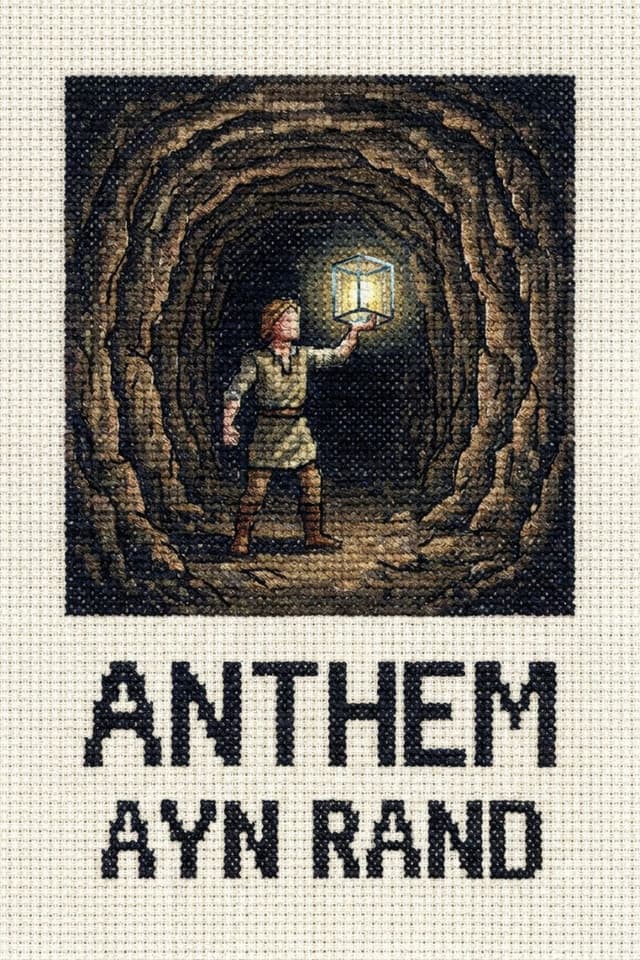
While sweeping the streets one day, Equality 7-2521 discovers something that changes everything: an underground tunnel, a relic from the Unmentionable Times. He begins sneaking away to the tunnel at night, alone. He steals candles. He experiments. He reads old manuscripts. He teaches himself things that no one in his world knows anymore, things that were buried when the collective decided that individual discovery was too dangerous to permit.
What he finds in that tunnel, what he builds with his own hands in secret, is something that could change his entire civilization.
It could also get him killed.
The Golden One
There is a woman. Her name is Liberty 5-3000, but Equality 7-2521 calls her the Golden One, secretly, in the privacy of his own mind, because she is beautiful and because giving someone a private name is an act of rebellion he can't stop himself from committing. She works in the fields, and when he passes her on the road, they look at each other. They should not look. They should not feel what they feel. But the thing growing between them doesn't care what should or shouldn't be.
The Golden One looks at Equality 7-2521 in a way no one in their world is supposed to look at anyone. Like he is singular. Like he is specific. Like he matters not as a unit of the collective but as himself.
This is the most dangerous thing either of them has ever done.
The Discovery
Equality 7-2521 takes his secret invention to the World Council of Scholars. He expects resistance, maybe even punishment for working alone. But he also believes that when the Scholars see what he has created, they will understand. They will see the value. They will recognize that this discovery can transform the world.
He is wrong about the Council in a way that reveals everything about the society he lives in. What happens next sends him running into the one place no person in his world has ever willingly gone.
The Uncharted Forest. The wilderness beyond the edge of the known world. The place where, according to everything he has been taught, nothing survives.
But something does survive out there. And what Equality 7-2521 finds among the trees and the ruins is more revolutionary than anything he built in his tunnel. It is a word. A single, ancient, forbidden word that rebuilds everything.
About the Author: Ayn Rand
Early Life in Russia
Ayn Rand was born Alisa Rosenbaum on February 2, 1905, in St. Petersburg, Russia. Her father, Zinovy, was a prosperous pharmacist, and the family lived a comfortable middle-class life. Alisa was precocious and fiercely intellectual, teaching herself to read at six and deciding to become a writer by nine. She was also socially isolated and stubbornly independent from an early age.
When she was twelve, the Russian Revolution tore her world apart. She watched the first shots fired from her apartment window. Her father's pharmacy was confiscated by the Bolsheviks. The family fled to the Crimea to escape the civil war, enduring periods of near-starvation before returning to the renamed city of Petrograd. At her university, she watched communist students take over the institution and destroy free inquiry. The experience embedded in her a permanent, visceral hatred of collectivism.
Her emotional lifeline during those years was Western culture: Viennese operettas and American movies, which she attended obsessively, saving her streetcar fare to afford tickets and walking to school through Russian winters. The glimpses of America she saw on screen became her image of what human life could be.
Escape to America
In late 1925, Rand obtained a visa to visit relatives in Chicago, ostensibly to study the American film industry. She had no intention of returning. She arrived in New York in February 1926 with fifty dollars and a new name. After a few months in Chicago, she left for Hollywood to become a screenwriter.
On her second day there, she was standing outside a studio gate when director Cecil B. DeMille spotted her staring at his car. He stopped, asked why she was staring, and when she explained she had just arrived from Russia and dreamed of writing for the movies, he gave her a ride to his set and hired her as an extra. Within a week, she met a young actor named Frank O'Connor on the same set. They married in 1929 and stayed married for fifty years.
Rand worked for years in Hollywood at various jobs, including stints in the wardrobe department at RKO, before selling her first screenplay and seeing her first play produced on Broadway. She published her first novel, We the Living, in 1936, drawing directly on her experiences in Soviet Russia.
Breakthrough
In 1937, while taking a break from research for her next novel, Rand spent two weeks writing a novella she called Anthem. She considered it deeply personal. It was published in England in 1938 but rejected by American publishers, one of whom told her she did not understand socialism.
The novel that made her famous, The Fountainhead, arrived in 1943 after being rejected by twelve publishers. It became a massive bestseller. Rand sold the film rights to Warner Bros. and returned to Hollywood to write the screenplay. She then began her most ambitious work, Atlas Shrugged, published in 1957. Critics savaged it. Readers made it a phenomenon.
Philosophy and Legacy
After Atlas Shrugged, Rand largely stopped writing fiction and devoted herself to developing and promoting Objectivism, the philosophical system she had been building throughout her career. She lectured, published essays, and cultivated a circle of devoted followers. She was a polarizing figure: adored by those who shared her belief in reason, individualism, and capitalism; despised by critics who found her philosophy cold, her characters mechanical, and her worldview simplistic.
Rand died on March 6, 1982, in her New York City apartment. Her books have sold over forty million copies and continue to sell hundreds of thousands each year. She remains one of the most widely read and fiercely debated authors of the twentieth century.
Fun Facts About the Book
Conceived in Soviet Russia
Rand first imagined the story as a four-act play during her college years at the University of Petrograd. She later said the idea came from hearing the relentless attacks on individualism in her classrooms and asking herself what the world would look like if people completely lost the concept of "I." The story stayed with her for over a decade before she finally wrote it in America.
Written in Two Weeks
Rand wrote Anthem during a break from the research and plotting for The Fountainhead, which was consuming most of her creative energy. The novella poured out in roughly two weeks in the summer of 1937. She described it as a kind of palate cleanser, a concentrated expression of the themes she was wrestling with on a much larger scale in The Fountainhead.
Rejected by American Publishers
Multiple American publishers turned the manuscript down in the late 1930s. Macmillan, which had published Rand's previous novel, rejected it with the explanation that she "did not understand socialism." The book was published in England by Cassell in 1938 but did not find an American publisher until 1946, after The Fountainhead had made Rand famous. She revised the text for the American edition, trimming what she considered overly poetic language and tightening the prose.
"My Manifesto"
In a letter to her British publisher, Rand called Anthem "more precious to me than anything I have ever considered writing. It is in a way, my manifesto, my profession of faith, the essence of my entire philosophy." In another letter, she described it even more simply: "Anthem is a poem."
The Original Title
Rand's working title was Ego. She changed it because she felt the original was too blunt, too clinical, and would give away the theme too quickly. Anthem suggested something more elevated, a hymn, a declaration, a song of celebration for the individual human spirit.
Rush and "2112"
The Canadian rock band Rush credited Anthem as a direct influence on their epic 1976 song "2112," which features striking parallels to the novella's plot and themes. Drummer and lyricist Neil Peart said he had read the book but wasn't consciously thinking of it when he wrote the lyrics. When he recognized the similarities, he acknowledged Rand in the album's liner notes. The band also named a song "Anthem," titled their Canadian record label Anthem Records, and maintained a long association with Rand's ideas.
Walt Disney Was Pitched
After the novella's American publication, Rand personally wrote to Walt Disney suggesting Anthem as a film project, arguing it would be a complete departure from conventional Hollywood. Disney was one of at least ten parties who considered adapting it. Warner Bros. also looked at it as a potential short film but deemed it too expensive. A 1950 radio drama remains the only adaptation from that era that was actually produced.
Still in Classrooms
Anthem is one of the most commonly assigned secondary school reading texts in the United States. The Ayn Rand Institute has distributed over 4.5 million free copies of Rand's novels to teachers who include them in their curricula. Among Rand's works, Anthem is frequently the entry point for young readers encountering her ideas for the first time.
Themes
The Sacred Individual
The entire novella is built around a single proposition: the individual human being is the fundamental unit of meaning in the universe. Not the group, not the state, not the collective. Rand presents a world where individuality has been annihilated and asks the reader to feel the horror of that loss. The rediscovery of the self isn't just an intellectual exercise for Equality 7-2521. It's a spiritual awakening.
The Tyranny of Collectivism
Rand draws a direct line from the idea that the group matters more than the individual to the practical consequences of that belief: enforced conformity, the suppression of talent, the stagnation of progress, and the destruction of love. In Anthem's world, collectivism hasn't created equality. It has created a new Dark Age. The society functions not despite the absence of individual thought but because of it.
The Power of Language
The elimination of the word "I" is not a detail in the story. It is the story. Rand argues that language shapes thought and that controlling language means controlling the mind. Without a word for the self, the self cannot be conceived. Equality 7-2521's journey is, at its core, a linguistic one: he is searching for a word that will make him real.
Progress and Independent Thought
Civilization in Anthem has regressed because innovation requires independent minds, and independent minds have been outlawed. The Council of Scholars doesn't reject Equality 7-2521's discovery because it doesn't work. They reject it because one person made it, alone, without permission. Rand argues that progress is not a collective achievement but the product of individuals who think for themselves and are free to act on what they discover.
Love as Rebellion
In a world where personal attachment is forbidden, the act of looking at one person and feeling something is a revolutionary act. The relationship between Equality 7-2521 and the Golden One is not a subplot. It is the emotional proof of the novella's argument. Love, by its nature, is selective, specific, and individual. It is the most personal thing a person can feel, which makes it the one thing a collectivist society cannot tolerate.
The Book's Legacy
Anthem occupies an unusual place in literary history. It is a slim, fiercely concentrated novella that has been read by millions, mostly through school assignments and the ongoing distribution efforts of the Ayn Rand Institute. It is simultaneously one of the most widely read dystopias of the twentieth century and one of the most overlooked in critical discussions of the genre, often eclipsed by Orwell's 1984, Huxley's Brave New World, and Zamyatin's We.
Its influence has been felt in unexpected places. Neil Peart's lyrics for Rush's "2112" brought Rand's ideas to a generation of rock fans who might never have picked up a philosophy book. The novella's stripped-down, almost mythic storytelling style has made it a touchstone for libertarian and individualist movements worldwide.
As a piece of writing, Anthem is Rand at her most compressed and her most emotionally direct. Stripped of the lengthy philosophical speeches that characterize her later novels, it reads more like a fable or a prose poem than a conventional narrative. For readers who bounce off the density of The Fountainhead or Atlas Shrugged, Anthem often serves as the gateway, the shortest path into Rand's worldview and the clearest distillation of her central conviction: that the smallest minority on earth is the individual.