Novelhalla
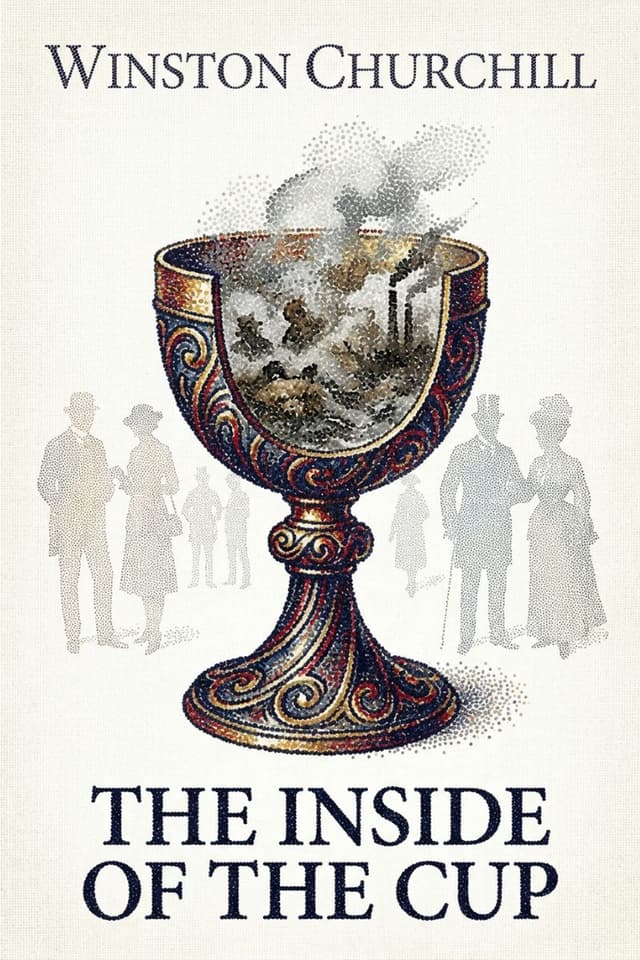
The Inside of the Cup
Read The Inside of the Cup by Winston Churchill for free on Novelhalla, and try out our easy-to-read modern edition of this classic book. You can also download the EPUB and read it on any device if you prefer!
The Plot
The New Rector
John Hodder arrives in a large Midwestern city to take up his position as rector of St. John's Church, one of the most prestigious Episcopal congregations in the region. He comes recommended as an orthodox man of solid conservative convictions, exactly what the wealthy vestrymen want. The church itself is a grand stone monument to an earlier era, built when this part of the city was fashionable. Now the neighborhood has changed. Just steps from the church doors lies Dalton Street, a notorious slum of tenements, saloons, and desperate poverty. The rich parishioners drive past this misery every Sunday on their way to worship, then drive back to their mansions on the west side of town.
Hodder notices the contrast immediately but is not yet troubled by it. He believes in the Christianity he has been taught: the creeds, the doctrines, the comfortable certainties. He believes that his job is to preach orthodox faith to respectable people.
The Friendship
Among his new congregation, Hodder forms an unlikely bond with Eldon Parr, the most powerful financier in the city. Parr is a pillar of the church, enormously wealthy, and feared throughout the business world. He is also profoundly lonely. His wife is dead. His son Preston has fled the family in disgrace after a forbidden love affair. His daughter Alison has broken with him and gone to New York to pursue settlement work and independence. Parr lives in a vast mansion that feels more like a prison than a home.
Hodder is drawn to Parr's intellect and apparent piety, and Parr is drawn to the rector's conviction and strength. Neither yet understands what the other truly is.
Dalton Street
Hodder begins to encounter the people of Dalton Street, first reluctantly, then with growing compulsion. He meets families ruined by forces they cannot understand. He meets women driven to desperate measures to survive. He meets men destroyed by the very economic system that has made his parishioners rich.
And he meets Horace Bentley, a saintly old gentleman who lives among the poor and ministers to them daily. Bentley was once wealthy himself, a founding member of St. John's Church, until Eldon Parr's business dealings destroyed him financially. Rather than grow bitter, Bentley has spent his remaining years serving the poor with quiet joy. He has developed a Christianity based not on creeds but on following the actual teachings of Jesus.
Through Bentley, Hodder begins to see that the faith he has been preaching may be hollow. The orthodox doctrines he has defended so vigorously seem disconnected from the radical message of Christ. Meanwhile, his wealthy parishioners, for all their church attendance, seem utterly indifferent to the suffering at their doorstep.
The Questions
As Hodder learns more about how Dalton Street came to be, uncomfortable truths begin to emerge about the pillars of his own congregation. The slums did not create themselves. The poverty is not an accident. And the man Hodder has come to admire most may be the architect of more suffering than the rector can imagine.
Hodder faces a crisis that will shake everything he believes about faith, about wealth, about the church he serves, and about himself. What does Christianity actually demand? What happens when a minister discovers that his most powerful parishioners may be the least Christian people in his congregation? And what is a man of God supposed to do when telling the truth might cost him everything?
Into this volatile situation returns Alison Parr, the financier's estranged daughter, a woman who left the church because she found it meaningless and who now encounters a rector whose faith is being remade by fire.
About the Author: Winston Churchill
Not That Winston Churchill
The American novelist Winston Churchill was born in St. Louis, Missouri, in 1871, and for the first two decades of the twentieth century, he was one of the most famous writers in the United States. He is not to be confused with the British statesman of the same name, who was born three years later and would eventually become far more famous. In fact, when both men began publishing around 1900, it was the American who was the established name. The British Churchill wrote to his American counterpart to work out the confusion, and thereafter published as "Winston Spencer Churchill" or "Winston S. Churchill."
Early Success
Churchill attended the United States Naval Academy at Annapolis, graduating in 1894. He briefly worked as an editor for the Army and Navy Journal and then Cosmopolitan Magazine before turning to fiction full-time. His second novel, Richard Carvel (1899), a Revolutionary War adventure story featuring John Paul Jones, sold nearly two million copies and made him wealthy. The Crisis (1901), set during the Civil War in his native St. Louis, and The Crossing (1904), about Kentucky pioneers, were equally successful. Between 1899 and 1913, Churchill appeared on the bestseller lists eight times, reaching the number one spot five times.
The Progressive Years
In 1899, Churchill moved to Cornish, New Hampshire, where he became part of an artists' colony that included the sculptor Augustus Saint-Gaudens. He built an elaborate mansion called Harlakenden House, which he later leased to President Woodrow Wilson as a summer residence. Churchill threw himself into Progressive Era politics, serving two terms in the New Hampshire legislature and running unsuccessfully for governor, first as a Republican and then in 1912 as a Progressive Party candidate. He was a friend of Theodore Roosevelt and shared Roosevelt's belief that the problems of industrial society could be solved through reform and public engagement.
His later novels reflected these concerns. Beginning with Coniston (1906), a story of political corruption in New Hampshire, Churchill moved away from historical romance toward contemporary social criticism. Mr. Crewe's Career (1908) satirized railroad influence in politics. The Inside of the Cup (1913), his last major bestseller, attacked the complacency of organized religion in the face of social injustice.
Withdrawal and Decline
After The Inside of the Cup, Churchill published a few more novels, but his popularity waned as literary tastes shifted after World War I. In 1919, he effectively retired from writing and withdrew from public life. He took up watercolor painting and lived quietly in New Hampshire. His final book, The Uncharted Way (1940), was a meditation on religion that attracted little attention. He died in Winter Park, Florida, in 1947, largely forgotten. Shortly before his death, he remarked, "It is very difficult now for me to think of myself as a writer of novels, as all that seems to belong to another life."
Fun Facts About the Book
The Bestseller of Two Years
The Inside of the Cup was the bestselling book in the United States in both 1913 and 1914, the first time any book had held the top spot for two consecutive years since Publishers Weekly began tracking sales. The New York Times also named it one of the best books of 1913.
A National Religious Debate
The novel sparked a genuine cultural phenomenon. Ministers preached sermons about it, both for and against. Church groups organized discussions. Naval theorist Alfred Thayer Mahan wrote a widely circulated critique warning that Churchill's dismissal of traditional doctrines like the virgin birth and resurrection endangered "the gigantic fabric of faith." The debate played out in newspapers across the country.
The Title from Matthew
The title comes from the Gospel of Matthew 23:26, in which Jesus condemns the Pharisees: "Woe unto you, scribes and Pharisees, hypocrites! For ye make clean the outside of the cup and of the platter, but within they are full of extortion and excess." The verse is quoted early in the novel and encapsulates its central theme: the hypocrisy of outward religious observance that ignores justice and compassion.
Modeled on St. Louis
Though the city is never named, the setting is clearly based on Churchill's hometown of St. Louis. The details of the church, the slums, the mansions, and the social dynamics all reflect the St. Louis Churchill knew. St. John's Church is modeled on actual Episcopal churches that had remained in deteriorating neighborhoods while their wealthy congregations moved to new suburbs.
Originally a Serial
The novel was first serialized in Hearst's Magazine from April 1912 through July 1913, making it nearly a year and a half of monthly installments before it appeared as a book. Churchill later expressed some reluctance about the book form, feeling the story worked better in serial format.
Progressive Era Platform
The novel functions as a fictional manifesto for Progressive Era ideals: women's suffrage, workers' rights, the eight-hour workday, regulation of trusts, and what would later become Social Security. Churchill believed these causes were not opposed to Christianity but were essential expressions of it.
A Silent Film Adaptation
In 1921, Paramount Pictures released a silent film adaptation directed by Albert Capellani, starring William P. Carleton as John Hodder. A print survives in the Library of Congress collection.
The Social Gospel Movement
The novel is a prime example of the Social Gospel movement in American Protestantism, which emphasized the application of Christian ethics to social problems like poverty, inequality, and labor rights. Churchill's rector John Hodder follows a spiritual journey that many real ministers were making during this period.
Themes
The Hypocrisy of Respectable Religion
The novel's central accusation is that Christianity as practiced by comfortable, wealthy Americans has become a hollow shell. The rich attend church, recite creeds, and consider themselves righteous while ignoring or actively perpetuating the suffering of the poor. They clean the outside of the cup while the inside remains corrupt.
Faith Versus Doctrine
The novel explores the tension between genuine faith in Christ's teachings and mere adherence to orthodox doctrines. Churchill suggests that obsession with correct belief in miracles and creeds may have replaced the more demanding work of actually following Jesus. The novel controversially questions doctrines like the virgin birth while affirming a Christianity based on justice and love.
The Sins of Capitalism
Eldon Parr represents the dark side of American capitalism. His wealth has been accumulated through practices that destroy lives, yet he considers himself a good Christian and a pillar of the church. The novel draws direct lines between corporate predation and urban poverty, arguing that the economic system itself produces misery that the church ignores.
The Church and the City
St. John's Church sits physically between two worlds: the slums of Dalton Street and the mansions of the wealthy. It has chosen to serve only one of those worlds while ignoring the other. The novel asks whether a church can claim to follow Christ while remaining indifferent to poverty at its doorstep.
Personal Transformation
At its heart, this is a story about a man whose comfortable certainties are shattered and who must decide what to build from the wreckage. Real faith, the novel argues, demands not just belief but action, not just respectability but risk.
The Corruption of Power
Eldon Parr is corrupted not only by his wealth but by his isolation. His money has made him powerful but lonely, feared but unloved. His children have fled him. The novel suggests that concentrated wealth inevitably corrupts both its possessors and the institutions that depend on them.
The Book's Legacy
The Inside of the Cup stands as perhaps the most significant novel of the Social Gospel movement, a fictional distillation of the religious debates that roiled American Protestantism in the early twentieth century. It gave popular expression to ideas that were reshaping how many Americans understood the relationship between faith and social responsibility.
The novel's immediate impact was enormous. For a brief moment in 1913 and 1914, Americans across the country were arguing about the questions Churchill raised: What does Christianity demand of the wealthy? Can a church be faithful while ignoring injustice? Is adherence to doctrine more important than works of mercy?
These questions have not gone away. Contemporary readers may find the novel's prose old-fashioned and its sermons lengthy, but they may also find its central challenge surprisingly relevant. The tension between comfortable religion and prophetic witness, between institutional respectability and radical compassion, remains unresolved.
Churchill himself gradually faded from public memory, overshadowed by his more famous British namesake and by changing literary fashions. But for readers interested in how Americans grappled with the social costs of industrialization, or in the religious ferment of the Progressive Era, The Inside of the Cup remains a valuable and often moving document of its time.