Novelhalla
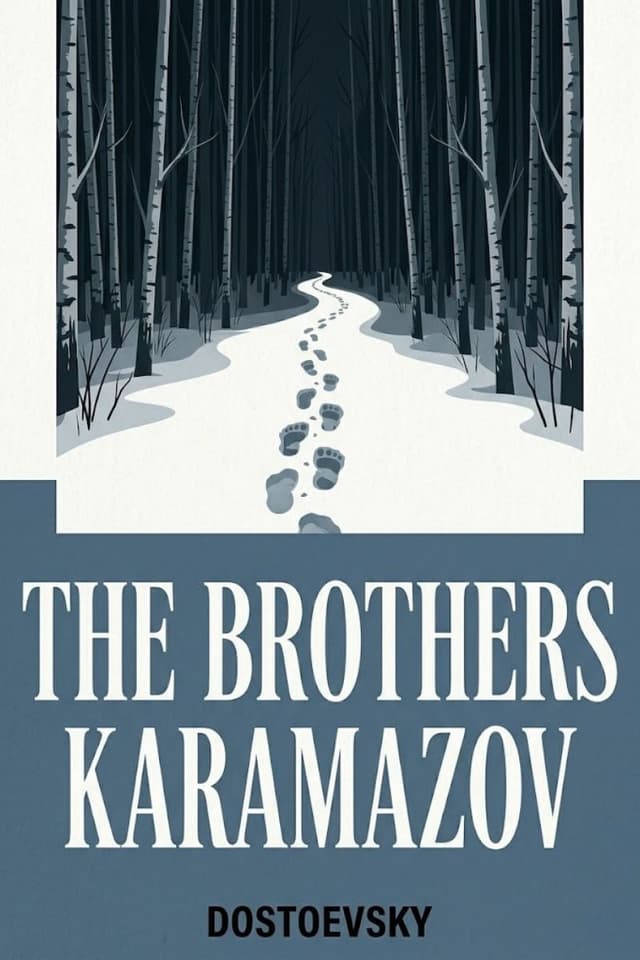
The Brothers Karamazov
Read The Brothers Karamazov by Fyodor Dostoyevsky for free on Novelhalla, and try out our easy-to-read modern edition of this classic book. You can also download the EPUB and read it on any device if you prefer!
The Plot
The Karamazov Family
In a provincial Russian town, the wealthy landowner Fyodor Pavlovich Karamazov has gathered his three legitimate sons for the first time in years. The occasion is a dispute over inheritance, but what emerges is something far darker: a family consumed by hatred, jealousy, and opposing visions of what it means to live.
Fyodor is a buffoon and a sensualist, a man who abandoned his sons as children and now spends his days drinking, scheming, and chasing women. He is despised by nearly everyone, including his own children. The question that hangs over the novel is not whether someone wants to kill him, but who will be the one to do it.
The eldest son, Dmitri, is a passionate, hot-tempered army officer who believes his father cheated him out of his inheritance. He needs money desperately, partly to pay debts and partly to win Grushenka, a local woman of complicated reputation. The problem is that his father also wants Grushenka and has set aside money to lure her. Father and son are rivals in every sense.
Ivan, the middle brother, is an intellectual who has recently returned from Moscow. He is brilliant, cold, and tormented by philosophical questions about God, morality, and the meaning of suffering. He has written articles arguing that without God, everything is permitted. Ivan watches his family's dysfunction with a mixture of contempt and fascination.
Alyosha, the youngest, is a novice at the local monastery, studying under the beloved Elder Zosima. He is gentle, kind, and serves as a bridge between the warring factions of his family. Everyone trusts Alyosha. Everyone confides in him. He moves through the novel like a witness to catastrophe.
There is also a fourth brother, though the family rarely acknowledges him: Smerdyakov, the illegitimate son born to a local beggar woman. He works as a cook in his father's house, epileptic and resentful, observing everything from the margins.
The Gathering Storm
The novel follows several months of escalating tension. Dmitri's rage at his father grows more violent. Ivan wrestles with ideas that seem to consume him. Alyosha tries to help everyone while also grappling with his own faith after his mentor Zosima falls ill.
At the center of everything is money: the 3,000 rubles Fyodor has set aside for Grushenka, which Dmitri believes is rightfully his. And there are the women: Grushenka, who seems to toy with both father and son, and Katerina Ivanovna, the proud noblewoman engaged to Dmitri, whom he treats badly but who cannot let him go.
Ivan shares with Alyosha a story he has composed, "The Grand Inquisitor," a parable about Christ returning to earth during the Spanish Inquisition, only to be arrested and condemned by a cardinal who argues that the Church has done humanity a favor by taking away its terrible freedom. It is a devastating critique of both religion and human nature, and it reveals the depths of Ivan's spiritual crisis.
The Crime and Its Aftermath
One night, Fyodor Karamazov is found murdered. The evidence points overwhelmingly to Dmitri, who had publicly threatened his father, who was seen near the house that night covered in blood, who had suddenly come into money he could not explain. He is arrested and put on trial.
But the truth of what happened that night is more complicated than it appears. The novel becomes a courtroom drama, a psychological investigation, and a meditation on guilt, innocence, and the terrible weight of human freedom.
About the Author: Fyodor Dostoevsky
Early Life
Fyodor Mikhailovich Dostoevsky was born in Moscow in 1821, the second of seven children. His father was a doctor at a hospital for the poor, and Dostoevsky grew up surrounded by suffering and mortality. His mother died of tuberculosis when he was fifteen, and two years later his father was murdered by his own serfs on the family estate, a trauma that would echo through his fiction for decades.
He trained as a military engineer in St. Petersburg but resigned his commission to pursue writing. His first novel, Poor Folk, published in 1846, brought him immediate fame. Critics hailed him as a major new voice in Russian literature.
Arrest and Mock Execution
In 1849, Dostoevsky's life changed forever. He had been meeting with a group of intellectuals who discussed socialism and criticized the Tsar. Police arrested the entire group, and Dostoevsky spent eight months in prison awaiting trial.
On December 22, 1849, he and his fellow prisoners were led to a public square and told they would be executed by firing squad. They were made to kiss the cross, their swords were broken over their heads, and the first three men were tied to posts. Dostoevsky stood in the second group, waiting his turn to die.
At the last possible moment, a messenger arrived with news that the Tsar had commuted their sentences. The entire execution had been staged as psychological torture, designed to terrify the prisoners into submission. Dostoevsky never recovered from those minutes spent believing he was about to die. The experience appears again and again in his novels, most notably in The Idiot.
Siberian Exile
Instead of death, Dostoevsky received four years of hard labor in a Siberian prison camp, followed by four years of compulsory military service. The conditions were brutal: he wore leg irons for four years and was surrounded by murderers and thieves. The only book permitted was the New Testament, which he read constantly.
These years transformed him. He emerged with a deep Christian faith, a profound sympathy for ordinary Russians, and a rejection of the Western intellectual ideas that had once attracted him. He also began suffering from epileptic seizures, a condition that would plague him for the rest of his life.
Later Years and Legacy
Dostoevsky returned to St. Petersburg in 1859 and began his greatest period of creativity. He wrote Crime and Punishment (1866), The Idiot (1869), Demons (1872), and finally The Brothers Karamazov (1880). Throughout these years he struggled with debt, a gambling addiction, and the deaths of his first wife and his three-year-old son Alyosha, who died of epilepsy inherited from his father.
He married his stenographer, Anna Grigoryevna, in 1867, and she became his steadfast support. She managed his finances, transcribed his dictation, and helped him complete his greatest works.
Dostoevsky died on February 9, 1881, just months after finishing The Brothers Karamazov, from a pulmonary hemorrhage. An estimated 30,000 mourners attended his funeral procession in St. Petersburg. His tombstone bears the epigraph from The Brothers Karamazov, a verse from the Gospel of John: "Unless a grain of wheat falls into the earth and dies, it remains alone; but if it dies, it bears much fruit."
Fun Facts About the Book
Dostoevsky's Final Work
The Brothers Karamazov was Dostoevsky's last and longest novel, completed just months before his death. He had spent nearly two years writing it, serializing chapters in the Russian Messenger magazine between January 1879 and November 1880. Many readers consider it the culmination of everything he had been working toward his entire life.
A Father's Grief
In May 1878, while Dostoevsky was planning the novel, his three-year-old son Alyosha died of epilepsy, a condition inherited from his father. The novelist's grief permeates the book. He named his hero after his lost son and gave him all the qualities he most admired. The scene where Elder Zosima consoles a mother mourning her dead child was written from devastating personal experience.
The Trip to Optina
After his son's death, Dostoevsky traveled to Optina Monastery, one of Russia's most important spiritual centers. There he found inspiration for the character of Elder Zosima and the novel's religious themes. Parts of Zosima's biography are based on texts Dostoevsky found at the monastery.
"The Most Magnificent Novel Ever Written"
Sigmund Freud called The Brothers Karamazov "the most magnificent novel ever written." He was fascinated by its themes of patricide and guilt, and in 1928 he published an essay analyzing Dostoevsky's psychology, arguing that the author's epilepsy was a physical manifestation of unconscious guilt over his own father's death.
Einstein's Favorite Book
Albert Einstein considered The Brothers Karamazov the greatest novel ever written. According to those who knew him, it remained his literary touchstone throughout his life, from his early years as a young physicist to his final days in Princeton.
The Grand Inquisitor
The chapter "The Grand Inquisitor," in which Ivan tells Alyosha his parable about Christ returning to earth, has been published countless times as a standalone work. It is one of the most famous passages in world literature, debated by philosophers, theologians, and political theorists for over a century. It has been interpreted as everything from a critique of the Catholic Church to a prophecy of totalitarianism.
An Unfinished Story
Dostoevsky intended The Brothers Karamazov to be only the first part of a larger work. The preface calls Alyosha the hero and hints at future events in his life. Dostoevsky planned a sequel that would follow Alyosha into adulthood, but he died before he could write it. What we have is complete in itself, but it is haunted by the shadow of a story never told.
William Shatner's Film Debut
The 1958 Hollywood adaptation starred Yul Brynner as Dmitri and featured William Shatner, in his first film role, as Alyosha. Lee J. Cobb received an Oscar nomination for his portrayal of Fyodor Karamazov. A Soviet adaptation from 1969 was nominated for the Academy Award for Best Foreign Film.
Themes
Faith and Doubt
The novel stages a battle between belief and unbelief, with Ivan and Alyosha representing the opposing sides. Ivan cannot accept a God who permits the suffering of innocent children. Alyosha cannot explain away that suffering but chooses faith anyway. The novel does not resolve this debate so much as let both positions stand in all their power.
The Problem of Evil
Ivan's famous chapter "Rebellion" catalogs the suffering of children in agonizing detail and asks how any divine harmony could be worth such a price. His conclusion that he "returns the ticket" to God's creation is one of the most powerful statements of the problem of evil in literature. Elder Zosima's response, emphasizing active love and personal responsibility, offers a counterweight but not a refutation.
Freedom and Responsibility
The Grand Inquisitor argues that most people cannot bear the burden of freedom and would gladly trade it for bread and security. The novel asks whether humans are truly capable of moral choice or whether we inevitably surrender our freedom to earthly and spiritual authorities. Every character's fate hinges on the choices they make.
Fathers and Sons
The Karamazov family is a study in failed fatherhood and its consequences. Fyodor abandoned his sons, and they grew up warped by his neglect. The novel asks whether children can escape the sins of their fathers and whether the cycle of dysfunction can be broken.
Guilt and Redemption
Nearly every character carries a burden of guilt. Dmitri feels guilty for his violence and his debts. Ivan feels guilty for his philosophical positions and what they might justify. Even Alyosha experiences a crisis when his faith is tested. The novel suggests that acknowledging guilt is the first step toward redemption, but that redemption requires more than acknowledgment.
The Russian Soul
Dostoevsky saw the novel as a statement about Russian identity. He positioned the Orthodox Christian faith of Zosima against the Western rationalism and socialism of Ivan, arguing that Russia's spiritual heritage was under attack from foreign ideas. The novel is partly a plea for Russians to embrace their own religious traditions rather than imported philosophies.
The Book's Legacy
The Brothers Karamazov is often called the greatest novel ever written, a judgment shared by writers as different as Virginia Woolf, Franz Kafka, Cormac McCarthy, and Haruki Murakami. It has been translated into every major language and remains one of the most widely read works of Russian literature.
The novel's influence extends far beyond literature. Philosophers from Friedrich Nietzsche to Jean-Paul Sartre have grappled with its questions. Theologians continue to debate the Grand Inquisitor. Psychologists see in it a prescient understanding of the unconscious mind.
For many readers, The Brothers Karamazov is a transformative experience. It forces confrontation with the deepest questions of existence: Does God exist? Why do the innocent suffer? What does it mean to be free? Can we be forgiven? These are not questions that admit of easy answers, and Dostoevsky does not pretend otherwise. Instead, he dramatizes them with such intensity that readers find themselves changed by the encounter. He stares unflinchingly at the worst of human nature and still finds reasons to believe in the best.