Novelhalla
Hard Times
Read Hard Times by Charles Dickens for free on Novelhalla, and try out our easy-to-read modern edition of this classic book. You can also download the EPUB and read it on any device if you prefer!
The Plot
Facts, Nothing But Facts
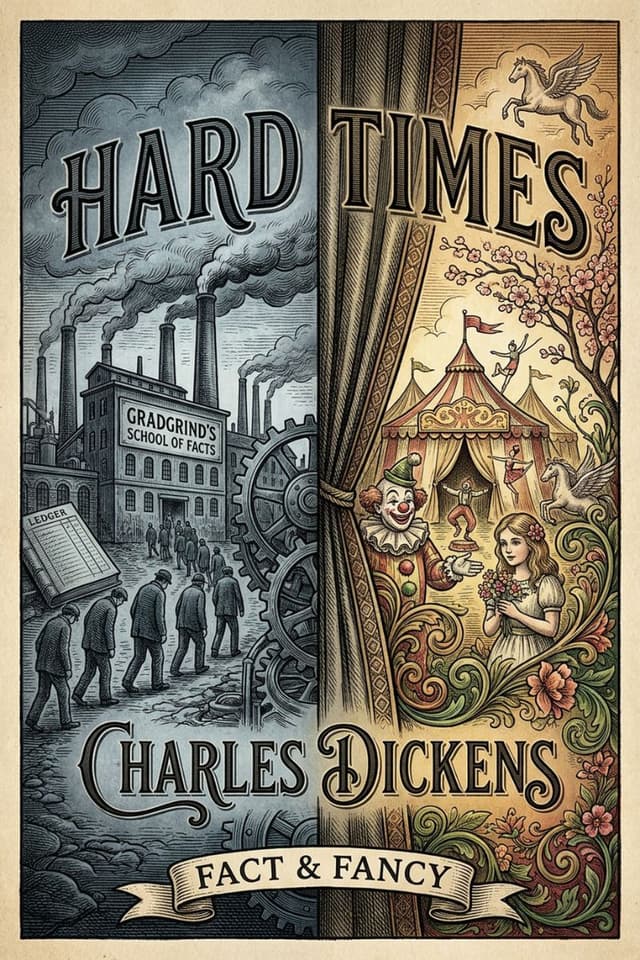
Welcome to Coketown. It's a town of red brick blackened by soot, of factory chimneys belching endless coils of smoke, of streets that all look the same and buildings that all look the same and lives that are all supposed to look the same. And presiding over this grim little world is Thomas Gradgrind, a man who believes in one thing above all else: Facts.
Gradgrind runs a school. In that school, children are taught to measure, calculate, define, and classify. They are not taught to imagine. They are not taught to feel. They are not taught to wonder. When a girl named Sissy Jupe, the daughter of a circus performer, is asked to define a horse, she can't do it to Gradgrind's satisfaction. She's been around horses her whole life, but she can't reduce one to a textbook entry. Her classmate Bitzer can. Bitzer rattles off a zoological profile like a machine, and Gradgrind beams. That's the kind of mind he's building.
And he's building them at home, too. His own children, Louisa and Tom, have been raised on this diet of pure reason since birth. No fairy tales. No games. No curiosity for curiosity's sake. Gradgrind has even named his youngest sons Adam Smith and Malthus, after political economists. He is not a man who does things halfway.
The Circus Girl
Then Sissy's father vanishes. He's a circus performer who's been losing his touch, and one day he simply disappears, leaving Sissy behind. Gradgrind, in a gesture that's partly charitable and partly experimental, takes the girl into his home. He'll raise her properly. He'll cure her of her fanciful circus upbringing and fill her head with useful facts.
It doesn't work. Sissy is hopeless at statistics. She can't stop caring about people as people instead of numbers. She keeps believing her father will come back. She keeps being kind. In the Gradgrind household, she's a failure by every metric that matters. And yet, somehow, she's the warmest thing in the house.
The Marriage
Gradgrind's friend Josiah Bounderby is a wealthy factory owner and banker. He's also a colossal blowhard. Bounderby never misses a chance to remind everyone that he's a self-made man, born in a ditch, abandoned by a worthless mother, raised in the gutter, and clawed his way to the top through sheer grit. He tells this story so often it's practically his religion.
Bounderby is decades older than Louisa Gradgrind. He wants to marry her anyway. And Gradgrind, applying his philosophy of rational self-interest to his own daughter's future, presents the match as a logical proposition. The numbers make sense. The arrangement is practical.
Louisa says yes. Not because she loves Bounderby. She doesn't. She says yes because she has never been taught to understand what she feels, let alone how to fight for it. She looks out the window at the factory smokestacks and says something haunting about how the smoke looks dull by day but fire burns underneath it at night. Her father doesn't understand what she means. Neither, really, does she.
The Worker
Meanwhile, down in Bounderby's factories, a man named Stephen Blackpool is living a very different kind of hard time. Stephen is honest, decent, and exhausted. He's trapped in a miserable marriage to an alcoholic wife who drifts in and out of his life, and he's in love with Rachael, a fellow factory worker he can never marry because divorce is a luxury only the rich can afford.
Stephen goes to Bounderby to ask about his options. Bounderby, with the casual cruelty of a man who's never had to worry about anything, tells him he's stuck. The law is the law. Facts are facts.
The Seducer
Into this powder keg walks James Harthouse, a bored London aristocrat who's decided to dabble in politics. He attaches himself to Gradgrind, now a Member of Parliament, and arrives in Coketown looking for something to amuse him. What he finds is Louisa.
Harthouse is charming, perceptive, and completely without conscience. He sees immediately what no one else has bothered to notice: that Louisa is deeply unhappy. And he decides, with the cool calculation of a man who treats other people's emotions as entertainment, to use that unhappiness as his way in.
He gets close through Tom, Louisa's brother, who has grown into a reckless, selfish young man. Tom drinks, gambles, and leeches off his sister's position as Bounderby's wife. He's the product of the Gradgrind system too, but where Louisa turned inward, Tom turned rotten.
The Unraveling
A robbery at Bounderby's bank sets everything in motion. Suspicion falls on Stephen Blackpool, who has recently been seen loitering outside the building and who has already been cast out by both his employer and his fellow workers. Stephen leaves town to find work elsewhere, unaware that his name is being dragged through the mud.
Mrs. Sparsit, Bounderby's housekeeper, a fallen aristocrat nursing her own bitter ambitions, watches the Harthouse situation develop with gleeful malice. She sees what's coming before anyone else does.
And Louisa? Louisa is standing at the edge of a decision that her entire upbringing has left her completely unprepared to make. The fire under the smoke is about to break through. What she does next will crack the Gradgrind philosophy wide open.
But the question isn't just what happens to Louisa. It's what happens to Stephen, trying to get back to clear his name on a dark road full of dangers he can't see. It's what happens when Bounderby's carefully constructed myth about his own past meets the truth. It's what happens when a system built entirely on facts finally has to reckon with the human beings it was supposed to serve.
About the Author: Charles Dickens
Early Life
Charles Dickens was born in 1812 in Portsmouth, the son of a navy clerk. His early childhood in Kent was happy enough, but when the family moved to London, everything fell apart. His father, a generous but reckless spender, was thrown into debtor's prison in 1824. Twelve-year-old Charles was pulled out of school and sent to work in a boot-blacking factory, pasting labels onto pots of shoe polish in a rat-infested warehouse by the Thames. The experience scarred him for life. He rarely spoke of it, but it powered nearly everything he wrote.
Rise to Fame
After a brief return to school, Dickens taught himself shorthand, worked as a law clerk, then a parliamentary reporter, and finally a journalist. His first novel, The Pickwick Papers, published in 1836, made him famous practically overnight. He was twenty-four. Over the next three decades, he produced an astonishing body of work: Oliver Twist, A Christmas Carol, David Copperfield, Bleak House, A Tale of Two Cities, Great Expectations, and many more. He published most of his novels in weekly or monthly installments, and readers across England, from factory workers to lords, waited desperately for each new chapter.
The Editor and Activist
Dickens wasn't content to just write novels. He founded and edited two literary magazines, Household Words and its successor All the Year Round, using them as platforms for social reform. He campaigned for better working conditions, sanitation, education, and legal protections for the poor. He gave public readings of his work that drew enormous crowds and left him physically drained. He was, in many ways, the first modern celebrity author.
Personal Life
His private life was more complicated. He married Catherine Hogarth in 1836 and they had ten children, but the marriage grew unhappy. In 1858, he separated from Catherine under circumstances that were messy and public. He spent his later years in a relationship with the actress Ellen Ternan, which he kept as private as a man of his fame could manage. He drove himself relentlessly, writing, editing, performing, and traveling until his health gave out. He died of a stroke in 1870 at the age of 58 and was buried in Westminster Abbey.
Fun Facts About the Book
Dickens's Shortest Novel
Hard Times is by far Dickens's shortest major novel, roughly a quarter the length of the books he wrote before and after it. The tight weekly serialization format in Household Words forced him to strip away the elaborate subplots, comic digressions, and sprawling character galleries that defined his other work. Some critics called the result lean and powerful. Others called it a menu card for a meal rather than one of Dickens's usual feasts.
The Preston Strike
In January 1854, just days after starting the novel, Dickens traveled to Preston, Lancashire, to observe a bitter labor dispute firsthand. Mill owners had locked out some 20,000 weavers who were demanding a ten percent wage increase. The strike had been grinding on for months. Dickens found the town bleak, the situation depressing, and the union leaders unimpressive. He turned his observations into both a magazine article and the industrial backdrop of the novel.
Choosing the Title
Dickens was famously indecisive about titles. He sent his friend and literary advisor John Forster a list of fourteen candidates, including "According to Cocker," "Stubborn Things," "Mr Gradgrind's Facts," "Two and Two Are Four," and "A Mere Question of Figures." Both men independently selected "Hard Times" as one of their top three choices, and that settled it.
No London, No Illustrations
Hard Times is the only Dickens novel set entirely outside London and one of only two written entirely in the past tense. It's also one of only two that were published without illustrations, which was unusual for Dickens, whose books typically featured memorable artwork by artists like Hablot Knight Browne (known as "Phiz").
The Circulation Boost
Dickens wrote Hard Times partly because sales of Household Words had been declining. The gamble paid off spectacularly. The novel more than doubled the magazine's circulation during its serialization run from April to August 1854. Dickens, characteristically, was both thrilled and exhausted, describing himself as "three parts mad, and the fourth delirious, with perpetual rushing at Hard Times."
The Dedication
Dickens dedicated the novel to Thomas Carlyle, the Scottish historian and essayist whose fiery writings about the dehumanizing effects of industrialism had deeply influenced him. Carlyle's famous phrase "the dismal science," his term for economics, hovers over the entire novel.
The Three Books
The novel is divided into three sections: "Sowing," "Reaping," and "Garnering." The titles are drawn from Galatians 6:7: "For whatsoever a man soweth, that shall he also reap." It's a tidy structural metaphor. Plant the seeds of a philosophy that crushes imagination and feeling, and watch what grows.
Themes
Fact vs. Fancy
This is the engine of the entire novel. Gradgrind's world runs on measurable, quantifiable truth. The circus represents everything he despises: imagination, emotion, play, wonder. Dickens stacks the deck from the first page, making it clear that a life lived entirely by facts is a life missing something essential. The question isn't whether fancy matters. It's how much damage gets done before anyone admits it.
The Human Cost of Industry
Coketown is a machine, and its workers are cogs. Dickens doesn't just describe bad working conditions. He shows what happens to people who are reduced to economic units: the "Hands," as the factory workers are called, as if they're nothing more than the body parts their employers need. Stephen Blackpool's story is the sharpest edge of this critique, a decent man ground down by a system that sees him as disposable.
Education as Control
Gradgrind's school isn't just misguided. It's a factory for producing obedient, unquestioning citizens. Teach children nothing but facts, forbid them from imagining or feeling, and you get adults who can't navigate their own emotional lives. Louisa's inability to understand what she wants and Tom's slide into selfishness are both direct products of the system their father built.
The Lie of the Self-Made Man
Bounderby's entire identity rests on his rags-to-riches story. He was abandoned, he was penniless, he pulled himself up by sheer will. It's the foundational myth of industrial capitalism: anyone can succeed if they work hard enough, and if you haven't succeeded, that's your fault. Dickens takes a very sharp pin to this particular balloon.
Marriage, Money, and Women's Choices
Louisa's marriage to Bounderby is a transaction dressed up as a rational decision. She has no money of her own, no profession, no real options. The novel is quietly furious about what happens to women in a system that treats marriage as an economic arrangement and then blames them when they're unhappy.
Historical Context
The Industrial Revolution at Full Throttle
By the 1850s, England's industrial cities were booming, belching smoke, and devouring workers. The factory system had transformed the economy but created enormous human suffering: child labor, crushing poverty, dangerous working conditions, and a growing divide between factory owners and the people who made them rich. Dickens had been visiting factories since the late 1830s and had seen the worst of it firsthand.
Utilitarianism Under Fire
The philosophy Dickens targets in Hard Times is utilitarianism, the school of thought associated with Jeremy Bentham and James Mill, which held that actions should be judged by their usefulness and that rational self-interest was the engine of social progress. Dickens saw this philosophy being used to justify terrible working conditions and soulless education. John Stuart Mill, James Mill's son, had famously suffered a nervous breakdown in his twenties, which he attributed to his father's rigidly analytical education. Louisa Gradgrind's story follows a strikingly similar arc.
The Book's Legacy
Hard Times has always divided readers and critics. Thomas Macaulay dismissed it as "sullen socialism." George Bernard Shaw loved it. John Ruskin called it his favorite Dickens novel. F.R. Leavis, one of the twentieth century's most influential literary critics, made the bold claim that it was Dickens's only "completely serious work of art," though he later walked that back.
What's undeniable is that Hard Times packs an outsized punch for its modest length. It's Dickens at his most focused and most angry, stripped of the comic sprawl that defines his longer novels and aimed like a weapon at the systems he despised.
The novel's central question hasn't aged a day: What happens when we build a society that values productivity over people, data over feeling, efficiency over imagination? Every generation that asks that question eventually finds its way back to Coketown.
The book is widely taught in schools, partly because it's short enough to actually finish in a semester and partly because its themes keep finding new relevance. The circus performers and the factory workers, the man who believes in nothing but facts and the girl who can't stop believing in people, they're still arguing. And the argument isn't over.