Novelhalla
Dubliners
Read Dubliners by James Joyce for free on Novelhalla, and try out our easy-to-read modern edition of this classic book. You can also download the EPUB and read it on any device if you prefer!
The Plot
A City in Miniature
Fifteen stories. Fifteen lives. All of them trapped in the same city.
Dublin at the turn of the twentieth century is a place where nothing seems to happen and everything festers. The streets are familiar, the routines are fixed, and the people are stuck. Not dramatically stuck, not chained-to-a-wall stuck, but quietly, invisibly stuck in the kind of life where the days blur together and the big moment you've been waiting for never quite arrives.
Joyce starts with children, watching the adult world with wide, confused eyes. A young boy sits at the bedside of a dead priest, trying to understand what the old man meant to him and why the adults keep whispering. Another boy wanders the Dublin docks with a strange older man whose conversation takes an unsettling turn. A third boy pins all his romantic hopes on a trip to a bazaar called Araby, convinced that if he can just get there, if he can just buy something for the girl he loves, everything will change.
It doesn't go the way he hopes.
The Weight of Ordinary Life
Then the stories grow up. A young woman stands at a dock, ticket in hand, a boat waiting to take her away from her dead-end life to a new country with a man who loves her. She has every reason to go. She has almost no reason to stay. And yet.
A pair of Dublin hustlers work an elaborate con on a summer evening, and the transaction at the center of it is smaller and sadder than you'd expect. A clerk humiliated by his boss at work goes drinking, loses an arm-wrestling match, and comes home to take it out on the only person smaller than himself. A woman cares for other people's children and visits her estranged family on Halloween, carrying a small, pathetic gift, navigating conversations loaded with things no one will say.
These are not adventure stories. They are stories about people who drink too much, or love the wrong person, or miss their chance, or never had a chance to begin with. They are stories about the moment you realize your life is not going to be what you thought it was.
Public Lives, Private Failures
The later stories widen the lens. A group of political canvassers sit in a committee room on a cold night, arguing halfheartedly about a dead leader and the state of Irish politics, and you can feel the idealism draining out of the room. A mother pushes her daughter's musical career with a ruthless determination that costs them both something they can't get back. A man falls into a religious retreat organized by well-meaning friends, and the priest's sermon is a masterpiece of comfortable self-deception.
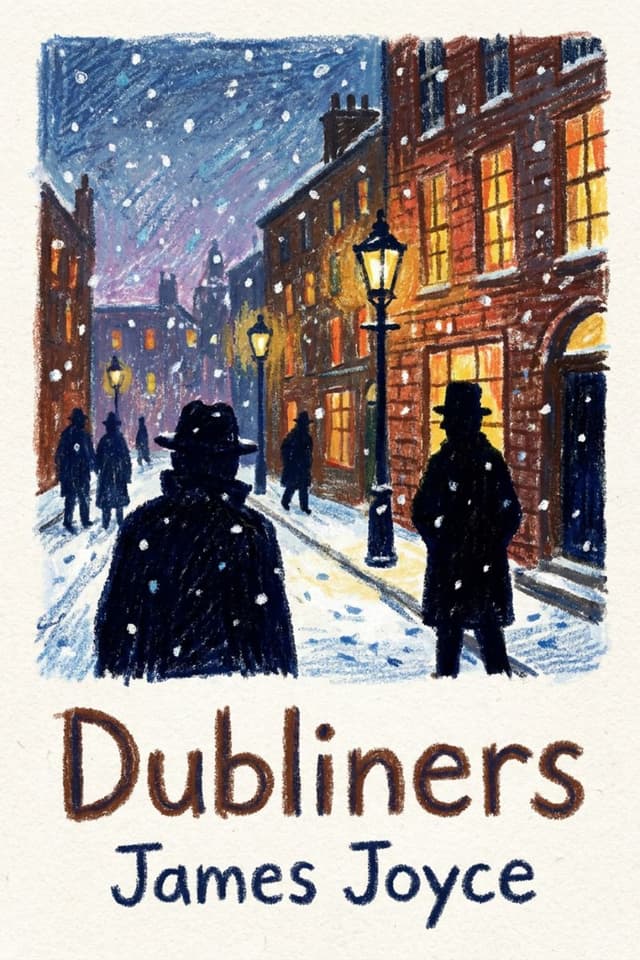
And through it all, Dublin itself is the real character. The pubs and parlors and boarding houses and churches. The rain. The gas lamps. The conversations that circle around the thing that actually matters without ever landing on it.
The Dead
Then comes the final story, and it changes everything.
A holiday party. An aging professor and his wife arrive at his aunts' annual gathering. The food, the music, the toasts, the gentle arguments about opera and politics and religion. It's warm and funny and achingly human. But as the evening unfolds, something shifts. A song is sung. A memory surfaces. And in a hotel room afterward, a conversation between husband and wife opens a door that has been closed for years.
What comes through that door is the kind of revelation that doesn't announce itself with thunder. It arrives softly, like snow, and it covers everything.
About the Author: James Joyce
A Dublin Childhood
James Joyce was born in 1882 in Rathgar, a comfortable Dublin suburb, the eldest of ten surviving children. His father, John Stanislaus Joyce, was a charming, improvident man whose drinking and financial mismanagement dragged the family from middle-class respectability into grinding poverty. Joyce attended Clongowes Wood College, a prestigious Jesuit boarding school, until his father could no longer pay the fees. After a humiliating stint at a less distinguished school, he was admitted to Belvedere College on a fee waiver, where he excelled academically.
The Young Rebel
At University College Dublin, Joyce studied modern languages and developed an obsessive admiration for Henrik Ibsen. He published a review of Ibsen's work in a major literary journal at eighteen, impressing Ibsen himself. He rejected Irish nationalism and the Catholic Church with equal fervor, convinced that both were traps designed to keep the Irish from thinking clearly. He was brilliant, arrogant, and absolutely certain he was destined for greatness.
Exile
In 1904, Joyce met Nora Barnacle, a chambermaid from Galway. Their first date, on June 16, would later become the most famous day in literary history: the date on which Ulysses is set. That October, the couple left Dublin for the continent. Joyce would return to Ireland only a handful of times and never again after 1912. He spent the rest of his life in Trieste, Zurich, and Paris, teaching English, borrowing money, drinking heavily, and writing the books that would reshape modern literature.
The Major Works
Dubliners was published in 1914 after a brutal nine-year battle with publishers and printers. A Portrait of the Artist as a Young Man followed in 1916. Then came Ulysses in 1922, a novel so revolutionary and so scandalous that it was banned in the United States and the United Kingdom for over a decade. His final work, Finnegans Wake (1939), pushed language itself to the breaking point.
Final Years
Joyce suffered from severe eye problems throughout his adult life and underwent more than a dozen surgeries. His daughter Lucia was diagnosed with schizophrenia, a source of immense grief. He and Nora finally married in 1931 after twenty-seven years together. Joyce died in Zurich on January 13, 1941, at the age of fifty-eight, from a perforated ulcer. He never received the Nobel Prize.
Fun Facts About the Book
Nine Years to Publish
Joyce first submitted Dubliners to a publisher in 1905. It was not published until 1914. In between, he submitted the manuscript eighteen times to fifteen different publishers. Printers refused to set type for stories they found obscene. One Dublin publisher accepted the book, then backed out and burned the printed sheets. Joyce managed to rescue a single copy by, in his own words, obtaining it "by ruse."
The Looking Glass
Joyce described Dubliners as "a nicely polished looking-glass" in which the Irish could take a good look at themselves. He wrote in what he called "a style of scrupulous meanness," stripping away ornament and commentary to let the reality of Dublin life speak for itself. He believed the book was a necessary first step toward Ireland's spiritual liberation. Ireland, for its part, was not eager to look.
"The Dead" Almost Didn't Exist
Joyce originally planned Dubliners as a collection of twelve stories. He added "The Dead" later, in 1907, and it became the longest and most celebrated piece in the collection. Many critics consider it not just the best story in the book but one of the greatest short stories ever written in English. T.S. Eliot was among those who held this view.
The Epiphany
Joyce built his stories around what he called "epiphanies," moments when a character suddenly sees something about themselves or their world with devastating clarity. These aren't dramatic plot twists. They're small, quiet shifts in understanding that change everything while appearing to change nothing.
Real Dublin, Real People
Joyce was almost pathologically precise about Dublin geography. Every street, pub, and building in Dubliners is real. Some of the characters were thinly disguised versions of real people, which was one of the reasons publishers were terrified of lawsuits. You can still walk the routes his characters take through the city.
No Quotation Marks
Joyce wanted Dubliners printed with dashes instead of quotation marks for dialogue, following continental European style. His publishers refused. It remains the only work of his that uses quotation marks. All his later books got the dashes he wanted.
Themes
Paralysis
The word appears on the very first page, and it haunts every story that follows. Joyce's Dublin is a city where people are frozen in place, unable to act, unable to leave, unable to change. The paralysis isn't physical. It's spiritual, emotional, social. Characters stand at the threshold of decision and can't step through.
The Desire for Escape
Nearly everyone in Dubliners wants to be somewhere else. A boy dreams of the exotic East at a bazaar. A young woman clutches a boat ticket. A man fantasizes about a life in London. But escape proves almost impossible. Dublin holds its people with invisible hands: family obligation, poverty, religion, habit, fear.
Epiphany and Self-Knowledge
The stories build toward moments of sudden, often painful recognition. Characters glimpse the truth about their lives, their relationships, their futures. Whether they can do anything with that knowledge is another question entirely.
The Weight of the Dead
Death is everywhere in Dubliners, from the dead priest in the opening story to the ghosts that haunt the final one. The living are shaped by the dead, defined by them, sometimes more connected to them than to anyone still breathing. The boundary between the living and the dead is thinner than anyone wants to admit.
Religion and Hypocrisy
The Catholic Church pervades Dublin life, but Joyce portrays it as more suffocating than sustaining. Priests are flawed or foolish. Religious rituals offer comfort but not meaning. The church is part of the machinery of paralysis, not a path out of it.
Class and Respectability
Joyce's characters are desperate to maintain appearances. They worry about what the neighbors think. They perform respectability even when the reality behind it is crumbling. The gap between how things look and how things are is where much of the collection's quiet tragedy lives.
The Book's Legacy
Dubliners is now widely regarded as one of the greatest short story collections ever published. It fundamentally changed what the short story could do, proving that a narrative didn't need a dramatic plot to be devastating, that the smallest moments of ordinary life could carry the weight of a novel.
"The Dead," the final story, has taken on a life of its own. John Huston adapted it into his final film in 1987, directing from a wheelchair while on portable oxygen. His daughter Anjelica starred as Gretta, and his son Tony wrote the screenplay, which earned an Academy Award nomination. A Tony Award-winning musical adaptation followed in 2000. Pedro Almodovar's 2024 film The Room Next Door centers the story as a key reference point.
Joyce's influence on the writers who followed him is almost impossible to overstate. The way contemporary short fiction handles silence, ambiguity, and the unspoken owes an enormous debt to these fifteen stories. Writers from Raymond Carver to Alice Munro to Colm Toibin have acknowledged Dubliners as foundational to their understanding of what a story can be.
The collection also created a template for the city as literary character. Joyce's Dublin is so precisely rendered that readers can walk its streets with the book as a guide, and many do. Bloomsday, the annual June 16 celebration of Ulysses, has its spiritual roots in the meticulous city-mapping that began here.
For all its reputation as "difficult" literature, Dubliners is actually the most accessible thing Joyce ever wrote. It's the door into his world. And once you walk through it, the city he built with words becomes as real as any place you've ever lived.