Novelhalla
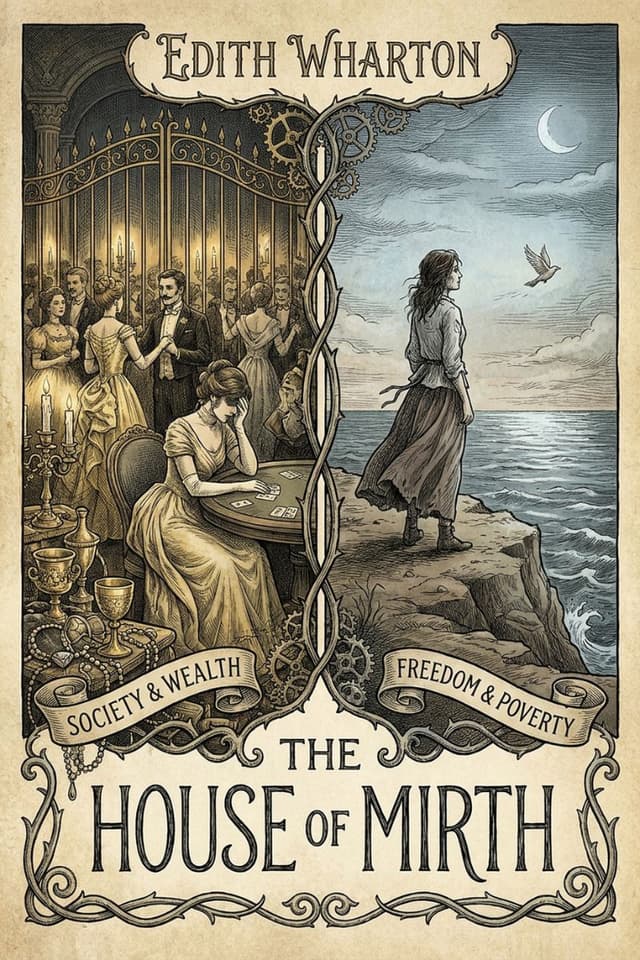
The House of Mirth
Read The House of Mirth by Edith Wharton for free on Novelhalla, and try out our easy-to-read modern edition of this classic book. You can also download the EPUB and read it on any device if you prefer!
The Plot
The Beautiful Miss Bart
Lily Bart is twenty-nine years old, beautiful, well-bred, and running out of time. In the glittering world of Gilded Age New York, where a woman's value is measured by her beauty and her marriage, Lily has been on the market for over a decade. She has the pedigree, the charm, the taste, and the face to secure any wealthy husband she wants. And yet she remains unmarried.
The problem is not a lack of suitors. The problem is Lily herself.
We meet her at Grand Central Station, spotted by her friend Lawrence Selden, a lawyer who moves easily through high society despite his modest income. He watches her with the mixture of admiration and wariness that everyone seems to feel around Lily. She is dazzling but also calculating, or at least she appears to be. Yet there is something in her that keeps sabotaging her own plans.
The House Party
Lily is on her way to Bellomont, the country estate of Gus and Judy Trenor, where the cream of New York society gathers for weekends of leisure, gossip, and bridge. Her target this time is Percy Gryce, a wealthy, dull young man with a passion for Americana and a domineering mother. Lily knows exactly how to handle him. She reads up on his interests, positions herself carefully, and begins to reel him in.
But Selden is also at Bellomont, and something about his presence throws Lily off her game. He offers her something the Percy Gryces of the world cannot: genuine conversation, intellectual companionship, the sense of being seen as more than a decorative object. In his company, Lily glimpses what she calls "the republic of the spirit," a realm beyond the petty calculations of society.
The trouble is that Selden cannot afford to marry her, and Lily cannot afford not to marry money.
The Debts
Lily's situation is more precarious than it appears. Her father died after losing his fortune, leaving her mother to die shortly after of what seemed like sheer horror at the prospect of poverty. Lily now lives with her wealthy Aunt Peniston, a cold woman who provides shelter but little else. She gives Lily a small allowance, nowhere near enough to maintain appearances in a world where a woman is judged by her wardrobe, her generosity at bridge, and her ability to reciprocate hospitality.
Lily gambles at cards, always hoping to win, always losing. Her debts mount. And then Gus Trenor offers to invest some money for her, claiming he can double it easily in the stock market. Lily accepts, grateful for the help. The checks start arriving, and she spends freely, not understanding until too late that Trenor has given her not investment returns but his own money, and that he expects something in return.
The Enemies
Lily's world is full of people who smile at her while waiting for her to fall. Chief among them is Bertha Dorset, a married woman who collects admirers and destroys rivals with equal enthusiasm. Bertha once had designs on Selden, and she has never forgiven Lily for attracting his attention. She is the kind of enemy who wounds with a whisper, who can ruin a reputation with a raised eyebrow and a well-timed silence.
There is also Simon Rosedale, a wealthy Jewish financier desperate to break into the society that snubs him. He sees Lily clearly, perhaps more clearly than anyone. He knows her value and her vulnerability. He offers her marriage, security, everything she needs. But Lily cannot bring herself to accept him, cannot shake her own prejudices or her longing for something more.
The Descent
What follows is a slow catastrophe. Lily makes choices that are not quite wrong but not quite right either. She puts herself in compromising positions while remaining technically innocent. She trusts people who betray her. She refuses to use weapons that might save her because using them would make her someone she does not want to be.
The society that once courted her begins to close its doors. The invitations slow, then stop. The friends who once competed for her company discover that they have other engagements. Lily learns what it means to be excluded from the only world she has ever known, and she discovers that the skills that made her a star in that world are useless anywhere else.
And through it all, Selden hovers at the edges of her life, drawn to her but never quite willing to risk everything for her, always arriving a moment too late.
About the Author: Edith Wharton
A Daughter of Old New York
Edith Newbold Jones was born in 1862 into the rarefied world she would later anatomize in her fiction. Her family was part of the old New York aristocracy, wealthy from Manhattan real estate, proudly established for generations. They were not the flashy new millionaires of the Gilded Age but something more genteel and, in their own estimation, more refined.
She spent much of her childhood in Europe, became fluent in French, German, and Italian, and received the education typical of girls of her class: enough to be decorative, not enough to be serious. She wanted more. She read voraciously from her father's library and began writing stories as a child. Her mother disapproved. Writing was not a suitable occupation for a young lady of good family.
Marriage and Escape
In 1885, at twenty-three and in danger of becoming an old maid, Edith married Edward "Teddy" Wharton, a friend of her brother's who was thirteen years her senior. He was pleasant, companionable, and entirely uninterested in intellectual pursuits. The marriage gave her freedom to travel, to build houses, and eventually to write. But it was never a meeting of minds, and it would eventually collapse under the weight of Teddy's mental illness and infidelities.
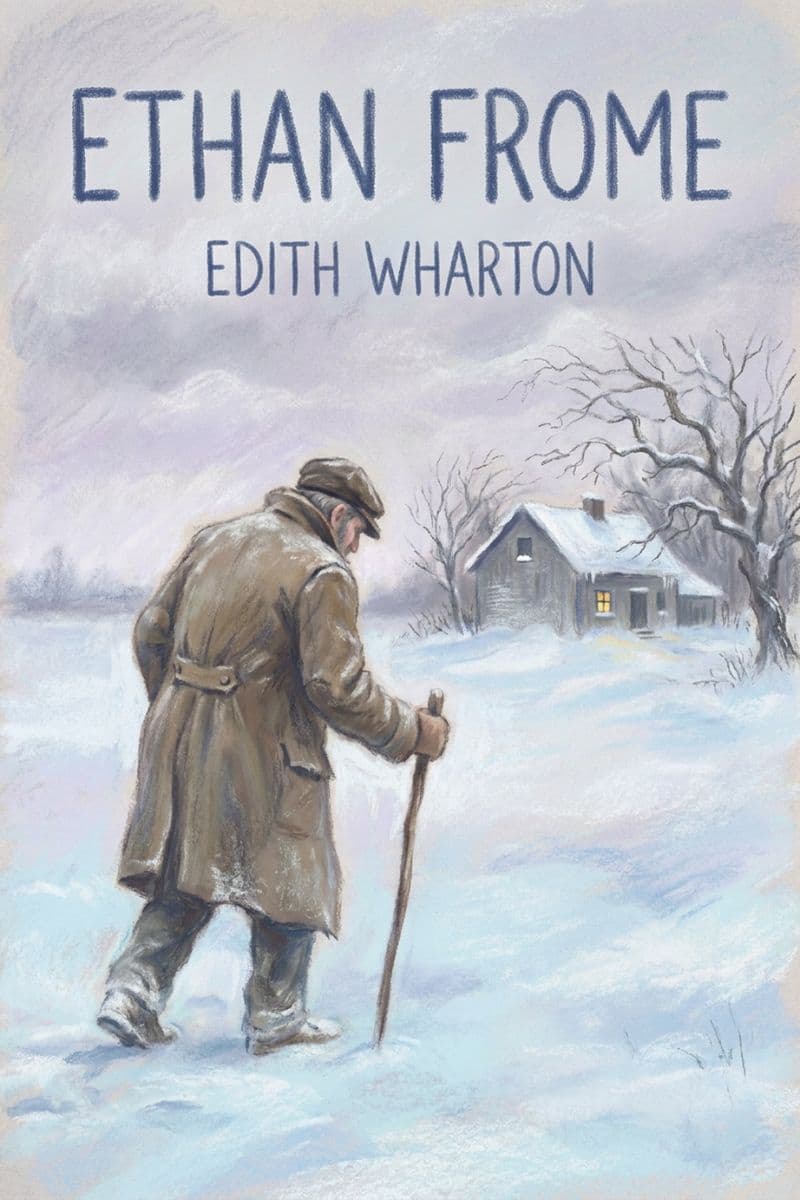
In 1902, the Whartons built The Mount, a grand estate in Lenox, Massachusetts, that Edith designed herself. Here she wrote The House of Mirth and Ethan Frome, entertaining a brilliant circle that included her close friend Henry James. But by 1911, her marriage was disintegrating, and she sold The Mount and moved permanently to France.
The Writer's Life
Wharton's first major success came with The House of Mirth in 1905. She was forty-three years old. The novel was serialized in Scribner's Magazine, then published as a book that sold 140,000 copies in its first months. The world she had been raised in was finally material she could use.
She continued writing prolifically for the rest of her life: novels, short stories, travel books, criticism. In 1921, she became the first woman to win the Pulitzer Prize for Fiction, for The Age of Innocence. She also wrote ghost stories that remain among the finest in the genre.
War and Later Years
When World War I broke out, Wharton was living in Paris. Rather than flee, she threw herself into relief work, organizing charities for refugees, setting up workrooms for unemployed women, and visiting the front lines to report on conditions. France awarded her the Legion of Honor for her service.
After the war, she divided her time between two homes in France, surrounded by friends, dogs, and gardens. She wrote until the end, completing her autobiography, A Backward Glance, in 1934. She died in 1937 at seventy-five, one of the most celebrated American writers of her era.
Fun Facts About the Book
An Instant Bestseller
The House of Mirth was a publishing phenomenon. Serialized in Scribner's Magazine beginning in January 1905, it generated such demand that the book publication in October sold 140,000 copies by year's end. Charles Scribner wrote to Wharton that it was "the most rapid sale of any book ever published by Scribner." Her royalties were worth more than half a million dollars in today's currency.
The Biblical Title
The title comes from Ecclesiastes 7:4: "The heart of the wise is in the house of mourning; but the heart of fools is in the house of mirth." The verse suggests that wise people contemplate serious matters while fools pursue pleasure. Wharton's title is deeply ironic: the "house of mirth" is the glittering society that will destroy Lily Bart, and there is nothing mirthful about it.
Rejected Titles
Wharton considered two other titles before settling on The House of Mirth. One was "A Moment's Ornament," from Wordsworth's poem about feminine beauty. The other was "The Year of the Rose." Both would have emphasized Lily's decorative function and her fading bloom, but The House of Mirth captured the novel's moral critique more powerfully.
Written from Experience
Wharton knew this world intimately because she had grown up in it. The mansions, the parties, the Newport summers, the elaborate rituals of calling and dining: all of it came from her own life. But she wrote from a distance, both geographical (much of the novel was written while she was living abroad) and emotional. She had escaped the trap that catches Lily Bart.
Henry James's Influence
Wharton's close friend Henry James was her literary model and mentor. She called him "Cher Maître" (dear master) in their correspondence. Like James, she was fascinated by the collision between American innocence and social corruption, though her style was sharper and her social criticism more direct.
Scandalizing Society
The novel shocked the very society it depicted. Some readers recognized themselves or their friends in Wharton's characters. A rector of Trinity Church in New York praised the book as "a terrible but just arraignment of the social misconduct which begins in folly and ends in moral and spiritual death." Others were less pleased to see their world exposed.
Multiple Adaptations
The novel has been adapted repeatedly for stage and screen. A Broadway play appeared in 1906, just one year after publication. Film versions followed in 1918, 1956, 1981, and 2000, with the last starring Gillian Anderson as Lily Bart.
The Tableau Vivant Scene
One of the novel's most famous scenes has Lily appearing in a tableau vivant, a popular entertainment where society women posed in elaborate costumes to recreate famous paintings. Lily's appearance is her greatest triumph, the moment when her beauty is most fully displayed. It is also a symbol of her predicament: she is literally an ornament, a living picture, valued only for how she looks.
Themes
Women as Commodities
Lily Bart exists in a marketplace where women are bought and sold through marriage. Her beauty is her capital, but it is a depreciating asset. At twenty-nine, she is already past her prime in a world that values youth above all. The novel exposes how completely a woman's survival depends on her ability to attract a wealthy husband, and how few options exist for those who fail.
The Prison of Society
Lily has been trained for only one thing: to be an ornament in high society. She has no skills that would allow her to support herself, no education beyond what was needed to make her charming at dinner parties. When society rejects her, she discovers that she is helpless. The very refinement that made her valuable in one world makes her useless in any other.
Moral Compromise
Throughout the novel, Lily is presented with opportunities to save herself by compromising her principles. She could use damaging letters to destroy her enemy. She could accept proposals from men she does not respect. She could trade on her beauty more explicitly. She refuses, again and again, and her refusals are both her tragedy and her nobility.
The Failure of Love
Lawrence Selden represents the possibility of love that transcends the marriage market. He sees Lily as more than a commodity; he offers her entry into his "republic of the spirit." But he is also a coward, unwilling to risk his comfort for her, always stepping back when stepping forward might save her. Their relationship is a study in missed connections and failures of nerve.
The Cruelty of Society
Wharton depicts high society as a system designed to destroy anyone who threatens its stability. Gossip is a weapon. Exclusion is a death sentence. The people who smile at Lily over dinner are the same people who will turn their backs when she falls. The novel shows how efficiently a community can annihilate someone while maintaining perfect manners.
Money and Morality
The novel constantly contrasts wealth with goodness, asking whether one can be both rich and moral. The characters who have money are often corrupt; the characters who have integrity are often poor. Lily is caught between these poles, wanting the luxury that money provides but unable to do what is necessary to get it.
The Book's Legacy
The House of Mirth established Edith Wharton as a major American novelist and remains one of the defining works of American literature. It is the essential novel of the Gilded Age, capturing both the glitter and the rot of a society built on money and manners.
Lily Bart has become one of fiction's great tragic heroines, a woman destroyed by a system she never chose and could never escape. Readers have debated for over a century whether her fate is inevitable or whether she could have saved herself, whether she is a victim or a participant in her own destruction. The novel refuses to provide easy answers.
Wharton went on to write many more novels, including The Age of Innocence, which won the Pulitzer Prize. But The House of Mirth remains her most searing work, the novel where her anger at the society that raised her burns brightest. It is a book about what happens when a woman is raised to be beautiful and nothing else, when her only purpose is to be looked at and admired, and when the world that created her decides it no longer needs her.