Novelhalla
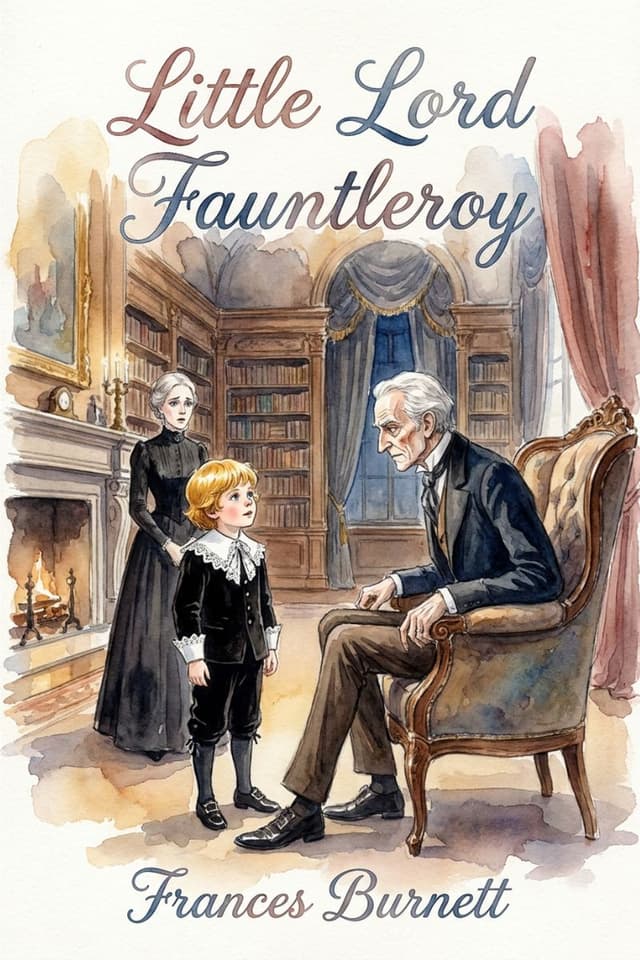
Little Lord Fauntleroy
Read Little Lord Fauntleroy by Frances Hodgson Burnett for free on Novelhalla, and try out our easy-to-read modern edition of this classic book. You can also download the EPUB and read it on any device if you prefer!
The Plot
The Boy from New York
Cedric Errol is seven years old, golden-haired, and the friendliest kid on his block. He lives with his mother in a shabby New York side street, the two of them getting by on very little since his father died. She's "Dearest" to him, and he's the center of her world. Cedric spends his days chatting up the neighborhood grocer, Mr. Hobbs, a gruff man who lets the boy sit on a cracker box and talk politics, and befriending Dick, a homeless bootblack who shines shoes on the corner. Cedric treats everyone he meets like they matter, because to him, they do.
Then a tall, thin lawyer named Havisham shows up at their door with news that changes everything.
The Inheritance
Cedric's father was English. Not just English, but the youngest son of the Earl of Dorincourt, one of the wealthiest and most powerful noblemen in England. The Earl hated that his son married an American woman, and he disowned him for it. But now the older sons are dead, and Cedric is the last heir. He has inherited the title Lord Fauntleroy, and his grandfather wants him in England immediately.
There's a catch. The Earl will provide for Cedric's mother, set her up in a cottage near the estate, but he refuses to meet her, speak to her, or allow her under his roof. She is to live apart from her son. Cedric's mother, quiet and brave, agrees to the arrangement for Cedric's sake. She won't take the Earl's money for herself, but she won't stand between her boy and his future.
Cedric says goodbye to Mr. Hobbs and Dick, promising to write, and sails for England with no idea what he's walking into.
The Earl
The Earl of Dorincourt is not a nice man. He's old, gout-ridden, and bitter. He's spent decades being cruel to his tenants, dismissive of his servants, and contemptuous of nearly everyone. He hated his older sons for their reckless lives, and he hated his youngest for marrying beneath him. He expects his American grandson to be a disappointment.
He is not prepared for Cedric.
The boy walks into the enormous estate and treats his grandfather like a hero. Not out of fear or flattery, but because Cedric genuinely believes the best of people. He assumes his grandfather must be generous and kind, because why else would someone have so much? He starts talking about all the good things they could do together for the tenants, the poor families, the people struggling on the estate.
The Earl, who has never done a charitable thing in his life, finds himself unable to disappoint the child. So he starts doing the things Cedric assumes he's already doing. He repairs cottages. He helps families. He feeds people. And something begins to shift.
The Transformation
The servants notice first. The tenants notice next. The whole countryside starts whispering about the change in the old Earl, and everyone knows it's because of the boy. Cedric is winning people over without trying, simply by being himself, generous, curious, fearless, and so thoroughly good-hearted that even the most suspicious people can't help warming to him.
But the Earl's growing affection for Cedric makes the situation with Cedric's mother more painful. The boy loves his grandfather and misses his mother, and the two people who matter most to him are separated by the old man's stubborn pride.
The Pretender
Just when the Earl is beginning to change, just when something real is growing between grandfather and grandson, a woman appears claiming that her son is the true Lord Fauntleroy. She says she was secretly married to the Earl's eldest son and that her boy is the rightful heir. If she's telling the truth, Cedric loses everything: the title, the estate, his place in his grandfather's life.
The Earl is shaken. The household is thrown into chaos. And back in New York, when Mr. Hobbs and Dick read about the claim in the newspapers, they recognize something about this woman's story that nobody in England could possibly know.
Whether the truth comes out, and what it costs, depends on a bootblack from the streets of New York who cared enough about a seven-year-old boy to pay attention.
About the Author: Frances Hodgson Burnett
Early Life
Frances Hodgson was born in 1849 in Manchester, England, the middle child of five. Her father ran an ironmongery business but died when she was just four, leaving the family in increasingly difficult circumstances. Frances grew up in a world of shrinking means and expanding imagination, scribbling stories in old notebooks because she couldn't afford proper writing paper. Her grandmother bought her books and fed her love of reading. By the time she was a teenager, Manchester's cotton economy had collapsed due to the American Civil War, and the family had nothing left.
A New World
In 1865, when Frances was sixteen, the family emigrated to Tennessee to live near a maternal uncle. The promised support never materialized. They ended up in a log cabin in New Market, and Frances took on the role of breadwinner, submitting stories to women's magazines starting at nineteen. Every manuscript she wrote was published. In 1873 she married Dr. Swan Burnett, and they had two sons, Lionel and Vivian. The family lived for a time in Paris before settling in Washington, D.C.
Fame and Heartbreak
Burnett's first major novel, That Lass o' Lowrie's, was published in 1877 to strong reviews. But it was Little Lord Fauntleroy in 1886 that made her famous and wealthy. She modeled Cedric on her son Vivian, right down to the golden curls and velvet suits she designed for her boys.
Then tragedy struck. In 1890, her eldest son Lionel died of tuberculosis at sixteen. The loss devastated her and colored the rest of her life with grief. She turned to spiritualism and theosophy searching for consolation, and the shadow of Lionel's death runs through much of her later work. Her marriage to Swan Burnett ended in divorce in 1898. A second marriage to the much younger actor Stephen Townsend in 1900 lasted barely two years.
Later Years and Legacy
Through all of it, Burnett kept writing. She produced over fifty books, including A Little Princess (1905) and The Secret Garden (1911), the novel that would eventually surpass Fauntleroy as her most enduring work. She divided her time between England and America, living for years at Great Maytham Hall in Kent, a manor house with a walled garden that inspired The Secret Garden.
She settled permanently on Long Island in her final years, building a home called Plandome. Her last public appearance was at the opening of a film adaptation of Little Lord Fauntleroy. She died in 1924 at seventy-four. A memorial statue in Central Park's Conservatory Garden depicts characters from The Secret Garden in her honor.
Fun Facts About the Book
The Harry Potter of Its Day
Little Lord Fauntleroy was a genuine cultural phenomenon. It sold over a million copies in English alone and was translated into more than a dozen languages. Readers followed the original serialization in St. Nicholas Magazine the way later generations would follow Harry Potter releases. There was Fauntleroy merchandise everywhere: velvet suits, lace collars, playing cards, chocolates. The comparison to Harry Potter's cultural footprint is one that literary historians have made explicitly.
The Velvet Suit Problem
Burnett designed outfits for her own sons that became the basis for Cedric's iconic look: black velvet suit, lace collar, golden ringlet curls. Reginald Birch's illustrations brought it to vivid life, and mothers across America rushed to dress their boys the same way. The Fauntleroy suit became a massive fashion trend for boys aged three to eight, lasting well into the early 1900s. Many of those boys, by all accounts, absolutely hated it.
A Landmark Copyright Case
When an unauthorized stage adaptation of the novel appeared in London in 1888, Burnett was furious. She began writing her own theatrical version on the train and then sued the plagiarist, E.V. Seebohm. She won, establishing a legal precedent for authors' dramatic rights over their own work. The Society of British Authors honored her at a banquet alongside James Russell Lowell, a champion of international copyright law. She then staged her own version, The Real Little Lord Fauntleroy, to rave reviews.
Based on Her Own Son
Vivian Burnett, Frances's younger son, was the direct model for Cedric. His golden curls, his charm, his habit of making friends with everyone he met. Vivian grew up knowing he was Fauntleroy, and in 1927 he published a biography of his mother called The Romantick Lady, written with obvious affection and a clear awareness that being the real Lord Fauntleroy had shaped his entire life.
Mary Pickford Played Both Roles
In the 1921 silent film adaptation, Mary Pickford, the biggest movie star in the world at the time, played both Cedric and his mother using pioneering double-exposure techniques. It was a technical marvel and a box office hit.
A Christmas Tradition in Germany
The 1980 film adaptation starring Ricky Schroder and Alec Guinness became an unexpected holiday classic in Germany, where it airs on television every Christmas. For many German families, it's as much a part of the season as any other holiday tradition.
Themes
The Power of Believing the Best
Cedric doesn't change his grandfather through arguments or moral lectures. He changes him by simply assuming the Earl is already good. The boy's faith creates a kind of mirror that the old man feels compelled to live up to. It's a surprisingly sophisticated idea for a children's novel: that believing in someone's goodness can sometimes call it into being.
Class and True Nobility
The novel draws a sharp line between rank and character. The Earl has all the status in the world and is miserable, cruel, and alone. Cedric has nothing but warmth and decency and wins over everyone he meets. Mr. Hobbs and Dick, working-class Americans, turn out to be more loyal and honorable than most of the aristocrats in the story. Real nobility, Burnett argues, has nothing to do with titles.
Mothers and Sons
The relationship between Cedric and his mother is the emotional spine of the book. She is brave, selfless, and heartbreakingly willing to sacrifice her own happiness for her son's future. The Earl's refusal to acknowledge her is the novel's deepest injustice, and the tension between Cedric's love for both his mother and his grandfather gives the story its real stakes.
American Innocence Meets English Tradition
Cedric arrives in England as an outsider, an American boy with no sense of class hierarchy, no deference to rank, and no understanding of why his grandfather's tenants are afraid. His democratic instincts clash with the rigid English social order, and the novel gently suggests that the American way of seeing people as equals might have something to teach the old world.
The Bridge Between Worlds
Burnett, who lived between England and America her entire adult life, used the novel to explore what happens when those two cultures collide. The book was credited in its time with actually improving Anglo-American relations, a remarkable claim for a children's story, but a testament to how deeply it resonated on both sides of the Atlantic.
The Book's Legacy
Little Lord Fauntleroy was the best-selling children's book of the late 19th century and one of the most culturally influential novels of its era. It shaped fashion, changed copyright law, and introduced a character so iconic that "Little Lord Fauntleroy" became a phrase in the English language, though over time it shifted from describing innocent charm to suggesting pampered preciousness.
The novel has been adapted for stage, film, and television repeatedly over more than a century, from the silent era through a beloved 1936 version starring Freddie Bartholomew to a 1980 film with Alec Guinness, and even a 43-episode Japanese anime series in 1988.
While The Secret Garden eventually eclipsed it in critical reputation, Little Lord Fauntleroy remains Burnett's most historically significant work: the book that made her famous, established her financial independence, and proved that a children's story could reshape the culture around it. It's a novel about the stubborn, world-changing power of a child who simply refuses to believe that anyone is beyond kindness.