Novelhalla
The Field of Ice
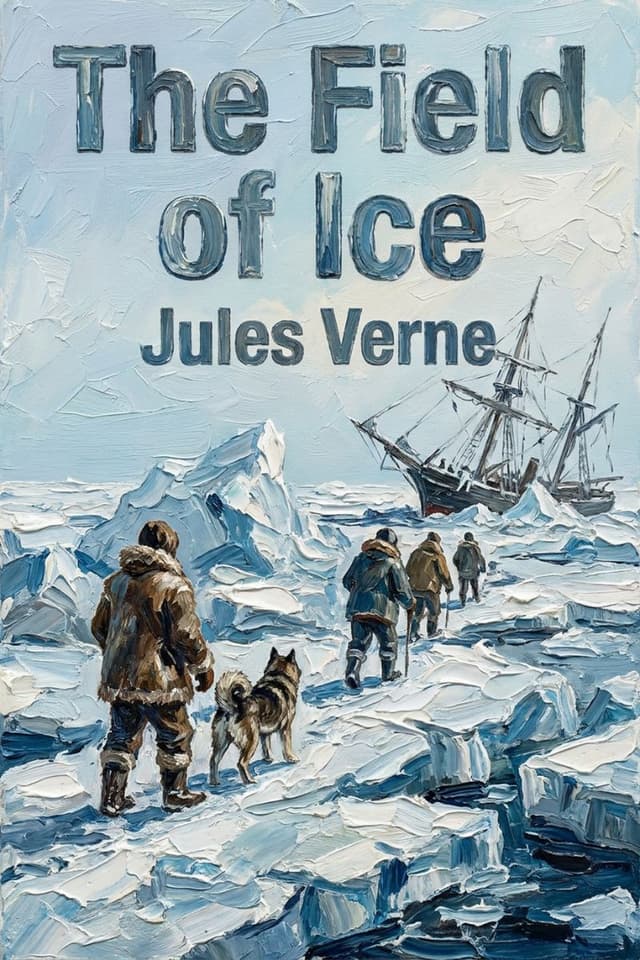
Read The Field of Ice by Jules Verne for free on Novelhalla, and try out our easy-to-read modern edition of this classic book. You can also download the EPUB and read it on any device if you prefer!
The Plot
Five Men and a Dead Ship
The brig was called the Forward, and now she's a smear of blackened iron on the ice. The crew mutinied, drank themselves stupid, hacked her down to the waterline for firewood, set her alight, and walked south. What's left is four Englishmen standing in a frozen desert twenty-five hundred miles from home with no vessel, no fuel worth the name, and food for about three weeks: Captain John Hatteras, whose entire life has narrowed to a single point at the top of the world; Doctor Clawbonny, whose bottomless memory for facts is about to become the most valuable object any of them owns; Johnson the old boatswain; and Bell the carpenter. Hatteras's dog Duk makes five.
They also have a dying man on the sledge. An American, scurvy-ridden, lips too swollen to form words, pulled half-frozen off the ice near a wreck nobody can explain. He's called Altamont, and when he finally forces out a single word, it changes everything about where these men are going and why.
The Wrong Direction
Every sane instinct says south. South is Smith Sound, whalers, Greenland settlements, England. Clawbonny and Johnson and Bell all want south. Hatteras wants north, and the terrible thing is that he might be right, because the only supplies within reach happen to lie three degrees closer to the Pole than any Englishman has ever stood.
What follows is a march that reads like an inventory of the ways the Arctic kills you. The last charge of powder gets spent on nothing. Fingers freeze to gunmetal. The dogs start eating their own harness. A polar bear begins following the party at a patient distance, waiting for them to lie down, and Johnson's mind starts to go. It's here that the Doctor performs the two feats of improvised science that made this book famous, and neither one involves anything you'd call equipment.
Two Captains, One Continent
Survival, when it comes, brings its own poison. There's an Englishman who believes the unmapped land beneath their feet belongs to the Crown, and an American who set foot on it first and has already named it. Both of them are proud. Both of them are right, depending on where you stand. And the two of them are now sealed into a snow house together for the length of an Arctic winter, with the temperature outside at seventy below and a doctor frantically changing the subject at every meal.
Clawbonny builds them a fortress on a cliff plateau, wires a lighthouse to a galvanic battery, and christens the whole geography with names chosen to keep the peace. It nearly works. Then the bears arrive, in numbers, and start doing something to the roof that no one inside can see or understand.
The Thaw
Spring is worse than winter, because spring makes the thing possible. Rain comes. The floes crack. The carpenter starts pulling planks off a dead ship to build a live one. And Hatteras stands on the shore of a sea that his entire century has argued about, a sea most geographers of 1861 genuinely believed existed, waiting for it to open.
North of them lies water no keel has touched, a coast no boot has printed, and roughly four degrees of latitude between one obsessed man and the only thing he's ever wanted. Between here and there: footprints in the snow that shouldn't be there, weather that has no interest in anybody's flag, and a rivalry that hasn't been settled so much as postponed.
About the Author: Jules Verne
The Lawyer Who Wouldn't
Jules Gabriel Verne was born on February 8, 1828, in Nantes, a busy French seaport where ships came and went in front of him every day of his childhood. His father Pierre was a lawyer and expected his eldest son to become one too, so he packed Jules off to Paris to study law. Jules finished the degree and then never practiced a day. He'd fallen in love with the theatre instead, and spent his twenties writing plays and libretti, working as secretary of the Théâtre Lyrique, and quietly not telling his father what he was actually doing with his life.
The Stockbroker with a Library Card
He married Honorine de Viane, a widow with two daughters, in 1857, and took a job as a broker at the Paris exchange to pay for it. He wrote in the early mornings before work. The rest of his free hours went to the Bibliothèque Nationale, where he built up the habit that would define his whole career: reading everything, on every subject, and taking notes. He wasn't inventing his science. He was researching it obsessively and then putting characters inside it.
In September 1862 a mutual friend introduced him to the publisher Pierre-Jules Hetzel, and everything changed. Hetzel published Five Weeks in a Balloon in 1863, signed Verne to a long contract demanding a punishing output of novels per year, and invented a name for the series they'd produce together: the Voyages Extraordinaires. Hetzel wasn't a passive publisher. He edited hard, pushed for optimism over pessimism, and killed at least one Verne novel outright.
The Amiens Years
The books made him rich and internationally famous. He bought yachts, sailed around Europe, crossed the Atlantic on the Great Eastern in 1867, and eventually settled in Amiens, his wife's home town, where he worked every morning with the regularity of a clerk and served on the municipal council. His personal life was harder than the public image. His son Michel was a long-running source of grief. In 1886 his nephew Gaston, suffering from mental illness, shot him in the leg over money, and Verne limped for the rest of his life. Hetzel died a week later. His mother died the year after.
The Dark Turn
The later novels get colder. Technology stops being a wonder and starts being a threat. He kept writing anyway, and kept selling, and by the end had produced more than sixty books in the series. He died at home in Amiens on March 24, 1905, at seventy-seven. He's now among the most translated authors who has ever lived, second only to Agatha Christie, and the phrase "father of science fiction" gets attached to him roughly as often as it gets attached to H. G. Wells.
Fun Facts About the Book
The Title Is a Translation Accident
Verne called it Le Désert de glace, "The Desert of Ice," and that's the name it goes by in French to this day. The English title comes from an anonymous Routledge translation published in London in 1874, and it stuck in Britain while American readers got the more literal version from Osgood in Boston the same year. Two titles, two translations, one book, and a century and a half of readers not realizing they've read it.
It's Really the Second Half
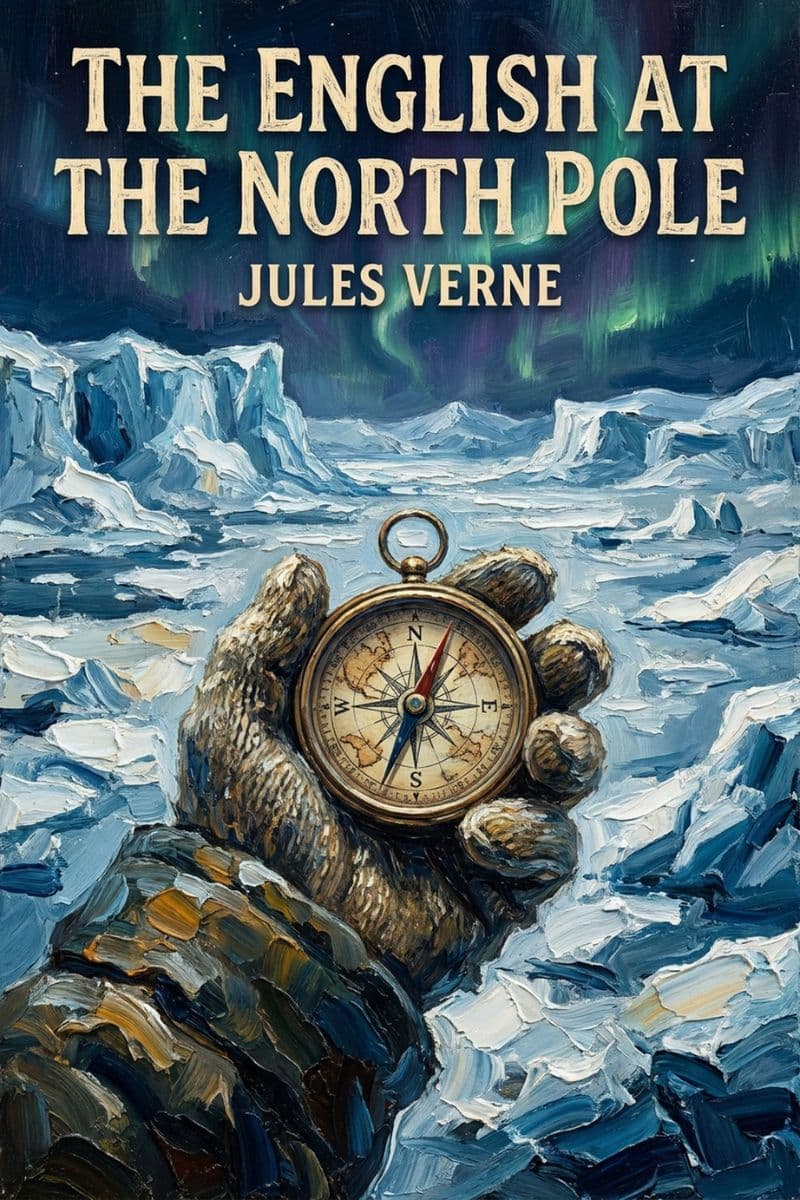
This is part two of a single novel that English publishers chopped down the middle. Part one, The English at the North Pole, covers the voyage of the Forward and everything that goes wrong aboard her. The split has meant that generations of readers have picked up the sequel first and simply started there, which works better than it has any right to.
The Book That Started the Series
Hetzel built the concept of the Voyages Extraordinaires around this novel. Confusingly, it's numbered second in the sequence, because three earlier Verne books from 1863 to 1865 were folded into the series retroactively once it existed. So the first book of the Voyages Extraordinaires is the second book of the Voyages Extraordinaires.
Hetzel Made Him Rewrite the Ending
Verne turned in a final act that his publisher found too bleak for a family readership, and Hetzel didn't suggest a change so much as require one. Verne rewrote it. The version everyone reads is the compromise, and it's still one of the strangest endings in nineteenth century adventure fiction.
The Mercury Bullet Is Real
When Clawbonny freezes mercury from a thermometer into a slug of metal to load a gun, he isn't performing an authorial miracle. He says outright that he remembered it from Captain John Ross's published voyages, where a mercury ball was reported to have punched through an inch-thick plank. Verne pulled it straight out of the source material, and the ice lens trick is equally grounded in real Arctic practice.
Verne Never Went Anywhere Near the Arctic
Every detail here came out of a library. The characters cite Parry, Ross, Belcher, Penny, McClure and Grinnell by name, argue about the Northwest Passage using real expedition records, and at one point Clawbonny reads aloud from Parry's account of the shipboard newspaper the crew published at Melville Island in 1819. Verne couldn't read English, so he worked from French translations of the English explorers, which is its own small miracle of scholarship.
No Frenchman in Sight
Verne was French. His hero is English, his rival is American, his comic relief and his heart are both English, and there's no French character anywhere in the main cast. He wrote a novel about British and American national pride from the outside, and let both of them make their case.
It Ran in a Children's Magazine
The story first appeared serialized in Hetzel's Magasin d'éducation et de récréation starting in 1864, aimed squarely at families. Which is worth remembering during the stretch where five starving men haven't eaten in thirty-four hours and one of them starts calmly explaining why they shouldn't keep the bear waiting.
The Illustrations
Édouard Riou produced 126 illustrations for it, and the early Routledge and Hetzel editions are collector's items largely because of them. The captions alone read like a summary of everything the Arctic can do to a person.
Themes
Obsession as an Engine and a Disease
Hatteras isn't ambitious. He's possessed. Every choice he makes runs through one filter, and the extraordinary thing is that his monomania is often the correct strategy, right up until it isn't. Verne lets you admire him and be frightened of him in the same paragraph, which is a harder trick than it sounds.
Flags Are Heavier Than They Look
The book's central conflict isn't man against ice. It's two men who can't agree on whose name goes on a piece of rock neither of them will ever profit from. National pride here is treated as a real force, as motivating as hunger and about as rational, and Verne is careful to make both the Englishman and the American look ridiculous and magnificent by turns.
Knowledge Is a Survival Tool
Clawbonny is the beating heart of the book and, functionally, its weapons locker. He doesn't out-shoot anyone or out-fight anyone. He remembers things he read. Over and over, the thing that saves this expedition is a fact somebody bothered to learn. It's the most Vernian argument there is: that curiosity isn't a luxury, it's equipment.
Nature Doesn't Have a Villain
There's no antagonist here in the ordinary sense. The cold isn't cruel, it's just cold. The bears aren't evil, they're hungry, and the book keeps pointing out that they're starving for exactly the same reason the men are. That indifference is what makes the survival sequences land.
Civilization Is a Thing You Build by Hand
Watching five men construct a house, a fort, a storehouse, a kennel, and an electric lighthouse out of snow, salvage and pure will is oddly moving. They name every bay and mountain. They hold a dinner party. They keep a schedule. The novel is quietly obsessed with the idea that order is something you manufacture, daily, against an environment that erases it.
The Last Blank Space
In 1861, nobody knew what was at the North Pole. Verne is writing into a genuine void on the map, and the book carries the specific excitement of a question that was still open. That's a feeling modern readers almost never get, and it's the reason this one still works.
Historical Context
The novel sits directly on top of two real nineteenth century obsessions. The first is the Franklin expedition, which vanished in the Arctic in the 1840s and triggered decades of search voyages that made polar exploration a matter of public passion and national honor across Britain and America.
The second is the open polar sea. It sounds absurd now, but for a long stretch of the 1800s serious geographers argued that the ring of pack ice surrounded a warm, navigable ocean at the top of the world. Matthew Fontaine Maury and August Petermann theorized it from ocean currents. Elisha Kent Kane and Isaac Israel Hayes reported open water and fed the optimism. Explorers pushed north for decades on the strength of it, and the theory wasn't really finished off until the 1880s, when George De Long's Jeannette went looking for the gateway and got crushed by ice instead.
Verne wasn't writing fantasy. He was writing the best available science, and the book is now an accidental time capsule of a world that seemed plausible and turned out not to exist.
The Book's Legacy
This is the novel that gave the Voyages Extraordinaires their shape. The formula Verne locked in here, meticulous real-world research wrapped around a driven protagonist and a genuinely dangerous journey, is the one that produced Twenty Thousand Leagues Under the Sea, Journey to the Centre of the Earth and Around the World in Eighty Days. Everything downstream starts in this ice.
Its most famous adaptation is Georges Méliès's 1912 silent film The Conquest of the Pole, one of the last major works by the man who made A Trip to the Moon. Méliès borrowed loosely and cheerfully, added a man-eating frost giant, and produced something now regarded as one of his masterpieces even though it lost money and helped ruin him. Beyond that, it's been strikingly under-adapted for a Verne novel, which is either an oversight or an opportunity.
Among Verne readers, this one has a particular reputation. It's less charming than his crowd-pleasers and considerably bleaker, and a number of critics have called it the most powerful thing he ever wrote. Hatteras belongs to the small, distinguished company of literary captains destroyed by the thing they're chasing, and he arrived there a decade after Ahab and a generation after Poe sent Arthur Gordon Pym toward a polar mystery of his own.
It also survives as something Verne never intended: a record of a lost scientific worldview, written with total sincerity by a man who believed it, about a place nobody had ever seen.