Novelhalla
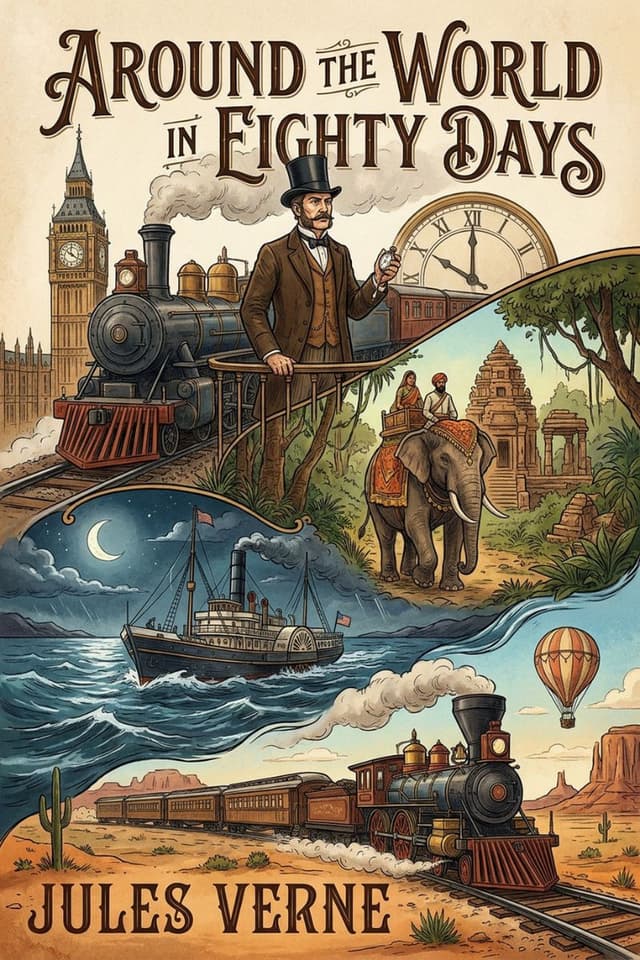
Around the World in Eighty Days
Read Around the World in Eighty Days by Jules Verne for free on Novelhalla, and try out our easy-to-read modern edition of this classic book. You can also download the EPUB and read it on any device if you prefer!
The Plot
Phileas Fogg is a wealthy English gentleman living in London in 1872. He's a man of precise habits, so precise that he fires his servant for bringing shaving water two degrees too cold. He hires a new valet, a Frenchman named Jean Passepartout, who is hoping for a quiet, predictable life.
That same evening, Fogg is playing whist at the Reform Club when a debate breaks out about whether it's possible to travel around the entire world in just eighty days. A recent newspaper article claimed it could be done, thanks to the opening of new railway lines in India and the Suez Canal. Fogg not only insists it's possible but bets twenty thousand pounds that he can do it himself, leaving that very night.
The Journey Begins
Fogg and Passepartout depart immediately, carrying a carpetbag with banknotes and little else. Their planned route takes them across Europe by rail, through the Suez Canal, across India, through Hong Kong and Japan, across the Pacific to America, and finally across the Atlantic back to England.
What Fogg doesn't know is that a detective named Fix has spotted him at the Suez Canal. A major bank robbery has just occurred in London, and the physical description of the thief matches Fogg perfectly. Fix becomes convinced this "wager" is actually a cover for fleeing England with the stolen money. He follows Fogg around the world, waiting for an arrest warrant that keeps failing to arrive.
Adventures Along the Way
The journey is anything but smooth. In India, the travelers discover a rail line marked on maps hasn't actually been built yet, forcing them to buy an elephant and trek through the jungle. During this detour, they rescue a young Indian woman named Aouda from being burned alive on her husband's funeral pyre. She joins their party and travels with them for the rest of the journey.
In Hong Kong, Fix gets Passepartout drunk and drugs him, causing the valet to miss the steamer to Japan. In America, the train is attacked by Sioux warriors, and Passepartout is taken prisoner, requiring a rescue mission. A blown bridge forces them to cross a rickety structure at full speed. They miss their steamer in New York and have to charter a ship across the Atlantic, eventually burning most of its wooden parts for fuel when coal runs out.
The Final Stretch
Fogg arrives in Liverpool with mere hours to spare, only for Fix to finally arrest him. By the time the real thief is caught and Fogg is released, he's lost the crucial time he needed. He returns to London believing he has failed, arriving five minutes too late.
But Passepartout discovers something remarkable. By traveling east around the world, they gained a day without realizing it. They crossed the International Date Line going the "wrong" direction, and it's actually Saturday, not Sunday. Fogg races to the Reform Club and walks through the door with seconds to spare, winning his bet.
The novel ends with Fogg marrying Aouda. He didn't gain any money from the adventure since his expenses roughly equaled his winnings, but he gained a wife, and Passepartout gained the quiet life he wanted (eventually).
About the Author: Jules Verne
Early Life
Jules Gabriel Verne was born in 1828 in Nantes, France, a busy port city. His father was a lawyer who expected Jules to follow him into the profession. As a boy, Verne was fascinated by ships and travel. According to family legend, he once tried to stow away on a ship bound for the Indies at age eleven, only to be caught and returned to his father, who made him promise to travel "only in his imagination" from then on.
Paris and the Theater
Verne studied law in Paris to please his father but spent most of his time writing plays and libretti. He befriended Alexandre Dumas (author of The Three Musketeers), who encouraged his writing. He worked as a stockbroker for years while writing on the side, an arrangement that made him miserable but paid the bills.
The Publisher Who Changed Everything
In 1862, Verne met publisher Pierre-Jules Hetzel, who would change his life. Hetzel saw potential in Verne's manuscript for Five Weeks in a Balloon and worked with him to revise it. The book was a hit, and Hetzel signed Verne to a contract for two novels a year, a partnership that lasted four decades and produced over sixty books.
Extraordinary Voyages
Verne called his series of novels "Voyages Extraordinaires." His goal was to sum up all the geographical, geological, physical, and astronomical knowledge of his time in entertaining adventure stories. Journey to the Center of the Earth, Twenty Thousand Leagues Under the Sea, and Around the World in Eighty Days made him one of the most popular writers in the world.
Later Life
Verne became wealthy and bought a series of yachts, finally getting to travel for real. His later years were marked by tragedy. His nephew shot him in the leg in 1886, leaving him with a permanent limp, and his relationship with his son Michel was troubled. His later novels grew darker and more pessimistic. He died in 1905 at age seventy-seven in Amiens, France, where a massive funeral procession honored him.
Fun Facts About the Book
It Was Inspired by Real Articles
Verne got the idea from actual newspaper articles discussing how new technologies like the Suez Canal, transcontinental railroads, and steamships had shrunk travel times dramatically. The theoretical possibility of circling the globe in eighty days was genuinely being debated.
Serialized for Maximum Suspense
The novel was first published in installments in the newspaper Le Temps in 1872. Readers waited eagerly to find out if Fogg would make each connection. Some reportedly placed bets on whether the fictional Fogg would succeed.
Real Travelers Tried to Beat It
After publication, people actually attempted to circle the globe faster than Fogg. Journalist Nellie Bly famously did it in 72 days in 1889-1890, even stopping to meet Jules Verne in France along the way. She asked if he thought she'd succeed. He said he hoped so but doubted it.
Fogg Has No First Name in French
The name "Phileas" doesn't appear in the original French text until later editions. Verne just called him "Fogg" throughout. The first name was added for English translations and eventually incorporated back into French editions.
The Date Line Twist Was Clever
The International Date Line twist at the end isn't a cheat. Verne plays fair with the reader. He mentions several times that Fogg doesn't adjust his watch or track local dates. Attentive readers could theoretically figure out the solution, though most didn't.
Passepartout Means "Goes Everywhere"
The valet's name is a pun. "Passe-partout" in French means a master key that opens any lock, or more loosely, something that goes everywhere. It's also slang for someone adaptable who can handle any situation, which Passepartout certainly proves to be.
No Hot Air Balloon
Despite what countless movie adaptations show, there's no hot air balloon in the book. Not even once. Verne had already written about balloons in Five Weeks in a Balloon and used other transportation for this story. Hollywood just can't resist adding one.
Verne Did the Math
Verne meticulously calculated distances and travel times using real steamship schedules and railway timetables. The route is genuinely possible given 1872 transportation. Tight, but achievable. Later readers found minor errors, but the basic logistics hold up.
Themes
Progress and Technology
The novel is essentially a celebration of the modern age. Steamships, railways, and the Suez Canal have conquered distance. Verne marvels at how technology has compressed the world. There's an optimism here about human achievement that feels very Victorian.
British Imperialism
Fogg travels through a world shaped by the British Empire: India under colonial rule, Hong Kong as a trading port, the Suez Canal as a shortcut to imperial possessions. The novel doesn't critique this much, but it's everywhere in the background. Fogg's Englishness opens doors throughout the journey.
Precision vs. Chaos
Fogg is a machine in human form, regulated entirely by schedules and calculations. The world keeps throwing chaos at him in the form of unfinished railways, storms, bandits, and arrests. The novel asks whether rigid planning can conquer unpredictable reality. Somehow, for Fogg, it does.
Money and Class
Fogg solves most problems by throwing money at them. He buys an elephant, charters ships, bribes officials. His wealth insulates him from consequences that would doom a poorer traveler. The novel doesn't judge this exactly, but it's hard to miss that Fogg's adventure is only possible because he's rich.
Seeing vs. Experiencing
Fogg travels around the entire world and sees almost nothing. He plays cards below deck, ignores scenery, has no interest in local cultures. Passepartout actually engages with the places they visit. The novel gently suggests that Fogg's rigid focus on the goal makes him miss the journey.
The Book's Legacy
Around the World in Eighty Days was Verne's biggest commercial success during his lifetime and remains one of his most beloved works. It established the "race against time" adventure genre that countless books and films have imitated since.
The novel helped cement the popular image of the Victorian English gentleman as unflappable, precise, and quietly competent, even though Verne was French and arguably poking fun at British stuffiness. Fogg became an archetype.
It's been adapted into films, television series, musicals, and even video games dozens of times. The 1956 film won the Academy Award for Best Picture. Most adaptations add that balloon, along with various villains and action sequences Verne never wrote, but the core appeal of the race around the world endures.