Novelhalla
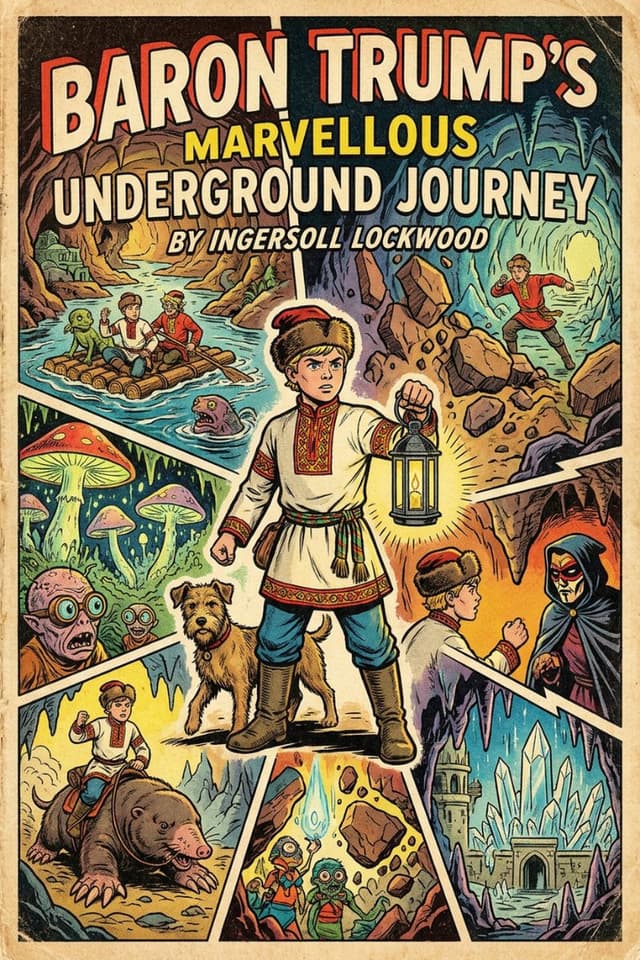
Baron Trump's Marvellous Underground Journey
Read Baron Trump's Marvellous Underground Journey by Ingersoll Lockwood for free on Novelhalla, and try out our easy-to-read modern edition of this classic book. You can also download the EPUB and read it on any device if you prefer!
The Plot
The Restless Baron
Young Baron Trump is bored out of his mind. He's a wealthy German aristocrat living in the grand Castle Trump, surrounded by luxury, servants, and every comfort a boy could want. But comfort is the last thing he's after. He's already traveled the world, already made a name for himself as an explorer. And now he's stuck at home with nothing but dusty books and a very grumpy dog.
That dog is Bulger, his fiercely loyal companion, and Bulger is miserable. The local mutts keep showing up beneath the castle windows trying to lure him out to play, which he finds absolutely beneath his dignity. His spirits are sinking. The Baron can tell: something has to change.
Then his father hands him a fifteenth-century manuscript written by a legendary Spanish philosopher known as Don Fum. And everything changes.
The Manuscript
Don Fum's crumbling, mildew-stained pages lay out an astonishing theory: the Earth is not solid. Deep beneath the surface, vast chambers stretch for hundreds of miles, and within them live entire civilizations, driven underground ages ago by catastrophic upheavals on the surface. Don Fum calls it the World within a World.
There's just one problem. The portals to this underground realm are hidden somewhere in northern Russia, along the western slope of the Ural Mountains. And Don Fum couldn't pinpoint the exact location. Instead, the manuscript repeats a single maddening phrase: "The people will tell thee."
What people? Where? The Baron doesn't know. But he doesn't care. He packs his bags, dresses in Russian clothing so he can move through the country unnoticed, says a tearful goodbye to his parents, and sets out with Bulger for the Russian wilderness.
Into the Earth
The journey across Russia is long, strange, and full of curious encounters. But with the help of locals who seem to know more than they let on, the Baron eventually finds what he's looking for: a vast, gaping well hidden in the northern landscape, its mouth fifty feet across and its depths impossible to see.
He lowers Bulger down on a rope. Then he follows.
What waits below is not darkness. It's not emptiness. It's a world.
The World Within a World
The underground realm is divided into lands, each stranger and more unsettling than the last. The first civilization the Baron encounters is the Transparent Folk, people whose bodies are completely see-through. They hide beneath long black cloaks and carry fans to shield themselves from view. But their transparency isn't just physical. In this land, lying is literally impossible. The moment someone tries to say something false, their body clouds and turns opaque for all to see. Honesty isn't a virtue here. It's biology.
The Baron moves deeper. He finds the Soodopsies, sometimes called the Ant People, a civilization driven underground by a sudden Ice Age so long ago that they've lost their sight, their hearing, and their speech entirely. They communicate through touch alone. And they've built a society without rulers, because, as they explain, no one wants to be in charge if there's no one to look at them and no one to flatter them.
There are frozen kingdoms ruled by monarchs who think so slowly their decisions take days. There are lands where the inhabitants have such short memories they can't hold a grudge for more than an hour. Giant creatures lurk in the caverns. Princesses appear and vanish. The rules of the surface world don't apply, and the deeper the Baron goes, the stranger things get.
The Question
But a world this bizarre doesn't let visitors pass through unchanged. Each civilization holds up a mirror to the surface world and what it reflects is not flattering. The Baron listens, observes, and presses on. Bulger stays close. The manuscript offers clues but no guarantees.
And the deeper they descend, the harder it becomes to find the way back up.
About the Author: Ingersoll Lockwood
Early Life and Diplomacy
Ingersoll Lockwood was born in 1841 in Ossining, New York, into a family of prominent lawyers. His father, Munson Lockwood, was a general in the New York State Militia and a passionate supporter of Hungarian independence. Like his father and uncles before him, Lockwood trained as a lawyer, but his first career was in diplomacy. In 1862, Abraham Lincoln appointed him Consul to the Kingdom of Hanover, making him the youngest member of the U.S. consular force at the time. He served in that post for four years.
A Second Career
After returning from Europe, Lockwood practiced law in New York City alongside his brother Henry. But by the 1880s, writing and lecturing had become his real passion. He published children's novels, political satire, plays, non-fiction, and poetry. In 1884, he married Winifred Wallace Tinker, a Vassar graduate and aspiring writer herself. They divorced in 1892.
Lockwood wrote prolifically during this period. His children's books followed a popular trend of the era: fantastical adventure stories featuring young protagonists journeying to strange lands, in the vein of Lewis Carroll's Alice in Wonderland.
Final Years
Lockwood spent his later years as something of a recluse in Saratoga Springs, New York. His last published work was a poetry collection called In Varying Mood in 1912. He died in 1918 at the age of 77 with no children or surviving relatives.
Fun Facts About the Book
Part of a Series
This novel is actually the second Baron Trump book. The first, Travels and Adventures of Little Baron Trump and His Wonderful Dog Bulger, was published in 1889. Both follow the same aristocratic German boy and his dog on increasingly bizarre adventures. The character's full name is Wilhelm Heinrich Sebastian Von Troomp, and he lives in, yes, Castle Trump.
A Hollow Earth Story
The novel belongs to a rich tradition of hollow earth fiction that was popular in the nineteenth century. The idea that the Earth might be hollow and inhabited goes back centuries, and writers from Edgar Allan Poe to Jules Verne explored the concept. Lockwood's version is lighter and more satirical than most, using the underground civilizations as funhouse mirrors for human society.
The Curious Modern Rediscovery
The Baron Trump novels were almost completely forgotten for over a century. Then in 2017, internet users noticed something remarkable: a nineteenth-century children's book series featuring a wealthy, boastful boy named Baron Trump who lives in a building called Castle Trump, travels to Russia, and follows guidance from a figure named "Don." The coincidences with the Trump political family caused the books to go viral and sent them rocketing up bestseller lists. For the record, "Don" in the novel is a Spanish honorific meaning "Mr.," not a first name, but the parallels made for irresistible reading.
Lockwood's Other Prediction
Lockwood also wrote a short novel called 1900: or, The Last President, published in 1896. It opens with New York City in an uproar following the shocking election of a populist outsider candidate. Mobs gather on Fifth Avenue. The establishment panics. It's a political satire of its era, but readers in 2017 found the echoes impossible to ignore.
Originally a Children's Book
Despite its recent rediscovery by adults, Baron Trump's Marvellous Underground Journey was written for young readers and was part of a wave of children's fantasy literature inspired by Alice in Wonderland. Contemporary reviewers were lukewarm. One 1891 critic described Lockwood's style as laboring through hundreds of pages of "fantastic and grotesque narrative," occasionally striking sparks of wit that gave off little light and no warmth.
The Illustrations
The original 1893 edition featured illustrations by Charles Howard Johnson, whose charming pen-and-ink drawings brought the underground civilizations to life. The book was published by Lee and Shepard in Boston.
Themes
The Impossibility of Honesty
The Transparent Folk can't lie. Literally. Their bodies betray every untruth. It's a simple fantasy concept, but the implications ripple outward. What would society look like if deception were physically impossible? Lockwood uses it to poke at a surface world where the loudest voice is often mistaken for the wisest.
Power, Vanity, and Why People Lead
The Ant People have no rulers, and their explanation is devastating: leadership, they argue, is just vanity wearing a crown. No one wants to govern if there's no one to watch them do it and no one to tell them how great they are. It's a sharp little knife hidden inside a children's adventure story.
The Value of Forgetting
The Happy Forgetters can't remember anything beyond the last hour. They hold no grudges. They carry no resentment. They live entirely in the present. It sounds like paradise, but there's a cost, and the Baron's visit to their land raises uncomfortable questions about whether memory is a gift or a burden.
The Outsider's Mirror
Every underground civilization serves as a distorted reflection of the world above. The Baron arrives as a visitor and observer, but the societies he encounters keep turning the lens back on him and on the reader. It's satire dressed up as bedtime reading.
The Book's Legacy
For most of its existence, Baron Trump's Marvellous Underground Journey was a footnote in literary history, a mildly eccentric Victorian children's book that couldn't compete with Alice in Wonderland or the Oz stories that followed a few years later. Critics and readers moved on.
Then the internet happened.
The book's 2017 rediscovery turned it into a genuine cultural phenomenon. It became a bestseller more than 120 years after publication. Conspiracy theorists spun wild tales about time travel. News outlets from Newsweek to the Washington Post covered the strange coincidences. The novel went from dusty Library of Congress archive to Amazon bestseller list practically overnight.
But beneath all the viral buzz, the book has a quieter legacy worth noticing. Lockwood was doing something genuinely clever: using a children's fantasy framework to deliver social satire about honesty, power, vanity, and the way civilizations organize themselves. The underground worlds aren't just weird. They're pointed.
The Baron Trump novels may have been rediscovered for the wrong reasons, but they reward readers who stick around for the right ones.