Novelhalla
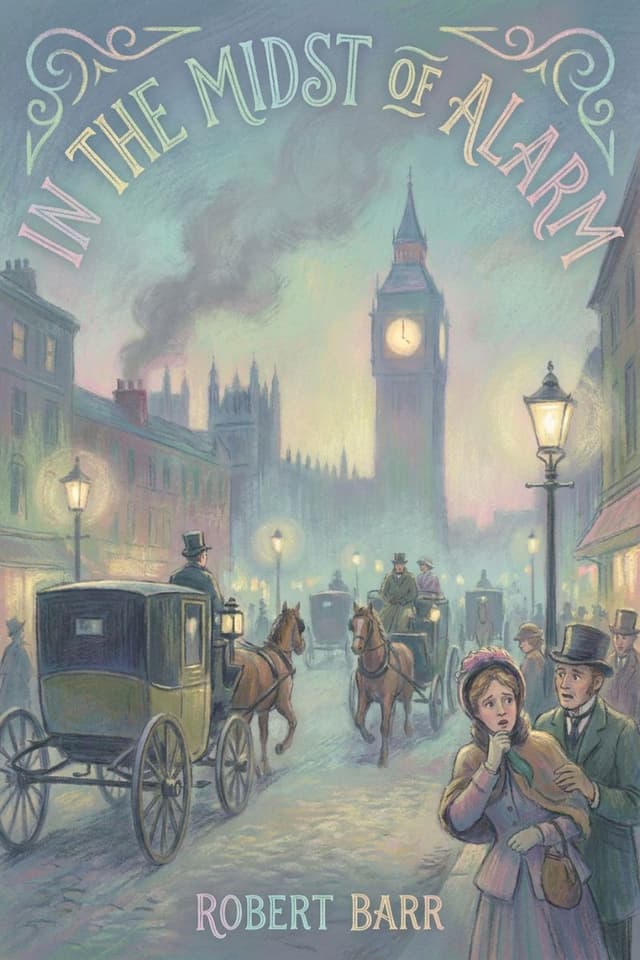
In the Midst of Alarm
Read In the Midst of Alarm by Robert Barr for free on Novelhalla, and try out our easy-to-read modern edition of this classic book. You can also download the EPUB and read it on any device if you prefer!
The Plot
The story opens in Buffalo, New York, in 1866, shortly after the end of the American Civil War. Richard Yates, an overworked New York newspaper reporter on the verge of a nervous breakdown, has been ordered by his doctor to take a complete rest in the countryside with a companion who will not discuss anything intellectually taxing.
Yates recruits his old schoolmate Professor Stillson Renmark, a reserved academic from the University of Toronto, for a camping trip in the Canadian countryside near Fort Erie in Ontario's Welland County. The two men could not be more different. Yates is brash, talkative, and thoroughly American in his irreverent humor. Renmark is quiet, dignified, and deeply Canadian in his sensibilities.
After crossing into Canada, they find lodging and a campsite on the farm of the Bartlett family. There they meet Kitty Bartlett, the farmer's pretty and spirited daughter, as well as Margaret Howard, an educated young woman from a neighboring farm. What begins as a simple rural retreat becomes complicated by romance, cultural misunderstandings, and the friction between American and Canadian temperaments.
The peaceful countryside is disrupted by news of the Fenian invasion. Irish-American veterans of the Civil War, organized as the Fenian Brotherhood, have crossed the Niagara River from Buffalo with plans to seize Canadian territory and hold it hostage for Irish independence from Britain. The local farmers and townspeople must suddenly contend with armed invaders, military mobilization, and the chaos of war arriving at their doorsteps.
Yates and Renmark find themselves caught up in the conflict, their vacation transformed into something far more dangerous and consequential. The invasion tests not only the characters' courage but also the developing relationships between the two Americans and the Canadian women they have come to care for.
About the Author: Robert Barr
Scottish Origins, Canadian Upbringing
Robert Barr was born in Glasgow, Scotland, in 1849, but his family emigrated to Upper Canada when he was just four years old. They settled on a farm near the village of Muirkirk in Ontario, where young Robert helped his father with carpentry and building work. This rural Canadian childhood gave him firsthand knowledge of the farming communities he would later depict in his fiction.
Teaching Career
Barr trained as a teacher at the Toronto Normal School and rose to become headmaster of the Central School in Windsor, Ontario. During his years as a schoolmaster, he began writing humorous pieces for local publications, discovering a talent for comic storytelling that would shape his literary career.
Journalism and Luke Sharp
In 1876, Barr left teaching to join the staff of the Detroit Free Press, where he wrote under the pseudonym "Luke Sharp." The name came from an undertaker's sign he passed on his daily commute, finding humor in the combination "Luke Sharpe, Undertaker." He rose through the ranks from reporter to columnist to exchange editor.
London and The Idler
In 1881, Barr moved to London to establish a British edition of the Detroit Free Press. The venture proved successful, and Barr became a fixture of London literary society. In 1892, he cofounded The Idler magazine with Jerome K. Jerome, author of "Three Men in a Boat." The illustrated monthly became a showcase for witty, sophisticated writing, featuring contributions from Arthur Conan Doyle, Mark Twain, Rudyard Kipling, and other leading authors of the day.
Literary Output
Barr wrote prolifically across genres, producing novels, short stories, and humorous sketches. He is perhaps best remembered today for "The Triumphs of Eugène Valmont," a series of detective stories featuring a vain French investigator whose cases often go comically wrong. He also wrote the first Sherlock Holmes parody, "The Adventures of Sherlaw Kombs," in 1892, though he and Conan Doyle remained good friends despite the gentle mockery.
Death
Barr died of heart disease in 1912 at his home in Woldingham, a village southeast of London. He was 63 years old.
Fun Facts About the Book
Based on Real Events
The Fenian Raid depicted in the novel actually happened. In June 1866, Irish-American veterans of the Civil War crossed the Niagara River from Buffalo and briefly occupied Fort Erie before fighting the Battle of Ridgeway against Canadian militia. The raid failed to achieve its goal of pressuring Britain to grant Irish independence, but it helped galvanize Canadian support for Confederation the following year.
The Battle That Made Canada
Historians have argued that the Fenian threat helped push reluctant Maritime provinces to support the union that created the Dominion of Canada in 1867. The novel captures the moment when this disparate collection of British colonies was beginning to develop a sense of national identity.
Barr's Personal Connection
Barr was seventeen years old and living in Ontario when the Fenian Raids occurred in 1866. The events he fictionalized were part of his own youth, and his portrayal of rural Ontario life draws on personal experience of the farms and villages of Canada West.
American-Canadian Friction
The novel gleefully exploits the cultural tensions between Americans and Canadians in the aftermath of the Civil War. Many Canadians resented American tolerance of Confederate activities in Canada during the war, while Americans often looked down on their northern neighbors. Barr mines this friction for comedy while also showing genuine affection for both nationalities.
The Title
The title comes from the Book of Common Prayer's marriage service, which speaks of matrimony not being entered into "unadvisedly or lightly, but reverently, discreetly, advisedly, soberly, and in the fear of God." The phrase "in the midst of alarms" suggests the romantic entanglements that develop against the backdrop of military crisis.
First Publication
The novel was originally published in 1894, nearly three decades after the events it depicts. By then, Barr had established himself in London literary circles and could look back on his Canadian youth with both nostalgia and humor.
Critical Reception
Contemporary reviewers praised the novel's wit and its vivid portrayal of Canadian rural life. The book was particularly popular in Canada, where readers appreciated seeing their own history and countryside rendered with affection and humor by someone who knew them firsthand.
Themes
National Identity
The novel explores what it means to be Canadian versus American in the mid-19th century. The characters' nationalities shape their assumptions, their manners, and their reactions to crisis. Barr portrays both countries with affectionate satire, finding absurdity in nationalism while acknowledging its power.
Old World and New
The Fenian invasion brings the conflicts of the Old World to North American soil. Irish grievances against Britain, carried across the Atlantic by immigrants, erupt in violence along the Canadian border. The novel examines how the New World inherits and transforms the quarrels of Europe.
City and Country
Yates arrives from New York seeking rural peace, only to find the countryside anything but simple. The Bartlett farm represents a way of life far removed from metropolitan newspapers and hotels, with its own rhythms, values, and complications. The collision of urban sophistication with rural tradition provides much of the novel's humor.
War and Peace
What begins as a pastoral retreat becomes entangled with military conflict. The novel examines how ordinary people respond when war arrives unexpectedly, disrupting daily life and forcing choices. The Fenian invasion, though brief, transforms everyone it touches.
Romance Across Borders
The courtships that develop between the American men and Canadian women must overcome not only personal obstacles but national ones. Can love bridge the gap between cultures that view each other with suspicion and occasional contempt?
Comedy and History
Barr approaches serious historical events with a light touch, finding humor in crisis without diminishing the real stakes involved. The novel suggests that laughter and danger can coexist, that human absurdity persists even in moments of genuine peril.
The Book's Legacy
"In the Midst of Alarms" remains one of the few novels to dramatize the Fenian Raids, an episode largely forgotten outside Canadian history courses. Barr's vivid portrayal of rural Ontario in the 1860s preserves a world that was already vanishing when he wrote, the farming communities of Canada West on the eve of Confederation.
The novel exemplifies Barr's particular talent for combining comedy with adventure, creating entertainment that also illuminates historical moments. His affectionate portrayal of Canadian life, written from the perspective of someone who had left but never forgotten his homeland, helped establish a tradition of Canadian regional fiction.
For modern readers, the book offers a window into 19th century attitudes, both the casual prejudices of the era and the genuine warmth that could develop across cultural divides. Its humor has aged better than many Victorian comedies, rooted as it is in recognizable human foibles rather than dated topical references.