Novelhalla
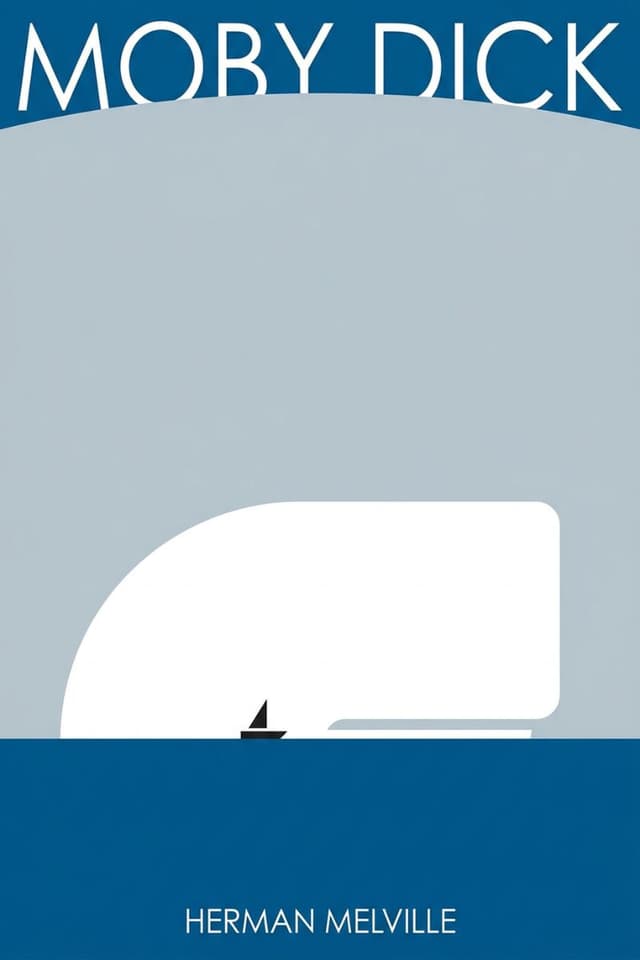
Moby Dick
Read Moby Dick by Herman Melville for free on Novelhalla, and try out our easy-to-read modern edition of this classic book. You can also download the EPUB and read it on any device if you prefer!
The Plot
Moby-Dick is part adventure novel, part philosophical meditation, and part encyclopedia of whaling. It follows a young sailor who signs up for a whaling voyage and finds himself caught up in his captain's obsessive, doomed quest for revenge against a legendary white whale.
Ishmael's Journey Begins
The novel opens with one of literature's most famous lines: "Call me Ishmael." Our narrator is a young man with a restless soul and an empty wallet who decides to cure his depression by going to sea. He's drawn specifically to whaling, captivated by the mystery and danger of hunting the great sperm whale.
Ishmael travels to New Bedford, Massachusetts, where he's forced to share a bed at a crowded inn with a stranger. That stranger turns out to be Queequeg, a heavily tattooed harpooner from the South Pacific who sells shrunken heads on the side. Despite his initial terror, Ishmael quickly befriends Queequeg, and the two become inseparable companions. Together they travel to Nantucket and sign aboard the Pequod, a whaling ship decorated with whale bones and ivory.
The Pequod Sets Sail
Before sailing, Ishmael hears ominous warnings about the Pequod's captain, Ahab, who lost his leg to a monstrous white whale called Moby Dick. Ahab doesn't appear on deck until the ship is well out to sea, and when he does, Ishmael sees a man consumed by dark obsession. A livid white scar runs down his face, and he stands on a prosthetic leg carved from whale jawbone.
Ahab eventually reveals his true purpose to the crew: this voyage isn't about filling the ship's hold with whale oil. It's about hunting down Moby Dick and killing him. Ahab nails a gold doubloon to the mast as a reward for whoever first spots the white whale, and through sheer force of will, he bends the crew to his monomaniacal quest.
The Hunt
What follows is a globe-spanning voyage through the world's whaling grounds. The Pequod hunts and kills numerous whales, and Ishmael uses these encounters to deliver extensive information about whale biology, the mechanics of whaling, and the industry's culture and history. The ship encounters other vessels, and Ahab obsessively questions each captain about Moby Dick's whereabouts.
Throughout the voyage, dark omens accumulate. The ship's voyage takes on an increasingly doom-laden atmosphere as Ahab drives them toward their final confrontation with the white whale.
About the Author: Herman Melville
Early Life
Herman Melville was born in 1819 in New York City to a family that had seen better days. His father was a merchant who went bankrupt and died when Herman was twelve, leaving the family in poverty. Melville's formal education ended early, and he worked various jobs including bank clerk, teacher, and farmhand.
Years at Sea
In 1839, Melville shipped out as a cabin boy on a merchant vessel to Liverpool. Two years later, he sailed on the whaling ship Acushnet, beginning an eighteen-month voyage that would provide the raw material for Moby-Dick. He jumped ship in the Marquesas Islands, lived briefly among a tribe rumored to be cannibals, and eventually made his way home via Tahiti, Hawaii, and a U.S. Navy frigate.
Early Success
Melville turned his adventures into his first novels. Typee (1846) and Omoo (1847), exotic tales of his South Seas experiences, were popular successes. He married Elizabeth Shaw in 1847, and for a few years he was a celebrated young author, friends with literary figures like Nathaniel Hawthorne, to whom he dedicated Moby-Dick.
Moby-Dick and Decline
Moby-Dick was published in 1851 to mixed reviews and poor sales. Critics were baffled by its strange mixture of adventure, philosophy, and cetology. The book that's now considered one of the greatest American novels was essentially a flop during Melville's lifetime.
His subsequent novels fared even worse. Pierre (1852) was savaged by critics. By the late 1850s, Melville had essentially given up on fiction. He worked as a customs inspector in New York for nearly twenty years, wrote poetry, and died in 1891 in near-total obscurity. His late novella Billy Budd wasn't published until 1924.
Rediscovery
The "Melville Revival" began in the 1920s, when critics and scholars recognized Moby-Dick as a masterpiece. Today Melville is considered one of America's greatest writers, though he never knew it. His gravestone in the Bronx was unmarked for years.
Fun Facts About the Book
Based on Real Events
The novel drew on several true stories. The Essex, a Nantucket whaler, was rammed and sunk by a sperm whale in 1820, and her crew endured a horrific ordeal at sea. Melville met the Essex's son of the captain and read the first mate's account. There was also a real albino sperm whale called Mocha Dick, known for his ferocity and the many harpoons stuck in his hide.
The Dedication
Melville dedicated Moby-Dick to Nathaniel Hawthorne "in token of my admiration for his genius." The two had become friends and neighbors in the Berkshires, and their intellectual friendship deeply influenced the novel's darker philosophical dimensions.
Two Different First Editions
The British edition, published first as "The Whale," differs significantly from the American "Moby-Dick." The British version lacks the epilogue explaining how Ishmael survived, leading confused British reviewers to wonder how a dead narrator could tell the story.
It Was a Commercial Failure
Moby-Dick sold only about 3,000 copies during Melville's lifetime and earned him roughly $1,200 total. When Melville died forty years after publication, the book was out of print and largely forgotten.
The Whale Chapters
About a third of the novel consists of chapters on whale biology, whale behavior, the history of whaling, and the technicalities of the industry. Some readers skip these chapters; others consider them essential to the book's meaning. Melville himself called the book "a wicked book."
The Opening Line
"Call me Ishmael" is one of the most famous opening lines in literature, though we never learn whether Ishmael is actually the narrator's name or just what he wants to be called. The biblical Ishmael was an outcast, the son of Abraham sent into the wilderness.
Cetology Errors
Despite the extensive whale chapters, Melville insists that a whale is a fish, not a mammal. He knew the scientific classification but rejected it, writing: "I submitted to no dictionary." He also significantly overestimates how long whales can hold their breath.
The White Whale's Symbolism
Readers and critics have interpreted Moby Dick as representing God, nature, death, evil, the unknowable, capitalism, America, and dozens of other things. Melville never clarifies, leaving the whale's meaning deliberately ambiguous. Ahab projects his own meaning onto the whale; so does everyone else.
Themes
Obsession and Madness
Ahab's monomaniacal pursuit of Moby Dick drives the novel. His obsession consumes his reason, his humanity, and eventually his ship and crew. The novel examines how a single consuming purpose can destroy everything else in a person's life.
The Limits of Knowledge
Ishmael spends chapters trying to classify, measure, and understand whales, yet ultimately concludes he cannot truly know them. The novel suggests that some things, the whale, the sea, the universe, remain beyond human comprehension despite our best efforts to categorize them.
Fate and Free Will
Characters debate whether their choices matter or whether fate controls everything. Ahab believes he's fated to confront Moby Dick. Starbuck believes in free will and moral choice. The novel never resolves this tension.
Man Against Nature
The whaling industry represents humanity's attempt to conquer and exploit the natural world. The novel shows this enterprise in all its bloody detail while also suggesting nature's ultimate indifference and power over human ambition.
Isolation and Connection
Ishmael's friendship with Queequeg, the bond between shipmates, and the loneliness of command all explore how humans connect and fail to connect with one another. Ahab's isolation grows throughout the novel as his obsession cuts him off from human sympathy.
Race and Democracy
The Pequod's crew is radically diverse for its time, including Pacific Islanders, Africans, Native Americans, and white Americans working together. The novel examines both the democratic possibilities of the ship and the racial hierarchies that persist aboard it.
The Book's Legacy
Moby-Dick is now considered the Great American Novel by many scholars and writers. Its influence extends through all of American literature and beyond. Writers from Faulkner to Cormac McCarthy have acknowledged its impact.
The novel pioneered techniques that would later be associated with modernism: its fragmented structure, shifting genres, philosophical digressions, and symbolic density were far ahead of their time. It's been adapted into films, operas, and countless other works, though none have fully captured its scope.
The white whale has become a cultural symbol for any obsessive, impossible pursuit. "Moby Dick" is shorthand for the thing that consumes and destroys us if we can't let it go. Captain Ahab remains one of literature's great monomaniacal villains, both terrifying and tragic.
The novel nearly vanished from literary history. That it survived and thrived is itself a kind of resurrection story, proof that great works sometimes have to wait for the world to catch up with them.