Novelhalla
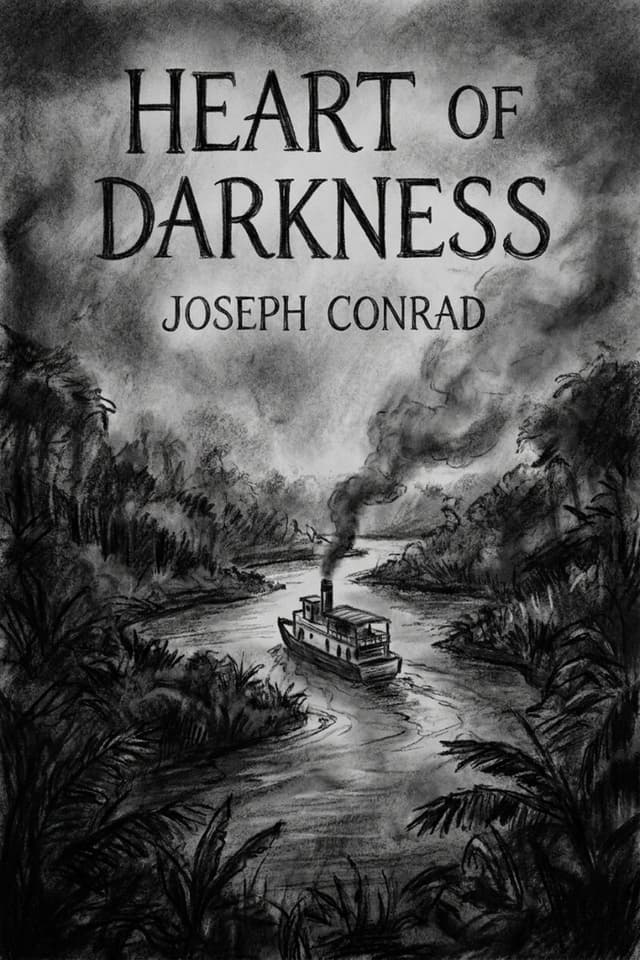
Heart of Darkness
Read Heart of Darkness by Joseph Conrad for free on Novelhalla, and try out our easy-to-read modern edition of this classic book. You can also download the EPUB and read it on any device if you prefer!
The Plot
The River
A man named Marlow is sitting on a boat anchored in the Thames at dusk, telling a story to a small group of friends. It's about the time he took a job captaining a steamboat up the Congo River for a Belgian trading company. He'd always wanted to go there. The blank spaces on the map called to him as a boy, and now the biggest blank space of all, the Congo, is calling again.
Getting the job takes some string-pulling. His aunt uses her connections in Brussels to get him appointed, and Marlow visits the Company's offices to sign his contract. The place gives him the creeps. Two women knit black wool in the waiting room like figures from a myth. The company doctor measures his skull and asks, almost casually, whether there's any history of madness in his family.
Marlow sails for Africa.
The Outer Station
What he finds when he arrives is not the noble enterprise the Company advertises back in Europe. At the first station, he sees a chain gang of African men with iron collars around their necks. He stumbles into a grove of trees where sick and starving workers have crawled away to die. Everywhere there is waste, cruelty, and incompetence dressed up in the language of civilization and progress.
The Company's employees are a miserable collection of backstabbers and schemers, all of them fixated on one thing: ivory. They call themselves "pilgrims" and carry long staves around the station, and they talk about nothing except profit and promotion. But there's one name that comes up more than any other.
Kurtz.
The Name on Everyone's Lips
Kurtz is the Company's most successful ivory agent, stationed at the very farthest trading post up the river. He sends out more ivory than all the other agents combined. Everyone has an opinion about Kurtz. Some admire him. Some envy him. Some are terrified of him. The Company's manager seems to quietly hate him. But everyone agrees on one thing: Kurtz is remarkable.
Marlow becomes obsessed. Not with the ivory, but with the man. Who is this person who went into the deepest part of the jungle and somehow became its most powerful figure? What kind of mind does that take? What has it cost him?
The problem is getting there. Marlow's steamboat has been sunk, and it takes months to repair while he waits at the Central Station, watching the petty cruelty and absurd bureaucracy of the colonial operation. When the boat is finally ready, the journey upriver begins.
Into the Interior
The river takes them deeper. The jungle closes in on both sides like a living wall. The further they go, the more the ordinary world falls away. Time feels different. The silence between the trees is enormous, broken only by distant drums and, once, a terrifying burst of arrows from the riverbank.
Marlow's crew includes a group of African workers the Company men dismissively call "cannibals," who turn out to be more restrained and dignified than any of the Europeans. He also has a small collection of Company "pilgrims" aboard who are useless in a crisis and dangerous when they're bored.
Along the way, they find an abandoned hut with a cryptic note and a battered old seamanship manual with strange annotations in the margins. Someone has been here before them. Someone who might be losing his grip.
The fog comes. The attacks come. The river narrows. And Marlow begins to realize that whatever waits at the end of this journey is going to be worse than anything the jungle has thrown at them so far.
Kurtz
They reach the Inner Station. And Kurtz is there.
But this is not the eloquent idealist the Company once sent into the wilderness with a mandate to bring civilization to the continent. Something has happened to Kurtz out here, far from any law or society or mirror that might show him what he's become. He has gone somewhere beyond ambition, beyond greed, beyond any boundary Marlow thought a person could cross.
The heads on the fence posts are the first clue. They are not the last.
Kurtz is brilliant. Kurtz is magnetic. Kurtz is dying. And the local people who surround him don't treat him like a trader. They treat him like a god.
Marlow has spent the entire journey wanting to meet this man. Now that he has, he has to decide what meeting Kurtz actually means, what it reveals about the darkness that lives not in the jungle, but in the people who came to conquer it.
The river only goes one direction from here. Whether Marlow can carry what he's learned back to the world he came from is another question entirely.
About the Author: Joseph Conrad
A Polish Childhood
Joseph Conrad was born Józef Teodor Konrad Korzeniowski in 1857 in what is now Ukraine, then part of the Russian-occupied territory that had once been Poland. His parents were Polish nobility, fiercely devoted to the cause of Polish independence. His father, Apollo, was a poet, translator, and political activist who was arrested and exiled to northern Russia for his role in organizing resistance against Russian rule. Conrad's mother followed Apollo into exile, taking their young son with her. She died when Conrad was seven, her health destroyed by the brutal conditions. His father died four years later. Conrad was eleven years old and an orphan.
He was raised by his maternal uncle, Tadeusz Bobrowski, and educated in Kraków. But Poland under occupation held no future for the son of political exiles, and Conrad was restless.
A Life at Sea
At sixteen, Conrad left Poland for Marseilles and joined the French merchant marine. He spent the next twenty years as a sailor, eventually joining the British merchant service, earning his captain's papers, and becoming a naturalized British citizen in 1886. He sailed to the West Indies, Southeast Asia, Australia, and, fatefully, the Congo.
In 1890, Conrad took command of a steamboat on the Congo River for a Belgian trading company. What he witnessed there, the systematic brutality of King Leopold II's colonial regime, shattered something in him. He returned to England physically wrecked by tropical disease and carrying the raw material for what would become his most famous work.
The Writer
Conrad didn't begin writing seriously until his mid-thirties, and English was his third language after Polish and French. He always spoke it with a heavy accent. That he became one of the greatest prose stylists in English literature is one of the more astonishing facts in literary history.
He published his first novel, Almayer's Folly, in 1895. Over the next two decades he produced an extraordinary body of work, including Lord Jim, Nostromo, The Secret Agent, and Under Western Eyes. He earned critical respect early but struggled financially for years. Popular success didn't come until the publication of Chance in 1913, by which point many critics believe his best work was behind him.
Final Years
Conrad married Jessie George in 1896 and settled in the English countryside, where he lived the rest of his life. He suffered from depression, gout, and the lingering effects of his years in the tropics. He continued writing until his death from a heart attack on August 3, 1924, at the age of sixty-six. His gravestone in Canterbury bears lines from Edmund Spenser about the peace that comes after storm.
Fun Facts About the Book
Conrad Barely Survived the Congo
Conrad spent about six months in the Congo in 1890, and the experience nearly killed him. He contracted dysentery and malaria, and his health never fully recovered. He later wrote that before the Congo he had been just a mere animal, but afterward he carried with him the knowledge of what humans could do to each other in the absence of accountability. He described the novella as experience pushed only very slightly beyond the actual facts of the case.
It Was a Flop at First
When the story was serialized in Blackwood's Magazine in 1899, it was published to celebrate the magazine's thousandth issue. Conrad was hesitant to contribute. When it appeared in book form in 1902, collected with two other stories in a volume called Youth, it received the least attention of the three. The collection wasn't even named after it. Academic interest didn't really begin until the 1940s and 1950s. Conrad never saw his most famous work become famous.
The Frame Narrative
The story has an unusual structure: a narrator aboard a boat on the Thames is listening to Marlow tell his tale, so the reader gets the story filtered through two layers of consciousness. This technique, which makes everything feel slightly uncertain and dreamlike, was groundbreaking for its time and helped push English fiction toward modernism.
English Was His Third Language
Conrad didn't learn English until his twenties and always spoke it with a thick Polish accent. He wrote all of his fiction in English, his third language after Polish and French. The lush, sometimes overwhelming style of his prose may owe something to the fact that he came to the language as an outsider, with an immigrant's heightened sensitivity to its rhythms and possibilities.
It's Technically a Novella
At roughly 38,000 words, the story sits in the gap between a short story and a full novel. Conrad preferred working at this length. He told his editor that the effects he was aiming for required the reader to look back on the work as a whole, something a short story couldn't achieve and a full novel might dilute.
T.S. Eliot's Obsession
T.S. Eliot was so taken with the novella that he originally planned to use a quotation from its climax as the epigraph for The Waste Land, one of the most important poems of the twentieth century. Ezra Pound talked him out of it. Eliot later used a line from the story as the epigraph for "The Hollow Men" instead, calling it the most appropriate quotation he could find.
Historical Context
King Leopold's Congo
The story is set against one of the great horrors of the colonial era. In the 1880s, King Leopold II of Belgium maneuvered to claim the Congo River basin as his personal property, not as a Belgian colony, but as his own private domain. He called it the Congo Free State, a name that was bitterly ironic.
Under the guise of humanitarian and scientific goals, Leopold's agents imposed a regime of forced labor, torture, and murder on the Congolese population to extract ivory and, later, rubber. Workers who failed to meet quotas had their hands cut off. Villages that resisted were burned. Women were kidnapped to coerce their husbands into compliance. Estimates of the death toll range from two to ten million people.
Conrad witnessed the early stages of this horror firsthand in 1890. The Company that employs Marlow in the story is a thinly veiled version of Leopold's operation, and the cruelty Marlow describes was drawn directly from what Conrad saw. The novella was one of the first literary works to depict European colonialism as something monstrous rather than noble, and it contributed to the international outcry that eventually forced Belgium to take the colony away from Leopold in 1908.
Themes
The Thin Line Between Civilization and Savagery
The novella's central provocation is that "civilized" Europeans, removed from the social structures that restrain them, are capable of extraordinary brutality. The jungle doesn't corrupt Kurtz. It reveals him. The darkness of the title isn't a place on the map. It's a quality of the human soul that polite society works very hard to pretend doesn't exist.
The Lie of Empire
Every European in the story wraps their greed in high-minded language. They talk about civilizing missions and enlightening the natives while they steal ivory and work people to death. Marlow watches this performance with growing horror and dark humor. The gap between what colonialism claims to be and what it actually does is the book's most savage indictment.
The Power of Fascination
Marlow is drawn to Kurtz long before he meets him. The pull is almost gravitational. There's something about a person who has gone beyond every limit, who has looked at the worst of themselves and not flinched, that is terrifying and magnetic in equal measure. The novella asks an uncomfortable question: why are we drawn to the very things that should repel us?
The Limits of Understanding
Marlow struggles to communicate what he experienced. His story circles and doubles back, groping for words that keep failing him. Some things, Conrad suggests, can be witnessed but never fully conveyed. The truth of what happens in the places where civilization falls away may be fundamentally unspeakable.
Isolation and Accountability
What happens to a person when no one is watching? When there are no laws, no social expectations, no consequences? The novella suggests that the answer is often terrifying. Kurtz's descent is enabled not by the jungle but by the total absence of anyone with the power or the will to say no.
The Book's Legacy
The novella's influence on twentieth and twenty-first century culture is enormous, far out of proportion to its slim page count. It is one of the most widely taught and analyzed works of English literature, a fixture on university syllabi around the world, and a touchstone for virtually every subsequent work about colonialism, power, and moral corruption.
Its most famous adaptation is Francis Ford Coppola's 1979 film Apocalypse Now, which transposed the story from the Congo to the Vietnam War, with Marlon Brando as Kurtz and Martin Sheen as the Marlow figure, Captain Willard. The film's nightmarish production, documented in the companion film Hearts of Darkness, ended up eerily mirroring the novella's own themes of ambition spiraling into madness.
The story also inspired the 2012 video game Spec Ops: The Line, which reimagined it as a military shooter set in a sandstorm-ravaged Dubai. The game's antagonist is named John Konrad, an obvious nod to the author, and the game uses the trappings of the genre to interrogate the player's own complicity in virtual violence.
T.S. Eliot drew on it for two of his most important poems. Orson Welles planned a film adaptation that was never made. The phrase "the horror" has entered the language as shorthand for the moment when someone confronts something they can never un-see.
But the legacy is complicated. Achebe's critique ensured that the novella can no longer be read without confronting its limitations, its failure to grant full humanity to the African people whose suffering is its subject. That tension, between its power as a critique of colonialism and its blindness to the people colonialism harmed most, makes it one of the most argued-about books ever written. It is a book that changed literature and that literature, in turn, has spent a century talking back to.