Novelhalla
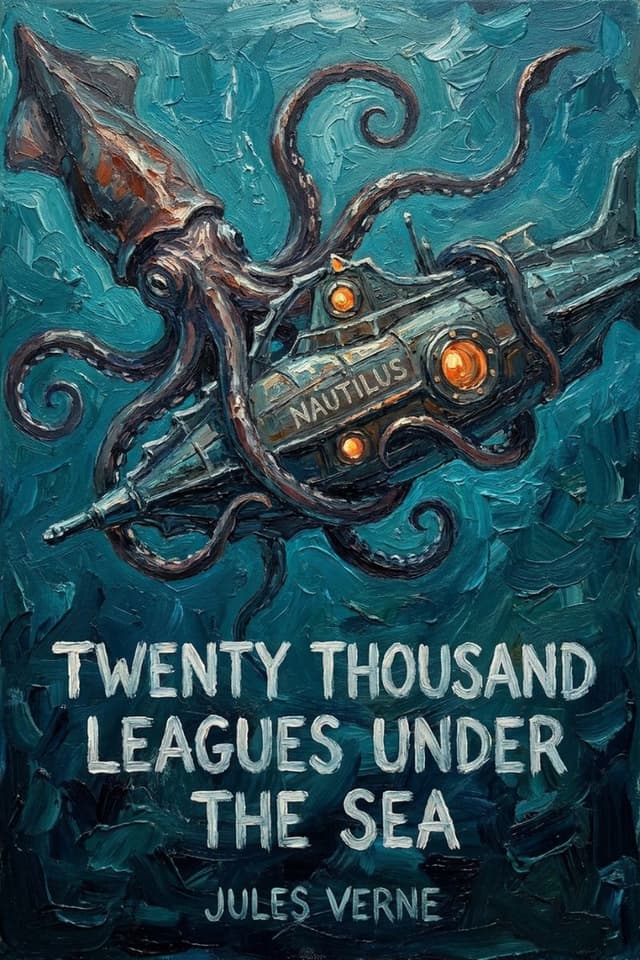
Twenty Thousand Leagues Under the Sea
Read Twenty Thousand Leagues Under the Sea by Jules Verne for free on Novelhalla, and try out our easy-to-read modern edition of this classic book. You can also download the EPUB and read it on any device if you prefer!
The Plot
The Monster
It's 1866, and something enormous is lurking in the world's oceans. Ships report a massive glowing creature, longer and faster than any whale, surfacing without warning across the Atlantic and Pacific. At first it's dismissed as sailors' tall tales. Then ships start getting damaged. Hulls are punctured. Vessels are sinking. Whatever this thing is, it's not just big. It's aggressive.
The world panics. The United States Navy dispatches the frigate Abraham Lincoln to hunt the creature down, and Professor Pierre Aronnax, a French marine biologist at the Museum of Natural History in Paris, is invited along as the resident expert. He brings his unflappable servant Conseil, a man whose devotion to his master is matched only by his obsession with classifying every living thing he encounters. Also on board is Ned Land, a Canadian harpooner with legendary aim and a short fuse. Together they sail from New York, around Cape Horn, and into the Pacific in pursuit of something no one fully understands.
They find it. Or rather, it finds them.
The Truth Beneath the Surface
What happens next changes everything. The creature is no animal. It is the Nautilus, a submarine of impossible sophistication, and it belongs to a man who calls himself Captain Nemo. His name means "no one" in Latin, and he intends to keep it that way.
Aronnax, Conseil, and Ned Land are pulled aboard and given a choice that isn't really a choice at all. They may live freely on the Nautilus, enjoying its wonders. But they may never leave. Captain Nemo has severed all ties with the surface world and has no intention of letting anyone carry his secrets back to it.
The Nautilus is unlike anything the nineteenth century should be able to produce. It runs entirely on electricity. It carries a library of twelve thousand volumes, a collection of fine art, and a pipe organ that Nemo plays alone in the evenings. Its dining table is set with food harvested entirely from the sea. It can dive to depths that would crush any known vessel. And through its enormous glass viewing panels, the ocean reveals itself in ways no human being has ever witnessed.
A World No One Has Seen
What follows is a journey across every ocean on earth, covering some twenty thousand leagues of distance. Aronnax is a scientist, and for him the Nautilus is the opportunity of a lifetime. He walks the ocean floor in a diving suit, hunting in underwater forests. He watches coral reefs build themselves in real time. He sees creatures that no textbook has ever described. He visits sunken ships and explores underwater caves. The Nautilus takes him to places the surface world doesn't even know exist.
But the wonder is always shadowed by unease. Nemo is brilliant, generous, and deeply cultured, but there is something wounded at his core. He speaks of the ocean as his true country, the only place where he is free. He funds mysterious causes on shore with gold recovered from shipwrecks. He shows flashes of terrible rage when certain subjects arise. And there are rooms on the Nautilus that Aronnax is not permitted to enter.
The Tension Builds
Ned Land has no interest in scientific marvels. He wants out. He watches the coastlines pass through the viewing panels and calculates distances, tides, currents. He is a man built for open air and the thrill of the hunt, and captivity is eating him alive. His frustration grows with every passing month, and he pushes Aronnax again and again to help him plan an escape.
Aronnax is torn. Part of him never wants the voyage to end. He is seeing things no scientist has ever documented, recording observations that could transform humanity's understanding of the deep. But another part of him knows that Nemo's generosity has hard limits, and that the captain's darkness is not just personal. Ships appear on the horizon. Nemo's mood shifts. And there are encounters beneath the waves that suggest the Nautilus is not merely a vessel of exploration.
Into Dangerous Waters
The journey grows more perilous. The Nautilus pushes south toward the polar ice, threading through frozen passages where one wrong calculation means being entombed beneath a ceiling of ice with a finite supply of air. Tensions among the crew escalate. A battle with enormous deep-sea creatures costs lives and leaves the submarine scarred. And Captain Nemo's behavior becomes increasingly erratic, his hatred for certain forces on the surface sharpening into something that looks less like philosophy and more like war.
Aronnax begins to understand that Nemo is not simply a man who chose to leave civilization. He is a man who was driven from it, and what he lost has twisted his extraordinary gifts into something unpredictable. The question is no longer just whether Aronnax, Conseil, and Ned Land can escape the Nautilus. It's whether they need to, before Nemo's private war pulls them under for good.
About the Author: Jules Verne
A Boy by the Sea
Jules Verne was born in 1828 in Nantes, a bustling port city on the Loire River in western France. His mother came from a family of navigators and shipowners, and the docks and harbors of Nantes fed his imagination from childhood. His father was a successful lawyer who expected Jules, as the eldest son, to follow him into the profession. Legend has it that at eleven years old, Verne secretly signed on as a cabin boy on a ship bound for the Indies, only to be intercepted by his father at the last port before open sea. He reportedly promised to travel "only in his imagination" from then on, a promise he kept in the most spectacular fashion imaginable.
The Reluctant Lawyer
Verne went to Paris in 1847 to study law, but his heart was already somewhere else entirely. He fell in with the theater world, wrote plays, and began publishing short stories and essays in literary magazines. He met Alexandre Dumas (the elder), who encouraged his writing. He served as secretary of the Theatre Lyrique and married Honorine de Viane Morel, a widow with two children, in 1857. To make ends meet, he worked as a stockbroker on the Paris exchange, but he woke at five every morning to write before heading to work, and he spent his free time buried in research at the National Library, filling notecards with scientific and geographical facts that would fuel decades of fiction.
The Extraordinary Journeys
Everything changed in 1862 when Verne met the publisher Pierre-Jules Hetzel. Hetzel recognized what Verne was trying to do, combining rigorous scientific fact with gripping adventure stories, and agreed to publish what would become the first of the Voyages Extraordinaires. Five Weeks in a Balloon appeared in 1863 and was a hit. Over the next four decades, Verne produced nearly sixty novels in the series, including Journey to the Center of the Earth, From the Earth to the Moon, Around the World in Eighty Days, The Mysterious Island, and, of course, Twenty Thousand Leagues Under the Sea. He became one of the most popular authors in the world.
Later Years
Success brought Verne financial security and a series of yachts on which he sailed the coasts of Europe. But his later years were marked by difficulty. His relationship with his son Michel was troubled. Financial pressures forced him to sell his beloved boat. In 1886, his mentally disturbed nephew shot him in the leg, leaving him with a permanent limp. His mother and his publisher Hetzel both died in 1887, and his later novels took on a noticeably darker tone. He entered politics, serving as a town councilor in Amiens for fifteen years. He died there in 1905 at the age of seventy-seven, leaving behind a drawer full of nearly completed manuscripts that his son edited and published posthumously.
Legacy
Verne has been the second most translated author in the world since 1979, behind only Agatha Christie and ahead of Shakespeare. He is widely considered one of the founders of modern science fiction, and his influence on the genre is immeasurable. His novels inspired real-world inventors and explorers, from submarine designers to astronauts, and they have never gone out of print.
Fun Facts About the Book
Leagues Are Distance, Not Depth
One of the most common misconceptions about the novel is that the title refers to depth. It doesn't. Twenty thousand leagues is approximately 80,000 kilometers, roughly twice the circumference of the Earth. It refers to the horizontal distance the Nautilus travels during its voyage. No submarine could descend twenty thousand leagues. The ocean isn't even close to that deep.
Nemo Was Supposed to Be Polish
Verne originally wrote Captain Nemo as a Polish nobleman whose family was slaughtered during the failed 1863 uprising against Russian rule. His publisher, Hetzel, insisted the character's nationality be obscured because France was allied with Russia at the time, and Hetzel didn't want to lose sales in the Russian market. The change actually made Nemo more compelling: a man with no name, no country, and a grief too large to speak of. In the later sequel, The Mysterious Island, Verne finally revealed Nemo as an Indian prince who fought against British colonial rule.
Verne Did His Homework
Before writing the novel, Verne studied a model of the French Navy submarine Plongeur at the 1867 World's Fair in Paris. He also collaborated with the French marine engineer Gustave Zede on a physical model of the Nautilus. The submarine he described, with its double hull, electric propulsion, water-tight compartments, and ballast tanks, was decades ahead of actual submarine technology. His diving suit descriptions were based on real equipment designed by Rouquayrol and Denayrouze in 1865, extrapolated into something far more capable.
The Name Has History
Verne named his fictional submarine after a real one. Robert Fulton, better known for inventing the commercial steamboat, built a working submarine called the Nautilus in 1800 for Napoleon. The name itself comes from the chambered nautilus, a marine mollusk that uses gas-filled chambers to control its buoyancy, essentially nature's own submarine.
A Mangled Translation
For over a century, most English-speaking readers encountered the novel through a deeply flawed 1872 translation by Lewis Page Mercier. Mercier cut large sections, mistranslated scientific passages, and introduced errors throughout. A science fiction critic in 1961 called the novel's speculation worthless, but scholars later pointed out that every error he cited existed only in the translation, not in Verne's original French. Accurate English translations didn't appear until the 1960s and later.
The CSS Alabama Connection
Scholars have noted striking parallels between Captain Nemo's Nautilus and the CSS Alabama, a Confederate warship built in secret in England during the American Civil War. Verne himself compared the two in a letter to Hetzel. Both vessels were partially built in Birkenhead, England. Both were declared pirate ships. The Alabama's commander, Raphael Semmes, was from Mobile, Alabama, echoing Nemo's motto "Mobilis in Mobile." And the ship that pursued the Nautilus in the novel bears the same name as the president who declared Semmes a pirate: Abraham Lincoln.
Verne's Most Personal Character
Verne reportedly incorporated more of his own personality into Captain Nemo than into any other character. Both were men of enormous intellectual curiosity who felt undervalued by the establishment. Verne once said in a late interview that the great regret of his life was that he had never been taken seriously by the French literary world. Nemo's retreat from a civilization that disappointed him echoes something real in Verne's own frustrations.
Themes
Freedom and Captivity
The novel operates on a brilliant contradiction. Captain Nemo claims to have found perfect freedom beneath the waves, but his guests are prisoners. He has escaped society's control only to impose his own. The ocean liberates him while the Nautilus confines Aronnax, Conseil, and Ned Land. The book constantly asks where freedom ends and captivity begins, and whether anyone on board, including Nemo, is truly free.
The Wonders and Dangers of Science
The Nautilus represents technology at its most dazzling and its most dangerous. It can illuminate the deepest ocean, sustain human life for months beneath the surface, and reveal natural marvels beyond imagination. It can also sink warships. Verne was fascinated by scientific progress but increasingly wary of what it could become in the wrong hands or the wrong emotional state. The Nautilus is both a laboratory and a weapon, and which one it becomes depends entirely on the man at the helm.
Man Versus the Surface World
Nemo has declared war on something, but the novel keeps the specifics deliberately vague. He speaks of oppressed peoples, of injustice, of a world that took everything from him. His exile is both a protest and a wound. The book asks whether it's possible to reject civilization entirely, and whether doing so is an act of strength or a slow surrender to bitterness.
The Ocean as Another World
Verne treats the sea not as empty space but as a fully realized world with its own geography, its own ecosystems, its own history. The ocean floor holds forests, mountains, lost cities, and the bones of ships long forgotten. The novel argues that there is an entire planet beneath the surface that humanity has barely glimpsed, and it treats that world with genuine awe.
The Ethical Trap
Aronnax faces a moral dilemma that deepens with every chapter. He is witnessing scientific miracles. He is collecting data that could revolutionize marine biology. But he is also a prisoner, and his host may be something worse than a captor. How long can the pursuit of knowledge justify staying? At what point does fascination become complicity?
The Book's Legacy
Twenty Thousand Leagues Under the Sea is one of the most influential novels ever written. It essentially invented the modern submarine in the public imagination, and real-world submarine developers acknowledged its direct inspiration. Simon Lake, who built some of the first functional American submarines, credited the book as his catalyst. John P. Holland, who built the U.S. Navy's first commissioned submarine, named one of his early companies the Nautilus Submarine Boat Company. And in 1954, the United States Navy launched the world's first nuclear-powered submarine and named it USS Nautilus, carrying a first edition of Verne's novel aboard when it made its historic voyage under the North Pole ice in 1958.
The 1954 Disney film adaptation, starring James Mason as Captain Nemo and Kirk Douglas as Ned Land, became a landmark of science fiction cinema. Harper Goff's steampunk-inflected design of the Nautilus for that film is arguably the most iconic submarine in pop culture history, spawning theme park attractions at both Disneyland and Walt Disney World.
Captain Nemo himself has become one of literature's great antiheroes, appearing in countless adaptations, sequels, and reimaginings, from Alan Moore's The League of Extraordinary Gentlemen to the anime series Nadia: The Secret of Blue Water. He endures because he is not a simple villain or hero. He is a man of extraordinary gifts and extraordinary pain, and the tension between the two has kept readers arguing about him for over 150 years.
The novel also stands as one of the first great works of environmental literature, long before the term existed. Verne's detailed, loving descriptions of marine ecosystems, his insistence on the ocean as a living world worthy of wonder and respect, anticipated the oceanic conservation movement by nearly a century. Jacques Cousteau himself acknowledged Verne's influence, and the novel remains a gateway for readers discovering the deep sea for the first time.