Novelhalla
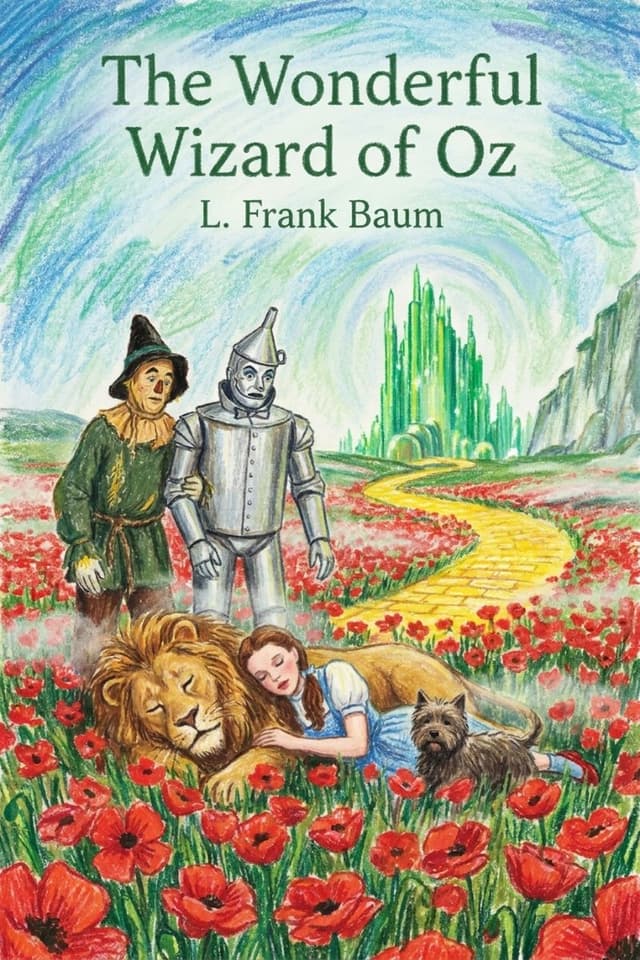
The Wonderful Wizard of Oz
Read The Wonderful Wizard of Oz by L. Frank Baum for free on Novelhalla, and try out our easy-to-read modern edition of this classic book. You can also download the EPUB and read it on any device if you prefer!
The Plot
A Gray Little House on a Gray Prairie
Dorothy lives in the middle of the Kansas plains with her Aunt Em and Uncle Henry, in a house so small it's basically one room, with a trapdoor in the floor for hiding when the storms come. Everything in her world has had the color scrubbed out of it. The grass is gray, the plowed land is gray, the sun has baked the paint off the house and the laughter out of her aunt. Uncle Henry never smiles at all. He works from morning until night and doesn't know what joy is.
The only bright thing Dorothy has is a small black dog named Toto, who has ridiculous ears and a way of making her laugh.
Then one afternoon the grass starts to ripple wrong and the sky turns a color nobody likes. Uncle Henry runs for the livestock. Aunt Em drops through the trapdoor into the cellar and screams for Dorothy to follow.
Dorothy goes after Toto instead.
Somewhere That Isn't Kansas
The house comes off its foundation with a girl and a dog still inside it, rises straight up into the middle of the cyclone, and travels for hours.
When it finally comes down, Dorothy opens the door onto a country so saturated with color it hurts to look at. There are green lawns, fruit trees, birds she's never seen, a stream running clear over the stones. There are also three very small people in blue, and an old woman in a white hat, and they're all thanking her for something she doesn't remember doing.
The house landed on somebody. Specifically, it landed on the Wicked Witch of the East, who had kept these people enslaved for years. All that's left of her is a pair of silver shoes sticking out from under the corner of the house, and everyone insists Dorothy should take them.
Dorothy doesn't want shoes. She wants to go home, and nobody here has ever heard of Kansas. There's only one person in the whole country who might be able to send her back: a great Wizard who lives in a city built of emeralds, at the end of a road paved with yellow brick. He's powerful, he's mysterious, and nobody has actually seen him.
The old woman kisses Dorothy on the forehead and tells her the mark will keep her from harm. Then she vanishes, which is apparently just a thing that happens here, and Dorothy starts walking.
Three Strangers with One Thing Missing
She doesn't stay alone for long.
First there's a scarecrow hanging on a pole in a cornfield, who turns out to be perfectly friendly and deeply embarrassed about the fact that his head is stuffed with straw. He's convinced he has no brains. Then there's a man made entirely of tin, frozen solid in the woods, rusted in place for over a year, still holding his axe. Once she oils his jaw enough for him to speak, he explains that his chest is hollow. He has no heart, and he misses having one more than he can say.
And then there's a lion who comes roaring out of the trees to attack them, and cries when Toto barks at him. He's the King of Beasts and he's a coward, and he's humiliated by it.
Every one of them wants to come along, because if the Wizard can send a girl back to Kansas, maybe he can hand out brains and hearts and courage too. They set off together down the yellow brick road, and the road runs through country that gets steadily less charming: ravines with no bridges, a forest full of things that hunt, a field of poppies that smells wonderful and means it.
The Terms of the Bargain
The Emerald City is real. It's blinding. Everyone entering has to wear green spectacles locked onto their heads with a little gold key, supposedly because the glory of the place would burn their eyes out otherwise.
The Wizard agrees to see them, but only one at a time. Dorothy is brought before an enormous disembodied head. The Scarecrow meets a beautiful woman with wings. The Tin Woodman faces a beast the size of an elephant with five eyes and five arms. The Lion walks into a room containing nothing but a ball of fire so hot he has to back away.
All four of them are told the same thing.
The Wizard will grant every one of their wishes. First they have to kill the Wicked Witch of the West.
The One Nobody Has Beaten
The Guardian of the Gates tries to warn them. The Witch of the West rules the western country, she's cruel and she's clever, and nobody who has ever gone after her has come back. There isn't even a road going that direction. You just walk west and eventually she notices you.
She has one eye, and it works like a telescope, and it can see everything happening in her country at once.
She sees a girl in silver shoes coming across her land days before the girl arrives, and she has wolves, and crows, and bees, and a golden cap that commands a tribe of winged monkeys to obey any three commands its owner gives.
Dorothy is eleven years old and traveling with a man made of straw, a man made of tin, and a lion who's afraid of the dark.
About the Author: L. Frank Baum
A Sickly Boy with a Printing Press
Lyman Frank Baum was born in 1856 in Chittenango, New York, and hated his first name so much that he went by Frank his entire life. His father had made a fortune in Pennsylvania oil, so Frank grew up on a large estate called Rose Lawn that he remembered ever after as a kind of paradise. He was a frail, dreamy child with a weak heart, taught at home, left mostly alone with his father's library.
At twelve his parents sent him to Peekskill Military Academy to knock the daydreaming out of him. It went badly. After two years he had something like a heart attack during a punishment and was allowed to go home, and he carried a distaste for military discipline for the rest of his life.
His father bought him a small printing press, and Frank immediately started producing his own newspapers. By seventeen he'd launched a journal for stamp collectors and gone into the stamp dealing business. The pattern of his whole life was already visible: an enthusiasm, a venture, and a leap into it with both feet.
Every Job in America
What followed was thirty years of trying almost everything. He bred fancy chickens and wrote a book about the Hamburg breed. He fell in love with the theater, and his father built him one, and he wrote and starred in a hit melodrama called The Maid of Arran. He toured with it. Then the theater burned down with his scripts inside it.
In 1882 he married Maud Gage, the daughter of Matilda Joslyn Gage, one of the most radical suffragists in the country and a woman who took her new son-in-law's imagination seriously. Their marriage was unusually equal for the era. They had four sons.
In 1888 he moved the family to Aberdeen in the Dakota Territory and opened a store called Baum's Bazaar. The store failed. He took over a newspaper, the Aberdeen Saturday Pioneer, and wrote a satirical column while a drought strangled the territory. The paper failed too. In 1891 he moved everyone to Chicago and worked as a reporter and then a traveling salesman, hauling china door to door, before landing a job editing a magazine about store window displays.
It's worth saying plainly that his Aberdeen years also produced two editorials, written after Wounded Knee, that called for the extermination of Native Americans. His descendants have publicly apologized for them. They sit uncomfortably beside everything else he wrote, and readers have been arguing about how to hold both facts ever since.
The Accidental Career
Broke and out of options, at his mother-in-law's insistence, Baum started writing down the nonsense stories he'd been inventing for his sons at bedtime. Mother Goose in Prose came out in 1897 and did well enough that he could quit selling china. Father Goose, His Book followed in 1899, illustrated by a hard-drinking, walrus-mustached artist named W. W. Denslow, and became the bestselling children's book of the year.
Then came the book about the girl and the cyclone, published in 1900 when Baum was forty-four. It made him famous, and a Broadway adaptation two years later made him rich, and he spent most of the rest of his life losing that money on theatrical ventures and film experiments.
He never intended to write a sequel. Children wrote him letters by the thousands demanding one. He gave in, tried repeatedly to end the series, and was still producing an Oz book a year when he died.
Ozcot
In 1910 the Baums moved to Hollywood and built a house they called Ozcot, paid for largely out of Maud's inheritance. Baum founded his own film studio in 1914 to bring Oz to the screen. It lasted about a year and lost everything.
So he gardened. He grew prize chrysanthemums and dahlias, kept an aviary of forty kinds of songbird that would eat out of his mouth, and answered letters from children by hand. His heart had been bad his whole life. In 1918 a serious illness left him mostly bedridden, and on May 6, 1919, nine days short of his sixty-third birthday, he had a stroke and died at home.
His reported last words to Maud were about the Shifting Sands, the desert that surrounds Oz.
Fun Facts About the Book
The Filing Cabinet
Baum told an interviewer in 1903 that he was telling the story to a group of children who wanted to know what the magical country was called, glanced at his filing cabinet, and saw the label on the bottom drawer: O to Z. Whether that's exactly true or a good line he liked repeating, it's the story he told.
The First Copy Was Assembled by Hand
The very first copy came off the press on May 17, 1900. Baum put it together himself and gave it to his sister, Mary Louise. General release came that September, the initial ten thousand copies sold out by October, and the second printing of fifteen thousand nearly did too.
The Publisher Only Agreed Because of the Stage Show
George M. Hill wasn't confident enough to print it on its own merits. He said yes after the manager of the Chicago Grand Opera House committed to turning it into a musical extravaganza to publicize the book. The show opened in 1902, became a monster hit, and eventually eclipsed the novel entirely. Then, in one of publishing's great ironies, Hill's company went bankrupt anyway.
Dorothy Was Named for a Baby Who Died
Maud adored her infant niece, Dorothy Louise Gage, and treated her like the daughter she never had. The baby died at five months old in November 1898, and Maud was inconsolable. Baum named his heroine after her and dedicated the book to his wife.
The Scarecrow Chased Him in His Dreams
As a boy, Baum had a recurring nightmare of a scarecrow pursuing him across a field, its straw fingers reaching for his neck, falling apart just before it caught him. Decades later he put his own nightmare on the yellow brick road and made it the kindest character in the book.
The Tin Woodman Started as a Store Window
Baum spent years obsessed with the art of the retail display window and even edited a trade magazine about it. According to his son, he once built an eye-catching figure for a window out of a wash boiler, some bolted stovepipes, and the bottom of a saucepan for a face, then stuck a funnel on its head.
The Green Spectacles Came from a Drought
While editing his newspaper in drought-ravaged South Dakota, Baum wrote a column about a farmer who put green goggles on his starving horses so they'd believe the wood shavings they were eating were grass. Ten years later, an entire city is wearing the same trick on its face.
The Shoes Are Silver
The ruby slippers were invented for the 1939 film to show off Technicolor. In the book the shoes are silver, which is a large part of why, sixty-four years after publication, a high school teacher named Henry Littlefield could publish an essay arguing the whole thing was a coded allegory about the gold standard, silver coinage, and the Populist movement. Scholars have been demolishing and resurrecting that theory ever since. Baum, for his part, never said a word about it.
The Illustrator Owned Half of It
W. W. Denslow co-held the copyright and shaped the book as much as anyone. His drawings run through the text on nearly every page in different color schemes, and merchants licensed his characters for toys, soap, and costume jewelry almost immediately. He and Baum later fell out spectacularly over money and credit and never worked together again.
Libraries Tried to Get Rid of It
In 1957 the director of Detroit's public libraries pulled the book for having no value for modern children and encouraging negativism. In 1986 a group of families in Tennessee sued over its inclusion in a school syllabus, objecting to good witches, talking animals, the idea that women are equal to men, and the suggestion that virtues might be developed rather than divinely issued.
It Has Been Stored in DNA
In 2020, researchers demonstrating a new method of encoding text into DNA used an Esperanto translation of the book as their test document, because at some point you have to admit the thing is indestructible.
Themes
Home Is a Choice, Not a Prize
Dorothy spends the entire story trying to get back to a place the narrator describes as gray, dry, joyless, and actively hostile to laughter. She never once wavers. The book takes seriously the idea that home isn't where things are best, it's where your people are, and that a child's loyalty to that isn't naive.
You Already Have It
The Scarecrow spends the journey solving every problem the group encounters. The Tin Woodman weeps over stepping on a beetle. The Lion charges at anything that threatens his friends, terrified the entire time. All three are certain they're missing the exact quality they demonstrate constantly. That gap between what people believe about themselves and what they visibly are is the engine of the whole book.
Authority Is a Performance
The Wizard shows a different face to every visitor, appearing as whatever will impress or frighten the person in front of him. The city looks like emeralds because everyone is required to wear green glass. Nobody has ever seen behind the curtain, and nobody has ever asked to. It's a remarkably cynical idea to hand a seven-year-old, and Baum hands it over cheerfully.
An American Fairy Tale
Baum said outright in his introduction that he wanted a modernized fairy tale, with the wonder kept in and the heartache and nightmares left out. No moralizing, no children eaten as punishment for disobedience. He built it out of cornfields, farmhands, scarecrows, and traveling salesmen instead of princes and castles, and in doing so basically invented American fantasy.
Girls Do the Work
Baum was raised by a mother interested in women's rights and married into the household of a famous suffragist. The result is a story where a small girl is the practical center of everything, the powerful figures in the country are all women, and the men in her party need her to lead them. In 1900, this was not the default.
Kindness as a Survival Trait
Almost every problem in the book is solved by somebody helping somebody else, and almost every ally is earned by an act of mercy. The heroes are dangerous only when their friends are threatened. For a story with this much peril in it, the operating principle underneath is startlingly gentle.
The Book's Legacy
It was the bestselling children's book in America for two years running, and by the time the copyright lapsed in 1956 it had sold three million copies. Baum wrote thirteen sequels. After his death his publishers handed the series to Ruth Plumly Thompson, who wrote twenty-one more, and a new Oz book appeared every Christmas from 1913 to 1942.
The 1902 Broadway musical made the story a national event. Silent films followed. Then in 1939 MGM spent a fortune turning it into a Technicolor showcase with Judy Garland, and that film, broadcast on American television every year for decades, became so culturally dominant that most people now picture the movie when they think of the book. It's worth remembering that the movie is an adaptation, and a fairly loose one. The book is stranger, darker, and considerably more violent, and it keeps going after the movie would have rolled credits.
The story kept getting rebuilt. In Russia it was rewritten without permission by Alexander Volkov into a six-book series of its own. In 1974 it came back as an all-Black Broadway musical that became a 1978 film. In 1995 Gregory Maguire retold it from the Wicked Witch's point of view, which became a 2003 Broadway musical that's now one of the longest-running shows in Broadway history, which became two blockbuster films in 2024 and 2025 that between them took well over a billion dollars.
The Library of Congress has called it America's greatest and best-loved homegrown fairy tale.
What's easy to miss under all that machinery is how good the original still is. It's short, it moves fast, it's funny, and it was written by a man who had failed at nine careers and was writing down bedtime stories because he had nothing left to try. He wanted, in his own words, to please a child. He aimed low and hit something enormous.