Novelhalla
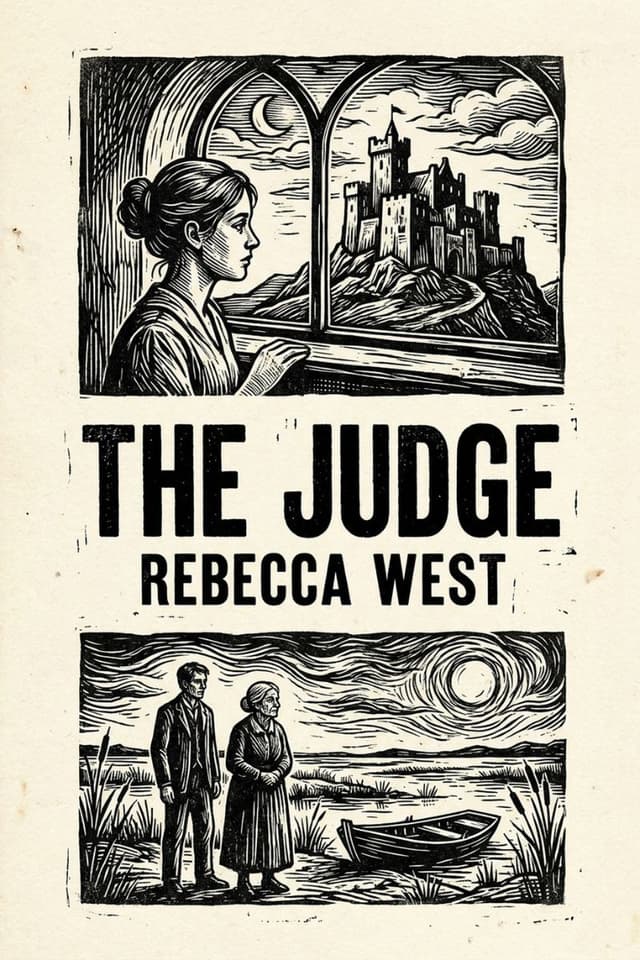
The Judge
Read The Judge by Rebecca West for free on Novelhalla, and try out our easy-to-read modern edition of this classic book. You can also download the EPUB and read it on any device if you prefer!
The Plot
A Girl on Fire
Edinburgh, the early 1900s. Ellen Melville is seventeen years old, works as a typist in a solicitor's office, and burns with the kind of restless hunger that makes small rooms feel like cages. She's a suffragette. She's poor. She lives in a tiny dark house with her mother, a gentle, worn-down woman who gave her daughter the only inheritance she had: an enormous capacity for love.
Ellen doesn't know she's beautiful. She has no idea the men in her office watch her or that her fierce opinions and her habit of leaping joyfully through the Pentland Hills make her magnetic. She only knows she wants more. More from life, more from the world, more than what Edinburgh and poverty and a typewriter seem willing to offer.
Then Richard Yaverland walks into the office.
The Man from Everywhere
Richard is older, worldly, successful. He's traveled to far-flung places, carries himself with a quiet authority, and holds the kind of progressive political views that make Ellen's heart race. He's everything she's been waiting for without knowing it. And he sees her, really sees her, in a way nobody else has.
The attraction is immediate and overpowering. Richard is drawn to Ellen's fire and innocence, to the simple goodness of her mother, to a warmth he has never quite had in his own life. He wants to marry her. Ellen, caught between her suffragette ideals and a love so intense it terrifies her, begins to surrender to something she never planned for.
But Richard carries a past. And that past has a name.
Marion
Before the wedding, Richard brings Ellen south to Essex to meet his mother. Marion Yaverland is a formidable woman, brilliant and deeply damaged, bound to her eldest son with a devotion that goes far beyond ordinary maternal love. She and Richard are extraordinarily close. She has traveled with him, lived through him, poured everything she has into him.
Because Marion's own story is one of betrayal and ruin. She was seduced by the local squire, left pregnant and disgraced. The small seaside town where she lived judged her without mercy. A marriage was arranged to save her reputation, but the man she married was cruel, and the life that followed was a kind of slow suffocation. Richard, her firstborn, became her redemption, her purpose, her reason for surviving.
There is also Roger. Marion's second son, born of that miserable marriage. A quieter, sadder figure who has lived his entire childhood in his brother's shadow, loved less, seen less, understood less. Marion tried to be fair. She knows she failed.
The Tightening Knot
Ellen arrives in this household expecting a future mother-in-law. What she finds is something far more complicated. Marion's bond with Richard is possessive, consuming, almost suffocating in its intensity. The sins of the past, the cruelty Marion endured, the guilt she carries, the favoritism she couldn't control, all of it has created a family wound that festers beneath the surface of every polite conversation.
Ellen, young and naive and desperately in love, has walked into a web she doesn't fully understand. The Yaverland family history begins to wrap itself around her. Richard's past starts to close in on both of them. And Marion, judged and punished her whole life for the choices forced upon her, now sits in judgment over the young woman who wants to take her son away.
Every mother is a judge who sentences the children for the sins of the father. And the verdict in this house has not yet been delivered.
About the Author: Rebecca West
The Youngest Fairfield
Rebecca West was born Cicely Isabel Fairfield in London in 1892, the youngest of three daughters. Her father was a journalist with a taste for political controversy. He brought Russian revolutionaries and political activists home for dinner, filling the house with debate and ideas. But he was also financially hopeless, and when he abandoned the family, Cicely's mother moved the girls to Edinburgh, where they lived in genteel poverty.
All three sisters made remarkable lives for themselves. The eldest, Lettie, became one of Britain's first fully qualified female doctors and a barrister. Cicely, the baby of the family, trained briefly as an actress before discovering her real weapon was the pen. She took her pen name from the rebellious heroine of Henrik Ibsen's play Rosmersholm and threw herself into the suffragette movement.
The Journalist Who Bit Back
By her late teens, West was writing for the feminist weekly The Freewoman, producing reviews so sharp they could draw blood. George Bernard Shaw said in 1916 that she could handle a pen as brilliantly as he could and far more savagely.
Her most fateful review was of H.G. Wells's novel Marriage, in which she called him "the Old Maid among novelists." Wells, intrigued rather than insulted, invited her to lunch. She was nineteen. He was forty-six, married, and one of the most famous writers in the world. By 1913, they were lovers. By 1914, West was an unmarried mother. Their son, Anthony, was born in August of that year.
Love, Writing, and Wreckage
The relationship with Wells lasted a turbulent decade. He refused to divorce his wife. West raised Anthony largely alone, navigating the impossible position of being an unmarried mother in a society that punished women for exactly that. The affair fueled her writing but consumed her personal life. She finally issued an ultimatum in 1923: marry me or I leave. Wells chose not to marry her, and West departed for America.
During this period she published her first two novels, The Return of the Soldier in 1918 and The Judge in 1922. Both drew on her experiences with love, motherhood, class, and the particular cruelties reserved for women who stepped outside the lines.
Dame Rebecca
West married a banker named Henry Maxwell Andrews in 1930 and found the stability that had eluded her. She continued writing prolifically across every genre: novels, criticism, travel writing, political journalism. In 1941, she published Black Lamb and Grey Falcon, a massive, brilliant account of Yugoslav history and culture that is considered one of the greatest works of travel literature ever written. After World War II, she covered the Nuremberg trials for The New Yorker.
By 1947, Time magazine called her "indisputably the world's No. 1 woman writer." She was made a Dame Commander of the British Empire in 1959. She kept writing, reviewing, and socializing into her eighties, counting Martha Gellhorn, Doris Lessing, and Warren Beatty among her friends. She died in London in 1983, at ninety.
Her relationship with her son Anthony remained painful to the end. He published a thinly veiled autobiographical novel that depicted his mother as neglectful and deceitful. West never forgave him and suppressed the English edition of the book until after her death.
Fun Facts About the Book
Written During the Wells Affair
West wrote The Judge while still entangled in her relationship with H.G. Wells and raising their young son as a single mother. The novel's intense exploration of motherhood, illegitimacy, and the damage inflicted on women by the men who betray them reads like a barely disguised reckoning with her own life.
Edinburgh Is a Character
West grew up in Edinburgh after her family moved there from London, and the city pulses through the first half of the novel. The descriptions of the Scottish landscape, the Pentland Hills, the cold beauty of the city, are so vivid that readers have called them some of the finest landscape writing in English fiction.
A Novel in Two Halves
The book has a striking structural split. The first half is a luminous Edinburgh romance between Ellen and Richard. The second half plunges into Marion's gothic backstory in Essex, shifting the tone dramatically toward something darker and more melodramatic. This structural boldness has divided readers for a century, with some finding it jarring and others finding it brilliant.
The Title's Double Meaning
"Every mother is a judge who sentences the children for the sins of the father." The title doesn't refer to a courtroom figure. It points to the way every character in the novel sits in judgment over every other, and how society judges women most harshly of all. Marion judges herself. The town judges Marion. Ellen judges Marion. The reader judges everyone.
A Suffragette Novel by a Real Suffragette
West didn't just write about the suffrage movement. She lived it. She participated in street protests alongside her sister Lettie, and her early journalism was devoted to the feminist cause. Ellen's suffragette passion isn't literary decoration. It's drawn from firsthand experience.
The Essex Marshes
The dark, waterlogged Essex landscape where Marion lives mirrors her psychological state so closely it becomes almost expressionistic. West had personal connections to Essex, having lived there during part of her relationship with Wells, and the bleak marshland atmosphere carries an emotional weight that goes beyond mere setting.
Themes
The Sins of the Fathers
The novel traces how the mistakes and cruelties of one generation cascade down into the next. Marion's betrayal by Richard's father shapes everything that follows: her obsessive love for her eldest son, her neglect of her younger one, and ultimately the trap that closes around Ellen. The past doesn't stay in the past. It hunts.
Motherhood as Battlefield
West writes about motherhood with a ferocity that is still startling. Marion's love for Richard is all-consuming and destructive precisely because it was forged in suffering. The novel refuses to sentimentalize mothers. It shows maternal love as something that can be fierce, sacrificial, suffocating, and dangerous all at once.
Women Under Judgment
Every woman in this novel is being judged. Ellen is judged for her ambition and her beauty. Marion is judged for her sexual history. Ellen's mother is judged for her poverty. The novel asks who has the right to pass these sentences and exposes a world where the harshest penalties are always reserved for women.
Innocence and Experience
Ellen begins the novel as a glorious innocent, full of fire and idealism and a teenager's certainty that she can conquer the world. Richard's past and his family threaten to extinguish that flame. The question running through the book is whether love and experience necessarily destroy the very qualities that made someone worth loving in the first place.
Class and Respectability
The novel cuts across class lines with precision. Ellen's poverty, Marion's fall from respectability, the squire's privilege, the small town's vicious enforcement of social codes: West shows how class and sexual morality intertwine to create prisons that are nearly impossible to escape.
The Book's Legacy
The Judge remains one of the most ambitious and psychologically intense novels of the early twentieth century. Its unflinching treatment of illegitimacy, maternal obsession, and the punishment of women for male transgressions was decades ahead of its time.
The novel is often overshadowed by West's more famous debut, The Return of the Soldier, and her nonfiction masterpiece Black Lamb and Grey Falcon. But readers who discover it tend to be shaken by its power. The descriptions of landscape alone would justify its reputation, but it's the psychological depth, the way West dissects love and guilt and judgment with surgical precision, that makes it unforgettable.
For modern readers, The Judge offers something rare: a novel written over a century ago that feels startlingly alive. Ellen Melville, the seventeen-year-old suffragette who wants everything and doesn't yet know the cost, could walk into any contemporary novel and feel right at home. And Marion Yaverland, the mother whose love became a weapon because the world left her no other choice, is one of the most complex and devastating characters in English fiction.