Novelhalla
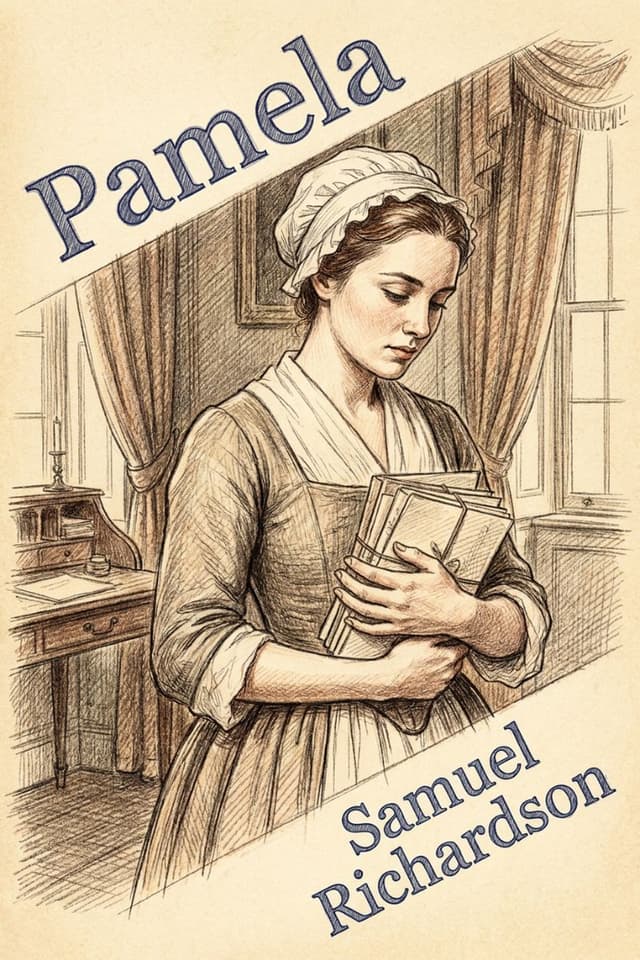
Pamela
Read Pamela by Samuel Richardson for free on Novelhalla, and try out our easy-to-read modern edition of this classic book. You can also download the EPUB and read it on any device if you prefer!
The Plot
This edition combines both volumes of Pamela into a single text. To read the original volumes separately, please visit https://gutenberg.org/ebooks/6124 for volume 1 and https://gutenberg.org/ebooks/12958 for volume 2.
A Servant's Predicament
Pamela Andrews is fifteen years old, pretty, literate, and virtuous. She works as a waiting maid to Lady B, a kind elderly woman who has taught her to read, write, and carry herself with grace far beyond her station. When Lady B dies, her son, the young and wealthy Mr. B, inherits the estate and Pamela's services along with it.
At first, Mr. B seems merely generous, giving Pamela gifts and praising her to others. But his attentions soon turn darker. He begins making advances, stealing kisses, hiding in closets to watch her undress. Pamela writes frantic letters to her poor but honest parents, who urge her to leave service and return home rather than risk her virtue.
But leaving proves harder than it sounds. Mr. B intercepts her letters, monitors her movements, and blocks her attempts to depart. The household becomes a strange battlefield. Mrs. Jervis, the kindly housekeeper, tries to protect Pamela. Mr. B oscillates between rage at her resistance and declarations that he cannot help himself. Pamela finds herself trapped between poverty at home and danger where she is.
The Abduction
When Pamela finally does leave the Bedfordshire estate, she believes she is heading home. Instead, Mr. B has arranged for his coachman to divert her to his remote Lincolnshire property, where she is held prisoner. Her new keeper is Mrs. Jewkes, a coarse woman who works actively to break down Pamela's defenses and deliver her to the master.
Cut off from her parents with no way to send letters, Pamela begins keeping a journal, hiding the pages in her clothing. She attempts to escape but finds the gates locked and injures herself badly. A local clergyman, Mr. Williams, tries to help her and even proposes marriage as a way to free her from Mr. B's control. Mr. B discovers the scheme and has Williams thrown into debtors' prison.
In the novel's most disturbing scene, Mr. B disguises himself as a maidservant and climbs into Pamela's bed. When she realizes what is happening, she falls into fits so severe that both Mr. B and Mrs. Jewkes fear she might die. Something in this moment finally gives Mr. B pause.
The Transformation
After the failed assault, Mr. B's behavior changes. He confesses to Pamela that he has read all her letters and journal entries and found himself moved by them. He admires her character. He loves her. But he hesitates to propose marriage because of the vast gulf between their social positions.
Pamela remains wary, suspecting a trick. When Mr. B finally lets her leave, she sets off toward her parents but receives a letter from him on the road, full of remorse and renewed declarations of love. Against all logic, she turns back. Mr. B proposes marriage in earnest, and Pamela accepts.
The wedding is small and private, held in the chapel at his estate. What follows is a new trial for Pamela: winning acceptance in a world that views her as an upstart servant who has tricked a gentleman into marriage.
The New Life
Mr. B's sister, Lady Davers, arrives furious at the news and treats Pamela with contempt. Other members of the gentry regard her with suspicion. Pamela must prove herself through patience, grace, and unfailing virtue until even her harshest critics acknowledge her worth.
Mr. B also reveals that he has an illegitimate daughter, Miss Goodwin, from a previous affair with a woman named Sally Godfrey. Rather than being scandalized, Pamela proposes that they bring the child into their household and raise her as their own.
The second volume follows Pamela into married life as she navigates motherhood, manages the household, and continues to demonstrate that virtue and good character matter more than birth. Her marriage is tested when she learns Mr. B has strayed, but forgiveness and moral steadfastness win out. Her parents are settled comfortably, and the former serving girl becomes a model of gentility admired by all who know her.
About the Author: Samuel Richardson
A Printer's Life
Samuel Richardson was born in 1689 in Derbyshire, one of nine children in a working-class family. His father was a joiner, a skilled craftsman who made wooden fittings for buildings. The family had hoped Samuel might enter the church, but they could not afford the education required for ordination.
Instead, at seventeen, Richardson was apprenticed to a London printer. He proved diligent and capable, eventually marrying his master's daughter and taking over the business. By his fifties, Richardson had become one of the most successful printers in London, handling contracts for the House of Commons and various newspapers.
The Accidental Novelist
Richardson came to fiction late and almost by accident. In 1739, two booksellers asked him to compile a book of model letters for people who lacked the education to write their own correspondence. As he worked on sample letters advising servant girls how to respond to improper advances from their masters, Richardson found himself absorbed in the story he was telling.
He set aside the letter-writing manual and began writing Pamela, completing the first draft in about two months. The novel he had accidentally invented would change literature forever.
Success and Controversy
Pamela was published anonymously in November 1740 and became an immediate sensation. Five editions appeared within the first year. The book inspired merchandise, paintings, theatrical adaptations, and even sermons recommending it to congregations. In 1742, Benjamin Franklin printed it in Philadelphia, making it the first novel published in America.
But success brought controversy. Critics accused Richardson of writing something salacious under the guise of morality. Henry Fielding wrote a savage parody called Shamela, portraying the heroine as a scheming fortune hunter who only pretends to virtue. Fielding followed this with Joseph Andrews, a comic novel featuring Pamela's supposed brother.
Later Works
Richardson went on to write two more novels. Clarissa (1747-1748), often considered his masterpiece, tells the tragic story of a virtuous woman destroyed by a rake who will not reform. Sir Charles Grandison (1753-1754) presents a male paragon of virtue. Both were massive works that further developed the psychological depth Richardson had pioneered in Pamela.
Richardson suffered from poor health in his later years, possibly from what is now believed to be Parkinson's disease. He died of a stroke in 1761 at age seventy-one and was buried at St. Bride's Church in London.
Legacy
Richardson's influence on the development of the novel was enormous. His focus on interior life, psychological realism, and moral complexity shaped generations of writers. Jane Austen admired him greatly. Denis Diderot compared him to Homer and Sophocles. Though his novels are less read today than those of Fielding or Austen, his innovations remain foundational to how we understand what fiction can do.
Fun Facts About the Book
Born from a Writing Manual
Pamela exists because Richardson got distracted. He was supposed to be writing a practical guide for uneducated people who needed help composing letters. When he came to the section on how servant girls should respond to inappropriate advances, he found himself inventing a character and her story. The letter-writing manual was eventually published, but Pamela had become something far more important.
The First Modern Bestseller
Pamela created what we would now call a media phenomenon. Within months of publication, people were buying Pamela-themed fans, teacups, and playing cards. Waxwork figures of the characters appeared. Paintings depicting scenes from the novel hung in fashionable spaces. It was the first time a work of English fiction had generated this kind of cultural merchandise.
First Novel Printed in America
When Benjamin Franklin published Pamela in Philadelphia in 1742, it became the first novel ever printed in the American colonies. The book did not sell particularly well there, but the distinction remains.
The Immediate Parody
Henry Fielding's Shamela appeared just six months after Pamela, one of the fastest literary parodies in history. Fielding transformed Richardson's virtuous heroine into a calculating schemer and her suitor into a buffoon named Squire Booby. The parody was so successful that "Booby" became a lasting English word for a fool.
The Two-Month Novel
Richardson wrote the first volume of Pamela in approximately two months, starting on November 10, 1739, and finishing on January 10, 1740. His wife and her friends became so invested in the story as he read it aloud that they urged him to complete it quickly.
The Rival Sequels
Because copyright law barely existed in the 1740s, unauthorized sequels to Pamela began appearing almost immediately. At least one, Pamela's Conduct in High Life, was published before Richardson could write his own sequel. Richardson was so annoyed by these spurious continuations that he rushed out his own second volume in 1741.
Recommended from the Pulpit
A clergyman in Slough reportedly read Pamela aloud to his congregation over several sessions. When the story reached its happy conclusion, the villagers were said to have rung the church bells in celebration. Whether or not this story is true, it captures the novel's extraordinary grip on readers.
Writing to the Moment
Richardson described his technique as "writing to the moment," meaning that Pamela records events almost as they happen, giving readers an unprecedented sense of immediacy and intimacy. This approach, possible because of the letter and journal format, became a defining feature of the psychological novel.
The Name Lives On
The name Pamela was rare before Richardson's novel but became suddenly popular afterward. The novel is credited with popularizing the name in English-speaking countries, where it remained common for centuries.
Themes
Virtue and Reward
The subtitle tells us what the novel is about: virtue rewarded. Pamela's steadfast refusal to compromise her chastity eventually wins her a husband, wealth, and social standing. Richardson presents this as moral instruction, showing that goodness pays off in the end. Critics have always debated whether this makes virtue a commodity to be traded for advantage.
Class and Mobility
The marriage between a servant and a gentleman was shocking to eighteenth-century readers. Richardson's novel suggests that character matters more than birth, that a poor girl with virtue and education deserves to rise. This message was both thrilling and threatening to a society built on rigid class distinctions.
Power and Vulnerability
Pamela has almost no power. She is young, female, poor, and employed by the man who threatens her. The novel explores how the powerless can resist the powerful, though critics have noted that Pamela's only real weapon is her virtue, and her reward is becoming the property of her former persecutor.
The Female Voice
By writing entirely from Pamela's perspective, Richardson gave readers access to a young woman's inner life in ways fiction had not done before. Her letters and journal entries reveal her fears, her strategies, her moments of doubt. This intimate access to female consciousness was revolutionary.
Reformation
Can a bad man become good? Mr. B begins as a predator and ends as a devoted husband. The novel asks readers to believe in his transformation, though many have found this the hardest part of the story to accept. Richardson would revisit this question in Clarissa, where the rake does not reform and the consequences are tragic.
Surveillance and Privacy
Mr. B intercepts Pamela's letters, hides to watch her undress, and eventually reads her most private journal entries. The novel is deeply concerned with who gets to see what, who controls information, and what happens when private thoughts become public. These concerns feel strikingly modern.
The Book's Legacy
Pamela is often called the first modern English novel, though scholars debate this endlessly. What is certain is that it changed what fiction could do and who could care about it. Richardson showed that a novel could focus on interior life, that ordinary people were worthy subjects, and that prose fiction could be taken seriously as literature.
The novel's influence rippled through the eighteenth and nineteenth centuries. Richardson's psychological approach shaped the work of writers from Rousseau to Austen. His epistolary technique was imitated countless times. Even writers who rejected his moral vision, like Fielding, defined themselves against him.
Modern readers often find Pamela difficult. The prose is verbose by contemporary standards, and the moral framework can feel alien or troubling. The idea that a woman should marry the man who tried to assault her sits uneasily with present-day sensibilities. Yet understanding why this novel mattered so much to its original readers remains essential for anyone interested in how the novel became the dominant literary form of the modern world.
Pamela also sparked one of literature's first great rivalries. The conflict between Richardson and Fielding, between sentimental morality and comic realism, between Pamela and Shamela, established a creative tension that would energize English fiction for generations. In that sense, Pamela gave birth not just to a new kind of novel but to the literary arguments that have shaped novel-writing ever since.