Novelhalla
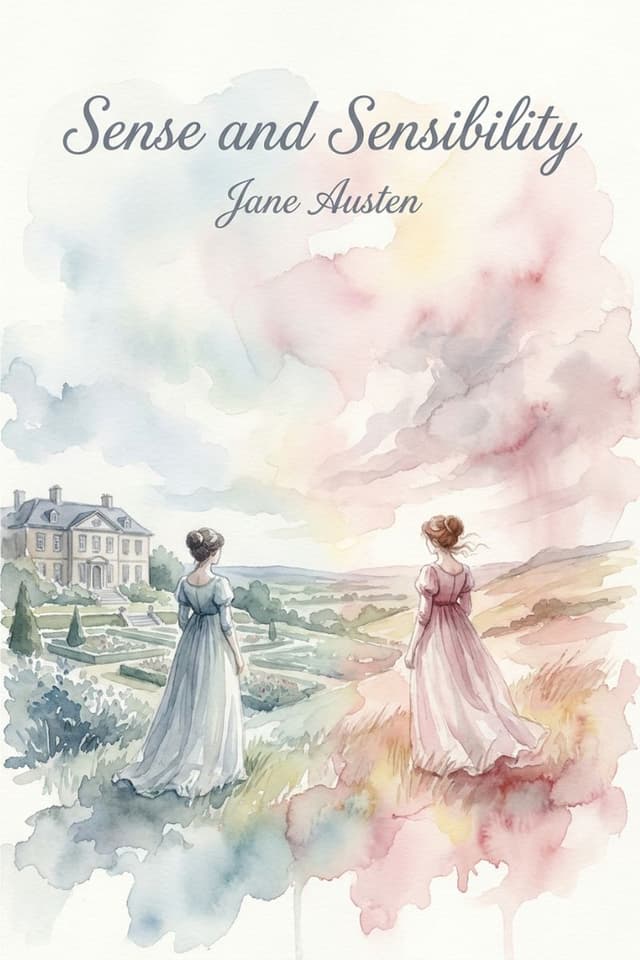
Sense and Sensibility
Read Sense and Sensibility by Jane Austen for free on Novelhalla, and try out our easy-to-read modern edition of this classic book. You can also download the EPUB and read it on any device if you prefer!
The Plot
The Dashwood Women
When Henry Dashwood dies, he leaves behind a wife and three daughters with almost nothing. The family estate, Norland Park, passes by law to his son from a first marriage, John Dashwood. On his deathbed, Henry extracts a promise from John to take care of his stepmother and half-sisters. John fully intends to honor that promise.
His wife Fanny has other ideas.
In one of the most wickedly funny scenes in English literature, Fanny talks her husband down from his generous intentions step by step. Perhaps he meant to give them three thousand pounds? Well, that seems excessive. Perhaps one thousand? But think of their own children's future. Perhaps an annuity? But what if the old lady lives forever? By the time she's finished, John has convinced himself that occasional gifts of fish and game will more than satisfy his obligations.
The Dashwood women must leave their home. Mrs. Dashwood, proud and easily wounded, wants to flee immediately, but her eldest daughter Elinor counsels patience. They need time to find somewhere they can afford to live on their tiny income. Eventually, a distant cousin offers them a cottage on his estate in Devonshire, far from everything and everyone they know.
Before they leave Norland, something happens that will shape the rest of the story. Elinor meets Edward Ferrars, Fanny's brother. He is quiet, reserved, and thoroughly unprepossessing. He has no ambition, no flash, no particular talents. Fanny makes clear that her family expects Edward to marry well, and a penniless girl is not what they have in mind.
Edward and Elinor form an attachment anyway. Nothing is declared. Nothing is promised. But something real passes between them, something Elinor holds close as her family packs up their lives and moves to the remote wilds of Devonshire.
Two Sisters, Two Temperaments
Elinor is nineteen, sensible, and self-controlled. She feels deeply but keeps her emotions private, managing her grief and her hopes with a composure that sometimes looks like coldness. She is the one who handles practical matters, who smooths over social difficulties, who considers consequences before acting.
Marianne is seventeen and her opposite in nearly every way. She believes that strong feelings should be expressed, that reserve is dishonesty, that love should be passionate and all-consuming or it is not love at all. She plays piano with wild emotion. She reads poetry aloud in the rain. She considers second attachments impossible and Colonel Brandon, who is thirty-five, practically ancient.
Colonel Brandon is a friend of their cousin Sir John Middleton. He is a quiet, dignified man who clearly admires Marianne from the moment he meets her. She finds him dull. He wears flannel waistcoats. He talks about sensible things. He does not quote Cowper or weep over dead leaves.
Then John Willoughby appears.
Willoughby
He rescues Marianne when she falls and twists her ankle on the rain-soaked hills. He is handsome, charming, passionate about poetry and music, everything Marianne has dreamed of in a romantic hero. Within days, they are inseparable. They ride together, read together, sing together. Their attachment is so open that everyone assumes an engagement must be imminent.
But Willoughby never actually proposes. And one morning, without warning, he announces he must leave for London immediately on business. Marianne is devastated. Still no engagement is announced. Still no promise is made. He simply vanishes from her life.
Meanwhile, Elinor carries a secret of her own. A confidence shared by a cunning young woman named Lucy Steele threatens everything Elinor hoped for with Edward. She cannot speak of it to anyone, not even her sister. Marianne, who believes Elinor feels nothing deeply, has no idea that behind that composed exterior, Elinor is suffering just as much as she is.
London
Mrs. Jennings, Sir John's cheerfully vulgar mother-in-law, invites the sisters to London for the winter social season. Marianne hopes desperately to see Willoughby again. Elinor dreads what London society might reveal.
The city brings secrets to light and forces both sisters to confront painful truths. The quiet steadiness of Colonel Brandon reveals hidden depths beneath his reserved exterior. Both Dashwood sisters will have their hearts tested, their assumptions challenged, and their understanding of love transformed.
What seems like the perfect romantic hero may prove to be something else entirely. And the man who seemed too dull to notice may turn out to be worth more than all the poetry in England.
About the Author: Jane Austen
Early Years
Jane Austen was born on December 16, 1775, in Steventon, Hampshire, the seventh of eight children. Her father, George Austen, was the rector of the local parish. The family was not wealthy but was intellectually rich, full of books and conversation and amateur theatricals.
Jane began writing as a child, producing stories, plays, and parodies for family entertainment. These juvenile works, which survive in three notebooks, are anarchic and funny, full of drunken heroines and absurd plot twists. By her late teens, she was working on the novels that would eventually be published, though publication was still far in the future.
The Writing Life
Austen wrote the first version of this story around 1795, when she was about nineteen. She called it "Elinor and Marianne" and wrote it as a novel-in-letters, a popular format at the time. She revised it extensively in 1797-98, converting it to third-person narration and changing the title. But finding a publisher proved difficult, and the manuscript sat for years.
In 1801, the family moved to Bath after Reverend Austen's retirement. Jane's writing productivity dropped dramatically during this period, whether from unhappiness or distraction remains unclear. After her father's death in 1805, Jane, her mother, and her sister Cassandra lived in reduced circumstances, moving between relatives until her brother Edward offered them a cottage at Chawton in 1809.
At Chawton, Austen returned to her manuscripts. She revised this novel one final time in 1809-10 and, with her brother Henry acting as her agent, found a publisher. Thomas Egerton agreed to publish on commission, meaning Austen bore the financial risk. She was thirty-five years old and had been writing seriously for nearly two decades.
Publication and Success
This novel appeared in late October 1811, published anonymously as the work of "A Lady." Austen paid for the printing herself and kept the profits after Egerton's commission. The first edition of 750 copies sold out by mid-1813, earning her about £140, a meaningful sum for a woman with almost no income.
She published three more novels during her lifetime: Pride and Prejudice (1813), Mansfield Park (1814), and Emma (1815). Two additional novels, Northanger Abbey and Persuasion, appeared posthumously in 1817. All were published anonymously, though word of her authorship spread through literary circles. The Prince Regent was a fan and requested that Emma be dedicated to him.
Final Years
Austen began experiencing health problems in early 1816, likely from Addison's disease, though the diagnosis is uncertain. She continued writing through her illness, completing Persuasion and beginning a new novel, Sanditon, which remains unfinished. She died on July 18, 1817, at age forty-one, in Winchester, where she had gone seeking medical treatment. She was buried in Winchester Cathedral.
Her brother Henry's biographical notice, published with the posthumous novels, finally revealed her identity to the public.
Fun Facts
The Original Format
Austen first wrote this story as an epistolary novel, told entirely through letters between characters. This format was popular in the eighteenth century, used by Samuel Richardson in Pamela and Clarissa. Austen later converted it to third-person narrative, though traces of the original structure remain in the letters that play crucial roles in the plot.
Published on Commission
Austen took a significant financial risk by publishing on commission. Under this arrangement, she paid for the printing and advertising herself and kept the profits after the publisher's cut. If the book had failed, she would have lost money she could not afford to lose. The gamble paid off: she earned £140 from the first edition alone, and the book's success gave her the confidence to continue publishing.
A Lady
The title page credited the novel only to "A Lady." This anonymity was partly about privacy and feminine propriety, but it also reflected the precarious position of women writers. Austen wrote at a desk in the family sitting room and reportedly used a creaking door as a warning system, hiding her manuscript when visitors approached.
The Second Edition
The success of Pride and Prejudice, published in 1813, boosted interest in Austen's earlier work. A second edition of this novel appeared in October 1813, credited to "the author of Pride and Prejudice." Austen continued to receive income from both editions through 1817.
Never Out of Print
This was the first Austen novel to be republished after her death and the first to be illustrated, appearing in Richard Bentley's Standard Novels series in 1833. It has never been out of print since 1811, remaining continuously available for over two hundred years.
The 1995 Film
The most celebrated adaptation is the 1995 film directed by Ang Lee, with a screenplay by Emma Thompson, who also starred as Elinor. Thompson spent five years writing the script and won an Academy Award for Best Adapted Screenplay. Kate Winslet earned her first Oscar nomination for her portrayal of Marianne. The film was both a critical and commercial success, helping to spark a renewed interest in Austen adaptations throughout the 1990s.
Colonel Brandon's Inspiration
Some scholars believe Colonel Brandon was inspired by Warren Hastings, the first Governor-General of India, who was a family friend of the Austens. Like Brandon, Hastings was associated with colonial India and had a complicated personal history.
Sisterly Devotion
Austen was extremely close to her own sister Cassandra, who remained her confidante, editor, and companion throughout her life. The relationship between Elinor and Marianne, despite their differences, reflects this deep sisterly bond. Cassandra never married either, and after Jane's death, she destroyed many of her sister's letters, protecting her privacy even in death.
Themes
Sense vs. Sensibility
The title announces the novel's central concern: the contrast between reason and emotion, restraint and expression, prudence and passion. Elinor represents "sense," the rational approach to life that considers consequences and respects social obligations. Marianne represents "sensibility," the belief that authentic feeling should be expressed freely and that emotional restraint is a form of dishonesty.
But the novel is more complicated than a simple endorsement of sense over sensibility. Elinor suffers because she cannot share her pain. Marianne's openness, while sometimes foolish, also represents a kind of integrity. The story suggests that both sisters have something to learn from each other.
Women and Money
The Dashwood women's predicament drives everything. Because inheritance laws favor male heirs, they are left with almost nothing when Mr. Dashwood dies. Their only path to financial security is marriage, but marriage itself is a gamble.
Austen does not preach, but her novel makes devastatingly clear how limited women's options were. Intelligence, education, and virtue count for nothing without money or a husband who has it.
Appearance vs. Reality
The most charming person in the room may not be the most worthy. The quiet, unassuming figure in the corner may have depths that flash and dazzle cannot match. The novel teaches its characters and its readers to look beyond surfaces, to value constancy over excitement, character over charisma.
Privacy and Performance
Elinor keeps her suffering private; Marianne performs hers publicly. The novel asks whether either approach is entirely healthy. Marianne's emotional displays make her vulnerable. But Elinor's silence means she bears her burdens alone, misunderstood even by those who love her. True intimacy might require something between these extremes.
Second Attachments
Marianne insists that true love happens only once and that second attachments are impossible. The novel gently but firmly challenges this romantic notion. Hearts can heal. New loves can grow. The passionate first attachment may be less valuable than the steady affection that develops over time with someone worthy of it.
The Book's Legacy
This was Jane Austen's first published novel, the book that launched one of the most beloved careers in English literature. It introduced themes she would explore throughout her work: the marriage market, the vulnerability of women without money, the tension between feeling and reason, the gap between appearance and reality.
The 1995 film introduced the story to millions of new readers and remains one of the definitive Austen adaptations. Emma Thompson's Oscar-winning screenplay emphasized the feminist elements of the story, showing how economic dependence shapes women's choices and how even intelligent, educated women were trapped by circumstances beyond their control.
The novel also established Austen's distinctive voice: the precise, witty prose that can deliver devastating criticism through understatement, the dialogue that reveals character through what is said and what is left unspoken, the careful observation of social dynamics that makes her drawing rooms feel as high-stakes as any battlefield.
For a first novel, written by a teenage girl in a country rectory, it is a remarkable achievement. It announced the arrival of a writer who would become one of the most read, most adapted, and most loved authors in the English language.