Novelhalla
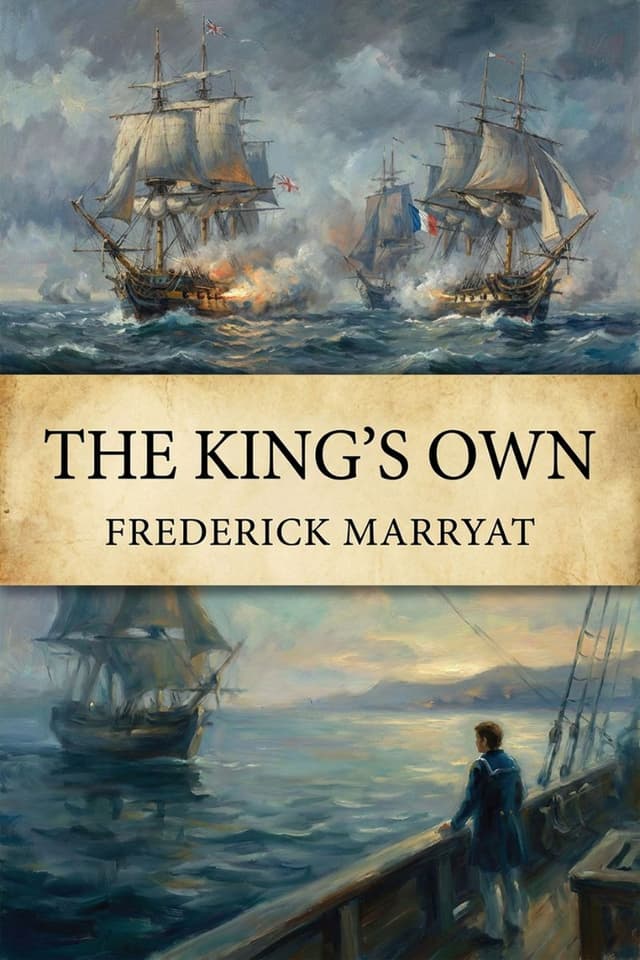
The King's Own
Read The King's Own by Frederick Marryat for free on Novelhalla, and try out our easy-to-read modern edition of this classic book. You can also download the EPUB and read it on any device if you prefer!
The Plot
The Hanging
It begins with a death. A sailor is hanged from the yardarm of a warship for his role in one of the most dangerous moments in British naval history: the mutiny at the Nore, 1797. Thousands of Royal Navy sailors, fed up with brutal conditions and wages that hadn't changed in over a century, seized control of their ships and threatened to blockade London itself. The government crushed the uprising. The ringleaders swung from ropes. And one of them left behind a young son.
The boy has no name that matters anymore. His father is a traitor. His mother is dead. He has nothing in the world except the deck of a warship and the rough kindness of the sailors who knew his father and feel they owe the child something.
They adopt him. The Royal Navy becomes his family. The ship becomes his home.
A Boy at Sea
The child grows up aboard ship, rising through the ranks the only way a boy without connections can: by being useful, by being brave, by learning the ropes in every sense of the word. Ship's boy. Then midshipman. Then, eventually, lieutenant. The sea is all he knows. Battle, storm, discipline, and the cramped, violent, stinking reality of life below decks on a man-of-war during the Napoleonic Wars.
This is not a romanticized navy. The floggings are real. The diseases are real. The cannonballs that tear through hulls and men alike are described by someone who watched it happen. The humor is dark and the camaraderie is fierce, the kind that forms between people who might die together before the week is out.
And there is a mystery. Branded on the young man's arm is a broad anchor, the mark stamped on all possessions belonging to the King. He doesn't know how it got there. Nobody does. But it means something. It means everything, if only someone could read it.
Smugglers, Battles, and Secrets
The young man's life is not confined to the Navy. He falls in with smugglers, tangles with the French, survives engagements that would make lesser men beg for shore leave permanently. The novel throws him from one crisis to the next: sea battles fought with cutlasses on slippery decks, chases through coastal waters, encounters with men who live entirely outside the law.
Meanwhile, the secret of his birth pulls at the edges of the story like an undertow. His father, the hanged mutineer, was not what he seemed. There is noble blood in the family line. There is an inheritance. There is a grandfather who is an admiral and has no idea his grandson is alive, scrubbing decks and dodging French cannonfire somewhere on the open ocean.
The anchor branded on his arm is the key to all of it. But the lock it fits is buried in a past that powerful people have every reason to keep hidden.
The Reckoning
The threads converge slowly: the young officer's growing reputation, the question of his parentage, the women who love him, the enemies who want him gone, and the sea itself, which cares nothing for any of it and will take whoever it pleases. Marryat drives the story toward a reckoning that is as unforgiving as the ocean.
Because this is a novel written by a man who survived fifty naval battles. He knows exactly how much the sea gives, and how much it takes back.
About the Author: Frederick Marryat
The Boy Who Kept Running
Frederick Marryat was born in 1792 in Westminster, London, the son of a wealthy member of Parliament. He had every advantage a boy could ask for. Good schools. Money. Social position. He hated all of it. What he wanted was the sea.
He ran away to join the Navy so many times that his father finally gave up and let him go. In 1806, at fourteen years old, Marryat boarded HMS Imperieuse as a midshipman under the command of Lord Cochrane, one of the most daring and brilliant naval officers in British history. Cochrane would later become the real-life inspiration for both Horatio Hornblower and Jack Aubrey, two of the most famous fictional sailors ever created. But before any of those characters existed, there was Marryat, a teenager on Cochrane's ship, learning war firsthand.
Fifty Battles
In his first two and a half years aboard the Imperieuse, Marryat took part in more than fifty engagements. He fought along the coasts of Spain and France. He helped capture castles, destroy telegraph stations, and take dozens of enemy ships. He jumped into the sea to save a fellow midshipman who had fallen overboard. He participated in fire-ship attacks against the French fleet. He was fourteen, fifteen, sixteen years old.
The adventures didn't stop when he left the Imperieuse. He fought in the War of 1812 against the Americans. He served in Burma, where disease killed more men than the enemy did. He was posted to St. Helena as a guard ship commander and sketched Napoleon's body on his deathbed, a drawing later sold as a lithograph across Europe. He invented a system of naval flag signals that became the standard code used by the Royal Navy and merchant ships for decades.
By the time he resigned his commission in 1830, he held the rank of post-captain and had lived enough for several lifetimes.
The Writer
Marryat turned to fiction the way he had turned to everything else: at full speed and with total confidence. His first novel appeared in 1829, while he was still in the Navy. After resigning, he wrote at a furious pace, producing novel after novel drawn from his own experiences at sea. He edited a literary magazine. He became friends with Charles Dickens. He traveled in Canada and the United States and wrote sharp, sometimes controversial accounts of what he found there.
His most famous works include Mr Midshipman Easy and Peter Simple, both rollicking naval adventures. He also wrote The Children of the New Forest, a beloved children's novel that has never gone out of print. Virginia Woolf praised his ability to put readers in the midst of ships and sea and sky with complete authenticity. Mark Twain, Joseph Conrad, and Ernest Hemingway all admired his work. Herman Melville reportedly read Marryat before going to sea himself, a decision that would eventually produce Moby Dick.
The End
Marryat's later years were not kind. Despite his success, he was constantly in debt. His marriage fell apart. He retreated to a small farm in Norfolk, where he wrote children's books to pay the bills. In 1847, his eldest son Frederick drowned when his ship sank off the coast of North Africa.
Marryat died in 1848, at fifty-six, from complications of the malaria he had contracted decades earlier in Burma. The sea had given him everything: his career, his stories, his fame. And it took his son.
Fun Facts About the Book
Written While Still at Sea
Marryat wrote much of the novel while serving as a naval officer. He was literally aboard ship, clinging to his desk during storms, scribbling chapters between duties. In one famous passage, he breaks the fourth wall entirely to describe his actual writing conditions: his ship being tossed by a gale while he tries to keep his inkwell from sliding off the table.
The Real Mutiny
The Nore mutiny of 1797 was one of the most frightening moments in British history. During a war with Revolutionary France, thousands of Royal Navy sailors seized their ships and threatened to blockade London. The government crushed the uprising and hanged the ringleaders. Marryat uses this real event as the engine of his entire plot, giving the novel a weight and urgency that pure fiction couldn't match.
A Schoolmate of Babbage
Before running away to sea, young Marryat attended Holmwood School in Ponder's End. One of his fellow students was Charles Babbage, who would go on to invent the concept of the programmable computer. The father of naval fiction and the father of computing sat in the same classroom.
Napoleon's Deathbed
Marryat was one of three officers who sketched Napoleon on his deathbed at St. Helena in 1821. He then carried the dispatches reporting Napoleon's death back to England. You can't make this stuff up. The man who wrote fiction about adventure was living adventures that would sound implausible in a novel.
The Cochrane Connection
Lord Cochrane, Marryat's first commanding officer, is one of the most remarkable figures in naval history. His exploits were so extraordinary that C.S. Forester used him as the model for Horatio Hornblower and Patrick O'Brian based Jack Aubrey on him. Marryat, who actually served under Cochrane and witnessed those exploits firsthand, wove his captain's daring and brilliance into nearly every novel he wrote.
Marryat's Signal Code
Before he was a novelist, Marryat was a practical innovator. He developed a system of flag signals for communicating between ships that was adopted by the Royal Navy and remained in use by maritime services for years. The system was known as Marryat's Code.
One of His Darker Books
Marryat was known for comedy and adventure, but The King's Own has a different tone. The grisly details of shipboard life, the violence, the injustice of the class system, and the weight of the mutiny all give the novel an edge that sets it apart from his lighter work. Readers who know Marryat only from Mr Midshipman Easy may find themselves in unexpectedly rough waters.
Themes
The Sins of the Father
The novel's central question is inescapable: what happens to a child whose father is hanged as a traitor? Can a boy outrun his parentage? The branded anchor on the young man's arm is both a clue to his true identity and a mark of the shame he carries. Birth determines everything in this world, whether you know your birth or not.
Class and Merit
The Navy is presented as both a rigid class system and one of the few places in Georgian England where talent can actually be recognized. The hero rises through the ranks, but he does so in a world where family name matters more than ability, and where the secrets of one's blood can elevate or destroy a life overnight.
Loyalty and Rebellion
The mutiny at the Nore sits at the heart of the novel, and Marryat refuses to make it simple. The sailors had genuine grievances. Their pay hadn't changed in over a century. The conditions were brutal. But mutiny during wartime is treason, and the consequences are final. The novel lives in the tension between understanding why men rebel and knowing what it costs.
The Brotherhood of the Sea
For all its darkness, the novel is also about the bonds between men who serve together. The sailors who adopt the orphaned boy do so out of loyalty to his dead father and a rough code of honor that exists below decks, invisible to officers and admirals. That code is real, and Marryat writes about it with the authority of someone who lived it.
Identity and Inheritance
Who are you if you don't know where you come from? The hero carries the proof of his heritage on his body without understanding what it means. The novel is built around the slow revelation of identity, the idea that the truth of who you are can be hidden in plain sight for years, waiting for the right moment to surface.
The Book's Legacy
The King's Own established Marryat as a serious writer and helped create the naval adventure genre that would flourish for the next two centuries. Without Marryat, there is no Hornblower, no Jack Aubrey, no Master and Commander. He was the original, the man who proved that life at sea could power great fiction, and he did it because he had lived that life himself.
The novel also stands as one of the earliest and most vivid fictional accounts of the Nore mutiny, an event that shook the British Empire at a moment when it could least afford to be shaken. Marryat understood the Navy from the inside: its cruelties, its heroism, its absurdities, and its strange, fierce loyalties. He put all of it on the page.
Virginia Woolf wrote that Marryat had the power to place readers among ships and men and sea and sky, all vivid, credible, authentic. That power is fully on display here. The King's Own is rougher and darker than Marryat's more famous comedies, but for readers who want to feel the spray on their face and the deck rolling under their feet, there is nothing quite like it.