Novelhalla
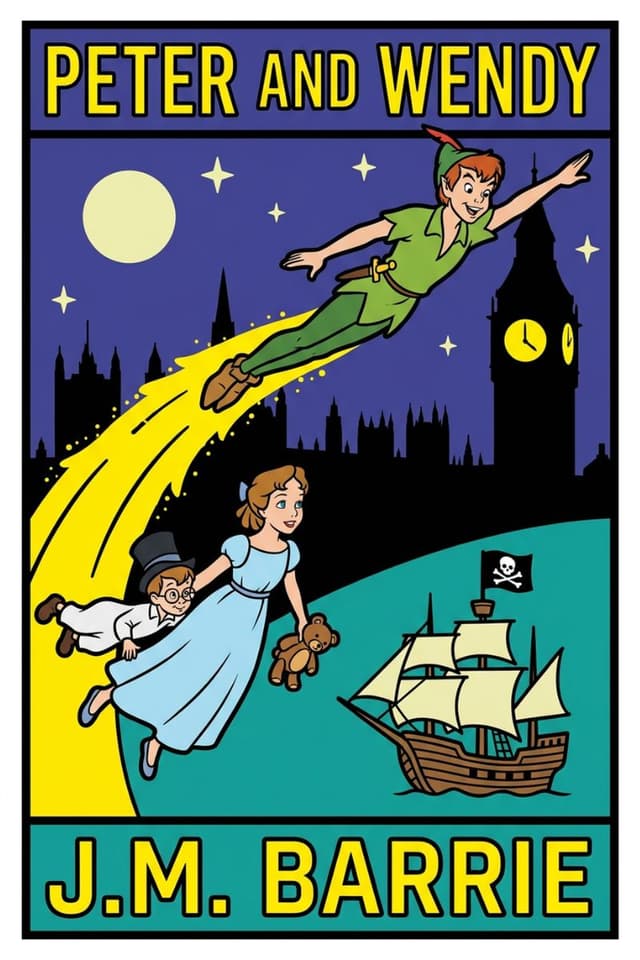
Peter And Wendy
Read Peter And Wendy by J. M. Barrie for free on Novelhalla, and try out our easy-to-read modern edition of this classic book. You can also download the EPUB and read it on any device if you prefer!
The Plot
The Nursery
All children, except one, grow up.
The Darling family lives in a modest London house with three children: Wendy, John, and Michael. Their mother, Mrs. Darling, is lovely and a little mysterious. Their father, Mr. Darling, is a man who pretends to understand stocks and shares and worries constantly about money. Their nursemaid is a large Newfoundland dog named Nana, who is better at the job than most humans would be.
Mrs. Darling first hears the name Peter Pan when she is tidying through her children's minds at bedtime, the way mothers do. She finds it everywhere, scribbled across their thoughts like graffiti. Wendy explains: Peter Pan is a boy who visits them at night. He lives with fairies. Mrs. Darling half-remembers the name from her own childhood, a distant, impossible memory of a boy who never grew up. She decides he isn't real.
Then one night, he leaves his shadow behind.
The Boy
Peter comes back for his shadow and accidentally wakes Wendy. He is not what she expects. He is small, radiant, and carelessly charming. He can't reattach his own shadow and cries when it won't stick. He doesn't know how old he is. He ran away from home the day he was born because he heard his parents discussing what he would be when he grew up, and he never wanted to be anything but a boy.
Peter lives in a place called Neverland with a gang of children called the Lost Boys, boys who fell out of their prams when their nurses weren't looking and were never claimed. There are no girls. Girls, Peter explains, are far too clever to fall out of their prams. What the Lost Boys need is a mother. Someone to tell them stories.
Peter invites Wendy to come to Neverland and be that mother. Wendy, who is practical and imaginative and perhaps a little too eager to grow up, says yes. Her brothers John and Michael come along. Peter blows fairy dust over them, they think lovely thoughts, and they fly out the nursery window toward the second star to the right and straight on till morning.
Their parents come home to an empty room.
The Island
Neverland is not the gentle place you might imagine. It's built from children's dreams, and children's dreams are full of violence. The island is a tangle of lagoons and forests and underground hideouts, populated by mermaids who try to drown you, a tribe of warriors, wild animals, and a ship full of pirates. When Peter is away, everything goes quiet and lazy. The moment he returns, the island wakes up, and everyone starts hunting everyone else.
The Darling children arrive in a shower of cannon fire. They're blown out of the sky by the pirates, and Wendy is nearly killed before she sets foot on the ground. The culprit is Tinker Bell, Peter's fairy companion, who is tiny, luminous, and murderous with jealousy. She tells the Lost Boys that Wendy is a bird Peter wants them to shoot down. A boy named Tootles, the gentlest of the group, fires the shot.
Wendy survives, saved by a button Peter had given her. The boys, horrified at what they've done, build a little house around her while she recovers. It is the first Wendy House.
Playing House
What follows is strange and wonderful and slightly unsettling. Wendy takes up the role of mother to the Lost Boys with a seriousness that blurs the line between play and something deeper. She cooks imaginary meals, tells bedtime stories, mends clothes, and tucks everyone in. The boys call her Mother. Peter plays at being Father. But he is clear, always, that it is pretend. He does not understand what a real feeling is. He is all instinct and appetite and forgetting.
The children live underground, entering through hollow trees carved to fit their bodies. It's cozy and thrilling and a little claustrophobic. John and Michael begin to forget their real parents. Even Wendy's memories start to blur at the edges.
Meanwhile, the mermaids lounge on Marooner's Rock and comb their hair in the moonlight. They are beautiful and they are not friendly.
Captain Hook
The pirates are led by Captain James Hook, a man of considerable education and terrible manners. He attended Eton. He is obsessed with "good form." He curls his hair and wears fine clothes and speaks with a sinister elegance that never quite hides the violence underneath. Peter Pan cut off his right hand in a fight and tossed it to a passing crocodile, who liked the taste so much that it has been following Hook ever since, hoping for the rest of him. The crocodile also swallowed a clock, so Hook can hear it coming. Tick, tick, tick.
Hook hates Peter with a passion that goes beyond rivalry. Peter is everything Hook is not: careless, fearless, unaware of death. Peter once declared, stranded on a rock with the tide rising around him, that dying would be "an awfully big adventure." Hook cannot forgive this.
The conflict between Peter and Hook builds through ambushes and skirmishes and one terrible night at the lagoon where Peter is wounded and left for dead on a rock the sea is about to swallow. Whether he survives that night, and how, is one of the most striking passages in the book.
The Stories and the Danger
Wendy tells the Lost Boys bedtime stories. One night she tells the story of three children who flew away from their parents and came home years later, and their mother had left the window open for them all that time. Peter says that isn't true. He tells them that when he finally went back to his own window, it was shut. There was a new boy sleeping in his bed. His mother had forgotten him.
The story unsettles everyone. Wendy decides it is time to go home. She begs Peter to come with her. The Lost Boys want to come too. Peter refuses, the way he always refuses anything that might mean growing up, with a brightness that looks like indifference but might be something else.
But Captain Hook has been listening. And what happens next is the reason you need to read this book, because Barrie writes it with a knife edge between fairy tale and nightmare. The pirates make their move. Hook creeps into Peter's underground home while the boy sleeps. A cup of poisoned medicine sits beside the bed. The only person who knows what Hook has done is Tinker Bell, and her light is growing dim.
About the Author: J. M. Barrie
A Boy Who Couldn't Grow Up
James Matthew Barrie was born in 1860 in Kirriemuir, Scotland, the ninth of ten children in a weaver's family. When he was six years old, his older brother David, his mother's favorite, was killed in a skating accident the day before his fourteenth birthday. The loss devastated their mother so completely that she never fully recovered. Young James tried to take David's place, wearing his brother's clothes, copying his whistle, doing everything he could to be the dead boy in order to win his mother's attention.
His mother found one consolation: David would never grow up. He would stay a boy forever. Barrie absorbed this idea at six years old, and it never left him.
The psychological stress of his childhood may have had physical consequences. Barrie suffered from what is now believed to have been psychogenic dwarfism. He never grew taller than five feet, and his marriage, which produced no children, was widely believed to have been unconsummated.
The Writer
Barrie studied at Edinburgh University, became a journalist, and moved to London, where he wrote novels and plays with increasing success. By the early 1900s, he was one of the most successful playwrights in England, with multiple hits running in the West End simultaneously.
But the work that would define him began not at a desk but in a park.
The Boys in the Garden
In 1897, Barrie met a spectacularly beautiful five-year-old boy named George Llewelyn Davies while walking his Saint Bernard dog in Kensington Gardens. George was there with his younger brother Jack and their baby brother Peter. Barrie enchanted the boys with stories of fairies, pirates, and desert islands. He could wiggle his ears and perform magic with his eyebrows. Before long, he had met their mother, Sylvia, an extraordinarily beautiful woman who was the daughter of novelist George du Maurier, and their father, Arthur, a young barrister who was less enthusiastic about this small, strange playwright who kept showing up at his house.
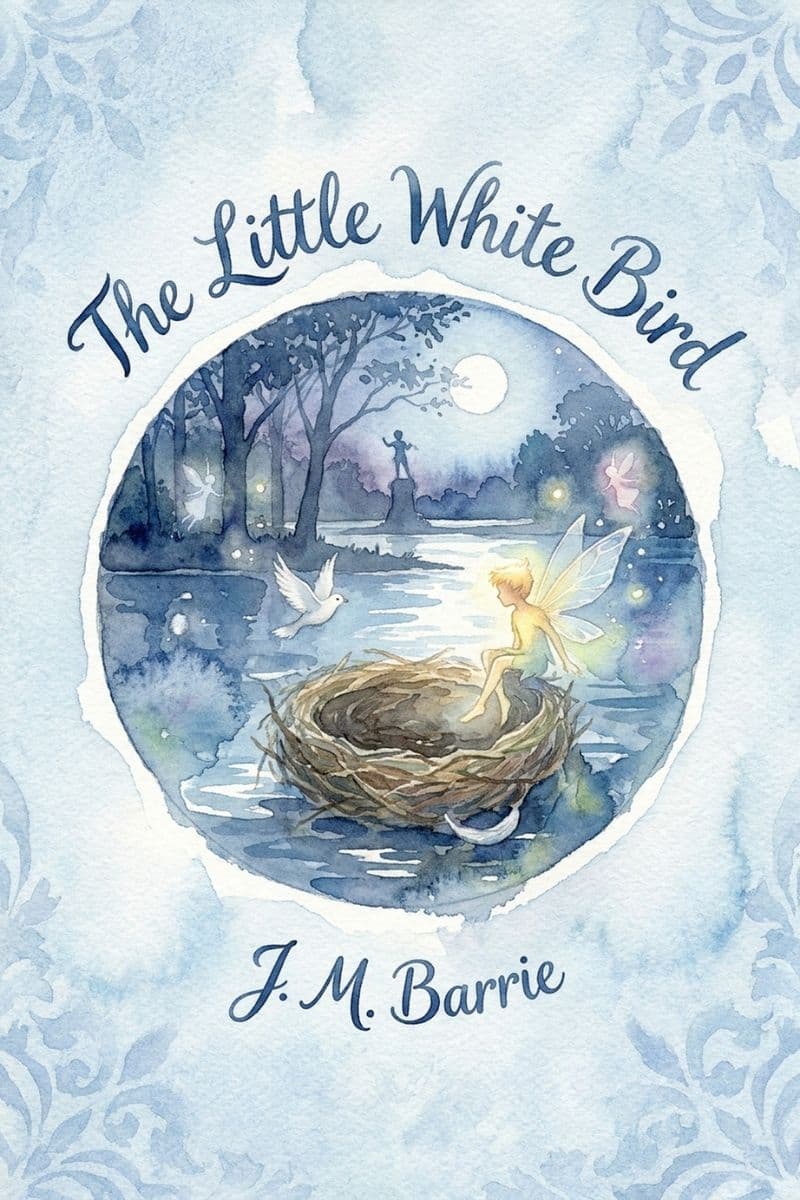
Barrie began weaving the boys into his fiction. Peter Pan first appeared in his 1902 novel The Little White Bird. The stage play Peter Pan, or The Boy Who Wouldn't Grow Up premiered in London on December 27, 1904. It was a sensation. Barrie continued revising it for decades. The novelization, Peter and Wendy, was published in 1911.
Guardian
Arthur Llewelyn Davies died of cancer in 1907. Sylvia died of the same disease in 1910. Barrie became guardian to all five of their boys: George, Jack, Peter, Michael, and Nicholas. He provided for them financially and emotionally, and they became the center of his life.
The cost was enormous. George was killed in World War I in 1915. Michael drowned in 1921 at the age of twenty, in circumstances that may or may not have been accidental. Peter, the boy who shared a name with the character and came to despise the association, calling the story "that terrible masterpiece," took his own life in 1960.
Final Years
Barrie continued writing but never produced anything that matched Peter Pan's impact. He was made a baronet in 1913 and received the Order of Merit in 1922. Before his death in 1937, he gave the copyright to Peter Pan to Great Ormond Street Hospital, London's leading children's hospital. It continues to receive royalties from the work to this day.
Fun Facts About the Book
Play First, Novel Second
Peter Pan started as a stage play in 1904, seven years before the novel was published. The play was a phenomenon from its first performance. Barrie spent those seven years revising the story, deepening the characters, and adding the darker, more psychologically complex elements that make the novel a very different experience from the play. If you only know Peter Pan from adaptations, the book will surprise you.
The Invention of Wendy
Several scholars credit Barrie with inventing the name Wendy. His childhood friend, Margaret Henley, the four-year-old daughter of poet William Ernest Henley, used to call Barrie her "fwiendy." She couldn't quite pronounce the word, and it came out as something close to "Wendy." Margaret died at the age of five. Barrie kept the name and gave it to the girl who would mother the Lost Boys.
The Narrator Is Strange
One of the most unusual things about the novel is its narrator, who is not neutral, not reliable, and not entirely on anyone's side. He interrupts the story to offer opinions, withholds information, admits he's selecting which details to share, and occasionally sounds like a man who knows far more about childhood than any child would be comfortable with. The narrator is one of the reasons the novel feels so different from the Disney version.
"Gay and Innocent and Heartless"
The novel's final line describes children as "gay and innocent and heartless." It's a devastating sentence. Barrie understood that innocence and cruelty are not opposites. Peter Pan's inability to grow up is also an inability to feel the way adults feel. He forgets people. He forgets Tinker Bell. He forgets the Lost Boys. He probably forgets Wendy. His eternal youth is not a gift. It's a kind of beautiful emptiness.
Hook Was an Afterthought
Captain Hook did not appear in early drafts of the play. He was created for a transitional scene meant to occupy the audience while the stagehands changed the set behind a curtain. Barrie liked the character so much that he expanded the role, and Hook became one of the most memorable villains in all of English literature.
The Crocodile's Clock
The crocodile that follows Captain Hook is one of literature's great images: a ticking animal, a living countdown, death with a built-in warning system. But the clock is running down. One day it will stop, and Hook will no longer hear death coming. Whether that day arrives during the events of the novel is something you'll have to read to find out.
Peter Pan Thins Them Out
In a detail that never made it into the Disney film, the novel mentions that when the Lost Boys start to grow up, Peter "thins them out." This is never fully explained, but the implication is dark. Either he banishes them or he does something worse. Barrie drops this detail casually, the way the novel drops many of its most disturbing ideas, in a tone that sounds like a bedtime story but reads like a warning.
The Gift to the Hospital
Before his death, Barrie gave the rights to Peter Pan to Great Ormond Street Hospital, ensuring that a story about children who never grow up would go on helping sick children indefinitely. British law has granted the hospital a special perpetual right to royalties, even after the standard copyright expired.
Themes
The Price of Never Growing Up
Peter Pan is usually read as a celebration of eternal childhood. The novel is something closer to a lament. Peter can fly, fight, and forget. He cannot love, grieve, or remember. He is magnificent and hollow. Barrie makes it very clear that the boy who never grows up is not free. He is trapped.
The Cruelty of Innocence
Children in this novel are not gentle creatures. They are imaginative, brave, loyal, and utterly heartless. Peter forgets people who have saved his life. Tinker Bell tries to murder Wendy out of jealousy. The Lost Boys shoot first and ask questions never. Barrie's children are recognizable precisely because they are not sanitized. He understood that children can be wonderful and terrible at the same time, often in the same breath.
Mothers
The novel is obsessed with mothers. Peter wants one and can't have one. The Lost Boys want one and recruit Wendy. Wendy wants to be one and plays the role with alarming commitment. Mrs. Darling waits at home with the window open. The entire machinery of Neverland runs on the presence or absence of mothers. What it means to be mothered, what it costs to be without a mother, and what happens when a child becomes a mother too soon are questions the book never stops asking.
Memory and Forgetting
Peter Pan's great tragedy is not that he can't grow up. It's that he can't remember. He forgets Tinker Bell after she dies. He forgets Captain Hook. He forgets the adventures he's had. He comes back for Wendy year after year and sometimes misses whole years without noticing. Memory is what connects us to the people we love, and Peter has none. He lives in an eternal present that looks like freedom but feels, to the reader, like a kind of solitary confinement.
Death as Adventure
The novel treats death with a frankness that can be startling. Peter's famous line about death being "an awfully big adventure" is usually quoted as bravery. In context, it's more complicated than that. Peter says it because he genuinely doesn't understand what death means. He has no framework for loss. The novel asks whether fearlessness in the face of death is courage or just another form of not understanding.
The Book's Legacy
Peter Pan is one of the most adapted stories in the English language. The 1953 Disney animated film defined the character for generations, softening his edges and brightening his world. Steven Spielberg's 1991 film Hook imagined Peter grown up. Countless stage productions, from the Mary Martin musical to annual British pantomimes, have kept the story alive in theatres for over a century.
But the novel itself remains stranger, darker, and more emotionally complex than any of its adaptations. The Disney Peter Pan is a cheerful boy on an adventure. Barrie's Peter Pan is something more unsettling: a boy who is charming and empty, brave and incapable of love, eternal and utterly alone. The novel's narrator does not let you forget this. He tells the story with warmth and wit and a sadness that creeps up on you until the final pages, when you realize that the story was never really about Neverland at all.
It was about the window. And whether it's still open.
The character's name has entered the language itself. "Peter Pan syndrome" became a recognized psychological term in 1983, used to describe adults who refuse the responsibilities of maturity. That the term is clinical, not whimsical, says something about how deeply Barrie understood what he was writing about.
The novel endures because it works on two levels at once. Children read it as an adventure about a boy who can fly and fight pirates. Adults read it as a meditation on what we lose when we grow up, and what we lose when we don't. Very few books manage to be both a fairy tale and its own critique. This one does.