Novelhalla
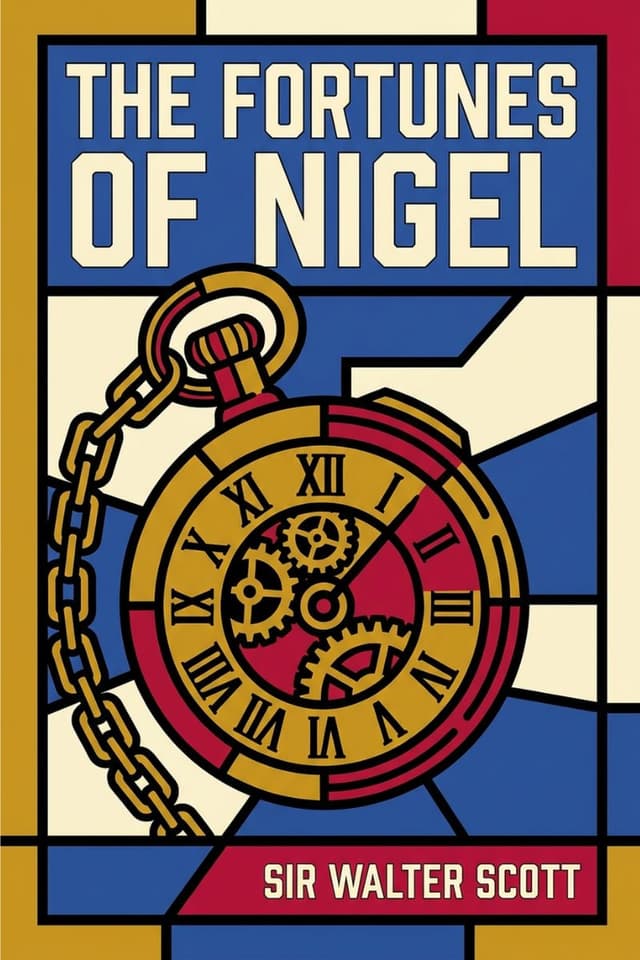
The Fortunes of Nigel
Read The Fortunes of Nigel by Walter Scott for free on Novelhalla, and try out our easy-to-read modern edition of this classic book. You can also download the EPUB and read it on any device if you prefer!
The Plot
A Lord in Rags
Nigel Olifaunt, Lord Glenvarloch, arrives in London with nothing but a title, a loyal servant, and a debt the king owes his dead father. The money is enormous. It was lent to King James back when he was still just the King of Scotland, before he inherited the English crown and all the wealth that came with it. Nigel's father helped James when it mattered. Now the old lord is gone, the estate is mortgaged to the hilt, and if Nigel doesn't recover what's owed, he'll lose everything his family has held for generations.
His servant Richie Moniplies is fierce, opinionated, and absolutely devoted to his young master. The two Scotsmen arrive in London battered and broke, strangers in a city that doesn't particularly like strangers, especially Scottish ones who've come to collect.
The Court of King James
London in 1623 is a city teeming with ambition, corruption, and spectacle. King James sits at the center of it all: brilliant, pedantic, paranoid, and impossible to predict. He quotes Latin when he should be making decisions. He lavishes affection on favorites and treats everyone else with suspicion. He is, in his own way, fond of Nigel's family. But fondness and action are very different things when you're a king with powerful men whispering in your ear.
The Duke of Buckingham, the most powerful man in the kingdom after the king himself, has his eye on Nigel's Scottish estates. So does Prince Charles. Nigel's petition isn't just a financial matter. It's a political one, and he has no idea how dangerous that makes it.
George Heriot, the king's goldsmith and a fellow Scot, takes pity on Nigel and helps him navigate the maze of royal bureaucracy. A legal arrangement is drawn up. Papers are signed. It looks like the money might actually come through.
And then Lord Dalgarno enters the picture.
The False Friend
Dalgarno is young, charming, well-connected, and rotten to the core. He befriends Nigel with the specific intention of destroying him. While appearing to show the young lord the pleasures of London society, Dalgarno is methodically leading him into gaming houses and taverns, letting Nigel's reputation curdle in the eyes of the court. Every night out is another nail in Nigel's coffin.
Meanwhile, David Ramsay, an eccentric watchmaker on Fleet Street, has a daughter named Margaret who is sharp, brave, and quietly paying attention to everything that's happening around young Lord Glenvarloch. She sees things Nigel doesn't. She understands dangers Nigel won't acknowledge.
By the time Nigel realizes what Dalgarno has been doing, even Richie Moniplies has nearly given up on him. The damage to his reputation is severe. His access to the king is gone. And the clock on his family's mortgage is still ticking.
Blood in the Park
When Nigel finally confronts Dalgarno with the truth of his treachery, things go badly. Dalgarno is contemptuous, mocking, utterly unbothered. Nigel loses his temper and draws his sword. He strikes Dalgarno in the royal park of St. James.
It's a catastrophic mistake. Drawing a weapon in the king's park is a crime punishable by the loss of his right hand. Nigel is now not just broke and disgraced. He's a fugitive.
He flees into the only place in London where the law can't follow: Alsatia.
Into Alsatia
Whitefriars, known to everyone as Alsatia, is a district of London that operates outside the law. An old monastery's sanctuary privileges have been twisted into a shield for everyone the city wants to forget: debtors, criminals, con men, thieves, and killers. The streets are narrow and filthy. The taverns never close. The residents will protect anyone who crosses the threshold, as long as they play by Alsatia's own brutal rules.
Nigel is hidden in the house of Trapbois, an old usurer whose daughter Martha is one of the few honest people in the entire district. It's a world that couldn't be further from the court he just fled, and it's every bit as dangerous.
The walls of Alsatia keep the law out. But they don't keep the violence out. And Nigel is about to learn that the men Dalgarno has dealings with operate in places far darker than gaming houses.
The Race Against Time
Outside Alsatia, Margaret Ramsay is working to save a man who doesn't even know she's trying. She has her own reasons, tangled up with her loyalty to Lady Hermione, a noblewoman Dalgarno has tricked and wronged. Margaret is clever, resourceful, and willing to take risks that would make most people in her position run the other direction.
Richie Moniplies, who left Nigel's service in despair, hasn't actually given up. He's come back to London, searching for his master, carrying secrets and loyalties that may prove more valuable than anyone realizes.
The king is fickle. Dalgarno is ruthless. The mortgage deadline is approaching. And somewhere between the court, Alsatia, and the Tower of London, Nigel's fortune will be decided. Whether he keeps his estates, his honor, or even his life depends on people he's only beginning to understand and alliances he never thought to make.
About the Author: Sir Walter Scott
The Edinburgh Boy
Walter Scott was born in 1771 in Edinburgh, the son of a solicitor. A childhood bout of polio left him with a permanent limp, and he was sent to his grandparents' farm in the Scottish Borders to recover. There, surrounded by the ruins of abbeys and the stories of old border raids, he fell in love with history, legend, and the landscape of Scotland. He read voraciously and listened to every ballad and folk tale the old people would share.
Lawyer, Poet, Phenomenon
Scott trained as a lawyer, like his father, and practiced law for much of his life. But his passion was writing. He first became famous as a poet, with sweeping narrative verse like The Lay of the Last Minstrel and The Lady of the Lake that made him one of the most popular writers in Britain. Then, in 1814, he published Waverley, a novel set during the Jacobite rising, and changed the history of fiction. He essentially invented the historical novel as a popular form.
The Anonymous Author
For years, Scott published his novels anonymously, credited only to "the Author of Waverley." It was one of the worst-kept secrets in literary history. Everyone knew, or at least suspected. But the mystery added to the excitement, and the books sold in extraordinary numbers. The Fortunes of Nigel was published in 1822, and the publisher reported that the entire first printing of 7,000 copies sold out in London by half past ten on the morning it arrived.
Fortune and Ruin
Scott used his literary wealth to build Abbotsford, a grand estate in the Borders that fulfilled his romantic vision of Scottish baronial life. But in 1826, the publishing house in which he was a partner collapsed, leaving him with debts of over 100,000 pounds. Rather than declare bankruptcy, Scott spent the rest of his life writing furiously to pay his creditors. He succeeded, but the effort destroyed his health. He died in 1832 at age sixty-one.
Legacy
Scott was the first English-language author to achieve genuine international fame during his own lifetime. His novels shaped how the entire world imagined Scotland and the Middle Ages. He influenced Balzac, Tolstoy, and virtually every historical novelist who followed. His monument in Edinburgh is the largest ever built to a writer.
Fun Facts About the Book
Sold Out by Breakfast
When the first batch of 7,000 copies reached London on its publication day in May 1822, the publisher Archibald Constable reported that every copy had been sold by 10:30 in the morning. He even spotted people reading it in the streets as they walked.
London Through Scottish Eyes
The novel is set entirely in London, which is unusual for Scott. But it's London seen through the eyes of Scottish characters, and one of its great pleasures is the friction between the Scottish community that followed King James south and the English city that didn't entirely welcome them. Scott builds a vivid, immersive portrait of the city in the 1620s, from the opulence of Whitehall to the squalor of Alsatia.
The Real Alsatia
Whitefriars, the lawless district where Nigel hides, was a real place. Located between Fleet Street and the Thames, it had been a Carmelite monastery before the dissolution. The old sanctuary privileges lingered, creating a no-go zone for law enforcement. Debtors, criminals, and fugitives took shelter there, and the residents violently resisted any attempt by authorities to enter. It wasn't brought under control until 1697, decades after the period Scott depicts.
The Real George Heriot
George Heriot, the king's goldsmith who helps Nigel, was a real historical figure. A wealthy Edinburgh jeweler who followed James to London, Heriot died in 1624 and left his fortune to establish a school for the orphaned sons of Edinburgh tradesmen. George Heriot's School still operates in Edinburgh today, housed in a magnificent building that has been compared to a palace.
King James as a Character
Scott's portrayal of King James is one of the novel's great achievements. He presents the king as a complex, contradictory figure: learned but pedantic, shrewd but cowardly, generous in impulse but stingy in practice. Critics at the time almost universally praised Scott's James as one of his finest character creations.
Two Novels at Once
Scott wrote at an astonishing pace. He began The Fortunes of Nigel immediately after finishing The Pirate, and by the time Nigel was published, he was already well into his next novel, Peveril of the Peak. He completed the first volume of Nigel before Christmas 1821 and finished the whole book by early May 1822.
A Novel About Money
More than most of Scott's books, The Fortunes of Nigel is a novel about money: who has it, who owes it, who controls it, and what people will do to get it. Every character, from the king down to the thieves of Alsatia, is defined by their relationship to debt, wealth, and financial obligation. Given that Scott himself would be ruined by debt just four years later, the theme has an eerie biographical resonance.
Themes
The Price of Honor
Nigel's entire quest is driven by honor: recovering what his family is owed, preserving the estate that bears his name. But honor in this novel is fragile and expensive. A single moment of lost temper in the park costs Nigel nearly everything. The novel asks whether honor is something you hold onto through restraint or something you defend with a sword, and suggests the answer is more complicated than any code of conduct admits.
The Corruption of Power
From the king's court to Alsatia's taverns, every layer of London society runs on corruption. Dalgarno weaponizes his social position. Buckingham uses royal favor to steal land. Even the sanctuary of Whitefriars is a kind of corruption, a legal loophole that shelters the worst alongside the desperate. The novel paints a city where power and morality almost never overlap.
Strangers in a Strange City
Nigel, Richie, Heriot, and the king himself are all Scots in London. The novel captures the tension of living as an outsider in a city that resents your presence, and the complicated loyalties of a community transplanted far from home. Scott understood this tension deeply, as a man who loved Scotland but spent his career writing for an English-speaking world.
Debt and Dependence
Nearly everyone in the novel owes someone something. The king owes Nigel's father. Nigel owes on his mortgage. Alsatia is full of debtors. The entire social fabric of the novel is held together by financial obligation, and the threat of what happens when those obligations come due drives every twist of the plot.
Appearance vs. Reality
Dalgarno appears to be a friend and is an enemy. The king appears to be sympathetic and does nothing. Margaret appears to be a simple watchmaker's daughter and turns out to be the bravest person in the story. Alsatia appears to be a refuge and is a trap. Nothing in this London is what it seems, and the characters who survive are the ones who learn to see through the performance.
Historical Context
London After the Union of Crowns
The novel is set roughly two decades after King James VI of Scotland inherited the English throne in 1603, uniting the two crowns. This wasn't a smooth merger. Scottish courtiers and fortune-seekers flooded London, generating resentment among the English. The political world Scott depicts, with its factions, favorites, and constant jockeying for the king's attention, closely mirrors the real anxieties of a court trying to hold two nations together under one deeply imperfect ruler.
The Shadow of Civil War
Scott set the novel in the early 1620s, knowing his readers would know what was coming. Within twenty years of the story's events, England would plunge into civil war. Prince Charles, who appears briefly as a minor character, would become King Charles I and lose his head on a scaffold. The novel hums with this dramatic irony: everything these characters are fighting over is about to be swept away by forces none of them can imagine.
The Book's Legacy
The Fortunes of Nigel was a commercial triumph on publication, though critics placed it in the middle tier of Scott's work. The plot was judged uneven, but the world-building was considered extraordinary. Scott's London, teeming with life from the palace to the gutter, was recognized as one of his most immersive creations.
The novel's depiction of Alsatia became the definitive literary portrait of that vanished district. For over a century, anyone writing about Whitefriars drew on Scott's description of its foggy, dangerous streets.
The book was adapted for the stage by Andrew Halliday, and its colorful cast of characters, the eccentric king, the loyal servant, the brave young woman in disguise, the charming villain, kept it in circulation throughout the nineteenth century. Modern readers who discover it find a novel that moves with surprising energy and speaks with unexpected relevance about money, power, and the cost of trusting the wrong people.