Novelhalla
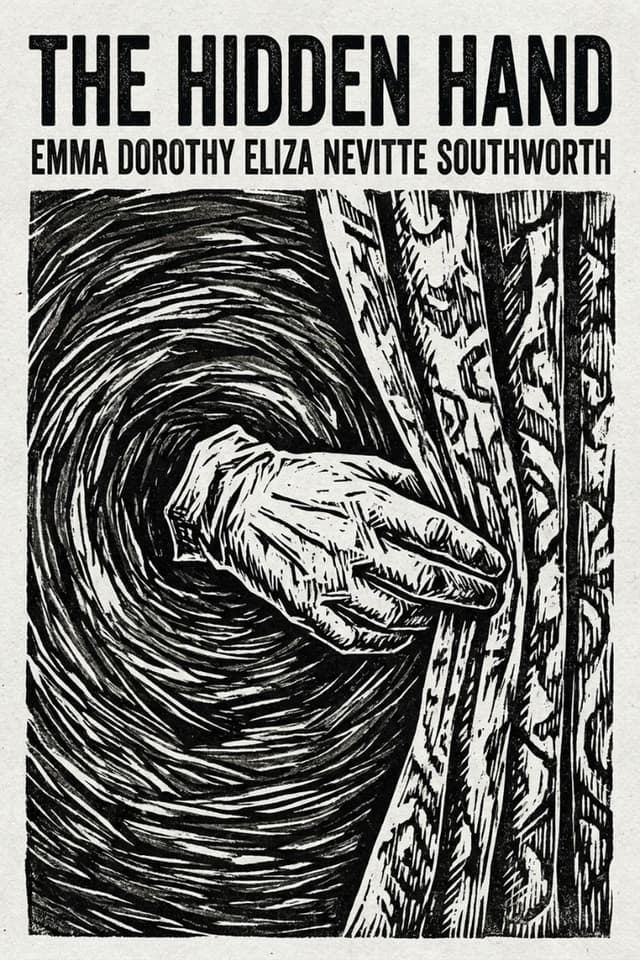
The Hidden Hand
Read The Hidden Hand by Emma Dorothy Eliza Nevitte Southworth for free on Novelhalla, and try out our easy-to-read modern edition of this classic book. You can also download the EPUB and read it on any device if you prefer!
The Plot
The Newsboy
On the streets of New York City, a scrappy kid in boy's clothes is making a living selling newspapers, carrying bags, and blacking boots. The kid is quick, funny, tough as nails, and has been surviving alone for years. There's just one problem: the kid isn't a boy. Her name is Capitola Black, and she's been dressing as a boy because a girl alone on the streets of New York can't get work, can't stay safe, and can't survive. A boy can.
When she's finally hauled before a judge for vagrancy, the truth comes out. And it turns out that someone has been looking for her.
Hurricane Hall
Major Ira Warfield is a cantankerous, bellowing old war veteran who lives on a remote Virginia plantation called Hurricane Hall. The name fits. The place is surrounded by steep gray rocks called the Devil's Hoof, perched above a raging mountain stream called the Devil's Run, and when storms roll through, the wind howls like something alive. Old Hurricane, as everyone calls him, is feared by his neighbors and obeyed by his servants, but underneath all that bluster is a man with secrets and a conscience that won't let him rest.
He's come to New York because a dying woman told him a story. Years ago, she was a midwife called to a mysterious house in the dead of night to deliver twins for a masked woman. The boy was stillborn. The girl survived. The midwife smuggled the baby out, named her Capitola, and raised her. But hard times scattered them, and the girl ended up alone on the streets.
Old Hurricane finds Capitola and brings her home to Hurricane Hall, names her his sole heir, and expects her to settle into the quiet life of a proper young lady.
He has no idea what he's gotten himself into.
Cap
Capitola does not do quiet. She does not do proper. She rides horses like a demon, talks back to everyone, makes the household servants either adore her or lose their minds, and treats every rule Old Hurricane sets down as a personal challenge. She is brave to the point of recklessness, funny to the point of insolence, and absolutely incapable of staying out of trouble.
But trouble is also looking for her.
The Villain
Colonel Gabriel Le Noir is one of the most dangerous men in Virginia, and he has very good reasons for wanting Capitola dead. She is the daughter of his brother, and her existence threatens an inheritance he has schemed, lied, and possibly killed to secure. Le Noir operates from the shadows, using money, connections, and hired muscle to get what he wants. His weapon of choice is Black Donald, a notorious outlaw and bandit leader who runs a gang from a hideout called the Devil's Punch Bowl.
Le Noir wants Capitola eliminated. Black Donald takes the job. What neither of them expects is that this teenage girl is going to be a significantly harder target than anticipated.
The Other Story
Running parallel to Capitola's adventures is the story of Traverse Rocke, a poor but noble young man, and his long-suffering mother Marah. Traverse catches the attention of kindly Doctor Day, who takes the boy under his wing and begins training him as a physician. In the process, Traverse falls in love with the doctor's gentle daughter, Clara Day. Clara is everything Capitola is not: sweet, obedient, soft-spoken, and deeply conventional. She is also in terrible danger, because when misfortune strikes her family, she falls under the power of the Le Noir family. And Craven Le Noir, the Colonel's son, wants Clara for himself.
The two storylines twist around each other in ways that keep revealing new connections, new betrayals, and new reasons to keep turning pages.
Capitola Versus Everyone
What makes this book impossible to put down is Capitola herself. She captures outlaws through sheer nerve. She fights a duel when no man will stand up for her honor. She outwits Black Donald when he breaks into her bedroom by using a trick so ingenious and so satisfying that you'll want to stand up and applaud. She disguises herself, talks her way out of impossible situations, and repeatedly saves people who are supposed to be saving her.
But the mysteries keep deepening. Who was Capitola's mother? What really happened in that house the night she was born? How does Old Hurricane fit into all of this? And what is the hidden hand that has been pulling strings behind every disaster, every disappearance, every act of cruelty in this story?
The answers, when they come, connect everything.
About the Author: E.D.E.N. Southworth
A Name Like No Other
Emma Dorothy Eliza Nevitte Southworth was born in Washington, D.C. on December 26, 1819. Her father, a Virginia merchant, died when she was three. On his deathbed, he had a priest re-christen little Emma with additional names so that her initials would spell E.D.E.N. It was a name perfectly suited to a future novelist, and she used it her entire career.
Hard Times
She grew up in her stepfather's school in Washington and recalled her childhood as lonely, with her happiest moments spent exploring Maryland's Tidewater region on horseback, soaking up the history and folklore that would later fill her novels. In 1840, she married inventor Frederick Southworth and moved to the Wisconsin frontier. Four years later, while she was pregnant with their second child, he abandoned the family and disappeared to South America.
Southworth returned to Washington with two small children and no money. She taught in the public schools during the day and wrote stories late at night. Her first published story appeared in 1846. By 1849, her first novel, Retribution, was a hit, and she never looked back.
The Most Popular Writer in America
Southworth eventually published over sixty novels and became, by many accounts, the most widely read American author of the second half of the 19th century. She signed an exclusive contract with Robert Bonner's New York Ledger that earned her around $10,000 a year, making her one of the highest-paid writers in the country. Her novels were serialized to enormous audiences, translated into German, French, Chinese, Spanish, and Icelandic, and devoured by readers from college professors to street kids.
She lived in a picturesque Georgetown cottage called Prospect Cottage, perched above the Potomac, where she wrote for decades. Despite being raised in a slave-owning family, she published in abolitionist newspapers, supported emancipation, and was a close friend of Harriet Beecher Stowe. During the Civil War, she volunteered as a nurse, managed the National Colored Home, and attended Lincoln's second inaugural ball.
Forgotten and Found
Southworth died in Georgetown on June 30, 1899. Her novels stayed in print into the 1920s, but the rise of literary modernism swept her reputation away. For most of the 20th century, she was virtually unknown. Scholars have recently begun recovering her work, recognizing her heroines as remarkably subversive figures who challenged Victorian ideas about femininity decades before such challenges became respectable.
Fun Facts About the Book
America's First Million-Seller
The Hidden Hand was one of the first American novels to sell over a million copies. It was so wildly popular that the New York Ledger serialized it three separate times: in 1859, 1868-69, and 1883. Each time, circulation spiked. The publisher used it as a guaranteed way to boost readership whenever numbers needed a lift.
Forty Stage Versions
More than forty theatrical adaptations of The Hidden Hand played in theaters across the United States. Capitola became a genuine cultural icon. Women wore Capitola hats, Capitola boots, and Capitola dresses. There is a Capitola Hotel and even a town in California named Capitola.
Based on Real Life
Southworth claimed that nearly every adventure in The Hidden Hand was drawn from real events. Given that the novel includes kidnappings, duels, bandits, trap doors, secret identities, and multiple murder plots, one has to wonder what kind of life she was leading in Georgetown.
The Scribbling Women
Nathaniel Hawthorne once complained bitterly about the "damned mob of scribbling women" whose enormous popularity kept publishers too busy to properly promote his own work. Southworth was very much one of those women. She outsold Hawthorne by staggering margins throughout her career, and there's a certain delicious justice in the fact that her most famous heroine could probably have beaten any of his protagonists in a fair fight.
Serialized Suspense
The novel was originally written for weekly serialization, which explains its relentless cliffhanger structure. Every chapter ends with something happening that makes it physically painful to stop reading. Southworth understood addictive storytelling long before anyone had a word for it.
The Sequel
The Hidden Hand was originally published in two parts, with the second half sometimes appearing under the title Capitola the Madcap. Some editions only include the first half, so readers should make sure they have the complete novel. There's nothing worse than getting halfway through Capitola's adventures and discovering the book just stops.
Themes
A Girl Can Do Anything
Capitola is the argument made flesh. She can ride, fight, think, scheme, joke, and survive better than almost any man in the novel. And she does it all while being told at every turn that girls are supposed to sit down, be quiet, and wait for someone to save them. Southworth never makes this preachy. She just lets Cap be Cap, and the point makes itself.
The Trap of Femininity
The novel runs two heroines side by side: Capitola, who refuses to play by the rules, and Clara Day, who follows them perfectly. Clara is beautiful, virtuous, obedient, and completely helpless when bad things happen to her. She needs Capitola to rescue her. Southworth isn't mocking Clara, but she's making a quiet, devastating point about what happens to women who do everything right in a world that doesn't protect them for it.
Class, Power, and Corruption
The Le Noir family represents the dark side of the Southern aristocracy: wealth and status used as weapons, respectability as a mask for villainy. The novel is fascinated by the gap between what powerful people appear to be and what they actually do when no one is watching.
Disguise and Identity
Capitola survives by performing different versions of herself. She's a boy on the streets, a proper young lady when it suits her, a warrior when she needs to be. The novel suggests that identity is less about what you are than about what you're willing to become when the situation demands it.
Found Family
Old Hurricane and Capitola start as strangers and become the most entertaining surrogate father-daughter pair in 19th-century fiction. Their bickering, mutual exasperation, and deep underlying affection give the novel its warmth. In a story full of missing parents, broken families, and secret origins, the bond you choose matters more than the one you're born into.
The Book's Legacy
The Hidden Hand was a phenomenon in its day, one of the best-selling and most widely adapted American novels of the 19th century, with a heroine who was as close to a household name as a fictional character could get. Capitola Black was the original action heroine: smart-mouthed, brave, independent, and completely unwilling to wait for a man to solve her problems.
The novel disappeared from popular consciousness in the early 20th century as literary tastes shifted toward the spare, serious style of modernism and away from the melodramatic storytelling that Southworth mastered. For decades, she was a footnote, remembered mostly as one of Hawthorne's "scribbling women."
But The Hidden Hand has been rediscovered by scholars and readers who recognize what it really is: a wildly entertaining novel with a genuinely subversive feminist heroine, written at a time when such characters were almost unheard of. Capitola doesn't just push against the boundaries of what women were allowed to do in 1859. She ignores them entirely, with a grin on her face and a plan already forming.
If you think feisty, independent heroines are a modern invention, this book would like a word.