Novelhalla
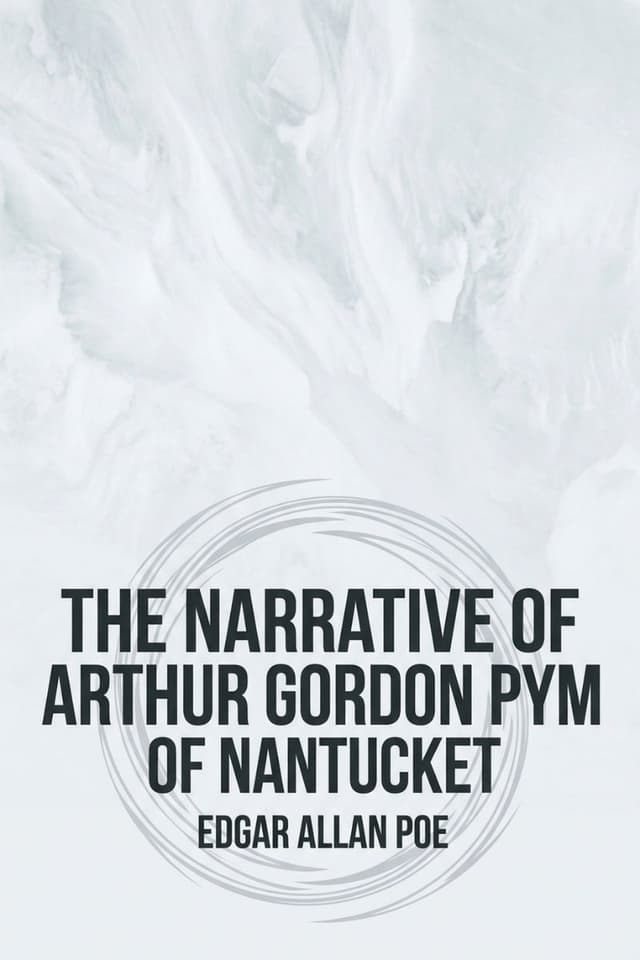
The Narrative of Arthur Gordon Pym of Nantucket
Read The Narrative of Arthur Gordon Pym of Nantucket by Edgar Allan Poe for free on Novelhalla, and try out our easy-to-read modern edition of this classic book. You can also download the EPUB and read it on any device if you prefer!
The Plot
The Call of the Sea
Arthur Gordon Pym is the son of a respectable Nantucket trader, heir to a comfortable fortune, with every reason to stay safely on land. But his closest friend is Augustus Barnard, whose father captains a whaling ship, and Augustus fills his head with tales of storm and adventure, of distant oceans and undiscovered shores. The sea calls to Pym with a voice he cannot resist.
One night, both young men drunk on wine and bravado, they take a small sailboat out into the harbor. A storm catches them. Their boat is run down by a whaling ship in the darkness, and they are pulled half-drowned from the wreckage. By morning they are back in Nantucket, able to pass off their haggard appearance as the aftermath of a party.
For most young men, such an experience would cure the longing for adventure. For Pym, it only sharpens the appetite.
The Stowaway
Augustus's father is preparing to sail on the Grampus, a whaling brig bound for the South Pacific. Pym begs to go along, but his grandfather forbids it. So the two friends devise a scheme: Pym will hide in the hold, concealed among the cargo, until the ship is too far from land for Captain Barnard to turn back. Augustus will smuggle him food and water. In a few days, the stowaway will reveal himself and be welcomed aboard.
Nothing goes according to plan.
Pym's hiding place is a coffin-shaped box wedged deep in the ship's hold, surrounded by barrels and crates in a space so dark and cramped that he loses all sense of time. His only companion is his beloved Newfoundland dog, Tiger. Augustus was supposed to visit him daily, but days pass without contact. Pym's provisions run out. He begins to hallucinate from hunger and thirst. He writes farewell notes that he knows will never be read.
When Augustus finally reaches him, Pym learns why he has been abandoned. Something terrible has happened on the Grampus. And Pym, hidden in the darkness below, has missed it all.
Dirk Peters
What Augustus tells him changes everything. The ship Pym stowed away on no longer exists as he knew it. The voyage to the South Pacific has become something else entirely. And the only ally the two young men have is a man named Dirk Peters: half Native American, enormously strong, with a face so misshapen it seems barely human. Peters is dangerous, unpredictable, and their only hope of survival.
The three of them must find a way through a nightmare that grows worse with each passing day. The Grampus becomes a floating hell of violence, desperation, and impossible choices. Men who were shipmates become enemies. The rules that govern civilized behavior fall away one by one. And the sea, indifferent to human suffering, offers no rescue.
The Jane Guy
Against all odds, Pym survives. He is picked up by a trading vessel called the Jane Guy, bound for the southern oceans. Most men who had endured what Pym endured would want nothing more than to return home. But Pym discovers that the horrors of the Grampus have not cured his hunger for the unknown. If anything, they have intensified it.
The Jane Guy's captain dreams of sailing farther south than any explorer before him, into waters that remain blank spaces on every map. Pym urges him onward. He wants to see what lies beyond the ice, beyond the limits of the known world. Dirk Peters, who also survived, accompanies him. The two men who shared unspeakable experiences are now bound together by something stronger than friendship.
Into the Unknown
As the Jane Guy sails deeper into Antarctic waters, the world begins to change in ways that defy explanation. The weather grows warmer instead of colder. The water takes on strange colors and textures. Islands appear that exist on no chart, inhabited by people who have never seen a white man, who live by customs that seem designed by some alien intelligence.
On an island called Tsalal, the crew of the Jane Guy encounters a tribe unlike any recorded in the annals of exploration. Everything about them is strange. Everything about their island is strange. Their chief welcomes the sailors with apparent friendship, but something feels wrong. The natives flinch at colors they have never seen. They shriek at sights that seem ordinary. What do they know that the sailors do not?
Pym presses on, driven by a compulsion he cannot name. He must see what lies at the bottom of the world. He must know what waits at the South Pole, in those regions where no human being has ever ventured.
The narrative that follows defies easy description. Poe presents it as the true account of Arthur Gordon Pym, edited for publication by Poe himself. Whether it is truth or fantasy, confession or hoax, readers have debated for nearly two centuries. All that can be said with certainty is that Pym's journey takes him to places that strain the boundaries of the believable, and ends with an image that has haunted readers ever since: a shrouded figure, vast and white, rising from the mist at the edge of the world.
About the Author: Edgar Allan Poe
The Orphan
Edgar Poe was born in Boston on January 19, 1809, to a pair of traveling actors. His father abandoned the family before Edgar was two. His mother died of tuberculosis in Richmond, Virginia, in December 1811, leaving three children orphaned. Edgar was taken in by John and Frances Allan, a wealthy Richmond merchant and his wife. They never legally adopted him, but they gave him their name: he became Edgar Allan Poe.
The Allans took young Edgar to England, where he attended boarding school for five years. He was a brilliant student, excelling in Latin and French. But his relationship with John Allan was troubled from the start. Allan was practical and hard-headed; Poe was sensitive and artistic. They would quarrel bitterly throughout their lives.
The Gambler and the Soldier
In 1826, Poe enrolled at the University of Virginia. He excelled academically but ran up enormous gambling debts that Allan refused to pay. After less than a year, he was forced to withdraw. He quarreled with Allan, left Richmond for Boston, and published his first book of poems under the pseudonym "A Bostonian." He was eighteen years old.
Unable to support himself, Poe enlisted in the United States Army under a false name. He rose to the rank of sergeant major in just two years. When Frances Allan died in 1829, Poe briefly reconciled with John Allan, who helped him obtain an appointment to West Point. But the reconciliation did not last. Allan remarried, and Poe, deliberately flouting regulations, got himself court-martialed and expelled. Allan disowned him entirely.
The Editor and the Writer
Poe moved to Baltimore, where he lived with his aunt Maria Clemm and her young daughter Virginia. He began writing short stories and submitting them to magazines. In 1833, "MS. Found in a Bottle" won a fifty-dollar prize and brought him to the attention of the literary world. By 1835, he was editor of the Southern Literary Messenger in Richmond, establishing his reputation as a fierce and brilliant critic.
In 1836, Poe married Virginia Clemm. He was twenty-seven; she was thirteen. The marriage appears to have been genuinely loving. Virginia became Poe's devoted companion, and her mother served as their housekeeper and caretaker. But Virginia was frail, and in 1842 she began showing symptoms of tuberculosis, the same disease that had killed Poe's mother.
The Raven
Poe's career was a constant struggle. He worked for various magazines in Philadelphia and New York, gaining fame for his criticism and his tales of horror and mystery. He developed the detective story with "The Murders in the Rue Morgue." He wrote poems of haunting beauty and stories of psychological terror. But he was poorly paid, frequently unemployed, and plagued by accusations of drunkenness and erratic behavior.
In January 1845, "The Raven" was published in the New York Evening Mirror. It made Poe a household name almost overnight. The poem about the grieving lover and the ominous bird that speaks only "Nevermore" was reprinted everywhere, parodied, celebrated. But fame brought little money. Poe earned perhaps fifteen dollars from the most famous poem in American literature.
Virginia died on January 30, 1847. She was twenty-four. Poe was devastated. He continued to write but his health and mental state deteriorated. He returned to Richmond in 1849, hoping to remarry a childhood sweetheart and start fresh.
The Mystery of Baltimore
On September 27, 1849, Poe left Richmond bound for Philadelphia. He never arrived. On October 3, he was found semiconscious on a Baltimore street, wearing clothes that were not his own, unable to explain what had happened to him. He was taken to a hospital, where he drifted in and out of consciousness, occasionally shouting at invisible companions. He died on October 7, 1849. He was forty years old.
The cause of his death has never been determined. Theories have included alcoholism, rabies, a brain tumor, and foul play. The mystery seems fitting for a man who made mystery his art. He is buried in Westminster Presbyterian Churchyard in Baltimore.
Fun Facts About the Book
Poe's Only Novel
The Narrative of Arthur Gordon Pym is the only complete novel Edgar Allan Poe ever wrote. He was primarily a short story writer and poet, and he later called Pym "a very silly book." But the novel's influence far exceeded his estimation of it.
A Hoax Within a Hoax
Poe framed the novel as a true account, with a preface in which "Arthur Gordon Pym" explains that he was persuaded to publish his adventures by his friend "Mr. Poe." The first installments, published in the Southern Literary Messenger, were presented as fact. Poe loved hoaxes and often blurred the line between fiction and reality.
Based on Real Expeditions
Poe researched Antarctic exploration extensively, drawing on accounts of actual voyages. He borrowed heavily from Benjamin Morrell's Narrative of Four Voyages and Jeremiah Reynolds's Address on the Subject of a Surveying and Exploring Expedition. Some passages closely follow these sources.
The Hollow Earth Theory
The novel's mysterious Antarctic setting was influenced by the Hollow Earth theory of John Cleves Symmes, who proposed in the 1820s that the earth was hollow and open at the poles. Poe had already used this theory in his earlier story "MS. Found in a Bottle." The idea of strange regions at the South Pole was taken seriously by many readers of the time.
Baudelaire's Champion
The novel received mixed reviews in America, but it found passionate admirers in France. Charles Baudelaire translated it in 1857, helping to establish Poe's reputation in Europe as a literary master. Jorge Luis Borges later called Pym "Poe's greatest work."
Jules Verne's Sequel
Jules Verne was so fascinated by Pym that he wrote a sequel: An Antarctic Mystery, published in 1897. Verne felt that Poe's story demanded continuation and attempted to resolve its mysteries.
Lovecraft's Inspiration
H.P. Lovecraft borrowed extensively from Pym for his 1936 novel At the Mountains of Madness, which is also set in Antarctica and features similar themes of ancient strangeness and cosmic dread. Lovecraft considered Poe one of his greatest influences.
A Disturbing Coincidence
The novel contains a scene involving castaways adrift at sea facing an unthinkable choice. In 1884, forty-six years after the novel's publication, a yacht called the Mignonette sank with survivors who faced circumstances eerily similar to those Poe described. The name of one of the real-life participants matched a character in Poe's fiction. This coincidence has been called one of the most remarkable in literary history.
Themes
The Lure of the Unknown
Pym is driven by an insatiable desire to see what lies beyond the horizon. Every disaster he survives only intensifies his longing for more. This is not rational ambition but something closer to compulsion, a drive that pushes him toward experiences most people would flee. The novel asks whether the urge to explore the unknown is heroic or self-destructive, and refuses to provide a comfortable answer.
Entrapment and Burial
Poe returns obsessively to images of confinement: Pym trapped in his coffin-like box in the hold, buried alive in darkness, sealed in spaces where no one can hear him scream. The terror of being enclosed, unable to escape, runs through the novel like a recurring nightmare. This was one of Poe's deepest fears, and it surfaces in many of his most famous tales.
The Fragility of Civilization
When disaster strikes, the rules that govern civilized behavior fall away with terrifying speed. Men who were friends become threats. Survival demands choices that would be unthinkable on land. The novel strips away the veneer of society to expose what lies beneath, and what it reveals is not reassuring.
The Unknowable
The novel ends without explaining itself. The final pages describe phenomena that defy rational interpretation, and then the narrative simply stops. Poe seems to be suggesting that some experiences cannot be put into words, that language fails when confronted with the truly alien. The mystery at the heart of Pym is not a puzzle to be solved but an abyss to be contemplated.
The Book's Legacy
The Narrative of Arthur Gordon Pym was not a commercial success in Poe's lifetime, and its author dismissed it as trivial. But the novel's influence has been profound and far-reaching.
Herman Melville, who owned a copy of Pym, echoed its themes and imagery in Moby-Dick. Jules Verne admired it so much that he wrote a sequel. H.P. Lovecraft used it as a template for his own tales of Antarctic horror. Writers from Baudelaire to Borges have praised it as a masterpiece of the strange and the uncanny.
The novel anticipated the genre of cosmic horror, the literature of the unnameable and incomprehensible that Lovecraft would later develop. It also stands as one of the earliest American novels to take adventure fiction into genuinely disturbing psychological territory, turning the sea voyage into a journey through the darkest regions of the human mind.
What waits at the end of Pym's journey? Readers have debated for nearly two centuries. The novel refuses to say, and in that refusal lies its strange, persistent power.