Novelhalla
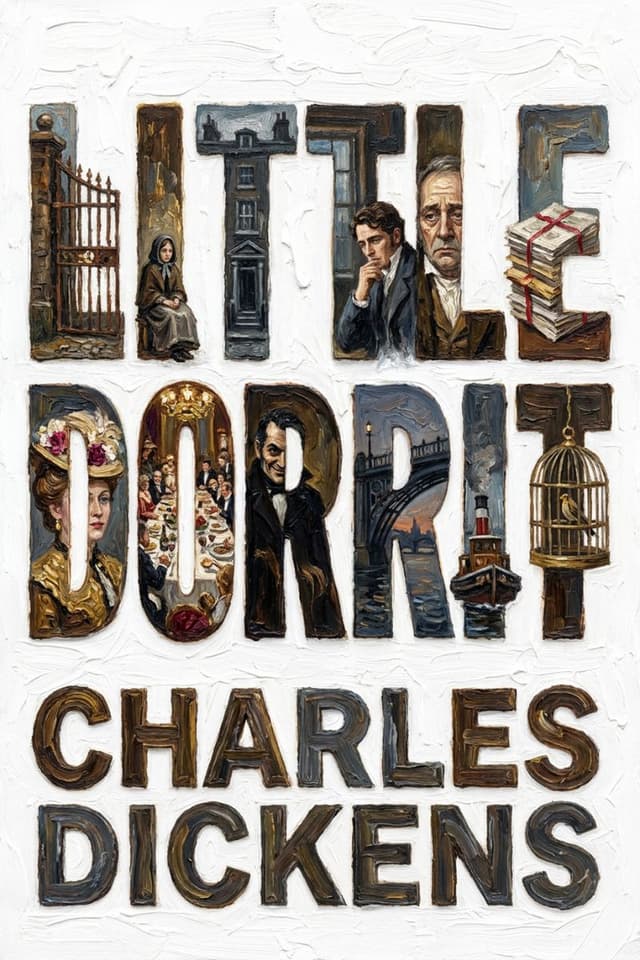
Little Dorrit
Read Little Dorrit by Charles Dickens for free on Novelhalla, and try out our easy-to-read modern edition of this classic book. You can also download the EPUB and read it on any device if you prefer!
The Plot
The novel opens in two prisons at once. In Marseilles, a murderer named Rigaud awaits trial in a sun-scorched cell. In London, an entire family lives inside the Marshalsea, the debtors' prison in Southwark where men who could not pay what they owed were locked up until they could, which meant, in many cases, forever.
William Dorrit has been in the Marshalsea for more than twenty years. He arrived with his wife and two small children, Fanny and Edward (called Tip). His wife was pregnant. Seven months later, she gave birth to a third child, a daughter named Amy, who has never known any other home. Mrs. Dorrit died when Amy was eight, and the little girl simply took her mother's place, caring for her father with a devotion that would define the rest of her life.
William Dorrit has become the longest-serving inmate in the prison, and the distinction has given him a kind of melancholy grandeur. He is known as the Father of the Marshalsea, and he has settled into the role with the quiet dignity of a man who has decided that if he must live in a cage, he will be its king. He does not work. He does not attempt to untangle the debts that put him there. He accepts small gifts of money from visitors and newer inmates with the gracious condescension of a nobleman receiving tribute, and if the tribute is slow in coming, he drops hints until it appears. He has built an entire identity out of refined helplessness.
Amy, whom everyone calls Little Dorrit because she is small and slight, supports the family through needlework she does outside the prison walls. She is free to come and go, as are all the family members who are not actually the debtor, but she returns to the Marshalsea every evening to be with her father. She never tells him that she works for his keep. She never lets him see how hard their life actually is. She protects his illusions the way a mother protects a child.
The World Beyond the Prison
Into this world comes Arthur Clennam, a man in his forties who is just returning to London after twenty years abroad in China, where he managed his family's business following his father's exile there. Arthur's father has recently died, and on his deathbed he pressed a watch into Arthur's hands with the cryptic words "Do Not Forget." Arthur is haunted by the suspicion that his family has done some wrong, that somewhere in his parents' past there is a debt of a different kind that has never been repaid.
Arthur's mother, Mrs. Clennam, is a formidable woman confined to a wheelchair in a crumbling house, running the family business through sheer force of will and her clerk, the sinister Jeremiah Flintwinch. She is rigid, pious, and cold, and Arthur has never felt loved by her. When he tells her he is leaving the family firm, she accepts his departure without visible emotion and takes Flintwinch as her new partner.
It is at his mother's house that Arthur first notices Little Dorrit, a tiny, pale seamstress who does needlework for Mrs. Clennam. Something about the girl troubles him. He follows her one evening and discovers that she lives in the Marshalsea. He begins to take an interest in her family, partly out of compassion and partly because he suspects that the Dorrits may somehow be connected to whatever secret his father wanted him to remember.
Arthur tries to investigate William Dorrit's debts through official channels, which brings him to the Circumlocution Office, a government department whose entire purpose, as far as anyone can tell, is to ensure that nothing ever gets done. The Office is staffed by the Barnacle family, an aristocratic clan that has attached itself to every branch of government like its namesake to the hull of a ship. Arthur is shuffled from clerk to clerk, from form to form, from one politely useless official to another. He gets nowhere. But in the waiting rooms of the Circumlocution Office, he meets Daniel Doyce, an inventor who has been trying for years to get a patent approved and who will become Arthur's friend and business partner.
The Wider World
The novel sprawls outward from the prison and the Circumlocution Office into a vast network of interconnected lives. In Bleeding Heart Yard, a cramped neighborhood of working poor, the Plornish family struggles to get by under the thumb of their landlord, the genial-looking Mr. Casby, whose benevolent appearance conceals a miser's heart. Casby employs a rent collector named Pancks, a small, driven, puffing man who does all the dirty work of squeezing tenants while Casby maintains his reputation as a kindly patriarch. Pancks is not what he seems. Beneath the hard exterior of the debt collector is a man of surprising conscience who has been conducting a secret investigation into the Dorrit family's tangled affairs.
Meanwhile, Arthur meets the Meagles family, including their daughter Pet, with whom he falls quietly and hopelessly in love. Pet, however, marries Henry Gowan, a well-connected but lazy artist who treats his wife with casual cruelty and his talent with casual neglect. The Meagles have also taken in a foundling girl called Tattycoram, whose simmering resentment at being a charity case eventually drives her into the arms of the mysterious Miss Wade, a bitter, isolated woman whose pain has hardened into something close to malice.
And above all of them, growing larger by the day, looms the figure of Mr. Merdle, the greatest financier in England. Merdle is everywhere. His name is spoken with reverence in drawing rooms, in government offices, in the financial press. Everyone wants to invest with Merdle. His wife, a grand society hostess always referred to in connection with her magnificent bosom, presides over gatherings where the wealthy and the powerful compete for Merdle's attention. Even Merdle's servants intimidate him. He moves through his own parties like a man who has wandered into the wrong house, clasping his wrists as though wearing invisible handcuffs, looking profoundly uncomfortable with the adoration of the world.
Rigaud, the murderer from the Marseilles prison, has meanwhile been acquitted for lack of evidence. He resurfaces in London under the name Blandois, a swaggering, menacing figure who presents himself as a gentleman while radiating danger. He begins visiting Mrs. Clennam, and whatever business he has with her, it is clearly something she cannot refuse and cannot discuss.
Book the First: Poverty
Pancks, through dogged detective work, uncovers a staggering revelation: William Dorrit is the unclaimed heir to a large fortune. The debts can be paid. The prison doors swing open. After more than two decades, the Father of the Marshalsea walks free.
What follows is one of the great studies in human nature in all of Dickens. You might expect the Dorrits to be grateful, transformed, humbled by their deliverance. Instead, wealth does to them precisely what prison did, only in reverse. William Dorrit immediately begins constructing a new fiction to replace the old one. Where once he was the dignified patriarch of the prison, he now becomes the dignified patriarch of high society, and the central project of his new life is the same as the central project of his old one: making sure nobody sees the truth.
The family decamps to Europe, accompanied by Mrs. General, a hired companion and governess whose approach to life can be summarized by her conviction that the words "prunes" and "prism" give the lips a pleasing shape and that unpleasant subjects should never be mentioned. Fanny takes to wealth like a natural, marrying Edmund Sparkler, the dim but well-connected stepson of Mr. Merdle. Tip continues to be useless, only now he is expensively useless. William Dorrit schemes to marry Mrs. General himself, ascending ever higher into the respectability he craves.
Only Amy is unchanged. Only Amy is unhappy. She is the same person she was in the Marshalsea, devoted and selfless and quietly heartbroken, because the family's new wealth has separated her from Arthur Clennam, whom she loves but who does not yet understand that he loves her back. Her father, once so dependent on her, now criticizes her for failing to adopt the manners of their new station. Her uncle Frederick, William's brother and a gentle, broken man who played clarinet in a theater orchestra, is the only family member who shares Amy's discomfort with their transformation.
Book the Second: Riches
The European tour continues through Venice and Rome, but William Dorrit's edifice of respectability is built on sand. At a grand dinner in Rome, his mind breaks. He rises from the table and begins speaking as though he is back in the Marshalsea, welcoming visitors and graciously accepting their tributes. It is devastating. He collapses and dies shortly afterward. His brother Frederick, who has been quietly fading for years, dies the same night.
Back in London, Arthur has been managing his partnership with Doyce and, at Pancks's urging, has invested heavily in Mr. Merdle's enterprises. Everyone has invested in Merdle. It is the sure thing, the golden opportunity, the investment that cannot fail. And then Merdle is found dead, having taken his own life. His financial empire is revealed to be a fraud, a hollow shell of borrowed money and false promises. Thousands are ruined. Among them is Arthur, who has not only lost his own money but the funds of his partner Doyce. He takes full responsibility and, with bitter symmetry, is imprisoned in the Marshalsea, where he is given the Dorrits' old room.
Arthur falls ill in prison, sinking into despair. He is visited by various people, including the relentlessly cheerful Ferdinand Barnacle, who assures him that the Circumlocution Office had nothing to do with his troubles. He is visited by Blandois, who is closing in on Mrs. Clennam with whatever weapon he holds over her. And he is visited by Little Dorrit, who has returned to London after her father's death and who walks back into the Marshalsea as though she never left, taking up her old position at the bedside of a broken man, nursing Arthur back to health with the same quiet devotion she once gave her father.
The novel's tangled mysteries converge. Blandois holds documents that reveal the truth about Mrs. Clennam and the Clennam family's connection to the Dorrits. The secret Arthur's father begged him not to forget involves the suppression of a legacy and the concealment of Arthur's true origins. What exactly has been hidden, who has been wronged, and whether the wrongs can ever be set right form the knot that the final chapters must untie.
About the Author
Charles Dickens was the most famous writer in the English-speaking world during his lifetime, and he remains one of the most widely read novelists who ever lived. He was born on February 7, 1812, in Landport, Portsmouth, the second of eight children. His father, John Dickens, was a naval pay clerk with a talent for living beyond his means, a trait that would scar his son's imagination permanently.
When Charles was twelve, his father was arrested for debt and sent to the Marshalsea prison in Southwark. The family moved into the prison with him, as was the custom, but Charles was sent instead to work at Warren's Blacking Factory, a boot-polish warehouse near the Thames, where he spent months pasting labels on bottles for six shillings a week. The experience was relatively brief, but the shame and terror of it never left him. He rarely spoke of it during his lifetime. His readers did not learn the full story until after his death, when his friend and biographer John Forster revealed it in 1870. But every debtors' prison in his novels, every abandoned child, every scene of institutional cruelty carries the emotional charge of those few months in the blacking factory.
Dickens received an interrupted education and eventually found work as a law clerk, then as a parliamentary reporter, where he developed both his shorthand skills and his contempt for the machinery of government. He began publishing sketches of London life under the pseudonym "Boz" in 1833, and in 1836 The Pickwick Papers began appearing in monthly installments and made him, almost overnight, the most popular author in England. He was twenty-four.
What followed was one of the most prodigious literary careers in history. Over the next thirty-four years, Dickens produced fifteen major novels, edited weekly journals, gave exhausting public readings, campaigned for social reform, managed an amateur theatrical company, fathered ten children, and maintained a public persona as the embodiment of Victorian domestic virtue while his private life grew increasingly complicated.
He married Catherine Hogarth in 1836, and the marriage produced ten surviving children but little lasting happiness. By the mid-1850s, Dickens was restless and dissatisfied. In February 1855, he received a letter from Maria Beadnell, a woman he had been passionately in love with as a young man. He arranged a reunion, expecting to find the enchanting girl of his memory. Instead he found a plump, breathless, middle-aged woman who talked without stopping. He was devastated, and he turned the experience directly into one of Little Dorrit's finest comic characters: Flora Finching, Arthur Clennam's former sweetheart, whom Arthur remembers as a lily and discovers has become a peony.
Little Dorrit was composed during one of the darkest and most turbulent periods of Dickens's life. He had lost faith in government after what he saw as catastrophic mismanagement of the Crimean War, where British soldiers died in appalling numbers from cold, disease, and administrative incompetence while officials in London insisted it was nobody's fault. He had originally planned to title the novel Nobody's Fault, a bitterly sarcastic reference to this refusal of accountability. The Circumlocution Office and its Barnacle family are his revenge.
The novel was serialized in twenty monthly parts between December 1855 and June 1857, illustrated by Hablot Knight Browne ("Phiz"), and published by Bradbury and Evans. The promotion was enormous: 310,000 handbills and 4,000 posters were printed for the first installment alone. Sales were strong throughout the run.
In 1857, while staging an amateur production of Wilkie Collins's play The Frozen Deep, Dickens met Ellen Ternan, an eighteen-year-old actress. He was forty-five. His infatuation with her precipitated a separation from Catherine in 1858 that became the great scandal of his career. He treated Catherine badly, publicly accusing her of being an inadequate mother and attempting to have her institutionalized. Catherine left the family home, taking only one of their children. Her sister Georgina stayed with Dickens and raised the rest. Dickens's relationship with Ellen Ternan, whatever its precise nature, lasted the rest of his life. He went to extraordinary lengths to conceal it, and both he and Ternan destroyed all their correspondence.
Dickens's later novels, including Little Dorrit, A Tale of Two Cities (1859), Great Expectations (1861), and Our Mutual Friend (1865), are darker, more structurally ambitious, and more psychologically complex than his earlier work. Critics have sometimes called this his "dark period," though it produced some of his finest writing.
He spent his final years giving punishing public reading tours that wrecked his health. He had always been an electrifying performer, acting out scenes from his novels with such intensity that audiences wept and fainted, but the readings took a physical toll from which he never recovered. He suffered a stroke on June 8, 1870, at his home at Gad's Hill Place, and died the following day. He was fifty-eight. Against his wishes for a quiet burial, he was interred in Poets' Corner at Westminster Abbey. His grave was left open for three days, and thousands came to pay their respects.
Fun Facts
-
The Marshalsea was personal. Dickens's own father, John Dickens, was imprisoned in the Marshalsea for debt in 1824, when Charles was twelve. The family moved into the prison while Charles was sent to work in a boot-polish factory. He kept this experience secret his entire life, and his readers did not learn of it until after his death. William Dorrit is a far more serious and complex portrait of the debtor-father than the cheerful Mr. Micawber in David Copperfield, who was Dickens's earlier, lighter version of the same raw material.
-
Flora Finching is revenge by novel. In 1855, Dickens reunited with Maria Beadnell, the great love of his youth, and was so shocked by the change in her that he immortalized the experience as Arthur Clennam's disastrous reunion with Flora. Maria, now Mrs. Winter, reportedly recognized herself and was not pleased.
-
The Circumlocution Office was current affairs. Dickens was enraged by the government's handling of the Crimean War, where administrative failures led to the deaths of hundreds of British soldiers. The Circumlocution Office and its doctrine of "How Not To Do It" were his satirical assault on the real bureaucracy he held responsible. He joined the Administrative Reform Association in 1855 and used the novel to channel his fury.
-
Mr. Merdle is based on real swindlers. The character draws on John Sadleir, an Irish politician and financier whose speculations collapsed in 1856, leading to his suicide by prussic acid on Hampstead Heath, and George Hudson, the "Railway King" whose empire of fraudulent speculation crashed in the late 1840s. Merdle's name is almost certainly a pun on the French word for excrement.
-
The original title was "Nobody's Fault." Dickens planned to call the novel Nobody's Fault, mocking the way officials evaded responsibility for the Crimean disaster by insisting no one was to blame. He changed the title as Amy Dorrit grew from a secondary character into the moral center of the story.
-
Sales were phenomenal. The first installment was backed by 310,000 handbills and 4,000 posters, and sales remained strong throughout the twenty-month run, making it one of Dickens's most commercially successful serializations.
-
Dickens visited the Marshalsea while writing the novel. Curiously, in the thirty years since his father's imprisonment, Dickens appears never to have returned to the site. When he finally did, while composing Little Dorrit, he found the front courtyard had become a butter shop and the prison walls had been absorbed into the surrounding neighborhood.
-
The novel fell out of favor, then came roaring back. Victorian and early twentieth-century critics often considered Little Dorrit one of Dickens's weaker efforts, too dark and sprawling. Modern critics have reversed this judgment entirely, and it is now frequently ranked among his masterpieces. George Bernard Shaw called it "a more seditious book than Das Kapital."
-
Kafka loved it. Franz Kafka, who knew something about bureaucratic nightmares, was a devoted admirer of the novel. He sent a copy to his fiancee Felice Bauer with the note: "You know it well. How could we forget Dickens." Tchaikovsky was also reportedly entranced by it.
-
The 2008 BBC adaptation is superb. Written by Andrew Davies and starring Claire Foy as Amy Dorrit, Matthew Macfadyen as Arthur Clennam, Tom Courtenay as William Dorrit, and Andy Serkis as Rigaud, it is widely considered one of the finest Dickens adaptations ever produced.
Themes
Prison as Metaphor. The Marshalsea is only the most visible of the novel's many prisons. Mrs. Clennam is imprisoned in her wheelchair and her crumbling house. The Circumlocution Office imprisons the public in an endless maze of forms and procedures. Society imprisons everyone in rigid expectations of class and propriety. Mrs. General's insistence on "prunes and prism" is a prison of manners. Even wealth, when the Dorrits finally achieve it, becomes a new kind of confinement, as the family devotes all its energy to concealing the past and performing respectability. Dickens asks whether anyone in his England is truly free, or whether the whole society is a Marshalsea with better furniture.
The Corruption of Money. The novel is structured in two halves titled "Poverty" and "Riches," and the bitter joke is that money solves nothing. The Dorrits in poverty are at least honest about their condition; the Dorrits in wealth become liars, snobs, and strangers to themselves. Mr. Merdle, the richest man in England, is miserable, and his wealth is a fiction that destroys everyone who believes in it. Only Amy, who never cared about money and cannot be changed by it, survives the transitions with her soul intact. Dickens is not arguing that poverty is virtuous, but that wealth as an end in itself is a particularly effective form of self-destruction.
Bureaucracy and Accountability. The Circumlocution Office is Dickens's most sustained attack on institutional failure. Its genius is the principle of "How Not To Do It," the art of appearing to address a problem while ensuring that nothing is ever actually accomplished. What makes the satire devastating is that no individual in the Office is particularly villainous. The Barnacles are pleasant enough, individually. It is the system itself that is monstrous, a machine designed to consume effort and produce nothing, and no one is responsible because no one is in charge. The parallel to the Crimean War failures that inspired the novel has only become more relevant with time.
Devotion and Self-Sacrifice. Amy Dorrit is one of Dickens's most complex heroines, and her goodness raises uncomfortable questions. She sacrifices everything for her father, then for Arthur, and the novel clearly admires her for it. But there is something troubling about a person whose entire identity is built around caring for others. Is Amy virtuous, or is she trapped in a different kind of prison, one built from duty and self-denial? The novel gestures toward this question without fully answering it, and readers have debated it ever since.
The Weight of the Past. Nearly every character in the novel is imprisoned by something that happened long ago. Arthur is haunted by his father's dying words and a wrong he cannot identify. Mrs. Clennam has built her entire life around concealing a secret from decades past. William Dorrit cannot escape the Marshalsea even after he leaves it; his mind returns there at the moment of his death. Miss Wade is consumed by old grievances. The novel suggests that the past is never really past, that the debts we refuse to acknowledge are the ones that imprison us most completely.
The Book's Legacy
Little Dorrit has had one of the most dramatic reversals of reputation in English literature. When it was published in 1857, it sold well but received mixed reviews. Many critics found it too dark, too sprawling, and too angry, lacking the exuberance and warmth of earlier Dickens. The influential Saturday Review complained that the novel was disjointed and its satire heavy-handed. For decades, it was treated as a minor work in the Dickens canon, overshadowed by David Copperfield, Bleak House, and Great Expectations.
The rehabilitation began in the early twentieth century. George Bernard Shaw championed the novel as one of Dickens's greatest achievements, calling it more revolutionary than Marx. Lionel Trilling's influential 1953 essay argued that Little Dorrit was Dickens's most profound exploration of society and selfhood, a novel that anticipated the concerns of modernist literature. By the mid-twentieth century, critics had recognized what Shaw and Trilling saw: that the novel's darkness and complexity were not weaknesses but the marks of a writer at the height of his powers, grappling with problems that simpler novels could not contain.
The Circumlocution Office has become one of Dickens's most enduring inventions, a shorthand for bureaucratic obstruction that has outlived the specific government it satirized. The phrase "How Not To Do It" entered the language. The Barnacle family, with their stranglehold on every branch of public administration, remain recognizable in any era where nepotism and institutional inertia conspire to prevent reform.
The character of Mr. Merdle has proved prophetic in ways Dickens could not have anticipated. Based on 1850s swindlers, Merdle has been compared to every subsequent financial fraud artist from Charles Ponzi to Bernie Madoff. The pattern is always the same: a figure of seemingly unassailable respectability, universally trusted, whose collapse reveals that an entire society was complicit in the delusion. Dickens understood that financial fraud does not succeed because the swindler is clever but because the victims want to believe.
The 2008 BBC television adaptation, with its remarkable cast and Andrew Davies's faithful screenplay, introduced the novel to a new audience and confirmed what readers of the novel had long known: that the story of Amy Dorrit, Arthur Clennam, and the world of prisons they inhabit is among the most moving and most modern things Dickens ever wrote.