Novelhalla
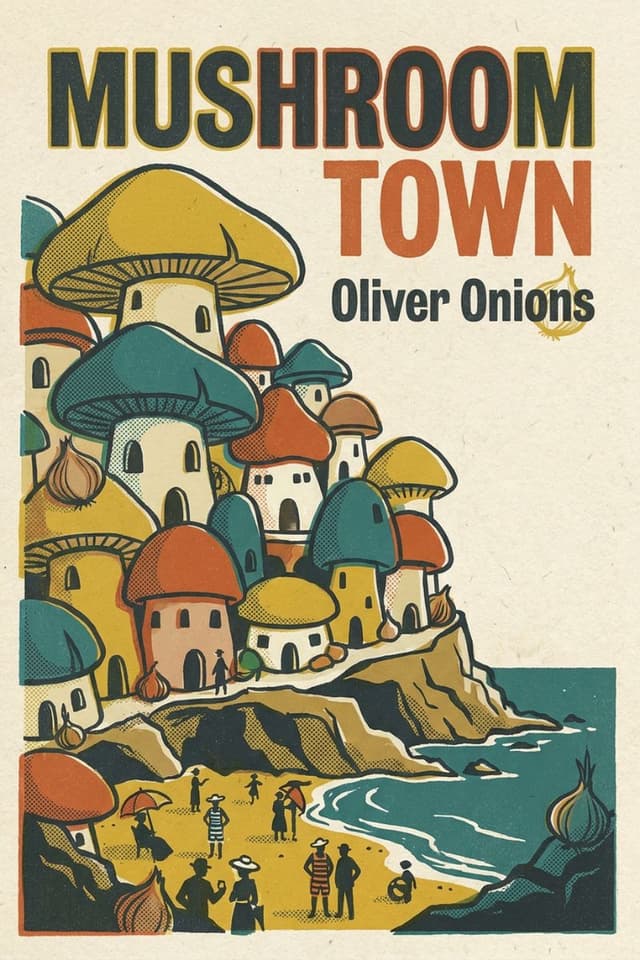
Mushroom Town
Read Mushroom Town by Oliver Onions for free on Novelhalla, and try out our easy-to-read modern edition of this classic book. You can also download the EPUB and read it on any device if you prefer!
The Plot
A Row of Cottages and Nothing Else
June 1880. A hired trap creaks along the coast road in North Wales carrying a Manchester cotton spinner, his wife, their two servants, a pile of tin trunks, and two children. Eleven-year-old John Willie Garden is running alongside with a catapult and both pockets full of ammunition. His little sister Minetta is asleep on her mother's shoulder. She's been ill, and the sea air is supposed to fix her.
What waits for them at the end of the road is Llanyglo: a dozen thatched cottages, three chapels, a school, a few scrabbly farms, one grocer's shop, and a stubby wooden jetty. Sand gets into everything. The nearest town with a bank is ten miles off. The matchboarding Edward Garden paid to have fitted in his cottage is still lying on the floor in a stack, because the man hired to do it, Dafydd Dafis, had a sick neighbor to sit with and then the fishing got good.
It's the most beautiful place any of them have ever seen, and by the end of the summer the Gardens have half gone native. John Willie has stopped wearing shoes. Minetta is brown as seaweed. Mrs. Garden has sent for her tricycle.
The Quiet Man With the Watch Chain
Edward Garden is a small, mild, clean-shaven man who wears gold-rimmed glasses and almost never says anything. Asked to give his opinion on a letter, he'll read it three times and then observe that it appears to be a letter. All Manchester quotes his judgments, on the rare occasions he offers one.
He came to Llanyglo for his daughter's health. That part is perfectly true. It's also true that the little silver trinkets dangling from his watch chain, the greyhounds and locomotives and winged wheels, are the tokens of a railway director, and that a railway director knows things about where track is going to be laid before anybody else does. Manchester and Liverpool are full of mill hands who get one week off a year and nowhere to spend it. Llanyglo has two miles of empty beach.
He buys a piece of ground from Squire Wynne, who is drowning so deep in mortgages he can't afford candles for his own chandelier, and he starts building a house. The Squire gives him one piece of advice on the way out: these people will do anything on earth for you if you go about it the right way, and nothing at all if you don't. The whole question of who owns land here comes down, in the end, to staying on the good side of Dafydd Dafis.
Stakes in the Ground
Then a Liverpool syndicate buys the land behind the house.
They're a company that sells shares in mines rather than mines, and what they need is a patch of genuine dirt with a genuine place name on it, somewhere far enough from civilization that nobody will come and look. To front the purchase they send Terry Armfield, a rapturous, hopeless, beautifully dressed young man who burns incense in his bedroom, who genuinely believes every word he says while he's saying it, and whose nickname among his own partners is one borrowed from the slang of the swell mob. They call him the Minder. He's the one who charms you while the others work out what you're worth.
Terry has surveyors drive stakes across the sandhills. Within a day the stakes are pulled up and a notice board is floating out on the tide. They're put back. They come up again.
What Terry has not grasped, and what the Squire tried to tell him, is that these are not fences. They're Saxon fences. Dafydd Dafis owns a harp, and in a dark farm kitchen with a single candle burning among the geraniums, he sits down and plays one very ordinary, very familiar tune, and every man in the room understands exactly what's being asked of him.
Summonses follow. And in the magistrates' court at Porth Neigr a strange affliction descends on the population of Llanyglo. Every witness called, every man charged, every neighbor who might have seen something, discovers that he has no English whatsoever. Dim Saesneg. Everything has to go through an interpreter, twice, in both directions, for days, while the rest of the county's business piles up behind it and the magistrate makes little dots on his blotting paper.
Two Lancashire brothers sitting in the well of the court, clog-sole men who bought alders all over Wales and picked up a good deal else along the way, are certain the outrage happened at ten o'clock, because they both looked at their watches. Nobody can shake them. Afterward, over beer in the tap room, the elder one starts thinking very slowly and carefully about a thin man who came into their lodgings that evening to collect a pair of boots, and about where their waistcoats were hanging at the time.
The House That Went Up in One Night
The Kerr brothers don't take it to a lawyer. They send home to Lancashire for the other two brothers, and on a moonless winter night, working by four lanterns with a nine gallon barrel tapped beside the sand heap, they build a house.
Not a wall. A house. There's an old Welsh custom, and the brothers know it because Ned has spent twenty years hearing gossip in every wood in the country: put up a dwelling on common land between dusk and dawn and get smoke out of the chimney by morning, and nobody can turn you out. Llanyglo has been insisting loudly and publicly that this land is common land. Sauce for the goose.
The village goes to bed. The village wakes up. Where there was nothing at all the night before, there's a house standing in the sandhills with smoke rising out of it.
And that is the thorn. That one squat, rough, workmanlike little building is the thing everything else in Llanyglo grows out of, because now there's a second English foothold, and the first one isn't giving ground either, and somewhere behind it all a syndicate is deciding what it wants to sell.
Thirty Years
The book begins, oddly enough, at the end. A stranger is taken up the headland by a local guide and shown the view: two miles of promenade, a pier three furlongs long with concert halls on the end that hold a thousand people apiece, hotels, gasometers, a railway station, a Kursaal with a Big Wheel turning in the gardens, electric light coming on down the front in three jumps. Nine thousand people live here in the winter. It's all about thirty years old. There are people born in this town who don't know their way around it.
The man to talk to, the guide says, is John Willie Garden, a bit over forty now, probably worth a quarter of a million, a good deal of it out of Llanyglo. Come to the Kursaal at a quarter to nine and you can meet him.
Everything in between is the story of how a stretch of sand with three chapels on it turned into that. Ambitious grocers who become men of property. A rising politician who discovers which way the money is pointing. A dreamer with a scheme for building something noble here, which is not remotely what his backers have in mind. A boy who grows up with one foot in each camp, speaking the local language when it suits him and forgetting it when that suits him better. And in the middle of the boom, a young man with money and a girl named Ynys, who belongs to a traveling family and to none of the settled worlds crowding into this town at all.
The mountains watch the whole thing. The guide, looking down at all that stone and iron and gilding, admits that sometimes he can't help thinking it wouldn't take much, one bad wind or an extra heave of the sea, and the entire place would simply be sponged out like initials on the sand.
About the Author: Oliver Onions
Early Life
George Oliver Onions was born in Bradford, Yorkshire, in November 1873, the son of a bank cashier. He studied art for three years in London at the National Arts Training Schools, which is the Royal College of Art today. He was a keen amateur boxer as a young man, and later listed his interests as motoring and science.
The Working Years
He didn't start as a novelist. He started as a commercial artist, designing posters and books and working as a magazine illustrator during the Boer War. He painted the dust jackets for his own earliest novels. His first book came out in 1900, and after that he wrote at an extraordinary pace across just about every genre going: comedies, crime, ghost stories, romances, historical fiction, even science fiction.
In 1909 he married the novelist Berta Ruck, who had been at the Slade with him. She was the daughter of a Merioneth family and the granddaughter of a Welsh-speaking grandmother who raised her. Through her, Onions acquired Wales, and the six years of hospitality he received there turned directly into this book. They had two sons, Arthur and William.
He served in the Royal Engineers during the First World War, and in 1918 he changed his name by deed poll to George Oliver, partly for his sons' sake. He went on publishing as Oliver Onions anyway.
Later Life
In 1939 he and Berta Ruck left London and settled in Aberdyfi on the Welsh coast, the country he'd written about so lovingly twenty-five years earlier. He kept writing into his seventies. His 1946 novel Poor Man's Tapestry won the James Tait Black Memorial Prize. He died in Aberystwyth in 1961, aged eighty-seven. Berta Ruck outlived him by seventeen years and died nine days after her hundredth birthday.
Legacy
Onions is remembered today almost entirely for one thing he probably didn't expect to be remembered for: ghost stories. His 1911 collection Widdershins, and above all the novella "The Beckoning Fair One," are considered among the finest supernatural fiction in English. Algernon Blackwood, H. P. Lovecraft and later horror writers all pointed to him. The realist novels he poured most of his career into fell out of print and are only now being rediscovered.
Fun Facts About the Book
The One Night House Is a Real Custom
The hafod unos is genuine Welsh folk tradition, not an invention for the plot. The idea was that a dwelling raised on common land in a single night, with smoke going up the chimney by morning, couldn't be pulled down, and the builder became a sort of tolerated freeholder. Whether it ever had any standing in actual law is another question entirely, which the book cheerfully raises and declines to settle. Houses across Wales still carry the name.
Don't Bother Looking for It on a Map
Onions opens the book by admitting he took liberties with Wales that were geographical, historical, etymological and even geological. Llanyglo is a composite stitched together out of several real places. He was writing at the exact moment the real coastal resorts were doing precisely this, so his imaginary town had plenty of models.
The Dedication Is to His Father in Law
The book is inscribed to Arthur Ashley Ruck, Berta Ruck's father, a colonel who served as Chief Constable of Caernarvonshire. Onions admits in the dedication that a good deal of his work had consisted of writing down things told to him by one of his Welsh hosts, and not always improving them.
It Was Written by a Horror Writer
Three years before this book, the same author published "The Beckoning Fair One," a story about a novelist slowly coming apart in a haunted set of rooms, which is routinely called one of the best ghost stories ever written in English. That's the reputation that survived. This is what he was actually spending his time on.
What "Glo" Means
Part of the plot turns on the fact that glo is Welsh for coal. The syndicate seizes on the place name as proof that there must be coal under the sandhills, on the reasoning that nobody names a place for nothing and all ground has something in it somewhere. It's about as rigorous as their geology ever gets.
The Timing
It was published in 1914, dated from Hampstead, and reached readers in the last months before the world it describes stopped existing. Onions was in uniform not long after.
It Starts With a Tour Guide
The opening isn't narration at all. It's one long monologue from an unnamed local walking a visitor up the headland and pointing things out, breaking off to mention the pier, the tram, the fireworks, the ruined British camp on the summit. Nothing is explained. You're simply shown the finished town, told it took thirty years, and then dropped back into 1880 to watch it happen.
Onions Ended Up Living There
Not in Llanyglo, which doesn't exist, but the man who wrote this affectionate and very clear-eyed book about English money arriving on the Welsh coast eventually moved to that coast permanently and died there.
Themes
Things That Grow Too Fast
The title is the thesis. A mushroom comes up overnight out of nothing, and everyone knows what that implies about how deep the roots go. The book keeps asking whether a place that appeared this quickly has anything holding it down, and whether the answer matters to the people making money from it.
What Money Does to a Place
Almost nobody in this book is a villain. Edward Garden isn't cruel, he's just quiet and extremely well informed. Howell Gruffydd is genuinely warm and also genuinely counting. The syndicate men are ridiculous rather than sinister. The transformation happens anyway, one perfectly reasonable transaction at a time, which is a far more unsettling account of how a place gets eaten than any conspiracy would be.
Two Peoples Sharing One Town
Lancashire and Wales end up living on the same two miles of sand, and the book watches the collision with enormous relish and no particular verdict. The Kerr brothers and Dafydd Dafis are equally stubborn, equally proud, equally clever, and neither side can quite believe what the other one is prepared to do about a fence.
Language as a Weapon
The courtroom chapter is one of the great comic set pieces in the book, and it's also completely serious. An entire village simply mislays the English language for three days and brings the machinery of the law to a standstill without ever once lying. Language here is a wall you can raise and lower at will, and everyone knows it, including the eleven-year-old who learns the trick from a fisherman in chapter one and uses it in the witness box.
The Believer and the Operators
Terry Armfield is the book's strangest creation: a man of real vision and real faith being used as camouflage by people with neither, who is never quite told what he's fronting for and never quite asks. The novel is fascinated by him and by the question of whether enthusiasm this pure is innocence or something more dangerous.
Growing Up Alongside a Town
John Willie arrives barefoot with a catapult and ends up a man of business with a candidacy and a quarter of a million pounds. The town grows up at exactly the same rate, and the book lets you decide what each of them gained and lost getting there.
Historical Context
The Wakes and the Railway
In the late nineteenth century, Lancashire mill towns shut down for one week a year, the Wakes, and entire populations decamped to the coast. New railway lines put the North Wales shore within a few hours of the smoke, and villages there swelled into full resort towns within a generation: promenades, piers, pavilions, boarding houses, all of it built fast and built for crowds. The novel is a close-range portrait of that exact process, written by someone watching it happen and married into a family who had been on the receiving end of it.
The Book's Legacy
This is the novel people mean when they say Oliver Onions deserves to be read for more than his ghosts. It's been compared to Hardy and to Forster, and the comparison isn't unearned: the same patient attention to a landscape, the same interest in what money and machinery do to a settled way of life, the same refusal to make anyone a straightforward hero.
It's also a strange and slightly experimental book for 1914. There's no single protagonist. The narrator is sometimes an anonymous local chatting to a tourist, sometimes a historian of the town, sometimes inside a small boy's head. Onions treats the town itself as the main character, with a birth and an adolescence and growing pains and things it tells and things it doesn't.
Modern readers tend to fall into two camps. It asks for patience, with long descriptive passages and a fondness for digression that was ordinary then and isn't now. Readers who give it that patience often say it does something very few novels manage, which is to make you feel you have actually lived somewhere for thirty years and watched it change beyond recognition, and to leave you unable to decide whether what happened was a tragedy or simply the world getting on with itself.