Novelhalla
The Poor White
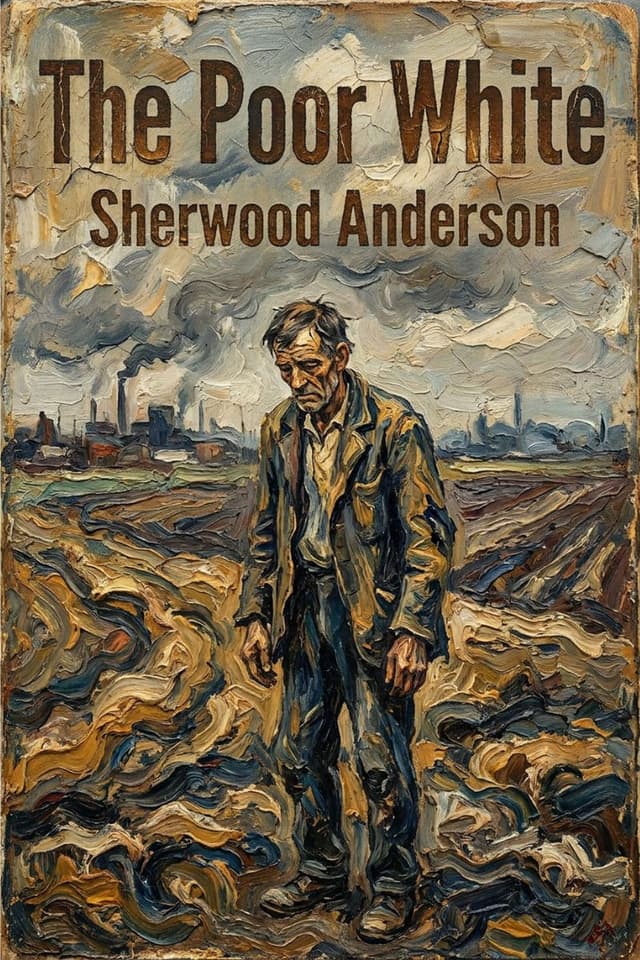
Read The Poor White by Sherwood Anderson for free on Novelhalla, and try out our easy-to-read modern edition of this classic book. You can also download the EPUB and read it on any device if you prefer!
The Plot
Mudcat Landing
Hugh McVey is born in 1866 in a place barely worth calling a town. Mudcat Landing, Missouri, sits on a mud bank along the Mississippi River, and everything about it is tired. The soil is thin and stony. The farmers are gaunt and defeated. The only businesses that turn a profit are the saloons, because the men of Mudcat Landing have decided that if life is going to be this miserable, they might as well be drunk for it.
Hugh's mother is dead. His father is a drifter and a drunk who sleeps on the riverbank when he's not doing odd jobs for whiskey money. Hugh grows up half-wild, lying in the grass for hours, watching the clouds, dreaming about nothing in particular. He's tall and awkward and slow, and everyone who looks at him sees the same thing: another piece of poor white trash destined to amount to nothing.
Sarah Shepard
Then the railroad comes to Mudcat Landing, and everything changes.
Hugh gets a job at the new train station, hauling bags and sweeping the platform. It doesn't pay much, but it comes with a roof. The station master, Henry Shepard, and his wife Sarah take the boy in. Sarah is from New England, brisk and sharp and utterly determined, and she looks at Hugh and sees something no one else has bothered to look for: potential.
She becomes his teacher. She drills him in reading and arithmetic, scolds the laziness out of him, fills his head with visions of the busy, thriving towns back East where people work hard and build things and don't just sit around waiting to die. She loves him like a son, fiercely and without sentimentality. Under her care, Hugh begins to wake up. He starts to believe that he might be more than the place he came from.
When the Shepards leave Mudcat Landing, Hugh heads east on his own. He drifts from town to town, working on railroads, doing odd jobs, always restless, always alone. He carries Sarah's voice in his head like a conscience, pushing him to keep moving, keep thinking, keep his hands busy. He's looking for something, though he couldn't tell you what.
Bidwell
He ends up in Bidwell, Ohio.
Bidwell is everything Mudcat Landing wasn't. It's a quiet, prosperous farming town surrounded by rich land and good people. Craftsmen run their own shops. Farmers work their own fields. Neighbors know each other. Life moves at the pace of the seasons, and there's a dignity to it, even if no one is getting rich.
Hugh takes a job at the telegraph office and settles into the rhythms of the town. But his mind won't rest. He watches the farmers planting cabbage by hand in the fields outside town, bent over row after row in the sun, and something clicks. He starts sketching designs. He starts tinkering. He starts building.
Hugh McVey is going to invent a machine that plants cabbage.
The Machine Age Comes to Town
His first invention is a failure. The cabbage planter doesn't work the way he imagined. But it's enough to attract the attention of Steve Hunter, a young man in town with big ambitions and a gift for talking people into things. Steve sees dollar signs where Hugh sees engineering problems. He convinces the town's wealthier citizens to invest, talks up the invention to anyone who'll listen, and positions himself as the man who's going to put Bidwell on the map.
Hugh goes back to his workshop. His next invention, a corn-cutting machine, actually works. And it works spectacularly.
Money pours in. Factories go up. Workers arrive from other towns, then other states. The old harness maker's shop closes because nobody needs handmade harnesses anymore. The blacksmith's forge goes cold. Farmhands who spent their lives working the land find themselves standing at machines in windowless buildings, doing the same motion over and over again, and they can feel something important slipping away but they can't name it.
Bidwell is becoming rich. Bidwell is becoming modern. And Bidwell is becoming something it never was before: ugly.
Clara
Meanwhile, there's Clara Butterworth.
Clara is the daughter of Tom Butterworth, the wealthiest farmer in the county. She's smart, restless, and deeply unhappy in ways she struggles to articulate. The men around her treat her as a prize to be won or a problem to be managed. She goes off to college at Ohio State, hoping to find some version of herself that makes sense, but the world there offers its own disappointments.
She comes home to a Bidwell she barely recognizes. The quiet town of her childhood is gone. Her father, once a farmer, now talks only about machines and money. The fields she grew up running through are being carved up for factory lots. And everywhere people are talking about one man: Hugh McVey, the inventor, the genius, the man who made it all happen.
Clara and Hugh circle each other from a distance. He is enormous, quiet, and painfully lonely. She is guarded, angry at the world, and terrified of vulnerability. Neither of them knows how to reach another person. Neither of them has ever really been touched.
What Progress Costs
As Hugh's inventions multiply and his wealth grows, the cost of Bidwell's transformation becomes harder to ignore. Old friendships fracture along new class lines. Workers who once took pride in their craft now punch clocks. A harness maker named Joe Wainsworth watches his life's work become obsolete and feels something dark and dangerous building inside him. Immigrants arrive to fill the factory floors, and the town that once knew everyone's name starts to feel like a place full of strangers.
Hugh himself is caught in the middle. He never wanted to be a businessman. He never wanted to destroy a way of life. He just wanted to solve problems with his hands. But the machines he built have taken on a life of their own, and the people who profit from them have no interest in slowing down.
And the people who've been ground up by them are starting to push back.
The question hanging over everything is whether Hugh McVey, who spent his whole life trying to prove he was more than poor white trash from a mud bank on the Mississippi, has built something worth having, or whether he's helped destroy the only kind of life that ever really mattered.
About the Author: Sherwood Anderson
Small-Town Ohio
Sherwood Anderson was born in 1876 in Camden, Ohio, the third of seven children. His father, Irwin, was a harness maker whose business was slowly killed by factory-made competition. The family drifted from one small Ohio town to another before settling in Clyde, where Sherwood grew up poor, restless, and fiercely observant. His mother worked herself to exhaustion taking in laundry. His father drank and told stories. Sherwood took every odd job he could find and earned the nickname "Jobby."
His mother died of tuberculosis in 1895 when Sherwood was eighteen. He left for Chicago almost immediately.
The Businessman
Anderson's early adulthood looked nothing like a future writer's biography. He served in Cuba during the Spanish-American War, finished prep school in Springfield, Ohio, and talked his way into a career in advertising in Chicago. He was good at it. He married Cornelia Lane, the daughter of a wealthy Ohio businessman. They had three children. He became president of a paint manufacturing company in Elyria, Ohio. He played golf. He joined the Elks Lodge. He was, by every outward measure, a success.
Then in November 1912, in the middle of dictating a letter to his secretary, he stopped talking, said something strange about his feet being cold and wet from walking in a river, and walked out of his office. He was found four days later in Cleveland, disoriented and disheveled, having suffered a complete mental breakdown.
He never went back to the paint business.
The Writer
Anderson returned to Chicago, divorced Cornelia, and threw himself into writing. His early novels were rough and raw, but in 1919 he published Winesburg, Ohio, a collection of interconnected stories about lonely, frustrated, secretly desperate people living in a small Midwestern town. It was a revelation. Critics hailed it as a new kind of American fiction, spare and psychologically piercing, written in a style that sounded like someone actually talking.
Anderson became a literary celebrity almost overnight. He influenced an entire generation of writers. William Faulkner called him the father of the American writers of his era. Ernest Hemingway learned from his style before turning against him. Gertrude Stein, whom Anderson met in Paris, became a close friend and acknowledged influence.
Later Years
Anderson married four times and never quite found the stability he craved. He used the earnings from his 1925 bestseller Dark Laughter to buy a farm in southwestern Virginia, where he settled down and edited two small-town newspapers. He kept writing novels, essays, and stories, though nothing matched the impact of Winesburg.
In 1941, Anderson and his fourth wife set out for South America on a trip to investigate labor conditions. During the voyage, he accidentally swallowed a toothpick, developed peritonitis, and died in Panama at the age of sixty-four. He is buried in Marion, Virginia.
Fun Facts About the Book
The Follow-Up to Winesburg
Poor White was published in 1920, just one year after Winesburg, Ohio made Anderson famous. Many critics consider it his finest novel. Where Winesburg was a series of intimate character sketches, Poor White is Anderson's attempt to tell the larger story of how industrialization transformed the American Midwest, and what it cost the people who lived through it.
Anderson's Father in the Pages
Anderson's own father was a harness maker whose business was destroyed by factory-made goods. In Poor White, a harness maker named Joe Wainsworth watches the same thing happen to him. The parallels are unmistakable. Anderson drew heavily on his family's experience of being ground down by the same forces of industrial progress the novel chronicles.
The Huck Finn Connection
Literary critics have long compared Hugh McVey's early life to Huck Finn's. Both are motherless boys raised by drunken fathers on the banks of the Mississippi. Both are taken in by well-meaning women who try to "civilize" them. Anderson was a devoted reader of Mark Twain, and the echoes are clearly intentional, though Hugh's story moves in a very different direction once he leaves the river behind.
A Poet Inspired
The German playwright Bertolt Brecht was so taken with an episode in Poor White that he wrote a poem about it. The piece, called "Coal for Mike," appeared in his 1939 collection and was directly inspired by a scene from Anderson's novel.
Anderson's Breakdown
The mental breakdown Anderson suffered in 1912, when he walked out of his paint factory mid-sentence and disappeared for four days, mirrors the psychological undercurrents of Poor White in striking ways. Hugh McVey's restless, half-understood dissatisfaction with the world he's helped create echoes what Anderson himself experienced as a successful businessman who felt his soul being hollowed out by commerce.
The Missing Book Five
The novel is divided into numbered "books," but there is no Book Five. The text jumps from Book Four to Book Six. This apparent misprint appeared in the original 1920 edition and has been preserved in subsequent printings. Whether it was an error or a deliberate quirk of Anderson's remains unclear.
Themes
The Cost of Progress
This is the novel's great subject. Bidwell's transformation from a quiet farming town into a manufacturing center brings wealth, but it also destroys a way of life. Craftsmen lose their livelihoods. Workers lose their autonomy. Neighbors become strangers. Anderson doesn't argue that progress is entirely bad, but he insists that we look honestly at what gets lost along the way, and who pays the price.
Loneliness and Disconnection
Nearly every character in the novel is profoundly alone. Hugh can't connect with other people despite desperately wanting to. Clara is surrounded by men who want to possess her but can't see her. The townspeople of Bidwell talk past each other, trapped behind what Anderson calls "walls of misunderstanding they themselves have built." The machines that were supposed to make life easier have somehow made people harder to reach.
The American Dream, Interrogated
Hugh McVey's story is, on the surface, a classic rags-to-riches tale. A poor boy from nothing rises through talent and hard work to become wealthy and famous. But Anderson refuses to let the story be that simple. Hugh's success doesn't make him happy. His wealth doesn't buy him connection. The dream works on its own terms but fails on the ones that actually matter.
Men and Women
Anderson writes with painful honesty about the gulf between men and women. Hugh and Clara are drawn to each other but barely know how to occupy the same room. Their courtship is awkward, halting, full of silences that could mean everything or nothing. Anderson understood that the inability to truly know another person, especially across the divide of gender, was one of the central tragedies of ordinary life.
The Land and What We Do to It
The Ohio farmland in this novel is almost a character. Anderson describes it with real tenderness: the fields, the barns, the rhythms of planting and harvest. And then he shows what happens when that land becomes real estate, when its value is measured in factory lots instead of bushels. The grief the novel carries for the landscape is quiet but unmistakable.
The Book's Legacy
Poor White never achieved the fame of Winesburg, Ohio, but many readers and critics consider it Anderson's most ambitious and complete work of fiction. Where Winesburg mapped the interior lives of isolated individuals, Poor White tried to capture the soul of an entire era: the moment when America stopped being a nation of farmers and craftsmen and became a nation of factories and machines.
The novel was praised by H. L. Mencken and Hart Crane when it first appeared, and it has continued to find readers who recognize its portrait of small-town transformation as eerily relevant to their own times. Belt Publishing reissued it in 2018 as part of a series reviving classic Midwestern fiction, and critics noted how little had changed in the century since Anderson wrote it. The factories that replaced the craftsmen have themselves been replaced. The small towns are still struggling. The loneliness Anderson described so precisely hasn't gone anywhere.
Anderson's influence on American literature is enormous, even if his name isn't as widely known as those of the writers he inspired. Faulkner, Hemingway, Steinbeck, and countless others learned from his spare, psychologically intense style. Poor White is the novel where Anderson tried to take everything he'd learned about lonely, frustrated people in small towns and show how the world made them that way. It's a slow, beautiful, deeply sad book about what happens when the future arrives before anyone is ready for it.