Novelhalla
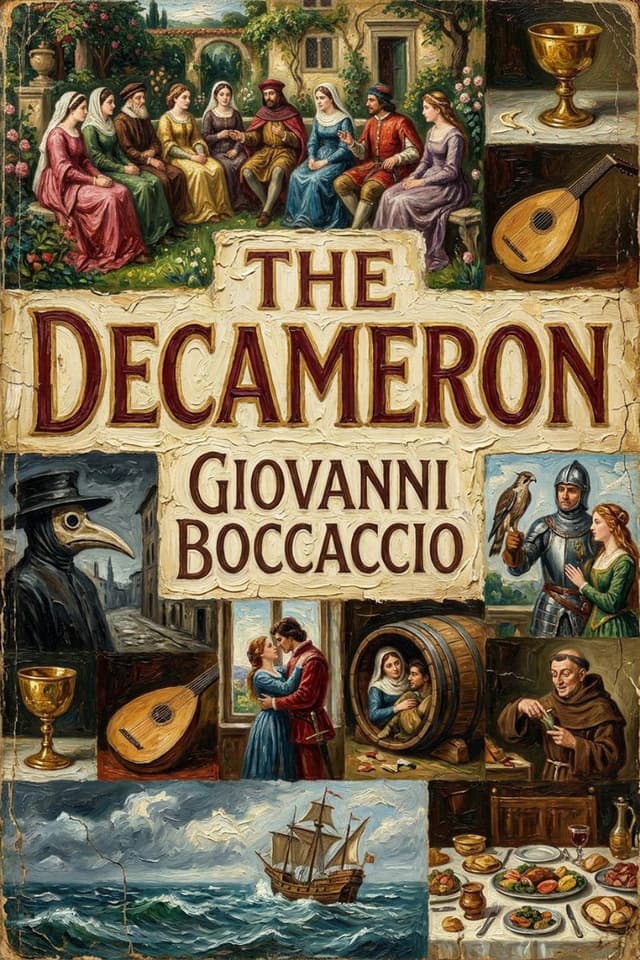
The Decameron
Read The Decameron by Giovanni Boccaccio for free on Novelhalla, and try out our easy-to-read modern edition of this classic book. You can also download the EPUB and read it on any device if you prefer!
The Plot
The Plague
Florence, 1348. The Black Death has come. Giovanni Boccaccio opens his masterpiece with one of the most vivid eyewitness accounts of the plague ever written. The dead pile up in the streets. Families abandon their sick. Neighbors refuse to help neighbors. The bonds that hold society together dissolve in the face of mass death. Every rule, every custom, every decency falls apart.
Into this nightmare steps a group of ten young people. Seven women and three men, all from wealthy Florentine families, who meet by chance in the church of Santa Maria Novella. The eldest among the women, Pampinea, proposes a plan: leave the city. Retreat to one of their country estates in the hills outside Florence, where the air is clean and the plague has not yet reached. Bring servants, bring provisions, and wait it out.
They agree. And so they go.
The Retreat
What they find in the countryside is a kind of paradise. Beautiful gardens, cool fountains, fine meals, birdsong instead of death bells. The contrast with what they have left behind could not be sharper. Boccaccio builds an Eden against a backdrop of hell.
But idle days need filling. Pampinea suggests a structure: each day, one of them will be crowned king or queen and will choose a theme for the day's entertainment. Every member of the group will then tell a story on that theme. Ten storytellers, ten stories a day, over ten days. One hundred stories in all. Each evening ends with a song. Then they rest, and begin again.
The ten days are not consecutive. They skip Fridays and Saturdays for religious observance and personal matters, stretching the storytelling across two weeks. The whole arrangement has an air of elegant civilization reasserting itself against chaos.
The Stories
The hundred tales range across the entire spectrum of human experience. There are love stories, both tender and tragic. Bawdy bedroom farces. Clever tricks played by wives on foolish husbands. Adventures of merchants in foreign lands. Stories about the hypocrisy of monks and priests. Tales of extraordinary generosity and shocking cruelty. Quick-witted retorts that save a person from disaster. Fools who get exactly what they deserve.
Some stories are set in Florence, others in Naples, Paris, Alexandria, or the distant East. Characters range from kings and queens to peasants and servants, from saints to scoundrels. The tone shifts constantly, from ribald comedy to genuine horror, from gentle romance to sharp social satire. One story might make you laugh out loud. The next might break your heart.
The daily themes give shape to this variety. One day calls for stories about people who achieve happiness after great misfortune. Another asks for tales of love that end badly. Another demands stories about clever replies. The final day, the tenth, asks for stories of extraordinary virtue and magnanimity, ending the whole collection on a note of moral elevation after all the mischief that came before.
About the Author: Giovanni Boccaccio
Early Life
Giovanni Boccaccio was born in 1313, likely in Florence or the nearby town of Certaldo, the illegitimate son of a Tuscan merchant named Boccaccino di Chellino. His mother's identity remains unknown. His father eventually married a noblewoman named Margherita de' Mardoli, and young Giovanni grew up in the merchant class of Florence, a world of commerce and ambition.
Around the age of thirteen, Boccaccio's father took him to Naples, where the elder Boccaccio served as an agent for the powerful Bardi banking house at the court of King Robert of Anjou. Giovanni was apprenticed to the bank but hated it. He persuaded his father to let him study law instead, which he also hated. What he loved was literature.
Naples and the Literary Life
Naples gave Boccaccio something Florence could not: access to a brilliant, cosmopolitan court. He mingled with scholars, aristocrats, and fellow writers. He fell in love with a woman he would call Fiammetta in his writings, who may have been Maria d'Aquino, the illegitimate daughter of King Robert himself. Whether this love affair was real or a literary invention remains debated.
During these years Boccaccio produced his earliest significant works, including Il Filostrato and the Teseida, narrative poems that would later provide source material for Geoffrey Chaucer. He was finding his voice as a writer, blending medieval romance with sharper, more realistic observation of human behavior.
Return to Florence
Around 1340, Boccaccio was called back to Florence when his father's finances collapsed along with the Bardi bank. The sheltered period of his life was over. What followed were years of difficulty, occasional poverty, and increasing literary ambition.
Then, in 1348, the Black Death struck Florence. Boccaccio lost his stepmother to the plague. He witnessed firsthand the devastation he would later describe in the opening pages of The Decameron. He began writing the book around 1349 and completed it by roughly 1353.
Petrarch and the Turn to Scholarship
In 1350, Boccaccio met the poet Francesco Petrarch, the most famous literary figure in Europe. It was a transformative friendship. Petrarch became Boccaccio's mentor and intellectual hero, and under his influence Boccaccio increasingly turned from vernacular storytelling to Latin scholarship and humanist pursuits.
Together with Dante Alighieri, who had died decades before either of them was born, Boccaccio and Petrarch form the "Three Crowns" of Italian literature. It was Boccaccio who became Dante's greatest champion: he wrote the first biography of Dante, gave public lectures on the Divine Comedy, and is even credited with adding the word "Divine" to the title.
Final Years
Boccaccio's later life was devoted to scholarship. He compiled encyclopedic works on classical mythology and wrote De Mulieribus Claris (On Famous Women), the first collection of biographies devoted to women in Western literature. He served as a diplomat for Florence, undertaking missions to the papal court and to Venice.
In his later years, Boccaccio reportedly experienced a spiritual crisis. A monk brought him a warning of imminent death, and he considered destroying his literary works. Petrarch talked him out of it.
Boccaccio's health declined in his final years, troubled by obesity and what appears to have been congestive heart failure. He died on December 21, 1375, in Certaldo, just over a year after the death of Petrarch. His personal library was bequeathed to the monastery of Santo Spirito in Florence, where it remains.
Fun Facts About the Book
The Title
"Decameron" comes from the Greek words deka (ten) and hemera (day), meaning "ten days' work." The title deliberately echoes the Hexaemeron, a common title for religious commentaries on the six days of biblical creation. By choosing this name, Boccaccio was slyly positioning his very earthly, very human collection of stories alongside sacred literature. The book also carries a subtitle: Prencipe Galeotto (Prince Galehaut), a reference to the character in Arthurian legend who arranged the first meeting between Lancelot and Guinevere. Boccaccio was signaling that his book was meant to serve as a kind of go-between, bringing lovers together through the power of storytelling.
The Human Comedy
Dante's great poem was originally titled simply the Commedia. It was Boccaccio who added the word "Divina" to give us the Divine Comedy. In turn, The Decameron has been nicknamed "The Human Comedy," a fitting counterpart: where Dante charted the soul's journey through the afterlife, Boccaccio mapped the full range of human behavior right here on earth.
Burned by Savonarola
In 1497, the Dominican friar Girolamo Savonarola organized his famous Bonfire of the Vanities in the center of Florence, inciting the burning of objects considered sinful, including art, cosmetics, mirrors, and books. The Decameron was among the works consigned to the flames. Roughly sixty years later, in 1559, the Catholic Church placed the book on the official Index of Forbidden Books. The Church's main objection was not actually the sexual content but the relentless mockery of corrupt clergy. Unable to suppress the book entirely, Pope Gregory XIII commissioned a sanitized edition in 1573 that replaced all the priests and nuns in the stories with secular characters, while leaving the bawdy content untouched.
Banned in America
The Decameron remained banned in the United States until the early 1930s, prosecuted under the Comstock Act of 1873, which made it illegal to send "obscene, lewd, or lascivious" materials through the mail. It was also banned in Australia until 1973. A book written in the 1350s was still scandalizing governments six hundred years later.
Boccaccio Borrowed Everything (and Made It Better)
Nearly all the plots in The Decameron are borrowed from earlier sources, including French fabliaux, Arabic folk tales, classical mythology, and existing Italian story collections. Some tales originated as far afield as India and Persia. What Boccaccio brought was not originality of plot but brilliance of execution. He deepened characters, sharpened dialogue, layered in irony and social commentary, and wove the borrowed material into something entirely new. Later writers would borrow from him just as freely.
Written for Women
Boccaccio explicitly states in his preface that The Decameron is written for women, specifically women in love who are confined by the limited social roles available to them and need stories for comfort and amusement. This was a striking dedication at a time when women were often discouraged from reading anything beyond devotional texts. The seven-to-three ratio of women to men among the storytellers reinforces this intention.
The Chaucer Connection
Geoffrey Chaucer almost certainly knew The Decameron. His Canterbury Tales, written decades later, uses a remarkably similar frame narrative structure (a group of travelers telling stories), and roughly a quarter of his tales have close parallels in Boccaccio's collection. Scholars debated for centuries whether Chaucer had direct access to the text. Recent scholarship has identified specific rhetorical echoes that strongly suggest he did, though Chaucer never once mentioned Boccaccio by name.
Shakespeare Borrowed Too
William Shakespeare drew on stories from The Decameron for several of his plays. The casket plot in The Merchant of Venice, elements of All's Well That Ends Well, and material in Cymbeline all trace back to Boccaccio's tales. The Decameron's influence on English literature extends through these and many other writers, including John Keats, whose poem "Isabella, or the Pot of Basil" retells one of the collection's most haunting love stories.
A Pasolini Film
Italian filmmaker Pier Paolo Pasolini adapted The Decameron into a film in 1971, selecting some of the bawdiest tales and rendering Boccaccio's subtle, metaphor-rich language into explicit visual form. The film outraged the Catholic Church and delighted audiences. It was the first entry in Pasolini's "Trilogy of Life," followed by adaptations of The Canterbury Tales and The Arabian Nights.
The COVID Connection
When the COVID-19 pandemic forced millions into lockdown in 2020, The Decameron experienced a dramatic surge in popularity. A book about young people isolating from a plague and passing the time by telling stories suddenly felt urgently relevant. The New York Times Magazine commissioned "The Decameron Project," an anthology of 29 new short stories by contemporary writers including Margaret Atwood and Edwidge Danticat, inspired by Boccaccio's original premise. Netflix also produced a miniseries loosely based on the setting in 2024.
Themes
Storytelling as Survival
At the heart of The Decameron is a radical claim: stories can save us. Boccaccio's ten young people flee a world that is literally falling apart, and they rebuild a miniature civilization through the act of telling tales. The storytelling is not escapism. It is the deliberate reconstruction of order, meaning, and human connection in the face of catastrophe.
Fortune and Human Wit
The medieval concept of Fortune, the great wheel that raises people up and casts them down at random, runs through the entire collection. But Boccaccio's characters are not passive victims of fate. Again and again, the stories celebrate human cleverness, resourcefulness, and quick thinking as tools for mastering or at least surviving Fortune's turns. The merchant who talks his way out of danger, the wife who outwits a jealous husband, the pauper who rises through ingenuity: these are Boccaccio's heroes.
The Corruption of the Church
No target in The Decameron is hit harder or more often than the clergy. Monks, priests, friars, nuns, and abbots appear throughout the stories as lustful, greedy, hypocritical, and absurd. Boccaccio was writing in the aftermath of the Black Death, when public faith in the Church had been deeply shaken by its failure to protect or explain the catastrophe. His satire gave voice to a widespread disillusionment.
Love in All Its Forms
Love appears in The Decameron in every possible register: noble and base, faithful and treacherous, comic and tragic, sacred and profane. Some tales celebrate romantic devotion that survives every obstacle. Others treat sexual desire as a natural appetite to be satisfied with practical good humor. Still others show love destroying lives. Boccaccio refuses to reduce love to a single idea, insisting on its full, messy, contradictory humanity.
Class, Merit, and Social Mobility
The stories constantly probe the tension between inherited rank and personal merit. Noble characters behave shamefully; peasants and merchants display extraordinary virtue and wit. Boccaccio, himself the son of a merchant in a society that officially prized aristocratic lineage, was deeply interested in the question of what actually makes a person worthy of respect.
Women's Intelligence and Agency
For a fourteenth-century text, The Decameron gives women a remarkable degree of voice and agency. Women outwit men, pursue their own desires, defend themselves with eloquence, and refuse to be passive objects. Boccaccio was not a modern feminist by any stretch, and some tales treat women as commodities. But the overall portrait is of women as intelligent, capable, and often more resourceful than the men around them.
The Book's Legacy
The Decameron is one of the foundational works of Western literature. It essentially invented Italian literary prose, establishing the Tuscan dialect as the standard for the Italian language in much the same way that Dante's Divine Comedy had done for Italian poetry. In the sixteenth century, the scholar Pietro Bembo held up Boccaccio's prose as the model for all Italian writing.
Its influence on subsequent literature is almost impossible to overstate. Chaucer's Canterbury Tales, Shakespeare's plays, Marguerite de Navarre's Heptameron, Keats's poetry, and countless other works across centuries and languages trace their lineage back to Boccaccio's hundred tales. The frame narrative structure itself became a template that writers would imitate for generations.
Beyond its literary influence, The Decameron is one of the great documents of human resilience. Written in the shadow of the worst catastrophe in European history, it insists that life is worth living, that laughter matters, that love persists, and that telling stories to one another is one of the most fundamentally human things we can do. It is bawdy, wise, cruel, generous, shocking, and tender, sometimes all within the same story.
More than 670 years after it was written, it remains startlingly alive. The stories still entertain. The satire still cuts. And the central image, of a small group of people huddled together against disaster, finding comfort and meaning in the simple act of sharing a story, has never stopped being relevant.